 VedaWatch
Sleep
Sleep consistency: why a regular bedtime matters, and how much
Sleep consistency explained: what the Sleep Regularity Index research found, how much bedtime variation is too much, social jet lag, and steps to steady it.
By VedaWatch editorial team · · 10 min read
The short answer
Sleep consistency means falling asleep and waking at similar times every day, weekends included. In large studies, people with the most regular sleep had lower risk of early death and heart disease than the least regular, even after accounting for sleep length. Aim to keep bedtime and wake time within about an hour, and anchor your wake time first.
What is sleep consistency, and why does a regular bedtime matter?
Sleep consistency, also called sleep regularity, is how similar your sleep timing is from one day to the next: when you fall asleep, when you wake up, and how long you sleep. Two people can both average 7.5 hours a night while one falls asleep at 11 pm every night and the other swings between 10 pm and 2 am.
For a long time, sleep advice focused on hours. Research over the last decade suggests timing matters too. In 2023 a National Sleep Foundation expert panel reviewed the evidence and agreed that consistency of sleep onset and wake timing is important for health, safety and performance. Irregular schedules have been linked with obesity, diabetes, heart disease and poorer mental health.
The likely reason is your body clock. Your circadian rhythm times hormones, body temperature and alertness across the day, and it is set mostly by light and by when you sleep and wake. When sleep timing jumps around, the clock keeps having to readjust, and your internal timing can drift out of step with your schedule.
One important caveat runs through all of this research: it is mostly observational. Irregular sleep could harm health, or poor health could make sleep irregular, or both. No trial has yet shown that making sleep more regular changes long-term outcomes. Still, a regular schedule is cheap, low risk and widely recommended.
What the Sleep Regularity Index research found
The Sleep Regularity Index (SRI) is the main research measure of sleep consistency. It checks, minute by minute, whether you were in the same state (asleep or awake) at the same time 24 hours apart, and scores the result from 0 to 100. A score of 100 means perfectly regular sleep and wake times; 0 means random timing.
The biggest study so far used one week of wrist accelerometer data from 60,977 UK Biobank participants, average age about 63, followed for about 6.3 years (Windred et al., SLEEP, 2024). The median SRI was 81. Compared with the least regular fifth of people (SRI below 71.6), the more regular groups had a 20% to 48% lower risk of dying from any cause, depending on the group and how much the analysis adjusted for other factors. In the fully adjusted model, the most regular fifth had a hazard ratio of 0.70, about 30% lower risk.
Two details make this study useful in practice. First, regularity predicted mortality better than sleep duration did, and adding duration to the model didn't significantly improve it. Second, the authors put the difference in everyday terms: the most regular fifth usually fell asleep and woke within roughly 1-hour windows, while the least regular fifth varied across roughly 3-hour windows.
Regularity also shows up outside heart and longevity research. In a 30-day study of 61 university students (Phillips et al., Scientific Reports, 2017), the least regular sleepers didn't sleep fewer hours on average than the most regular ones, but their body clock, measured by the evening rise in melatonin, ran much later, and their grades were lower. Modelling suggested that different patterns of light exposure explained much of the shift in body-clock timing.
How much bedtime variation is too much?
There is no official cut-off. The National Sleep Foundation panel concluded that regularity matters but didn't set a number, partly because studies measure it in different ways. What the studies do offer is a useful range.
In the Multi-Ethnic Study of Atherosclerosis (Huang et al., Journal of the American College of Cardiology, 2020), 1,992 adults aged 45 to 84 wore a wrist tracker for 7 days and were followed for a median 4.9 years. Compared with people whose sleep onset time varied by 30 minutes or less (standard deviation), people whose onset varied by more than 90 minutes had about twice the risk of a cardiovascular event (hazard ratio 2.11). Night-to-night variation in sleep length of more than 120 minutes, compared with 60 minutes or less, showed a similar link (hazard ratio 2.14).
Putting those studies together gives practical bands, not clinical thresholds. Read them as a guide to where you stand, not a diagnosis:
- Bedtime spread of about 30 minutes or less: steady. This matches the most regular reference group in the cardiovascular study.
- About 30 to 60 minutes: fairly regular. Roughly the 1-hour windows the most regular UK Biobank group kept.
- About 60 to 90 minutes: irregular enough to be worth working on, especially if it comes from late weekends.
- More than 90 minutes: the range linked with higher cardiovascular risk in MESA, and closer to the 3-hour windows of the least regular UK Biobank group.
- Worked example: bedtimes of 10:30, 11:00, 10:45, 11:15 and 10:30 pm on weeknights have a spread (standard deviation) of about 17 minutes. Add 12:30 and 1:00 am on Friday and Saturday and the 7-night spread jumps to about 55 minutes. Two late nights can triple your variability.
Is a consistent wake time more important than bedtime?
The research scores both, and you can't have regular sleep with only one of them fixed. In practice, though, wake time is the easier anchor. You control your alarm; you can't make yourself fall asleep on cue.
Getting up at the same time every day, then getting daylight soon after, gives your body clock a steady signal each morning. Over days, sleepiness tends to arrive at a more predictable time in the evening, and bedtime follows. Light is the strongest timing cue for the clock, which is why the student study found light exposure patterns behind the irregular sleepers' later body clocks.
Then set bedtime by counting back from that wake time. The American Academy of Sleep Medicine and Sleep Research Society recommend at least 7 hours of sleep a night for adults, so a 6:30 am wake time means being asleep by about 11:30 pm, and in bed a little before that.
How to make your bedtime consistent: a practical plan
Change one thing at a time and give each step a week or two. The aim is a schedule you can keep on Saturday as well as Tuesday.
- Measure first. Look at when you actually fell asleep and woke over the last two weeks, not when you meant to. Note your earliest and latest bedtimes and whether the late ones cluster on weekends.
- Pick a wake time you can keep seven days a week. Choose the time your weekdays already need, then keep weekends within about an hour of it.
- Count back your sleep need to get a bedtime. Use at least 7 hours of sleep plus the time it usually takes you to fall asleep.
- Move gradually if your target is far from your current habit. Shift bedtime earlier in small steps every few days rather than all at once, or you'll lie awake.
- Start winding down before bed. Dim lights and put screens away; a set routine, done in the same order each night, becomes a cue for sleep.
- Get light early, avoid bright light late. Go outside or sit by a window soon after waking, and keep evenings dim.
- Plan your late nights. When a late night is unavoidable, still get up within about an hour of your usual time and make up the difference with an earlier bedtime the next night, rather than a long lie-in.
- Review after two weeks. Check whether your bedtime spread has narrowed. Progress over weeks matters more than any single night.
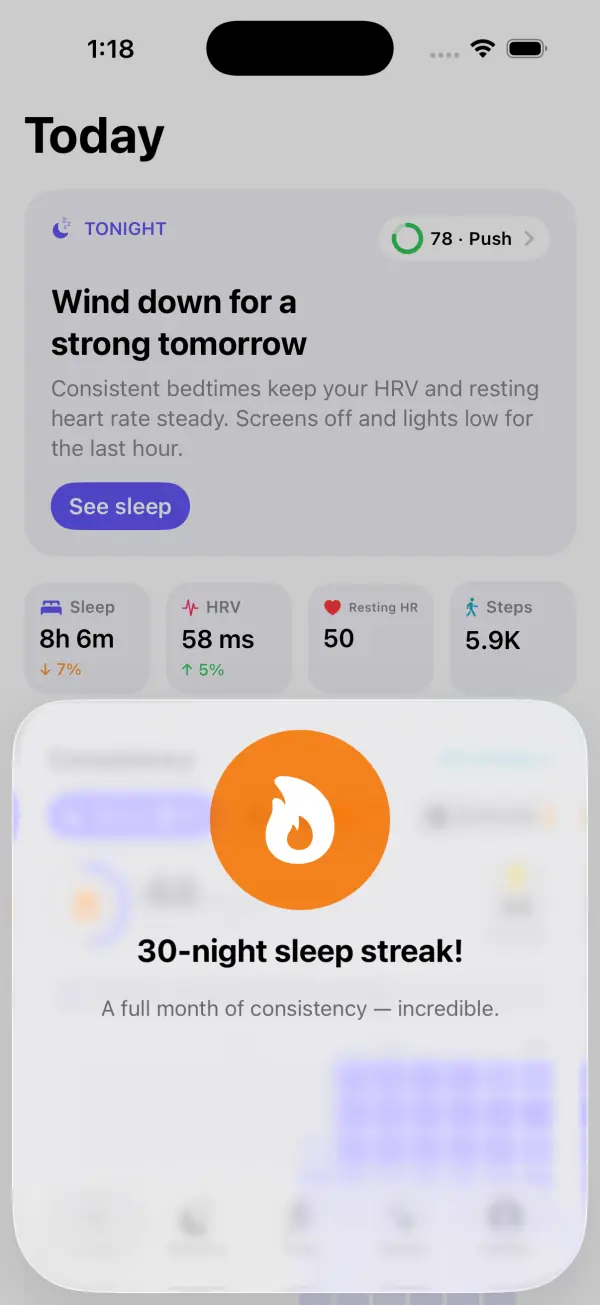
How to check your sleep consistency on Apple Watch
If you wear your Apple Watch to bed with sleep tracking on, it records when you fell asleep and woke up each night. Apple's sleep score, from 0 to 100, gives up to 30 points for bedtime consistency, based on when you fell asleep over the last 13 nights. The other points come from sleep duration (up to 50) and interruptions (up to 20). A low consistency share is a sign that your timing, not just your hours, is costing you.
The Health app's sleep charts show each night's sleep as bars, so you can scan the start times by eye. What neither shows directly is a single number for how much your bedtime swings. A quick way to estimate it: write down the last 14 sleep start times, and see how many fall within 30 minutes of your typical time.
Remember that wrist trackers estimate sleep from movement and heart rate. They're good at spotting sleep and less good at spotting quiet time lying awake, so your recorded sleep start can be a little earlier than when you actually drifted off. For consistency, that matters less: you're comparing nights measured the same way.
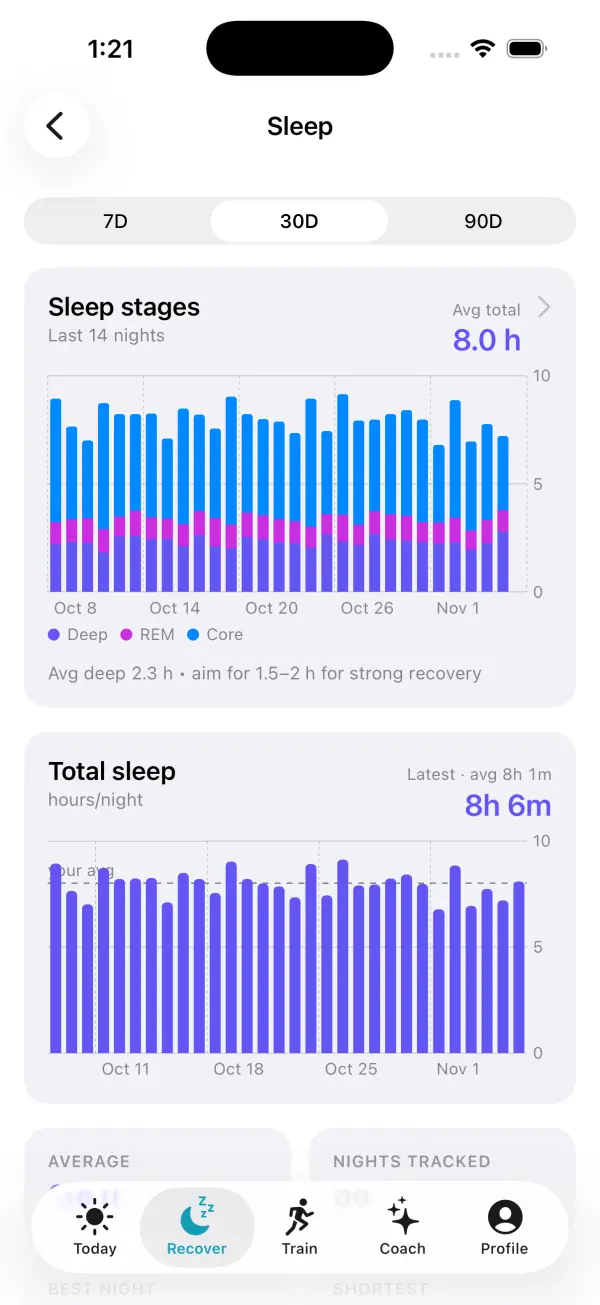
How VedaWatch helps you keep a regular bedtime
VedaWatch reads your Apple Watch sleep from Apple Health and works out your sleep timing on your iPhone. It treats bedtime as when your Watch first recorded you asleep, and ignores naps under 2 hours.
When your bedtime has been swinging, a Sleep rhythm insight appears on Today and in the Recover tab. It needs at least 7 nights from the last 14 and shows up when your bedtime spread is an hour or more. It tells you your usual bedtime, the range over the last two weeks, and the typical swing, with a chart of each night's bed and wake times. When there's enough data, it also compares your own next-morning HRV after nights near your usual bedtime with nights well off it, and says so only when the difference is meaningful. It suggests a fixed wake-up time as the easiest anchor.
When you get it right, Your wins on Today can show "A steady bedtime all week": bedtimes within about 30 minutes of each other on at least 6 of the last 7 nights. If the week before swung by an hour or more, it says your bedtime is much steadier this week.
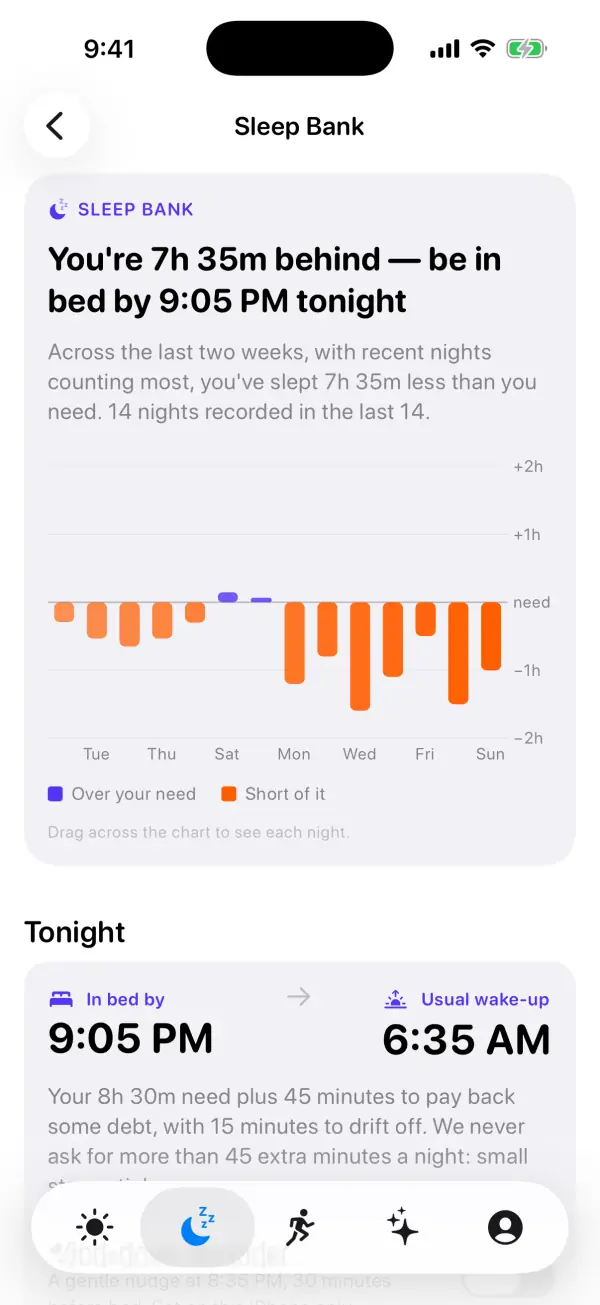
Sleep Bank on the Recover tab turns your usual wake-up time (the median of your last 14 nights) into a bedtime for tonight, based on your sleep need and any sleep debt. An optional wind-down reminder, off by default, arrives 30 minutes before that bedtime and is scheduled for the following nights at your usual bedtime too. These features are worked out on your iPhone and don't need Pro; VedaWatch Pro, at $6.99 a month or $59.99 a year, adds the AI Coach, where you can ask how consistent your sleep schedule has been.
When irregular sleep is worth talking to a doctor about
Most irregular schedules come from life: shift work, children, travel, late screens and weekend plans. Some don't. If you can't fall asleep until very late however hard you try, wake far earlier than you want and can't get back to sleep, or feel very sleepy in the day despite enough time in bed, a circadian rhythm disorder, insomnia or a condition such as sleep apnea may be involved. Loud snoring or pauses in breathing that someone else notices are another reason to get checked.
Talk to a doctor if sleep problems last for weeks, affect your mood, work or driving, or come with other symptoms. This guide is general information, not medical advice, and sleep data from a watch or app is a wellness estimate, not a diagnosis.
Frequently asked questions
Does napping hurt sleep consistency?
A short early-afternoon nap usually doesn't shift your night much, but long or late-afternoon naps can push bedtime later. If your bedtime is irregular, try keeping naps short and earlier in the day and see whether the night settles.
Is it better to sleep in on weekends or keep my alarm?
If you are short on sleep, some catch-up on free days may help, but sleeping in until late shifts your body clock and makes Monday harder. Keeping wake time within about an hour and going to bed earlier is the gentler way to catch up.
I work shifts. Can I still have consistent sleep?
Rotating shifts make full regularity impossible, but you can still keep timing as steady as possible within each block of shifts and protect a dark, quiet sleep window. If shift work leaves you exhausted or unable to sleep, talk to a doctor about shift work sleep problems.
How long does it take to get used to a new bedtime?
It varies from person to person and depends on how far you are moving it. Shifting in small steps every few days and keeping a fixed wake time usually works better than one big change, so give it a couple of weeks before judging.
Is a later bedtime fine as long as it's the same every night?
Regularity and timing are separate. A consistent late schedule is generally better than an irregular one, but if it leaves you short on sleep on workdays, it still adds up to sleep debt.
Related guides
- Best time of day to work out: morning vs evening, by goal
- What time should I go to bed? A bedtime calculator that works
- Can you catch up on sleep? What weekend recovery sleep can't fix
- Sleep debt calculator for Apple Watch: how VedaWatch's Sleep Bank works
- Apple Watch Sleep Score explained: what's good and how to raise it
- How much sleep do I need? By age, for athletes, and for you
- How to fall asleep faster: CBT-I techniques that work
Sources & further reading
- Windred DP et al. Sleep regularity is a stronger predictor of mortality risk than sleep duration: a prospective cohort study. SLEEP, 2024
- Sletten TL et al. The importance of sleep regularity: a consensus statement of the National Sleep Foundation sleep timing and variability panel. Sleep Health, 2023
- Huang T, Mariani S, Redline S. Sleep Irregularity and Risk of Cardiovascular Events: The Multi-Ethnic Study of Atherosclerosis. Journal of the American College of Cardiology, 2020
- Phillips AJK et al. Irregular sleep/wake patterns are associated with poorer academic performance and delayed circadian and sleep/wake timing. Scientific Reports, 2017
- Wittmann M et al. Social jetlag: misalignment of biological and social time. Chronobiology International, 2006
- Roenneberg T et al. Social jetlag and obesity. Current Biology, 2012
- Watson NF et al. Recommended Amount of Sleep for a Healthy Adult: a joint consensus statement of the AASM and SRS. Journal of Clinical Sleep Medicine, 2015
- Apple Watch User Guide: View your sleep score on Apple Watch
This guide is educational, not medical advice, and has not been clinically reviewed. VedaWatch is not a medical device. If you have symptoms or concerns about your heart or health, contact a qualified healthcare professional.
Put your trends in perspective.
Explore HRV, sleep, and recovery with VedaWatch on your iPhone.
Download VedaWatch on the App Store →
What is social jet lag?
Social jet lag is the gap between when your body clock wants you to sleep and when work, school or social life make you sleep. Researchers measure it as the difference in the midpoint of your sleep between free days and work days (Wittmann et al., Chronobiology International, 2006). It feels like flying a couple of time zones west every Friday and back every Monday, without leaving home.
Worked example: on weekdays you sleep 11 pm to 6:30 am, a midpoint of 2:45 am. On weekends you sleep 1 am to 9:30 am, a midpoint of 5:15 am. That's 2.5 hours of social jet lag every week, even though you sleep the same 8.5 hours on both. Monday morning then feels like waking at 4 am.
In a large European questionnaire study, more social jet lag was associated with a higher body-mass index (Roenneberg et al., Current Biology, 2012). As with the regularity research, that's an association, not proof that late weekends cause weight gain.
There is a real trade-off here. The same National Sleep Foundation panel noted that if you are short on sleep during the week, catching up on free days may help. The way to reconcile the two is to fix the cause: get enough sleep on work nights so you need less catching up, and when you do catch up, go to bed a little earlier rather than sleeping in until late morning.