 VedaWatch
Sleep
Can you catch up on sleep? What weekend recovery sleep can't fix
Can you catch up on sleep? What studies show about weekend lie-ins, how long it takes to pay back sleep debt, what recovery sleep can't undo, and a realistic plan.
By VedaWatch editorial team · · 10 min read
The short answer
Partly. Extra sleep after a short week reduces sleepiness and pays back some debt, but lab studies find one or two long nights don't fully restore attention, and weekend lie-ins didn't prevent the metabolic effects of short weekday sleep. Repaying debt takes several nights of a little more sleep, and the lasting fix is enough sleep most nights.
Can you catch up on sleep? The short answer
You can catch up on some lost sleep, but not all of it, and not quickly. When you've been short on sleep, your body responds to the next chance to sleep by sleeping longer and more deeply. That rebound is real, and you will usually feel less sleepy after it. What the research doesn't support is the idea that a long Saturday and Sunday wipe the slate clean after five short nights.
Three findings sum it up. First, recovery is slow: in one lab study, repaying just one hour of accumulated sleep debt took about four days of sleeping as long as people wanted. Second, it's incomplete in the short term: after five nights of 4 hours in bed, even a single 10-hour recovery night didn't bring attention and sleepiness back to normal. Third, weekend lie-ins don't seem to protect metabolism if the short nights start again on Monday.
So the honest answer to "can you pay back sleep debt" is yes, slowly, and the most effective way to do it is a little extra sleep across several nights rather than one giant lie-in. The rest of this guide goes through the evidence, the limits, and a plan you can actually follow.
What studies show about weekend recovery sleep
The clearest experiment is a 2019 study in Current Biology by Depner and colleagues. Thirty-six healthy young adults lived in a lab. A control group had 9-hour sleep opportunities every night. One group had 5-hour opportunities throughout. A third group had 5-hour nights for a five-day workweek, then a weekend where they could sleep as much as they wanted, then two more short nights.
Given a free weekend, people slept only about 1.1 hours more in total than at baseline, far less than they had lost during the week. Late-evening snacking dropped over the weekend, but once short nights returned, their body clocks were shifted later, after-dinner eating and body weight went up again, and insulin sensitivity fell by roughly 9% to 27% depending on the measure. The authors concluded that weekend recovery sleep is not an effective way to prevent the metabolic effects of recurring short sleep.
Population studies give a more mixed picture. A Swedish cohort of 43,880 people followed for 13 years found that, among adults under 65, those who slept 5 hours or less on both weekdays and weekends had a higher death rate than people who consistently slept 6 to 7 hours. People who slept short on weekdays but long on weekends did not differ from that reference group, which the authors cautiously suggested could mean weekend sleep compensates to some degree.
A larger 2024 UK Biobank study measured sleep with wrist accelerometers rather than questionnaires in 73,513 adults followed for about 8 years. It found weekend catch-up sleep was not associated with either death or new cardiovascular disease, in either direction, including among people sleeping under 6 hours on weeknights. Observational studies like these can't show cause and effect, but together they suggest weekend sleep is neither a cure nor clearly harmful. It simply doesn't replace sleeping enough during the week.
How long does it take to pay back sleep debt?
Longer than most people expect. In the Kitamura study of individual sleep need, volunteers were allowed extended sleep in the lab for many consecutive nights. Their nightly sleep was highest at first and then settled at their personal optimum. The researchers estimated that even 1 hour of hidden sleep debt took four days of extended sleep to recover.
Short-term recovery from a harder week is incomplete too. In the Banks study, 159 healthy adults spent 5 nights with only 4 hours in bed and then got one recovery night of between 0 and 10 hours in bed. More recovery sleep helped, but even at 10 hours in bed, which gave about 9 hours of actual sleep, attention lapses, sleepiness and fatigue had not returned to baseline. The authors suggested full recovery may need more than one night.
An older study by Belenky and colleagues found something similar over a longer window. After 7 nights of 5 or 7 hours in bed, three recovery nights of 8 hours in bed did not bring reaction speed back to where it started. The researchers proposed that the brain adapts to chronic short sleep in a way that persists for several days after normal sleep returns.
A useful rule of thumb from this research: think in nights and weeks, not in a single weekend. A small debt of an hour or two can be repaid with a little more sleep over several nights. A debt built up over weeks of short sleep takes correspondingly longer, and for some effects, how well you sleep going forward matters more than repaying the past.
What weekend recovery sleep can and can't fix
Recovery sleep is good at reducing the feeling of sleepiness. Across these studies, subjective sleepiness tends to improve fairly quickly once you get more sleep. That's exactly why it's easy to overestimate how recovered you are.
It's less reliable at restoring sustained attention and reaction time, which recovered only partly after one to three recovery nights in the Banks and Belenky studies. That matters for anything that needs steady focus, including driving on a Monday morning after a short week and a lie-in.
And in the Depner study, it didn't prevent changes in insulin sensitivity, evening eating and weight when short nights resumed. The pattern of short week, long weekend, short week again seems to carry its own cost, partly because sleeping in shifts your body clock later.
In practice: a lie-in after an unusually rough week is reasonable and will help you feel better. Relying on it every week as a substitute for enough weeknight sleep is the habit the evidence doesn't support. The American Academy of Sleep Medicine and Sleep Research Society recommend that adults sleep 7 or more hours per night on a regular basis.
Why very long lie-ins can backfire
Sleeping several hours past your usual wake time on Saturday and Sunday is a bit like flying a couple of time zones west for the weekend. Light hits your eyes later, your body clock drifts later, and on Sunday night you're not sleepy at your usual bedtime. You lie awake, get up for work on Monday short again, and the cycle restarts. The Depner study saw this directly: body clock timing was delayed during the short nights that followed the weekend.
This doesn't mean any extra weekend sleep is harmful. It means how you add the sleep matters. Going to bed earlier keeps your morning light and wake time roughly the same, while sleeping in until midday moves your whole schedule. If you want more sleep at the weekend, an earlier night or a short, early-afternoon nap is usually easier on your body clock than a very late wake-up.
For more on keeping a steady schedule, see the guide on sleep consistency and a regular bedtime.
A practical plan to pay back sleep debt
Here's a plan built on the research above. It assumes you're a generally healthy adult carrying debt from a busy stretch, not someone with ongoing insomnia or a sleep disorder.
A worked example: say your body does best on 8 hours and you've slept 6 hours 30 minutes on each of five weeknights. That's 7 hours 30 minutes behind by Friday. Two 10-hour weekend nights add back 4 hours, but you'd still be 3 hours 30 minutes behind, and the Sunday-night slump would likely start the next week short again. Going to bed 45 minutes earlier for the next five nights repays nearly 4 more hours without moving your wake-up time at all.
- Estimate your need. If you wake on your own feeling rested after a few holiday days, that's a good guide. Most adults need at least 7 hours.
- Add up the gap over the last week or two: your need minus what you actually slept each night. Use sleep, not time in bed.
- Keep your wake-up time roughly the same every day, weekends included. This anchors your body clock.
- Repay by going to bed earlier, not by sleeping in. Add a modest amount each night, for example 30 to 45 minutes, and spread the repayment over several nights.
- If you need a weekend top-up, prefer an earlier night or a short nap in the early afternoon over a very late wake-up.
- Protect the gains: once the debt is gone, set a bedtime that gives you your full need every weeknight, so there's nothing to repay next weekend.
- Check how you feel during the day, not just the hours. If you're still struggling to stay awake after a couple of weeks of enough sleep, talk to a doctor.
Do naps count toward catching up on sleep?
Naps are sleep, so they do reduce sleep pressure and can take the edge off a short night. They're especially useful when you can't go to bed earlier, such as during a busy week or after shift work.
The trade-off is timing. A long or late nap reduces the sleep drive you'll need to fall asleep at night, which can push your bedtime later and keep the cycle going. If naps leave you lying awake at night, keep them shorter and earlier, or skip them and go to bed earlier instead.
If you find you need a nap most days despite getting what should be enough sleep at night, that's worth mentioning to a doctor.
When catching up on sleep isn't the real problem
Sleep debt from a busy schedule is fixable with more time in bed. But if you are giving yourself enough time to sleep and still wake up unrefreshed, the issue may be the quality of your sleep rather than the amount.
Talk to a doctor if you snore loudly or someone notices pauses in your breathing, if you regularly struggle to fall asleep or stay asleep, if you fall asleep in situations where you're trying to stay awake, or if you feel extremely tired for weeks without an obvious reason. These can be signs of conditions such as sleep apnea, insomnia or other medical issues that more sleep alone won't fix.
This guide is general information, not medical advice. A wearable can show patterns in your sleep, but it can't diagnose a sleep disorder.
How VedaWatch helps you pay back sleep debt gradually
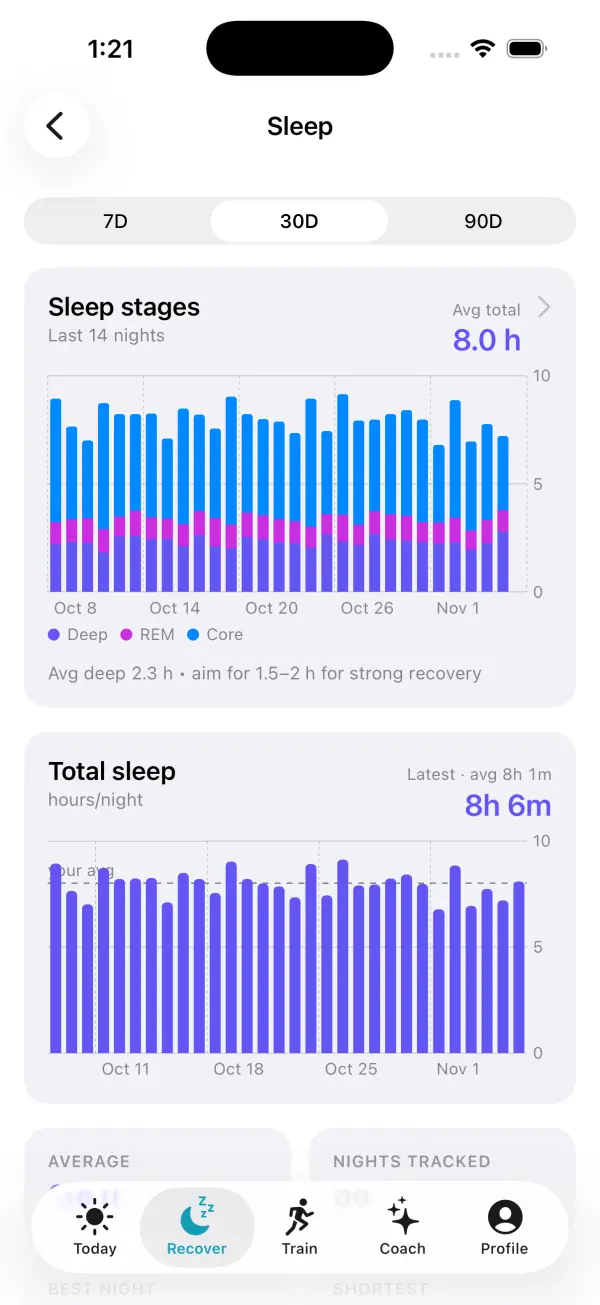
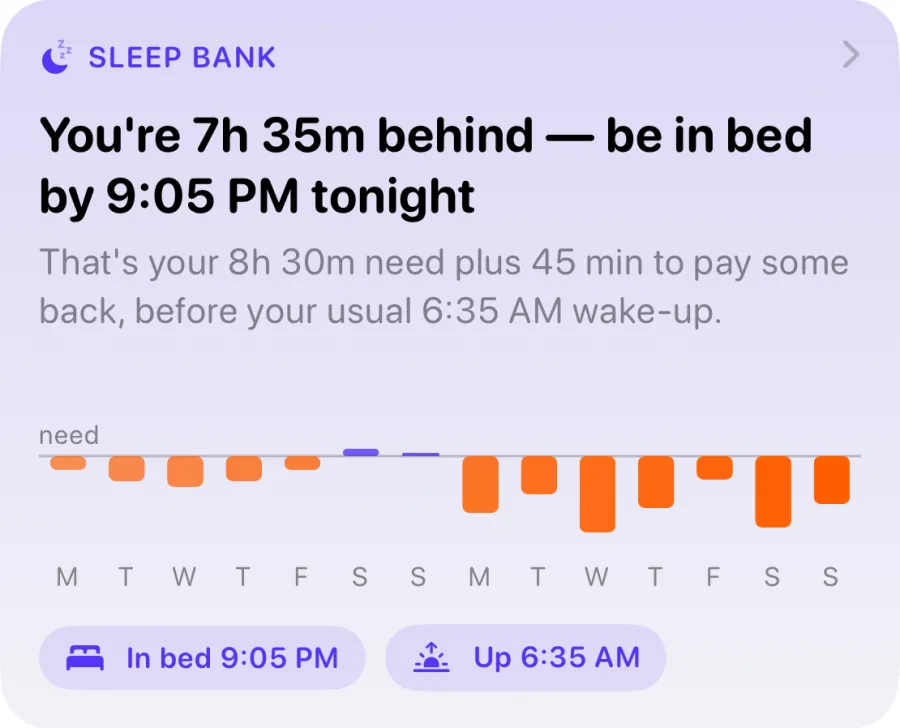
If you wear your Apple Watch to bed, VedaWatch's Sleep Bank on the Recover tab follows the approach in this guide. It compares each of your last 14 nights with your sleep need, counts recent nights more, and tells you in one line how far behind or ahead you are and when to be in bed tonight.
The bedtime is built from your usual wake-up time, so the plan pays debt back by going to bed earlier rather than sleeping in. It aims to repay a debt over about four nights, adds extra time in 5-minute steps, and never asks for more than 45 extra minutes in one night. Debts under 30 minutes don't change the plan.
Your sleep need starts at 8 hours and is learned from nights you woke on your own, such as weekends or mornings at least 45 minutes later than usual. A lie-in straight after a night under 7 hours is treated as catch-up sleep, not your true need, so a big weekend recovery doesn't inflate it. You can also set your need by hand.
You can turn on an optional wind-down reminder 30 minutes before tonight's bedtime, and a Sleep debt building alert for evenings when you're behind by an amount you choose. The full details of how the balance is calculated are in the Sleep debt calculator guide.
Frequently asked questions
Is it bad to sleep in on weekends?
An occasional lie-in after a short week is fine and helps you feel less sleepy. The problem is relying on it every week, and very late wake-ups that shift your body clock and make Sunday night and Monday morning harder.
How much extra sleep should I add each night to catch up?
There's no single research-backed number. A modest amount added at bedtime across several nights is easier to keep up and kinder to your body clock than one very long night.
Can you catch up on sleep in one night?
Not fully if the debt built up over several nights. In a lab study, one 10-hour night in bed after five 4-hour nights still left attention and sleepiness short of normal.
Why do I feel worse after sleeping 10 hours?
Waking from deep sleep or at a very different time from usual can leave you groggy for a while, and a late wake-up shifts your body clock. A steadier wake time with an earlier bedtime usually feels better than a very long lie-in.
How accurate is Apple Watch for tracking sleep debt?
Apple Watch estimates sleep from its sensors rather than measuring brain activity, so it's good for trends over many nights but not exact for any single night. Treat a debt figure as a guide and pay attention to how you feel during the day.
Related guides
- Sleep debt calculator for Apple Watch: how VedaWatch's Sleep Bank works
- How much sleep do I need? By age, for athletes, and for you
- Sleep consistency: why a regular bedtime matters, and how much
- What time should I go to bed? A bedtime calculator that works
- Apple Watch sleep tracking: how accurate is it, and what to do when it's wrong
- Does Apple Watch track naps? What it records and how to log them
Sources & further reading
- Depner CM et al. Ad libitum weekend recovery sleep fails to prevent metabolic dysregulation during a repeating pattern of insufficient sleep and weekend recovery sleep. Current Biology, 2019
- Kitamura S et al. Estimating individual optimal sleep duration and potential sleep debt. Scientific Reports, 2016
- Banks S et al. Neurobehavioral dynamics following chronic sleep restriction: dose-response effects of one night for recovery. Sleep, 2010
- Belenky G et al. Patterns of performance degradation and restoration during sleep restriction and subsequent recovery: a sleep dose-response study. Journal of Sleep Research, 2003
- Åkerstedt T et al. Sleep duration and mortality: does weekend sleep matter? Journal of Sleep Research, 2019
- Chaput JP et al. Device-measured weekend catch-up sleep, mortality, and cardiovascular disease incidence in adults. Sleep, 2024
- Watson NF et al. Recommended amount of sleep for a healthy adult: a joint consensus statement of the AASM and SRS. Sleep, 2015
This guide is educational, not medical advice, and has not been clinically reviewed. VedaWatch is not a medical device. If you have symptoms or concerns about your heart or health, contact a qualified healthcare professional.
Put your trends in perspective.
Explore HRV, sleep, and recovery with VedaWatch on your iPhone.
Download VedaWatch on the App Store →