 VedaWatch
Sleep
How to fall asleep faster: CBT-I techniques that work
How to fall asleep faster using CBT-I methods: stimulus control, a wind-down hour, light and caffeine timing, normal sleep latency, and Sleep Focus on iPhone.
By VedaWatch editorial team · · 11 min read
The short answer
To fall asleep faster, keep a fixed wake time, go to bed only when sleepy, and get up if you lie awake frustrated. Give yourself a dim, screen-free wind-down hour, stop caffeine at least 6 hours before bed, and get daylight in the morning. Taking up to 30 minutes to fall asleep is normal.
How to fall asleep faster: the short plan
Most "fall asleep fast" tips work on the last five minutes of the night. The approach with the best evidence works on the whole day. Cognitive behavioral therapy for insomnia (CBT-I) is what the American Academy of Sleep Medicine (AASM) strongly recommends for chronic insomnia in adults, and its core pieces are things you can start tonight without a prescription.
In plain terms, falling asleep quickly depends on three things lining up: enough sleep pressure built up since you woke, a body clock that says it's night, and a mind and body calm enough to let go. The plan below targets all three:
- Fix your wake time, seven days a week. It anchors your body clock and builds sleep pressure for the next night.
- Go to bed when you're sleepy (eyelids heavy, nodding off), not just tired or because it's "bedtime".
- Use the bed for sleep and sex only. If you're lying awake and getting frustrated, get up, do something calm in dim light, and come back when sleepy.
- Wind down for the last hour: dim lights, put the phone away, and do something slow, like reading a paper book, stretching or slow breathing.
- Stop caffeine at least 6 hours before bed, and earlier if you're sensitive.
- Get bright daylight soon after waking and keep evenings dim, so your body clock doesn't drift later.
- Avoid daytime naps while you're working on this, so sleep pressure is high at night.
How long should it take to fall asleep?
The time from lights out to sleep is called sleep latency (or sleep onset latency). In 2017 a National Sleep Foundation expert panel reviewed 277 studies and voted on what counts as good sleep quality. For every age group, they agreed that falling asleep within 15 minutes indicates good sleep quality, and that 16 to 30 minutes is also good. For all ages except older adults, 46 to 60 minutes indicates poor sleep quality, and more than 60 minutes indicates poor sleep quality at any age.
So if it takes you 20 minutes, there's nothing to fix. Lying awake for 45 minutes or more on most nights is a different story, and that's where the techniques below matter most.
Falling asleep instantly isn't automatically a good sign either. If you're out within a minute or two every time your head hits the pillow, or you doze off in meetings, you may simply be short on sleep. The panel didn't set a lower limit, but very fast sleep onset alongside daytime sleepiness is worth checking against how many hours you're actually getting.
Worked example: you turn off the light at 11:00 pm. Fall asleep by 11:15 and you're in the good range; by 11:30, still fine. Still awake at 11:50 most nights for a few weeks, and it's time to change your routine, and to talk to a doctor if it carries on for months.
Why you can't fall asleep even when you're tired
Being tired and being sleepy aren't the same. Tired is drained, low on energy, maybe wired. Sleepy is the heavy-eyed pull towards sleep. You fall asleep fastest when sleep pressure (which builds the longer you're awake) peaks at the same time as your body clock's night signal, including the evening rise of the hormone melatonin.
Three things commonly break that alignment. Going to bed early to "catch up" means you lie down before pressure is high enough. A late or long nap releases some of the pressure. And bright light in the evening, especially from screens held close to your face, can push your body clock later, so the night signal arrives after you've already gone to bed.
The third factor is arousal. Worry, planning tomorrow, a hard workout late in the evening or a racing heart after an argument all keep the brain in alert mode. Over weeks, lying awake in bed can also teach your brain that bed is a place for being awake and frustrated. That learned link is exactly what stimulus control is designed to break.
Stimulus control: the CBT-I rule for falling asleep
Stimulus control is one of the single techniques the AASM guideline suggests on its own for chronic insomnia (a conditional recommendation, meaning most people benefit but it depends on the person). Its goal is to re-link your bed with sleep and to steady your wake time. The instructions are simple; following them every night is the hard part.
Expect the first week or two to feel worse, not better. Getting up when you can't sleep, and still rising at your fixed time, can leave you more tired at first. That extra sleep pressure is part of how it works. If you're not sure you can manage it safely, for example if you drive for work, do this with a clinician.
- Pick one wake time and keep it every day, weekends included, however the night went.
- Go to bed only when sleepy. If that's later than your usual bedtime, that's fine: sit up in dim light until it arrives.
- No reading, scrolling, TV, eating or worrying in bed. Move those to a chair in another room.
- If you can't fall asleep and start feeling restless or frustrated, get up. Don't watch the clock to decide; go by how you feel.
- Do something quiet and dull in dim light, such as a paper book, folding laundry or slow breathing, and go back to bed when sleepy. Repeat as often as needed.
- Skip daytime naps while you're retraining your sleep.
A 60-minute wind-down routine that helps you fall asleep
A wind-down routine gives your brain a predictable signal that the day is over. Screens matter here for two reasons: the content keeps you engaged, and the light reaches your eyes. In a 2015 study, 12 young adults read on a light-emitting e-reader or a printed book for about 4 hours before bed for five evenings each. After the e-reader they took about 10 minutes longer to fall asleep (about 26 versus 16 minutes on average), their evening melatonin was suppressed by about 55%, and their melatonin rise came more than 1.5 hours later.
A warm shower or bath can help too, probably by drawing heat to the skin and speeding the body's evening cool-down. A 2019 meta-analysis found that bathing in water at 40 to 42.5 C (about 104 to 108.5 F) 1 to 2 hours before bed, for as little as 10 minutes, was linked to falling asleep faster. Take care with hot water if you have heart problems or low blood pressure, or are pregnant.
Here's an example for an 11:00 pm bedtime. Shift the times to fit yours:
- 9:30 pm: warm shower or bath for 10 minutes or more, 1 to 2 hours before bed.
- 10:00 pm: wind-down starts. Lights dimmed, phone on charge outside the bedroom or face down, Sleep Focus on.
- 10:00 to 10:15 pm: write tomorrow's to-do list and any worries on paper, so they're not in your head at 2 am.
- 10:15 to 10:45 pm: something calm: a paper book, gentle stretching, or slow breathing.
- 10:45 pm: bathroom, cool and dark bedroom, alarm set for your fixed wake time.
- 11:00 pm: into bed if you feel sleepy. If not, stay up in dim light a little longer.
Light and caffeine timing: when to stop and when to start
Caffeine lasts longer than most people expect. In a 2013 study, 12 healthy sleepers took 400 mg of caffeine (a large dose, roughly several cups of coffee) at bedtime, 3 hours before, or 6 hours before. Even at 6 hours, an in-home sleep monitor recorded about an hour less total sleep than with a placebo, and participants largely didn't notice the difference themselves. The authors advised avoiding substantial caffeine for at least 6 hours before bed.
Practically: if you go to bed at 11 pm, make 5 pm the latest, and earlier is better if you drink a lot or feel sensitive to it. Remember tea, cola, energy drinks, pre-workout powders and dark chocolate also contain caffeine.
Light works the other way round. Bright light in the morning helps set your body clock earlier, which makes it easier to feel sleepy at a sensible time. Bright light late in the evening pushes it later. A simple rule: get outside or near a bright window soon after your fixed wake time, and keep the last hour before bed dim.
Alcohol often makes people feel sleepy, but it tends to fragment sleep later in the night, and late meals and late hard workouts can keep you alert. Our guide on how alcohol affects sleep covers that in detail.
How to use Sleep Focus on iPhone and Apple Watch
Apple's built-in sleep schedule is a ready-made way to keep a fixed wake time and protect your wind-down. Once it's set, Sleep Focus can filter out notifications and calls and signal to others that you're unavailable. You can schedule a wind-down period from 15 minutes to 3 hours before bedtime, and Sleep Focus begins at the start of it. On Apple Watch, Sleep Focus turns off the watch display and limits distractions before your scheduled bedtime.
To set it up on iPhone (iOS menus can shift slightly between versions):
- Open the Health app, tap Browse, then Sleep, then Sleep again, and tap Get Started.
- Set a sleep goal, then tap Edit below Schedule and choose your days.
- Drag the bedtime and wake-up handles. Make the wake time the same on every day if you can; that's your CBT-I anchor.
- Set the wind-down time. 30 to 60 minutes fits the routine above.
- Go to Settings, then Focus, then Sleep, to choose who can still reach you and customize your Lock Screen and Home Screen during Sleep Focus.
- On Apple Watch, wear it to bed with sleep tracking on. If it's below 30 percent charged at bedtime, it prompts you to charge it, so top it up during your wind-down.
What to do in bed: breathing, relaxation and the military method
Relaxation therapy is another single technique the AASM guideline suggests for chronic insomnia. It covers methods like progressive muscle relaxation (tensing and releasing muscle groups from feet to face), slow breathing and guided imagery. Their job is to lower the alertness that keeps you awake, and they work best when practiced during the day too, so they feel familiar at night.
A simple version to try: breathe in through your nose for about 4 seconds and out slowly for about 6, with your hand on your belly so it rises and falls. Keep going for a few minutes and let your attention rest on the breath. If your mind wanders to tomorrow, bring it back without judgment.
The "military method" and the 4-7-8 breath are popular online, but we couldn't find controlled trials showing they help you fall asleep in a specific number of seconds or minutes. They're low-risk ways to relax, so use them if they help, but don't treat the "in 2 minutes" claims as evidence.
Whatever you try, avoid effort. Trying hard to sleep is itself arousing. If relaxation turns into clock-watching and frustration, follow stimulus control and get up for a while.
How VedaWatch helps you build a faster-to-sleep routine
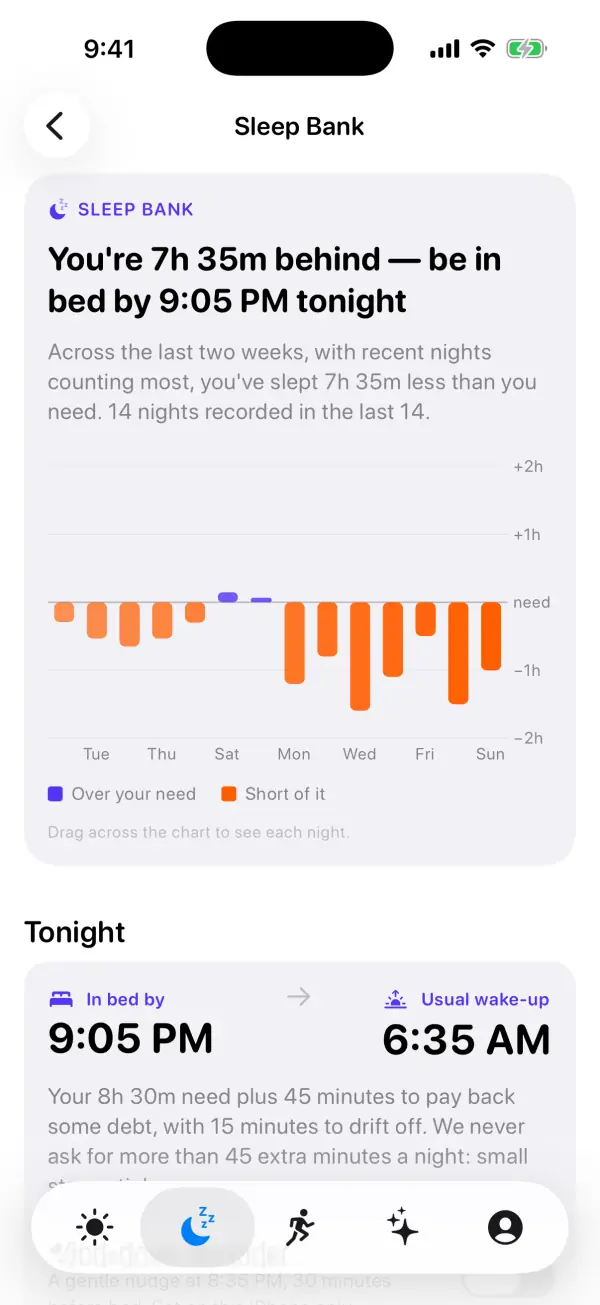
VedaWatch can't make you fall asleep, but it can make the routine easier to keep. Sleep Bank learns your usual wake-up time from the sleep your Apple Watch records and works back to a bedtime for tonight: your sleep need before your usual wake-up, with 15 minutes to drift off, plus a little extra if you're behind (never more than 45 minutes a night). Keeping the wake time fixed and moving only the bedtime is the same idea as stimulus control.
Turn on the wind-down reminder in Sleep Bank and you'll get a gentle nudge 30 minutes before that bedtime. In the evening, the Today screen shows tonight's plan and, once you're inside the wind-down window, suggests screens off and lights low for the next half hour.
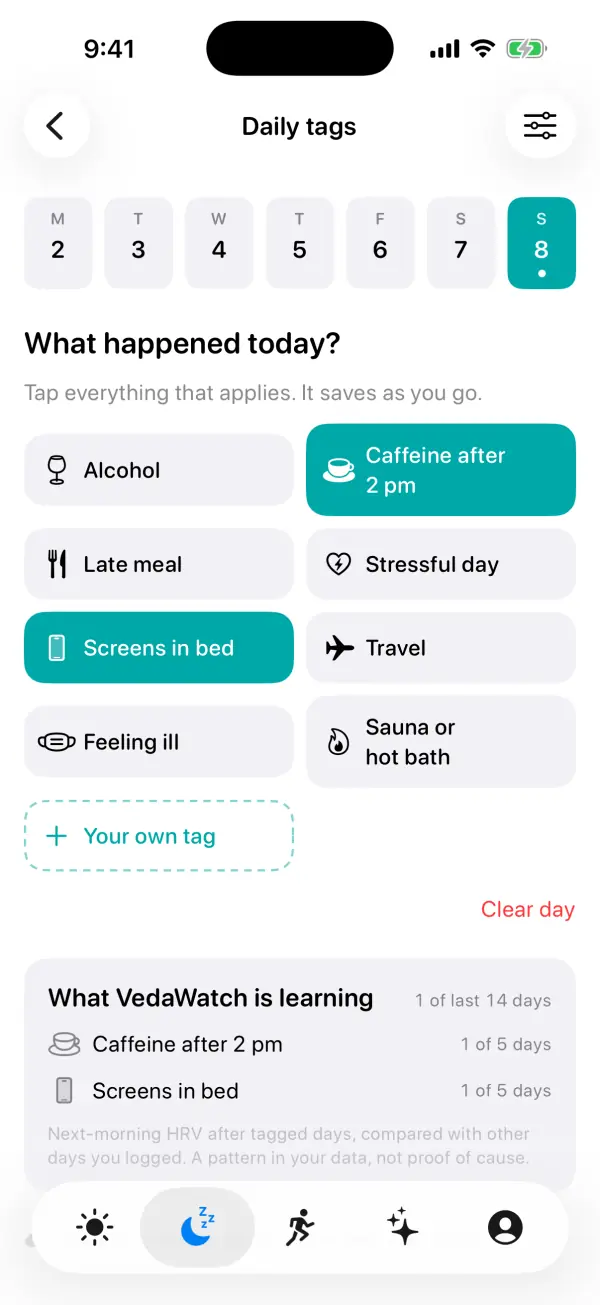
For the wind-down itself, the guided library includes Evening wind-down, a 15-minute session of slow belly breathing and floor stretches. And Daily tags let you mark days with Caffeine after 2 pm, Screens in bed, Late meal, Alcohol or Stressful day. Once a tag has enough logged days, VedaWatch shows whether your next-morning HRV tends to differ after those days, a pattern in your own data rather than proof of cause.
Sleep Bank also shows how far behind or ahead of your sleep need you are across the last 14 nights, which helps you judge whether a slow-to-sleep spell is costing you real sleep. None of this replaces medical advice.
When trouble falling asleep needs a doctor
A few bad nights after stress, travel or a schedule change are common and usually pass. The US National Heart, Lung, and Blood Institute describes chronic insomnia as trouble sleeping on at least three nights a week for more than three months that isn't better explained by another health problem. If that sounds like you, talk to a doctor. Full CBT-I, delivered by a trained clinician or a structured program, is the first-line treatment, and it includes parts like sleep restriction therapy that are best done with guidance.
See a doctor sooner if you have loud snoring, gasping or pauses in breathing at night, an urge to move your legs in the evening, low mood or anxiety that keeps you awake, or you're so sleepy during the day that it affects driving or work. These can point to conditions that need their own treatment. A wearable can help you describe your sleep pattern, but it can't diagnose a sleep disorder.
Frequently asked questions
Is it bad if I fall asleep in under 5 minutes?
Not necessarily, but if it happens every night and you're sleepy during the day, you may not be getting enough sleep. Try giving yourself more time in bed for a week or two and see whether the daytime sleepiness eases.
Should I stay in bed and rest if I can't sleep?
CBT-I advises against it. Lying awake for long stretches teaches your brain that bed is a place to be awake, so get up when you feel frustrated and return when sleepy.
Does melatonin help you fall asleep faster?
Melatonin is a supplement with mixed evidence for everyday sleep onset, and products and doses vary widely. Ask a doctor or pharmacist before using it, especially if you take other medicines or are pregnant.
Can Apple Watch tell me how long it took to fall asleep?
Apple Health shows when your Apple Watch estimated you were asleep and in which stages, but it doesn't give a dedicated time-to-fall-asleep number. Comparing when you went to bed with when the first asleep segment starts gives a rough estimate, not a clinical measurement.
How long does stimulus control take to work?
Many people notice changes over a few weeks, and the first week can feel harder because of the extra tiredness. Stick with the fixed wake time and talk to a clinician if things aren't improving.
Related guides
- Why do I wake up at 3am? Causes and how to get back to sleep
- Sleep consistency: why a regular bedtime matters, and how much
- How much sleep do I need? By age, for athletes, and for you
- Sleep debt calculator for Apple Watch: how VedaWatch's Sleep Bank works
- How alcohol affects sleep: REM, waking at 3 am and your heart
- Does caffeine affect HRV? Coffee, sleep and your cutoff time
- Apple Watch sleep tracking: how accurate is it, and what to do when it's wrong
Sources & further reading
- Edinger JD et al. Behavioral and psychological treatments for chronic insomnia disorder in adults: an American Academy of Sleep Medicine clinical practice guideline. J Clin Sleep Med. 2021;17(2):255-262
- Ohayon M et al. National Sleep Foundation's sleep quality recommendations: first report. Sleep Health. 2017;3(1):6-19
- Drake C et al. Caffeine effects on sleep taken 0, 3, or 6 hours before going to bed. J Clin Sleep Med. 2013;9(11):1195-1200
- Chang AM et al. Evening use of light-emitting eReaders negatively affects sleep, circadian timing, and next-morning alertness. PNAS. 2015;112(4):1232-1237
- Haghayegh S et al. Before-bedtime passive body heating by warm shower or bath to improve sleep: a systematic review and meta-analysis. Sleep Med Rev. 2019;46:124-135
- National Heart, Lung, and Blood Institute: Insomnia
- Apple Support: Set up sleep in Health on iPhone
- Apple Support: Set up sleep schedules on Apple Watch
This guide is educational, not medical advice, and has not been clinically reviewed. VedaWatch is not a medical device. If you have symptoms or concerns about your heart or health, contact a qualified healthcare professional.
Put your trends in perspective.
Explore HRV, sleep, and recovery with VedaWatch on your iPhone.
Download VedaWatch on the App Store →