 VedaWatch
Sleep
How much sleep do I need? By age, for athletes, and for you
How much sleep you need by age, per the AASM and National Sleep Foundation, why athletes often need more, and how to find your own number from your sleep data.
By VedaWatch editorial team · · 9 min read
The short answer
Most adults need at least 7 hours of sleep a night, and the National Sleep Foundation recommends 7 to 9 hours for ages 18 to 64 and 7 to 8 hours from 65. Teens need 8 to 10. Athletes in hard training often do better above 8 hours. Your own need sits somewhere in that range, and two weeks of data can show where.
How much sleep do adults need?
The two main expert statements agree on the floor. The American Academy of Sleep Medicine (AASM) and the Sleep Research Society (SRS) say adults should sleep 7 or more hours per night on a regular basis to promote optimal health. The National Sleep Foundation (NSF) recommends 7 to 9 hours for adults aged 18 to 64, and 7 to 8 hours for adults 65 and older.
The AASM and SRS panel is blunt about the low end. Regularly sleeping less than 7 hours is linked with weight gain and obesity, diabetes, high blood pressure, heart disease and stroke, depression, and a higher risk of death, along with poorer immune function, more pain, worse performance and more accidents. These are associations from many studies, not a promise that one short week causes harm, but the direction is consistent.
Two details are easy to miss. First, both statements mean sleep, not time in bed. If you're in bed for 7 hours and awake for 40 minutes of it, you got about 6 hours 20 minutes. Second, "7 or more" is a minimum for most people, not a target everyone should aim for exactly. Many healthy adults need closer to 8.
How much sleep you need by age
Children need much more sleep than adults, and the amount falls steadily through childhood and the teenage years. The two sources below use slightly different age bands, so they're listed separately. The AASM figures for children were endorsed by the American Academy of Pediatrics. For babies under 4 months, the AASM gives no recommendation because healthy newborns vary so much.
National Sleep Foundation recommended ranges, per 24 hours:
- Newborns (0 to 3 months): 14 to 17 hours.
- Infants (4 to 11 months): 12 to 15 hours.
- Toddlers (1 to 2 years): 11 to 14 hours.
- Preschoolers (3 to 5 years): 10 to 13 hours.
- School-age children (6 to 13 years): 9 to 11 hours.
- Teenagers (14 to 17 years): 8 to 10 hours.
- Young adults (18 to 25 years) and adults (26 to 64 years): 7 to 9 hours.
- Older adults (65 and up): 7 to 8 hours.
- AASM for children, per 24 hours on a regular basis: 4 to 12 months, 12 to 16 hours including naps; 1 to 2 years, 11 to 14 hours including naps; 3 to 5 years, 10 to 13 hours including naps; 6 to 12 years, 9 to 12 hours; 13 to 18 years, 8 to 10 hours. Adults: 7 hours or more.
How much sleep do athletes need?
There's no official number just for athletes, and that's deliberate. A 2021 expert consensus on sleep and the athlete, published in the British Journal of Sports Medicine, concluded that a one-size-fits-all target such as 7 to 9 hours is unlikely to be ideal for health and performance, and recommended an individual approach that takes the athlete's own sense of their sleep need into account.
What the research does show is that extra sleep can help people who train hard. In a Stanford study, 11 college basketball players spent at least 10 hours in bed a night for 5 to 7 weeks. Their measured sleep rose by about 111 minutes a night. By the end, their 282-foot sprint time fell from 16.2 to 15.5 seconds, free throws and three-pointers each improved by about 9%, reaction times got faster, and daytime sleepiness dropped sharply. In a smaller study the consensus describes, trained cyclists and triathletes performed better in endurance tests after three nights of about 8.4 hours than after their usual 6.8 hours, which led those authors to suggest endurance athletes sleep more than 8 hours.
Treat those studies as encouraging rather than settled. The basketball study had no control group and only 11 players, and the consensus panel notes that whether more than 8 hours should apply to all athletes, in every sport, is still unresolved. A sensible reading: if you train hard most days, plan for the upper half of the adult range, 8 to 9 hours of actual sleep, and check how you respond.
Athletes also tend to get less sleep than they need. The same consensus reports that 50% to 78% of elite athletes in studies experience sleep disturbance and 22% to 26% have highly disturbed sleep, with early training, evening competition, travel and high training loads among the usual causes. Short naps are one practical patch: the consensus cites studies in which 20 to 30 minute naps improved sprint performance and jump power.
Is 9 or more hours too much sleep?
Not automatically. The AASM and SRS panel says regularly sleeping more than 9 hours may be appropriate for young adults, for people recovering from sleep debt, and for people who are ill. For other adults, the panel says it's uncertain whether that much sleep carries any health risk.
The NSF adds a practical margin: an hour or two either side of a range may be appropriate depending on the person. So an adult who wakes refreshed after 9.5 hours isn't necessarily doing anything wrong.
What deserves attention is a change you can't explain. If you used to feel fine on 7.5 hours and now need 10 and still wake tired, that's worth mentioning to a doctor, because long sleep that doesn't refresh you can go along with an untreated sleep disorder, depression, or another health problem.
How to find your personal sleep need
Population ranges tell you roughly where to look. Your own need is a single number inside them, and it differs from person to person. In a lab study of 15 healthy young men given 12 hours in bed every night for 9 nights, their sleep settled to an estimated optimum that averaged 8.41 hours but ranged from 7.29 to 9.26 hours. At home, the same men averaged only 7.37 hours, so most were carrying about an hour of hidden debt without knowing it. The researchers also estimated that repaying just 1 hour of that kind of debt took about four days.
That gives you a home version of the same test. It works best on a holiday or a quiet stretch with no early starts:
- Pick about two weeks with no alarms needed and no late events. Skip alcohol close to bedtime and late caffeine so they don't blur the result.
- Go to bed when you feel sleepy, not by the clock, and let yourself wake naturally.
- Wear your sleep tracker every night, or keep a simple diary of when you fell asleep and woke.
- Ignore the first several nights. If you're carrying debt, they'll run long as your body repays it.
- Average your actual sleep over the last 5 to 7 nights. That figure is a reasonable estimate of your need.
- Example: nights 1 to 6 average 9 hours 10 minutes, then settle around 8 hours 5 minutes. Your need is probably close to 8 hours, so a 7-hour weeknight leaves you about an hour short.
No holiday coming? Use your weekends
Most people can't spend two weeks without alarms. Your normal life still holds clues. Alarm mornings show how much sleep fits into your schedule, while mornings you wake on your own show more of what your body wants.
Compare the two. If you regularly sleep 6 hours 45 minutes on weekdays and 8 hours 30 minutes when you can wake naturally, you're probably short during the week. One caution: a long lie-in straight after a short night is partly catch-up, so it can overstate your true need. Look at natural-wake nights that follow ordinary nights.
Also look at how you feel rather than only at numbers. The honest test is whether you wake without an alarm most days, stay alert through the morning without leaning on caffeine, and don't nod off in quiet moments in the afternoon.
Signs you're not getting enough sleep
The tricky part about mild, ongoing sleep loss is that you stop noticing it. In a classic lab study, people kept to 6 hours a night for two weeks built up thinking deficits equivalent to up to two nights without any sleep, yet rated themselves only slightly sleepier as the days went on. Feeling "used to it" is not the same as being fine.
Signs that you're regularly getting less than you need include:
- You need an alarm almost every day, and you sleep much longer whenever you can.
- You fall asleep within moments of lying down, or doze off when reading, in meetings, or as a passenger.
- You lean on caffeine to get through the morning or the afternoon dip.
- Your concentration, reaction time or mood is worse than usual, and small things irritate you.
- Workouts feel harder than they should, and recovery seems slow.
- Your wearable shows your recovery markers drifting, such as a lower HRV or a higher resting heart rate than usual, during a run of short nights. These are clues, not proof.
Why time asleep matters more than time in bed
Every recommendation above is about sleep itself. Most people spend some time in bed awake: falling asleep, waking in the night, lying there before getting up. So to get 8 hours of sleep you usually need to be in bed for longer than 8 hours.
Sleep trackers help here, with a caveat. The athlete consensus notes that consumer wearables typically overestimate total sleep time compared with lab sleep studies, partly because lying still while awake can look like sleep. Use your watch for trends and comparisons over weeks rather than treating a single night's figure as exact. If you want to know how Apple Watch performs specifically, see our guide to Apple Watch sleep tracking accuracy.
How VedaWatch helps you track your sleep need
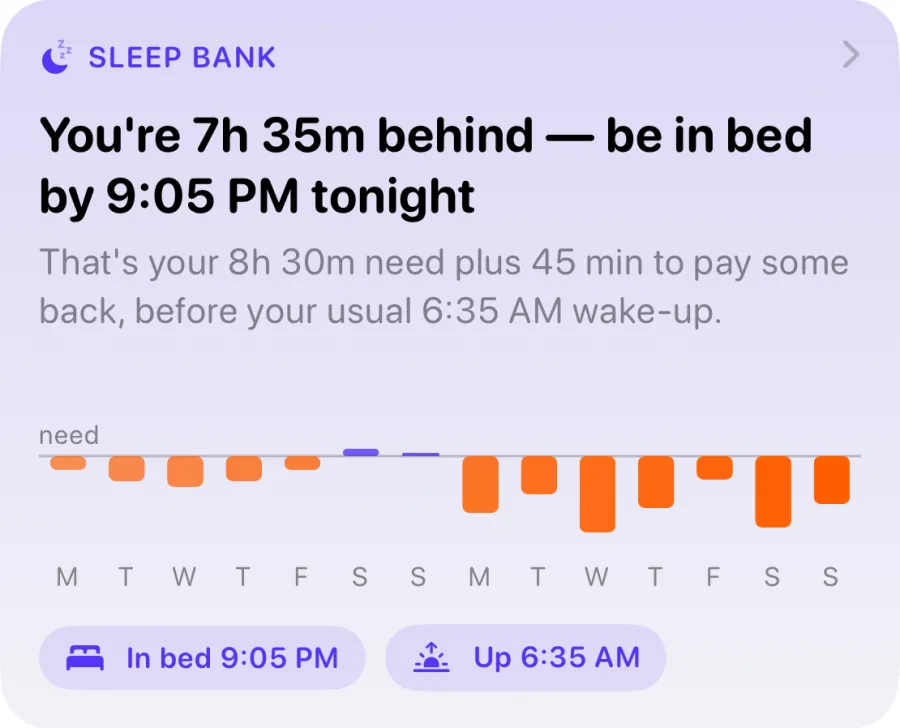
If you wear an Apple Watch to bed, VedaWatch's Sleep Bank does the weekend comparison above for you. It starts from a sleep need of 8 hours. It then looks at nights in the last 30 days when you woke on your own, meaning on a weekend or at least 45 minutes later than your usual time, and leaves out lie-ins that follow a night under 7 hours, since those are catch-up. After 4 such nights it starts moving towards their median, fully after 10, and keeps the learned need between 7 and 9 hours, rounded to 15 minutes.
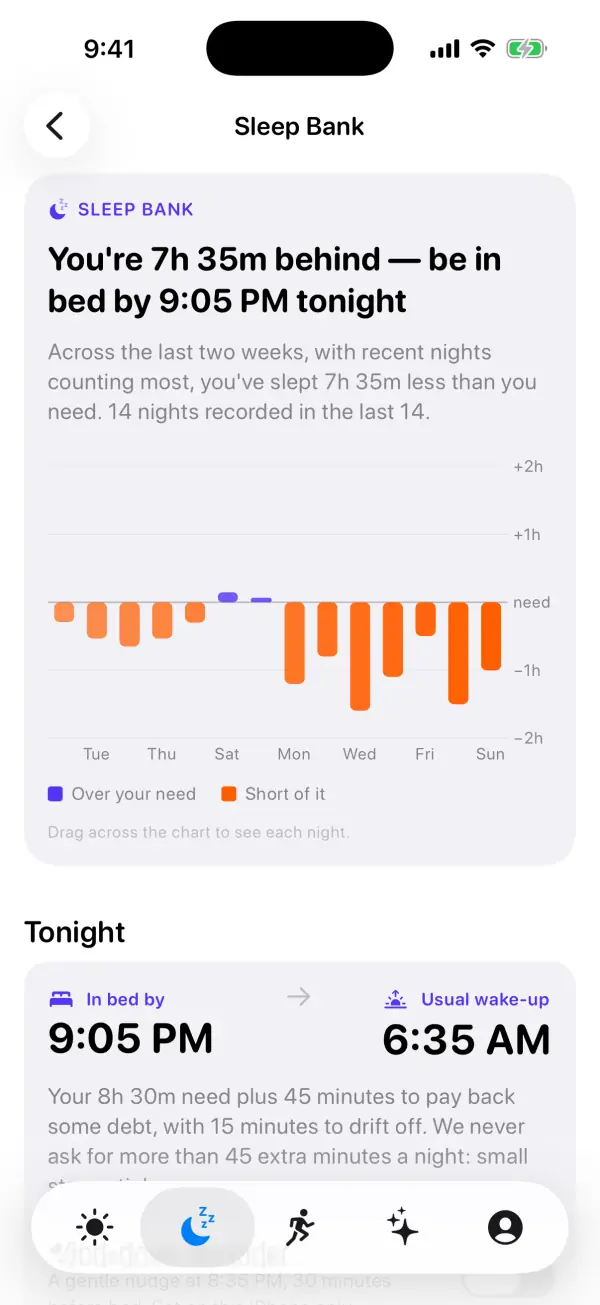
If you already know your number, for example from a holiday test, you can set it yourself anywhere from 6 to 10 hours in 15-minute steps, and the app still shows what your nights suggest. Sleep Bank then compares your last 14 nights with that need, counting recent nights most, and turns the result into one line: how far behind or ahead you are, and when to be in bed tonight. It pays debt back gradually, never adding more than 45 minutes to a night.
Everything is worked out on your iPhone from the sleep your Watch saves to Apple Health. It's an estimate built on consumer sleep tracking, not a medical test.
When to talk to a doctor about sleep
Changing your schedule fixes a lot of tiredness, but not all of it. Talk to a doctor if you're getting enough time in bed and still feel exhausted, if someone notices you snore loudly, gasp or stop breathing during sleep, if you regularly struggle to fall or stay asleep, or if you feel the need to sleep far more than you used to.
A doctor or sleep specialist can check for conditions such as sleep apnea or insomnia, which no amount of extra time in bed will solve. And if you're drowsy behind the wheel, pull over: that's a safety issue, not a scheduling one.
Frequently asked questions
Is 6 hours of sleep enough?
For most adults, no. The AASM and SRS panel recommends at least 7 hours on a regular basis, and in a lab study people kept to 6 hours for two weeks steadily lost performance while barely feeling sleepier.
Do naps count toward my sleep total?
For young children, the AASM ranges include naps. For adults, a nap can top up a short night and short naps have helped athletes' sprint performance, but most guidance is about regular nighttime sleep, so treat naps as a patch rather than a plan.
Do women need more sleep than men?
The AASM, SRS and National Sleep Foundation give the same ranges for both. Individual need varies within those ranges for everyone, so your own data is a better guide than averages for any group.
Do you need less sleep as you get older?
Slightly, according to the National Sleep Foundation, which recommends 7 to 8 hours from age 65 compared with 7 to 9 for younger adults. Sleeping much less than that, or feeling unrefreshed, is worth raising with a doctor rather than putting down to age.
Can I train my body to need less sleep?
There's no good evidence that you can. People on restricted sleep tend to feel used to it while their performance keeps slipping, which is why feeling fine on 6 hours is not reliable proof that you need only 6.
Related guides
- Sleep debt calculator for Apple Watch: how VedaWatch's Sleep Bank works
- Can you catch up on sleep? What weekend recovery sleep can't fix
- What time should I go to bed? A bedtime calculator that works
- Apple Watch sleep tracking: how accurate is it, and what to do when it's wrong
- Does sleep help muscle recovery? What the research shows
- How much deep sleep do you need? Minutes by age, Apple Watch
Sources & further reading
- Watson NF et al. Recommended amount of sleep for a healthy adult: a joint consensus statement of the AASM and SRS. Sleep, 2015
- Hirshkowitz M et al. National Sleep Foundation's sleep time duration recommendations: methodology and results summary. Sleep Health, 2015
- Paruthi S et al. Recommended amount of sleep for pediatric populations: a consensus statement of the AASM. Journal of Clinical Sleep Medicine, 2016
- Walsh NP et al. Sleep and the athlete: narrative review and 2021 expert consensus recommendations. British Journal of Sports Medicine, 2021
- Mah CD et al. The effects of sleep extension on the athletic performance of collegiate basketball players. Sleep, 2011
- Kitamura S et al. Estimating individual optimal sleep duration and potential sleep debt. Scientific Reports, 2016
- Van Dongen HPA et al. The cumulative cost of additional wakefulness: dose-response effects of chronic sleep restriction and total sleep deprivation. Sleep, 2003
- National Sleep Foundation: How many hours of sleep do you really need?
This guide is educational, not medical advice, and has not been clinically reviewed. VedaWatch is not a medical device. If you have symptoms or concerns about your heart or health, contact a qualified healthcare professional.
Put your trends in perspective.
Explore HRV, sleep, and recovery with VedaWatch on your iPhone.
Download VedaWatch on the App Store →