 VedaWatch
Sleep
What time should I go to bed? A bedtime calculator that works
Work out what time to go to bed from your wake-up time and sleep need: a bedtime table, worked examples, the truth about 90-minute cycles, and chronotype tips.
By VedaWatch editorial team · · 10 min read
The short answer
Start from the time you have to get up, subtract the hours of sleep you need (at least 7 for most adults), then subtract about 15 minutes to fall asleep. Waking at 7:00 AM with an 8-hour need means lights out by 10:45 PM. Keep that wake time fixed, even on weekends.
What time should I go to bed? Work back from your wake-up time
There's no single right bedtime for everyone. The right one for you depends on two things: the time you need to get up, and how much sleep your body needs. Your wake-up time is usually the fixed part, set by work, school or children, so the reliable way to choose a bedtime is to count backwards from it.
The formula is simple: bedtime = wake-up time minus your sleep need minus the time it takes you to fall asleep. Most adults need at least 7 hours of sleep a night, according to a joint consensus statement from the American Academy of Sleep Medicine and the Sleep Research Society. Many people need more than that, which is why it's worth finding your own number rather than aiming for the minimum.
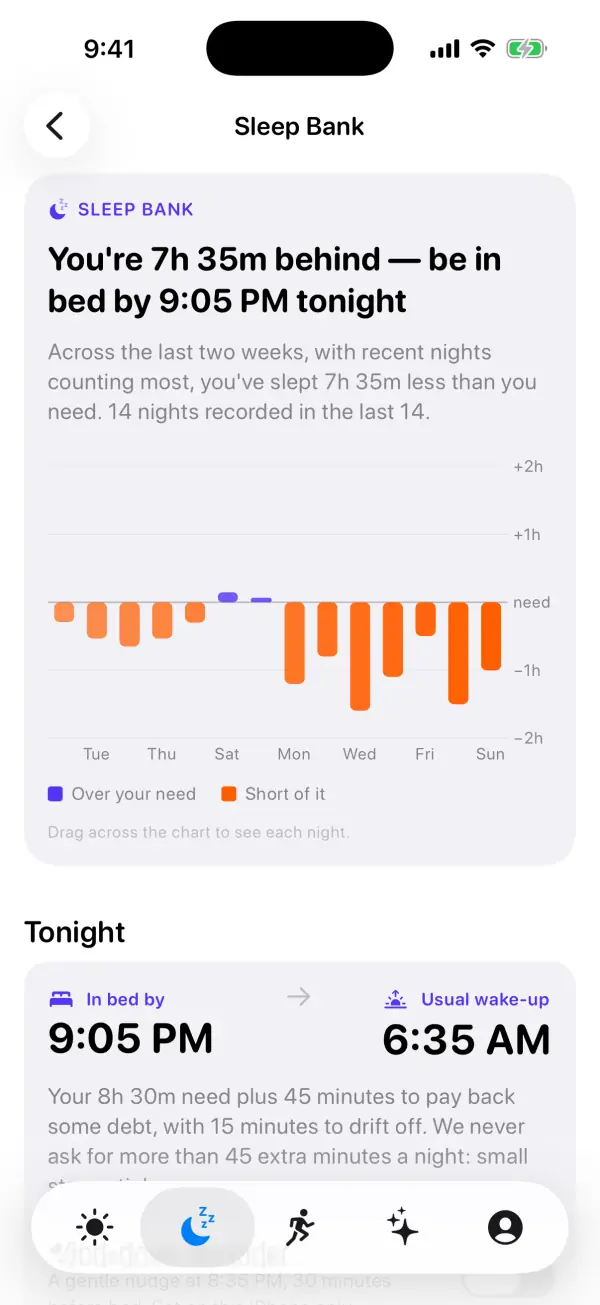
Falling asleep isn't instant, so most bedtime calculators add an allowance of about 15 minutes, and VedaWatch's Sleep Bank uses the same 15 minutes. If you usually lie awake longer, add more. If you wake up a few times in the night and lie awake for a while, add a little extra on top, because those minutes aren't sleep either.
- Write down the time you must be up on a normal day, for example 6:30 AM.
- Pick your sleep need. If you don't know it, start with 8 hours and adjust later.
- Subtract the sleep need from the wake time: 6:30 AM minus 8 hours is 10:30 PM. That's when you should be asleep.
- Subtract about 15 minutes to fall asleep: in bed with the lights off by 10:15 PM.
- Start winding down 30 to 60 minutes before that, so screens are off and the lights are low by the time you get into bed.
Bedtime calculator: a table by wake-up time
If you'd rather not do the arithmetic, use the table below. Each line gives the lights-out time for 7, 8 and 9 hours of sleep, with 15 minutes already allowed for falling asleep. Find your wake-up time, then pick the column that matches your sleep need.
Seven hours is the floor for most adults rather than a target. If you feel you only just get by on 7, try the 8-hour column for two weeks and see whether your daytime energy changes.
- Wake at 5:30 AM: in bed by 10:15 PM for 7 hours, 9:15 PM for 8 hours, 8:15 PM for 9 hours.
- Wake at 6:00 AM: in bed by 10:45 PM for 7 hours, 9:45 PM for 8 hours, 8:45 PM for 9 hours.
- Wake at 6:30 AM: in bed by 11:15 PM for 7 hours, 10:15 PM for 8 hours, 9:15 PM for 9 hours.
- Wake at 7:00 AM: in bed by 11:45 PM for 7 hours, 10:45 PM for 8 hours, 9:45 PM for 9 hours.
- Wake at 7:30 AM: in bed by 12:15 AM for 7 hours, 11:15 PM for 8 hours, 10:15 PM for 9 hours.
- Wake at 8:00 AM: in bed by 12:45 AM for 7 hours, 11:45 PM for 8 hours, 10:45 PM for 9 hours.
How much sleep do you need to count back from?
The sleep need you subtract matters far more than any other part of the formula. Get it wrong by an hour and every bedtime in the table is wrong by an hour too. Official ranges are a good starting point: the AASM recommends 8 to 10 hours for teenagers aged 13 to 18, and at least 7 hours for adults. The National Sleep Foundation suggests 7 to 9 hours for adults aged 18 to 64 and 7 to 8 hours for those 65 and over.
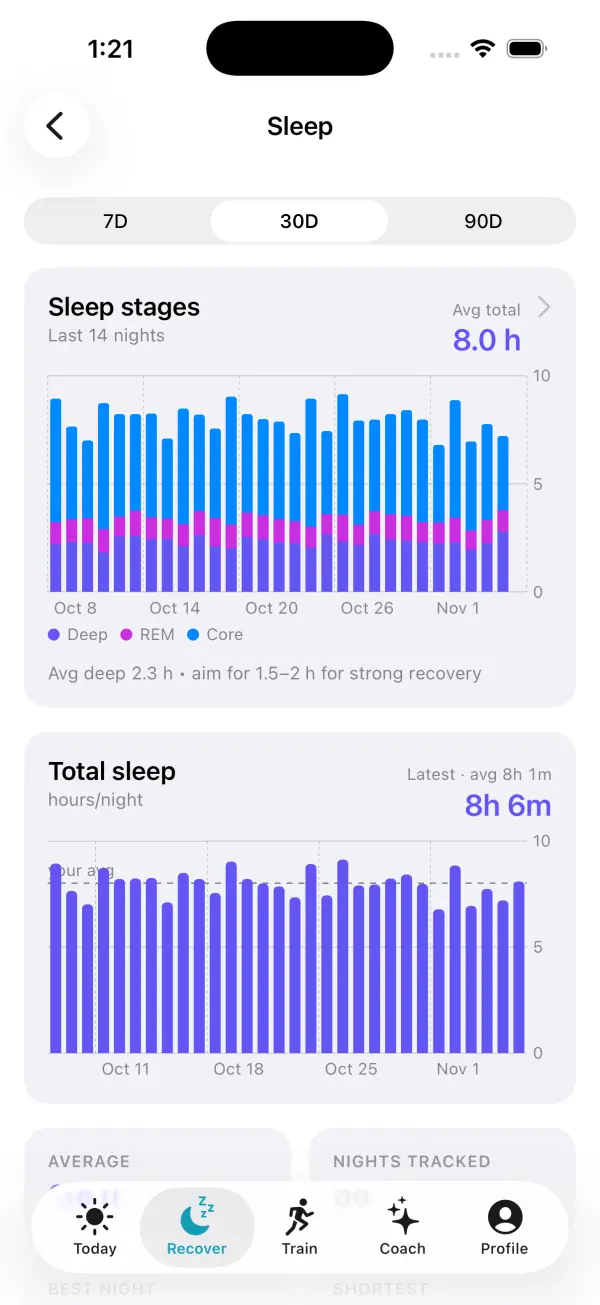
Within those ranges, your own need is personal. The best clue is how long you sleep when nothing wakes you up: on a holiday, or on weekend mornings once any backlog has been slept off. If you always sleep 9 hours given the chance, an 11:30 PM bedtime before a 7:00 AM alarm is leaving you short every night, however normal it feels.
Our guide on how much sleep you need goes through this in detail, including how to use your weekends to estimate your number. Once you have it, the bedtime falls out of the arithmetic.
Worked examples: three real schedules
The commuter. Sam has to leave at 7:15 AM and gets up at 6:15 AM. On a two-week holiday Sam settled at about 8 hours a night. 6:15 AM minus 8 hours is 10:15 PM, minus 15 minutes to fall asleep: in bed by 10:00 PM. Sam has been going to bed at 11:30 PM, which means sleeping about 6 hours 30 minutes and running 1 hour 30 minutes short every weeknight.
The early-shift worker. Priya starts work at 6:00 AM and gets up at 4:45 AM. Her need is about 7 hours 30 minutes. 4:45 AM minus 7 hours 30 minutes is 9:15 PM, so she should be in bed by 9:00 PM. That's early enough to clash with family evenings, which is exactly why she needs to know the number: it shows how much any late night costs her.
The parent of a toddler. Alex is woken at 6:00 AM most days and needs 8 hours, so the plain answer is in bed by 9:45 PM. Alex is also woken once most nights and is up for around 20 minutes, so Alex adds that to the plan and aims for 9:25 PM. Night wakings eat into sleep just like a late bedtime does.
In all three cases the wake-up time stays put and the bedtime moves. That's the right way round: a regular wake-up time is the anchor your body clock sets itself by, and the bedtime is what you adjust to protect your sleep.
Should you time your bedtime to 90-minute sleep cycles?
Many online bedtime calculators count back in 90-minute sleep cycles, so they suggest 7 hours 30 minutes or 9 hours of sleep rather than 8, with the promise that you'll wake at the end of a cycle and feel less groggy. The idea has a real basis: sleep does run in repeating cycles of non-REM and REM sleep, and about 90 minutes is a fair rough average.
The problem is the precision. In a large lab analysis of 6,064 recorded cycles from 369 healthy people, the median cycle lasted 96 minutes, cycle length varied a lot between people, and the first cycle of the night was consistently shorter than the ones after it. Cycle length also shifted with age, sex and how sleep-deprived people were. So a calculator that adds up exact 90-minute blocks can drift well away from your real cycles by morning. Five cycles of 96 minutes is 8 hours, not 7 hours 30 minutes, which is a 30-minute miss before you even count the time it takes to fall asleep.
Grogginess on waking, called sleep inertia, is real and tends to be worse if you're woken abruptly from deep (slow-wave) sleep, according to a review of the research. But most deep sleep tends to come earlier in the night, and without serious sleep loss, sleep inertia rarely lasts more than about 30 minutes. Not getting enough sleep is the bigger cause of feeling rough in the morning.
The practical takeaway: use your sleep need, not a cycle count, to set your bedtime. Never cut your sleep short to land on a cycle boundary. If you're choosing between 7 hours 30 minutes and 8 hours, choose the one closer to what your body actually needs.
Night owl or early bird? How chronotype changes your bedtime
Your chronotype is your body clock's natural timing: when you'd fall asleep and wake up if nothing forced your hand. Early types (larks) get sleepy early and wake easily; late types (owls) feel alert in the evening and struggle with early alarms. Chronotype isn't laziness. It's partly biological and it changes with age. A survey of about 25,000 people found that sleep timing gets later through the teenage years and then turns back towards earlier at around age 20, which is why teenagers find early bedtimes so hard.
Chronotype changes how easy your bedtime will be, but not the arithmetic. An owl who must be up at 6:30 AM still needs the same hours of sleep as a lark, so the bedtime is the same on paper. The difference is that an owl may lie awake if they jump straight to it.
If your target bedtime feels impossible, move towards it in small steps over a week or two rather than all at once. Get daylight soon after you wake up, keep evening light dim, and hold the same wake-up time on weekends, because big weekend lie-ins push your body clock later again. If you have some control over your schedule, the better fix may be to move the wake-up time later rather than fight your chronotype every night.
Does going to bed at the same time every night matter?
A bedtime is only useful if you keep it. Going to bed at 10:30 PM on weeknights and 1:00 AM at weekends shifts your body clock back and forth, so Sunday night's 10:30 PM feels like 8:00 PM to your brain and sleep won't come. Researchers call that pattern social jet lag, and our guide to sleep consistency covers what the evidence says about it.
A fixed wake-up time is the most useful single habit. If you go to bed late one night, try to get up at your normal time anyway and go to bed a little earlier the next night, rather than sleeping in. If you're already behind on sleep, pay it back with slightly earlier bedtimes over several nights, not one huge lie-in.
Once you've chosen your times, write them into a schedule you'll see. On iPhone, the Sleep schedule in the Health app lets you set a bedtime, a wake-up time and a sleep goal, and it warns you when the schedule is shorter than your goal. Use the same numbers you worked out above.
How VedaWatch works out your bedtime from Apple Watch data
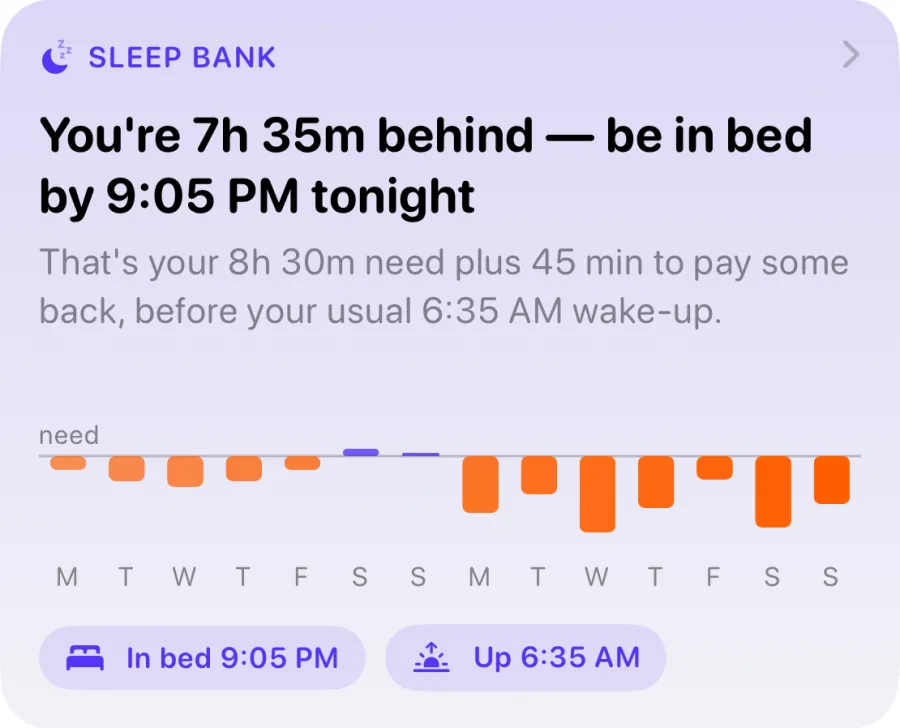
If you wear an Apple Watch to bed, VedaWatch's Sleep Bank does this calculation for you from the sleep your Watch saves to Apple Health. It finds your usual wake-up time from the median of your last 14 nights (it needs at least 5), counts back your sleep need, and allows 15 minutes to fall asleep. The result appears on the Recover tab as a single line, such as "be in bed by 10:40 PM tonight".
Your sleep need starts at 8 hours. VedaWatch then learns from nights in the last 30 days when you woke up on your own rather than to an alarm, and you can set it yourself anywhere from 6 to 10 hours. If you've built up a sleep debt over the last two weeks, it adds a few minutes to pay some back, never more than 45 extra minutes in one night.
You can also turn on a wind-down reminder, a notification on your iPhone 30 minutes before tonight's bedtime. It's off by default. The numbers are estimates based on Apple Watch sleep tracking, which isn't perfect, so treat them as a guide rather than a rule.
When a bedtime isn't the problem
A good bedtime only helps if you can sleep once you're there. If you regularly take a long time to fall asleep or lie awake for long stretches despite feeling tired, still feel exhausted after enough time in bed, snore loudly or have been told you stop breathing in your sleep, or find your sleep timing is so late that it can't fit around school or work, talk to a doctor. These can be signs of conditions such as insomnia, sleep apnea or a circadian rhythm disorder, which are treatable.
This guide is general information, not medical advice. If you have a health condition, work shifts, or take medication that affects sleep, ask a clinician what bedtime and sleep length make sense for you.
Frequently asked questions
Is it better to go to bed at 10 PM or 11 PM?
It depends on when you get up. With a 7:00 AM alarm and an 8-hour need, 10:45 PM works; with a 6:00 AM alarm, 10 PM leaves you closer to 7 hours 45 minutes of sleep once you allow time to fall asleep. The best bedtime is the one that gives you your full sleep need before a wake-up time you can keep every day.
What time should I go to bed if I wake up at 6 AM?
For 8 hours of sleep, be in bed by about 9:45 PM; for 7 hours, about 10:45 PM. Both include roughly 15 minutes to fall asleep.
Is it bad to go to bed after midnight?
Not by itself, if you can still get your full sleep need and keep a regular schedule. The trouble is that a late bedtime with a fixed early alarm usually means sleeping too little.
Do sleep cycle alarms that wake you in light sleep work?
They aim to catch a lighter stage within a window before your alarm, which may feel easier for some people. They don't make up for too little sleep, and they shorten your night if they wake you early, so set your bedtime by your sleep need first.
What bedtime should a teenager have?
Teens aged 13 to 18 are advised to get 8 to 10 hours, so a 7:00 AM wake-up points to lights out somewhere between about 8:45 PM and 10:45 PM. Teenagers' body clocks naturally run late, so a regular routine and dim evening light help more than simply ordering an earlier bedtime.
Related guides
- How much sleep do I need? By age, for athletes, and for you
- Sleep debt calculator for Apple Watch: how VedaWatch's Sleep Bank works
- Sleep consistency: why a regular bedtime matters, and how much
- Can you catch up on sleep? What weekend recovery sleep can't fix
- How to fall asleep faster: CBT-I techniques that work
- Apple Watch sleep stages: what Awake, REM, Core, and Deep mean
Sources & further reading
- Watson NF et al. Recommended amount of sleep for a healthy adult: a joint consensus statement of the AASM and SRS. Sleep, 2015
- Paruthi S et al. Recommended amount of sleep for pediatric populations: a consensus statement of the AASM. Journal of Clinical Sleep Medicine, 2016
- Hirshkowitz M et al. National Sleep Foundation's sleep time duration recommendations: methodology and results summary. Sleep Health, 2015
- Cajochen C et al. Ultradian sleep cycles: frequency, duration, and associations with individual and environmental factors. Sleep Health, 2024
- Tassi P, Muzet A. Sleep inertia. Sleep Medicine Reviews, 2000
- Roenneberg T et al. A marker for the end of adolescence. Current Biology, 2004
- Apple Support: Track your sleep on Apple Watch and use Sleep on iPhone
This guide is educational, not medical advice, and has not been clinically reviewed. VedaWatch is not a medical device. If you have symptoms or concerns about your heart or health, contact a qualified healthcare professional.
Put your trends in perspective.
Explore HRV, sleep, and recovery with VedaWatch on your iPhone.
Download VedaWatch on the App Store →