 VedaWatch
Workouts & Training
Best time of day to work out: morning vs evening, by goal
What's the best time of day to work out? What studies show on morning vs evening workouts for strength, weight loss and sleep, and how to test timing yourself.
By VedaWatch editorial team · · 9 min read
The short answer
For most people, the best time of day to work out is the time you can keep doing. Strength and power tend to peak in the late afternoon and evening, but reviews find training at different times builds strength and muscle about equally. Evening exercise doesn't harm sleep for most people; the one caution is a vigorous session ending within about an hour of bedtime.
What is the best time of day to work out?
The short answer: whichever time you'll stick to. The research on workout timing is real but the effects are small, and they are much smaller than the difference between training regularly and training on and off.
The clearest findings are about performance on the day. Your body has a daily rhythm in core temperature, hormones and alertness, and maximum strength and power follow it. A 2022 meta-analysis of 63 studies in Medicine & Science in Sports & Exercise found strong evidence that anaerobic power and jump height are highest between about 1 pm and 8 pm, some evidence that grip strength peaks between about 2 pm and 9 pm, and only little evidence of a peak time for maximum endurance.
Long-term results are a different question, and there the evidence is much flatter. A 2023 systematic review in Sports Medicine - Open, which looked at 26 training studies, concluded that current research provides evidence neither for nor against one time of day being better for performance or health gains. Its one consistent signal was that people improved most when they were tested at the same time of day they trained.
So the practical rule is simple. Pick a time that fits your life, protect your sleep, and if you have an event at a fixed time, do some of your training at that time too.
Morning vs evening workouts: what actually differs?
Morning and evening sessions feel different, and that's mostly the body clock. Early in the day, muscles and joints are cooler and stiffer, and many people need a longer warm-up before hard efforts feel normal. By late afternoon, body temperature is near its daily high, and strength, power and speed tend to be a little better.
Each slot has practical trade-offs too:
- Morning: fewer things get in the way, it's easier to make a habit, and it leaves the evening free to wind down. The cost is often a shorter night if you have to set an early alarm, and less time to eat beforehand.
- Lunchtime: breaks up a sedentary day and avoids both early alarms and late finishes, but time is tight and showers can be a problem.
- Late afternoon and early evening: usually your strongest and most coordinated window, which suits heavy lifting, intervals and skill work. The risk is that work or family plans push it back or cancel it.
- Late evening: fine for most people, but a hard session that ends right before bed can make it harder to fall asleep. More on that below.
Is it better to lift weights in the morning or evening?
On any single day, you will usually lift a bit more in the evening. A 2019 meta-analysis in Chronobiology International of 11 resistance-training studies found that, before training began, people were stronger in the evening than in the morning.
Over weeks of training, though, time of day mattered little. Increases in strength were similar whether people trained in the morning or the evening, and muscle growth was similar too. One interesting detail: people who trained in the morning narrowed their usual morning-evening strength gap, so their morning strength caught up with their evening strength. In other words, your body partly adapts to the time you usually train.
If you lift in the morning, give yourself a slightly longer warm-up and a couple of extra ramp-up sets before your heaviest work. Our guides on progressive overload and on how many sets per muscle per week matter far more for results than the clock does.
What's the best time to work out for weight loss?
There's some evidence that morning exercise may help a little, but it isn't strong enough to choose a time you can't keep. The study most often quoted is a secondary analysis of the Midwest Exercise Trial 2, published in the International Journal of Obesity in 2020. Adults with overweight or obesity did a supervised 10-month exercise programme, five days a week. Those who did most of their sessions between 7 am and noon lost about 7.2% of body weight on average, while those who mostly exercised between 3 pm and 7 pm lost less, with no clear difference in measured calorie intake or energy expenditure to explain it.
That result needs caution. People weren't randomly assigned to a time slot, the groups were small (21 early and 25 late exercisers), and the authors say the mechanism is unclear. It's a reason to try mornings if they suit you, not proof that evening exercise works less well.
What matters more for weight is the total amount of activity over weeks, along with food. The WHO recommends adults get 150 to 300 minutes of moderate activity or 75 to 150 minutes of vigorous activity each week, plus muscle-strengthening on two or more days. Whatever time of day gets you there most reliably is the right one.
Does working out at night affect sleep?
For most healthy adults, no, and the old advice to avoid exercise in the evening isn't well supported. A 2019 systematic review and meta-analysis in Sports Medicine by Stutz and colleagues at ETH Zurich pooled 23 studies that compared sleep after a single evening workout with a night without exercise. Overall, evening exercise slightly increased deep (slow-wave) sleep, by about 1.3 percentage points, slightly reduced the lightest stage of sleep, and delayed the first REM period by about 8 minutes. The authors concluded that the studies don't support the idea that evening exercise harms sleep; if anything, rather the opposite.
The exception is hard, late exercise. The same review found that vigorous exercise ending one hour or less before bedtime might make it take longer to fall asleep and reduce total sleep time and sleep efficiency. It also found that sessions that were hard relative to what a person normally does were linked to more time awake in the night, though the authors note these moderator findings rested on few studies.
A sensible approach for evening training:
- Finish hard intervals, races and heavy sessions at least an hour before you plan to be in bed, and ideally two or more if you're sensitive.
- Keep the very latest sessions easy or moderate: an easy run, a walk, mobility or light strength work.
- Cool down properly, have a shower, and keep the bedroom cool, since a higher body temperature at bedtime was linked to worse sleep in the review.
- Watch the extras: pre-workout drinks are often high in caffeine, and bright gym lighting and screens late at night can push bedtime back.
- Keep your bedtime and wake time regular even on training days. Evening workouts that shift bedtime later every week can cost you more sleep than the exercise itself.
Why consistency matters more than timing
If one finding stands out across this research, it's that a regular time helps you exercise more. A 2019 study in Obesity looked at 375 people in the US National Weight Control Registry who had lost weight and kept it off. About two-thirds exercised at a consistent time of day. Those people exercised more often and for longer each week, and were more likely to meet the 150-minute guideline, than people whose timing varied. How much they exercised didn't differ by which time of day they chose: early mornings worked as well as evenings, as long as they were consistent.
This fits what we know about habits. A workout that happens at the same time, after the same cue, such as dropping the kids at school or closing the laptop, takes less willpower each week. Choosing training days and a time in advance is one of the simplest ways to build that cue.
Your body clock adapts as well. As the strength research above shows, training regularly at one time of day partly shifts when you perform best toward that time. That's another reason a consistent slot tends to feel better over time, whichever slot it is.
How to test the best workout time for you with Apple Watch
Averages from studies can't tell you how your own sleep and recovery respond to an early or late session. Your Apple Watch can help, as long as you compare many days rather than one. The useful signals are overnight HRV and resting heart rate, along with sleep duration and how long it took to fall asleep.
- Wear your Apple Watch to bed with Track Sleep with Apple Watch turned on, so every night has sleep, heart rate and HRV data.
- Choose two time slots to compare, such as before 9 am and after 7 pm, and keep the sessions roughly similar in type and effort.
- Train in each slot for at least two or three weeks, or alternate them, rather than switching for a single day.
- Each morning, note overnight HRV, resting heart rate and sleep from the Health app, along with how you felt during the workout.
- Compare each morning with your own normal, as a percentage above or below your usual HRV, rather than with someone else's numbers.
- After at least 5 mornings after each slot, compare the averages. A consistent gap of several percent, with resting heart rate moving the opposite way, is a real pattern for you. A gap that flips around is noise.
- Don't forget performance and enjoyment. If your evening sessions are stronger and you sleep fine after them, that's a perfectly good answer.
How VedaWatch helps you find your best workout time
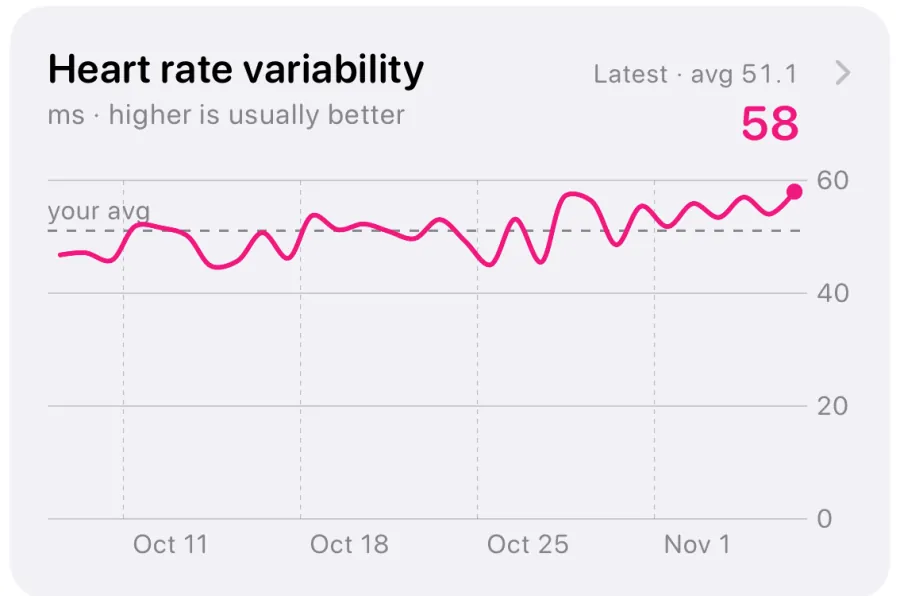
VedaWatch reads your workouts, sleep, HRV and resting heart rate from Apple Health, and checks for a late-workout pattern for you. On days you trained, it compares next-morning HRV, as a percentage of your normal, after workouts that ended after 8 pm with workouts that ended earlier. It needs at least 30 mornings of HRV and 5 days in each group, and only names a pattern when the gap is at least 4% and clearly bigger than its uncertainty. If it finds one, you may see a card such as Late workouts cost you recovery or Evening workouts suit you, and it can appear under What moves your recovery on the Recover tab.
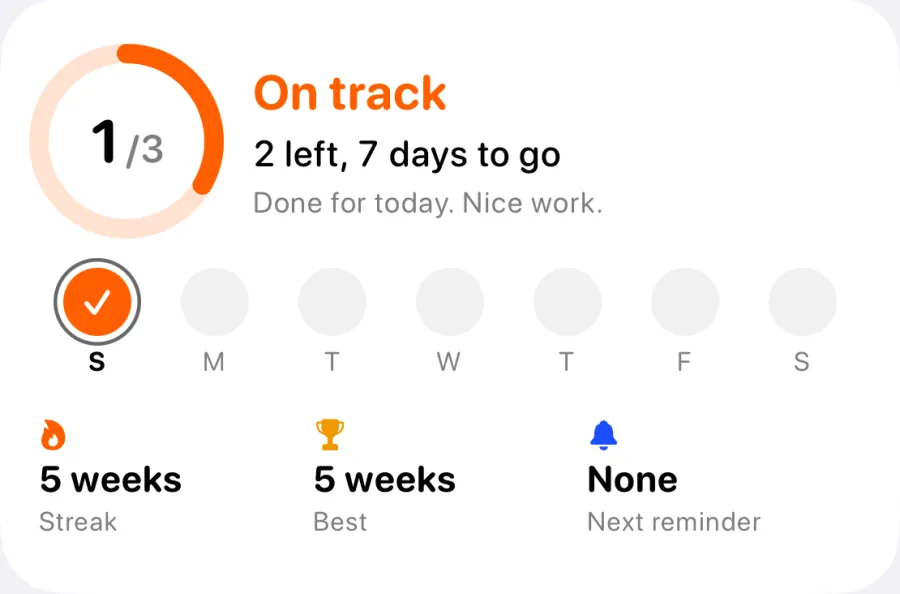
The weekly training target helps with the consistency side. You pick how many days a week you'll train, can choose training days, and can turn on a daily reminder at a time you set, 6 pm by default. Any guided session or Apple Health workout of 20 minutes or more counts, whatever time you do it. Each morning, your readiness score, built from overnight HRV, resting heart rate and sleep against your own baseline, tells you whether today's session should be harder or easier.
These are patterns in your own data, not proof of cause and not medical advice.
When workout timing isn't the real problem
If you sleep badly after almost every workout, whatever the time, or you regularly lie awake for a long time, wake many times a night, or feel unrefreshed despite enough time in bed, it's worth talking to a doctor. Persistent insomnia and sleep disorders are common and treatable, and they aren't fixed by moving a workout.
Also get medical advice before starting or stepping up exercise if you have a heart condition or other health problem, and stop and seek help if you have chest pain, unusual breathlessness, dizziness or a racing or irregular heartbeat during exercise.
Frequently asked questions
Is it better to work out in the morning or at night?
Neither is clearly better for long-term results. Strength and power are usually a little higher later in the day, but reviews find similar gains from morning and evening training, so choose the time you can keep.
Is working out at 9 pm bad for sleep?
Usually not. A meta-analysis of 23 studies found evening exercise didn't harm sleep overall, but vigorous exercise ending within about an hour of bedtime might, so keep late sessions easier or finish hard ones earlier.
Does working out in the morning burn more fat?
One trial found people who mostly exercised in the morning lost more weight over 10 months than late-afternoon exercisers, but people weren't randomised to times. Total weekly activity and diet matter much more than the clock.
Should I work out fasted in the morning?
An easy session fasted is fine for most people, but hard or long sessions usually go better with some carbohydrate first. Our guide on what to eat before a morning run covers amounts and timing.
Can my body adapt to training at a certain time?
Partly, yes. In resistance-training studies, people who trained in the morning narrowed their usual gap between morning and evening strength, and training and testing at the same time of day tends to give better results.
What time should I train if I have a race in the morning?
Do at least some of your key sessions at race time in the weeks before, so your body, breakfast and warm-up are used to it. Studies suggest performance improves most when training and testing happen at the same time of day.
Related guides
- How to stay consistent with workouts: set a weekly training target
- Sleep consistency: why a regular bedtime matters, and how much
- What to eat before a morning run: by run length and timing
- HRV after a workout: the normal dip and how long recovery takes
- What lowers your HRV? Use a tag journal to find out
- How to fall asleep faster: CBT-I techniques that work
Sources & further reading
- Stutz J, Eiholzer R, Spengler CM (2019). Effects of evening exercise on sleep in healthy participants: a systematic review and meta-analysis. Sports Medicine 49(2):269-287. doi:10.1007/s40279-018-1015-0
- Knaier R et al. (2022). Diurnal variation in maximum endurance and maximum strength performance: a systematic review and meta-analysis. Medicine & Science in Sports & Exercise 54(1):169-180. doi:10.1249/MSS.0000000000002773
- Bruggisser F et al. (2023). Best time of day for strength and endurance training to improve health and performance? A systematic review with meta-analysis. Sports Medicine - Open 9:34. doi:10.1186/s40798-023-00577-5
- Grgic J et al. (2019). The effects of time of day-specific resistance training on adaptations in skeletal muscle hypertrophy and muscle strength: a systematic review and meta-analysis. Chronobiology International 36(4):449-460. doi:10.1080/07420528.2019.1567524
- Willis EA et al. (2020). The effects of exercise session timing on weight loss and components of energy balance: Midwest Exercise Trial 2. International Journal of Obesity 44(1):114-124. doi:10.1038/s41366-019-0409-x
- Schumacher LM et al. (2019). Relationship of consistency in timing of exercise performance and exercise levels among successful weight loss maintainers. Obesity 27(8):1285-1291. doi:10.1002/oby.22535
- World Health Organization (2020). WHO guidelines on physical activity and sedentary behaviour
- Apple Support: Track your sleep on Apple Watch and use Sleep on iPhone
This guide is educational, not medical advice, and has not been clinically reviewed. VedaWatch is not a medical device. If you have symptoms or concerns about your heart or health, contact a qualified healthcare professional.
Put your trends in perspective.
Explore HRV, sleep, and recovery with VedaWatch on your iPhone.
Download VedaWatch on the App Store →