 VedaWatch
Workouts & Training
How to increase running mileage safely (and the 10% rule)
How to increase running mileage safely: what the research says about the 10 percent rule, single-run spikes, ACWR and cutback weeks, plus a worked 8-week build.
By VedaWatch editorial team · · 10 min read
The short answer
Build mileage in small steps from what you already run comfortably, and take a lighter week every third or fourth week. The 10% rule is a reasonable ceiling, not a proven shield. Watch single runs too: a large cohort found injury rates rose once one run exceeded your longest run of the past 30 days by more than 10%.
How to increase running mileage safely
Start from the weekly distance you can repeat right now without unusual soreness, heavy fatigue or pain. Add a little each week, keep most of the extra running easy, and every third or fourth week run noticeably less so your body can catch up. That's the whole method. The details are about how big "a little" is and which number you watch.
The research behind those details is thinner than most running advice suggests. A 2018 systematic review found very limited evidence that sudden changes in training load cause running injuries, and found no support for the 10% rule specifically. It also concluded that no one knows a precise safe threshold. What the evidence does support is the general idea: big, sudden jumps are a risk, and they're avoidable.
So the practical rules in this guide are deliberately simple. Grow weekly distance gradually, never let one run jump far past your recent longest run, build in lighter weeks, and change one thing at a time: frequency, then duration, and only then speed.
What is the 10 percent rule in running?
The 10 percent rule says you shouldn't increase your weekly running distance by more than 10% over the previous week. Ran 30 km last week? Aim for no more than 33 km this week. In miles, 20 miles becomes 22.
It spread because it's easy to remember and easy to apply. It was never derived from a study, though. It's a coaching rule of thumb that later research tried to test.
Two things about it are worth knowing before you follow it. First, it compounds: adding 10% every week for 8 weeks multiplies your distance by about 2.1 (1.1 to the power of 8), so a strict 10% rule with no lighter weeks doubles your mileage in two months. That's a big jump for many runners. Second, at low volume it's almost meaningless. Ten percent of 10 km is 1 km, which is one extra short jog, and it would take months to reach a 5K training base that way.
Does the 10% rule prevent running injuries? What studies found
The best direct test is the GRONORUN randomized trial of 532 novice runners preparing for a 6.7 km (4-mile) event. One group followed a standard 8-week program. The other followed a graded 13-week program built on the 10% rule. Injury rates were essentially identical: 20.8% in the graded group and 20.3% in the standard group. For new runners training toward a short race, following the 10% rule didn't reduce injuries.
A 1-year cohort study of 874 novice runners who were each given a GPS watch looked at it from another angle. Overall injury rates didn't differ significantly between runners who increased weekly distance by less than 10%, by 10 to 30%, or by more than 30%. For a specific group of distance-related injuries, including patellofemoral pain, iliotibial band syndrome and medial tibial stress syndrome (shin splints), runners who increased by more than 30% over two weeks had a higher rate (hazard ratio 1.59), though the result fell just short of statistical significance. The authors' cautious advice: novice runners may do well to keep progression below 30% over a two-week period.
The newest and largest piece of evidence changes the question. In a 2025 study of 5,205 runners and 588,071 running sessions from the Garmin-RUNSAFE cohort, weekly change (this week compared with last week) showed no significant association with overuse injury. What did matter was the single session: when one run was more than 10% longer than the longest run in the previous 30 days, the overuse injury rate went up. Runs 10 to 30% longer had a hazard rate ratio of 1.64, runs 30 to 100% longer 1.52, and runs more than twice as long 2.28.
Put together: the 10% weekly rule isn't wrong as a ceiling, but the evidence that it protects you is weak, and your longest single run may deserve more attention than your weekly total. These are observational findings with self-reported injuries, so treat them as strong hints rather than settled rules.
The ACWR alternative: comparing this week with the last four
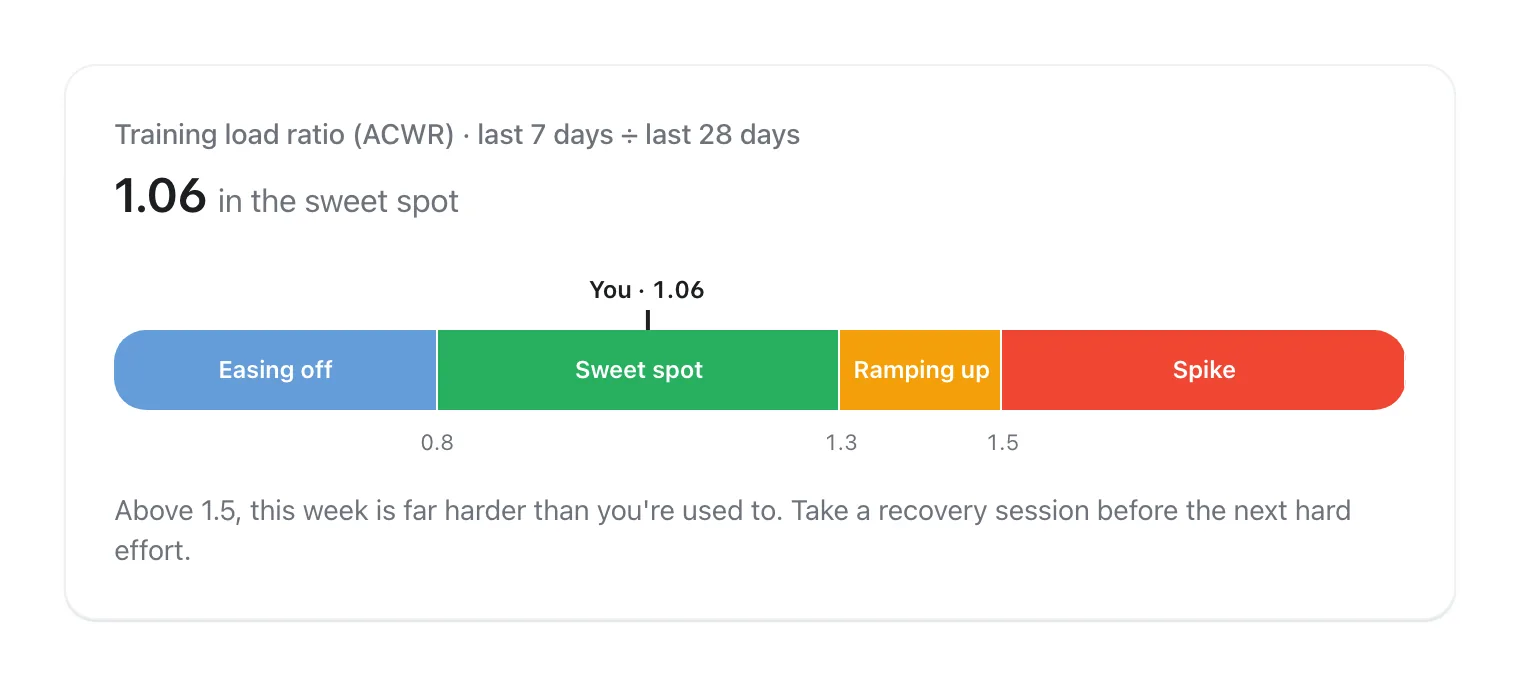
Instead of comparing this week with last week, the acute:chronic workload ratio (ACWR) compares your recent load (usually 7 days) with your longer-term average (usually 28 days). A ratio of 1.0 means you're doing what you're used to. 1.3 means about 30% more. The idea comes from team-sport research popularized by Tim Gabbett, who argued that athletes who build high loads gradually tend to get injured less than those whose load jumps around.
A ratio of roughly 0.8 to 1.3 is widely used as a sweet spot, with more caution above 1.5. Treat those bands as a convention, not a validated line: methodologists have criticized the ratio's statistical properties, and in the 2025 running cohort above, higher ACWR values were actually associated with lower injury rates, the opposite of what the theory predicts. Our training load and ACWR guide covers that debate in detail.
Where ACWR still helps is in spotting the obvious mistake the 10% rule misses: a runner who did very little for three weeks and then has one big week. Week to week, that can look like a modest increase over a lighter week. Against the 28-day average it stands out clearly. Apple Watch's own Training Load feature uses the same 7-day versus 28-day comparison. Use it as a second opinion on your weekly total, alongside the single-run check.
Cutback weeks: how often and how much to drop
A cutback (or down) week is a planned week of lower volume in the middle of a build. You keep running, keep some easy strides or a short quality session if you do them, and run less in total. The point is to let tissues and energy levels catch up before the next step, and to stop small aches from becoming big ones.
There's no trial that pins down the perfect rhythm. A common coaching pattern is three building weeks followed by a lighter week at roughly three-quarters of the volume, which is also the pattern VedaWatch's training plans use. Some runners, especially if they feel beaten up sooner, prefer two building weeks and one lighter week.
Two details make cutbacks work. Shorten the long run in that week too, not just the easy runs. And when the next block starts, return to the volume you reached before the cutback, not to a big new high. Measured against the light week, that first week back will look like a large jump, which is exactly why a 28-day comparison is more useful than week-on-week math.
A worked 8-week mileage build (20 km to 30 km a week)
Here's how the rules above fit together for a runner who currently runs about 20 km (12.4 miles) a week over three or four runs, with a longest run of 8 km. Each line shows the weekly total, the long run, and a rough ratio of that week against the average of the four weeks before it (a distance-based stand-in for ACWR, assuming the four weeks before the plan were also about 20 km).
Notice what the plan does. Weekly increases stay at 10% or less inside each block. The long run never grows by more than about 6% over the longest run of the previous 30 days, safely under the 10% single-run threshold. The ratio stays between 0.87 and 1.21. And week 5 looks like a 30% jump over week 4, but it only returns to week 3's level, which is why the four-week comparison stays calm.
To run it in miles, multiply each number by 0.62: the build goes from about 12.5 to about 18.5 miles a week, with the long run growing from 5 to about 7 miles. Add the extra distance to easy runs, not to fast sessions.
- Week 1: 22 km total, long run 8.5 km. Ratio about 1.10.
- Week 2: 24 km total, long run 9 km. Ratio about 1.17.
- Week 3: 26 km total, long run 9.5 km. Ratio about 1.21.
- Week 4 (cutback): 20 km total, long run 7 km. Ratio about 0.87.
- Week 5: 26 km total, long run 10 km. Ratio about 1.13. Back to week 3's volume, not higher.
- Week 6: 28 km total, long run 10.5 km. Ratio about 1.17.
- Week 7: 30 km total, long run 11 km. Ratio about 1.20.
- Week 8 (cutback): 24 km total, long run 8 km. Ratio about 0.92. Hold around 26 to 30 km for a few weeks before the next build.
Where to add the extra distance
How you add mileage matters as much as how much. A few habits keep the same weekly total gentler on your body.
- Add a run before you lengthen runs. Going from three runs to four spreads the load. A new run can start short and easy.
- Grow runs a little at a time. Lengthen easy runs and the long run in small steps, and check each run against your longest run of the past 30 days.
- Change one variable at a time. Don't add distance, hills and speed work in the same week. If you're adding volume, keep intensity steady.
- Keep the added running easy. Extra kilometres should be conversational. Our easy run pace guide shows how slow that usually is.
- Count everything that loads your legs. A hilly hike, a long cycling day or a heavy leg session adds load too, even if it isn't on your running log.
- Repeat a week when life gets in the way. Bad sleep, illness or a stressful week are good reasons to hold, not build.
Signs you're increasing mileage too fast
Mileage plans are guesses about your body. These signals tell you the guess was too optimistic, and they're more important than any percentage.
Pain that makes you change how you run, pain that gets worse as a run goes on, or pain that's still there the next morning are reasons to stop building and cut back. So is a sharp, localized tender spot on a bone, such as the shin or the top of the foot, which can be an early sign of a bone stress injury. Generalized fatigue that doesn't lift after a lighter week, worse sleep, or easy runs that suddenly feel hard also suggest you need a pause.
Data can help you notice the pattern earlier. A resting heart rate that stays above your normal for several days, or HRV that stays below it, often goes along with accumulated fatigue, though illness, alcohol and stress do the same. These aren't diagnoses. If pain persists for more than a few days, keeps you from running normally or comes with swelling, see a doctor or physiotherapist, and talk to a doctor before a big increase in training if you have a heart or other health condition.
How VedaWatch helps you build mileage gradually
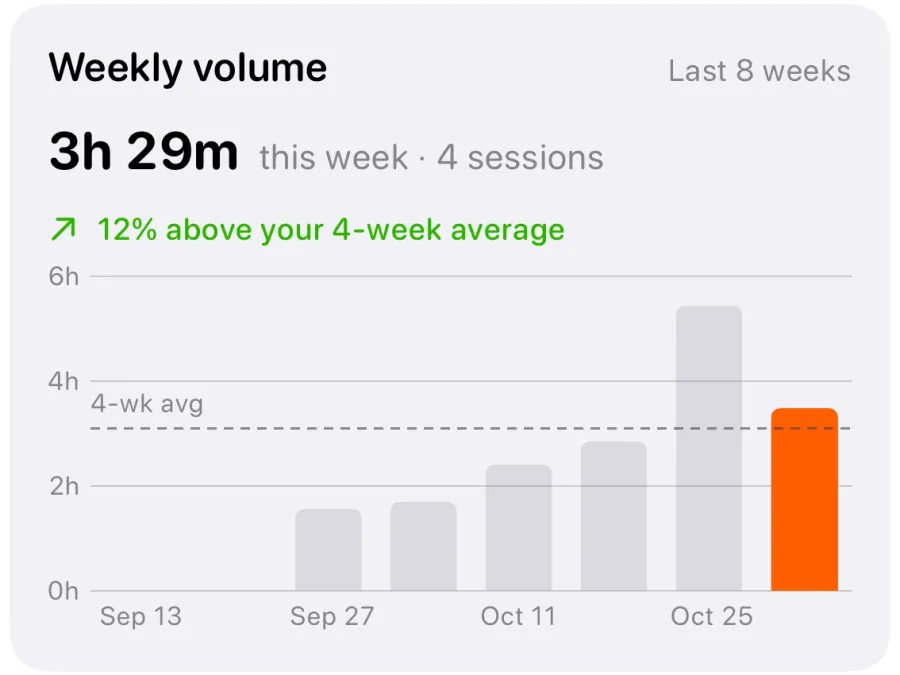
VedaWatch reads the runs and other workouts your Apple Watch saves to Apple Health, so you don't have to keep a separate log. On the Train tab, the Weekly volume card shows your training time for each of the last 8 weeks, a dashed line at the average of your previous four complete weeks, and how this week compares, such as 12% above your 4-week average. It counts time, not distance, and includes all your workouts, which matches the idea that total load matters.
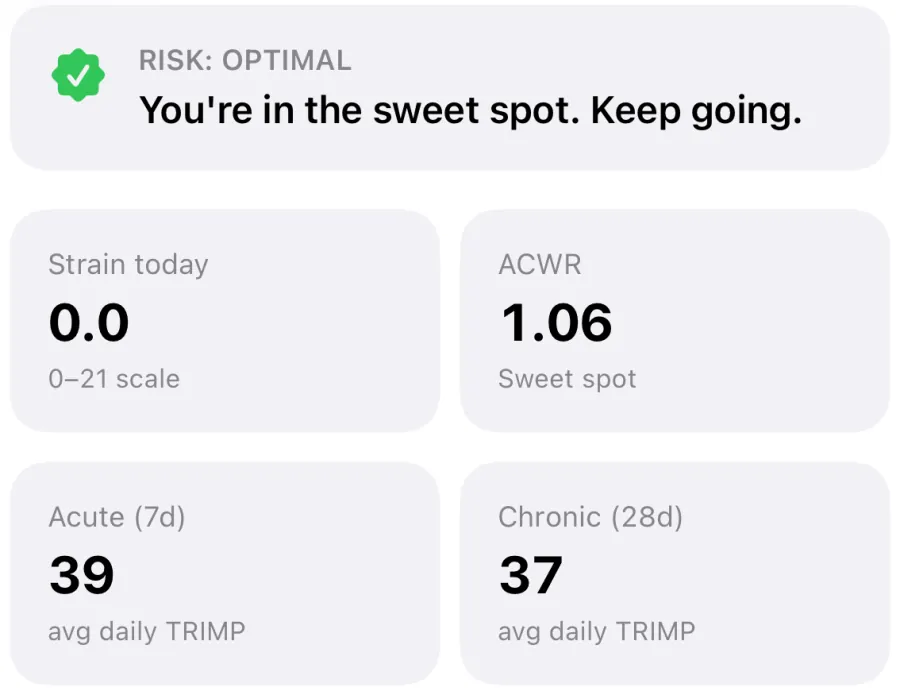
The Training load screen computes an acute:chronic ratio from the last 7 days against the last 28, weighting each workout by heart rate intensity when heart rate is available, and labels it with the bands above. If you turn on the Training load spike alert (one of the recommended alerts), VedaWatch taps you when your last 7 days run well above your 4-week average. It needs at least 6 workout days in the last 28 before it fires.
If you want the structure done for you, VedaWatch Pro ($6.99 a month or $59.99 a year) includes training plans for a 5K, 10K or half marathon. Their volume follows the same 3:1 rhythm described above: three weeks that grow a little, then a lighter week at about three-quarters. Each morning, readiness and training load can swap a hard session for an easy one. VedaWatch doesn't track your single longest run against the 10% threshold, so keep an eye on that yourself.
Frequently asked questions
Is the 10% rule outdated?
Not outdated, just unproven. A randomized trial in novice runners found it didn't reduce injuries, and newer data points to big single-run jumps as a stronger warning sign than weekly totals. It still works as a sensible ceiling for most weeks.
Can beginners increase mileage by more than 10% a week?
At very low volume, 10% is a tiny change, so beginners often add a short run or a few minutes instead of following a percentage. The novice cohort study suggests staying under about 30% over two weeks, and building in lighter weeks.
How long does it take to go from 20 to 40 km a week?
At the pace of the 8-week example above, which adds about 10 km to your peak week per 8 weeks, that's roughly 16 weeks, plus any weeks you hold steady. A strict 10% rule with no lighter weeks would get there in about 8 weeks, which is the kind of fast doubling worth avoiding.
Should I increase mileage and speed work at the same time?
It's safer not to. Build volume with easy running first, then hold volume steady while you add or lengthen faster sessions.
How should I come back to mileage after time off?
Don't jump straight back to your old weekly total, even if it felt easy before. Restart below where you stopped, keep the long run modest, and rebuild over a few weeks. After an injury, follow your clinician's return-to-run plan.
Related guides
- First marathon training plan: a 16-week beginner guide
- Apple Watch Training Load and ACWR, explained (and why sports scientists argue about it)
- Easy run pace: how slow should easy runs be?
- Training for a 5K, 10K or half marathon with Apple Watch: a plan that adapts to your recovery
- Deload week: what it is, when to take one and how to do it
- Signs of overtraining: what your Apple Watch can and can't show
- How to start running again after a break: a plan by break length
Sources & further reading
- American Journal of Sports Medicine (2008): No effect of a graded training program on the number of running-related injuries in novice runners: a randomized controlled trial (Buist et al.)
- Journal of Orthopaedic & Sports Physical Therapy (2014): Excessive progression in weekly running distance and risk of running-related injuries (Nielsen et al.)
- International Journal of Sports Physical Therapy (2018): Is there evidence for an association between changes in training load and running-related injuries? A systematic review (Damsted et al.)
- British Journal of Sports Medicine (2025): How much running is too much? Identifying high-risk running sessions in a 5200-person cohort study (Frandsen et al.)
- British Journal of Sports Medicine (2016): The training-injury prevention paradox: should athletes be training smarter and harder? (Gabbett)
- International Journal of Sports Physiology and Performance (2020): Acute:Chronic Workload Ratio: Conceptual Issues and Fundamental Pitfalls (Impellizzeri et al.)
- Apple Support: Track your training load on Apple Watch
This guide is educational, not medical advice, and has not been clinically reviewed. VedaWatch is not a medical device. If you have symptoms or concerns about your heart or health, contact a qualified healthcare professional.
Put your trends in perspective.
Explore HRV, sleep, and recovery with VedaWatch on your iPhone.
Download VedaWatch on the App Store →