 VedaWatch
Recovery & Apple Watch
Signs of overtraining: what your Apple Watch can and can't show
The signs of overtraining, from overreaching to overtraining syndrome, which ones Apple Watch can pick up (HRV, resting HR, load spikes) and what to do next.
By VedaWatch editorial team · · 9 min read
The short answer
The main signs of overtraining are performance that keeps dropping despite rest, persistent fatigue, training feeling harder than usual, poor sleep and low mood. Apple Watch can flag supporting clues, such as a resting heart rate above your normal, an HRV trend off your baseline and a sudden training load spike, but it can't diagnose overtraining.
What are the signs of overtraining?
The one sign every expert agrees on is a drop in performance that doesn't come back with normal rest. The 2013 joint consensus statement from the European College of Sport Science and the American College of Sports Medicine says the only certain sign is a decrease in performance in training or competition. Its diagnostic checklist then asks about unexplained underperformance, persistent fatigue, an increased sense of effort in training and disturbed sleep.
Around that core you usually see a cluster of other changes: low mood or irritability, less motivation, heavy legs and soreness that linger, more colds, and changes in appetite. None of these on its own means you are overtrained. Hard training is supposed to make you tired, and stress, illness, poor sleep or under-eating can produce exactly the same picture.
That is why it helps to separate three things people lump together as overtraining, and to be honest about which signs a wearable can actually measure. An Apple Watch is good at noticing that your body looks different from your own normal. It cannot tell you why.
Functional overreaching vs overtraining syndrome
The consensus statement describes a continuum. What separates the stages is mainly how long it takes performance to come back, not how hard the training was.
Functional overreaching is often planned, for example a training camp or a big block before a taper. A 2020 review in Sports Medicine notes that it is often induced on purpose, though it also argues that pushing deliberately into it isn't always needed, or always helpful, for adaptation. Nonfunctional overreaching is where things start to go wrong. Overtraining syndrome is rare and serious, and in practice it is often only identified in hindsight, once the time course is clear.
- Functional overreaching: performance dips for a short spell after hard training, then rebounds above where it was. The consensus statement says recovery from overreaching is possible within about 2 weeks.
- Nonfunctional overreaching: performance stagnates or falls and does not come back for several weeks or months, often with low vigor, more fatigue and other signs of distress. Athletes do recover fully with enough rest.
- Overtraining syndrome: a prolonged maladaptation where underperformance and mood disturbance persist despite weeks or months of recovery. The statement notes that full recovery may take months, possibly years.
- Diagnosis by exclusion: there is no test that rules overtraining syndrome in. A doctor first has to exclude other causes, such as infection, anemia, thyroid or other hormonal problems, eating too little, and injury.
Overtraining signs Apple Watch can pick up
Your Watch measures several things that can move when training stress outruns recovery. Read them as clues to check, not as a verdict, and always against your own baseline rather than someone else's numbers.
- Resting heart rate above your normal. A meta-analysis cited in the consensus statement found that short overload periods of under 2 weeks raised resting heart rate by about 4.5 bpm on average. The same statement warns that resting heart rate changes are not consistently found in athletes with overtraining syndrome, so a normal resting heart rate doesn't rule it out.
- HRV off your baseline. Overnight heart rate variability can drift down as fatigue builds, but it can also go up. The next section explains why direction alone can mislead.
- A training load spike. Apple's Training Load compares the intensity and duration of your last 7 days of workouts with the previous 28 days and places you on a scale from well below to well above. A sharp jump is one of the training errors the consensus checklist asks about.
- Workouts that cost more for less. If your usual easy route takes longer at the same heart rate, or you can't reach your normal heart rates in hard intervals, that is the performance drop showing up in your workout data. The consensus statement mentions a lower maximal heart rate after intensified training.
- Several overnight signals off at once. Apple's Vitals app builds a typical range for overnight metrics and, by default, notifies you when at least two of them fall outside it. Apple suggests possible reasons such as illness, medication or elevation, and says the Watch is not a medical device.
- Shorter or more broken sleep. Disturbed sleep is on the consensus checklist, and your Watch can show a run of short nights.
Does HRV go down when you overtrain?
Often, but not reliably, and that surprises people. In a 77-day case study of two elite triathletes (Plews et al., 2012), the athlete who became nonfunctionally overreached showed a steady decline in the 7-day rolling average of HRV in the weeks before a poor race, and the day-to-day variation in HRV shrank too. The athlete who stayed healthy had stable HRV over the same period.
Shorter overload can push HRV the other way. A 2021 meta-analysis (Manresa-Rocamora et al.) found that weekly averaged HRV tended to rise in functionally overreached endurance athletes, a sign of increased parasympathetic activity, while single-day HRV readings did not detect the change. The consensus statement also describes one overtrained athlete whose HRV went up and resting heart rate went down.
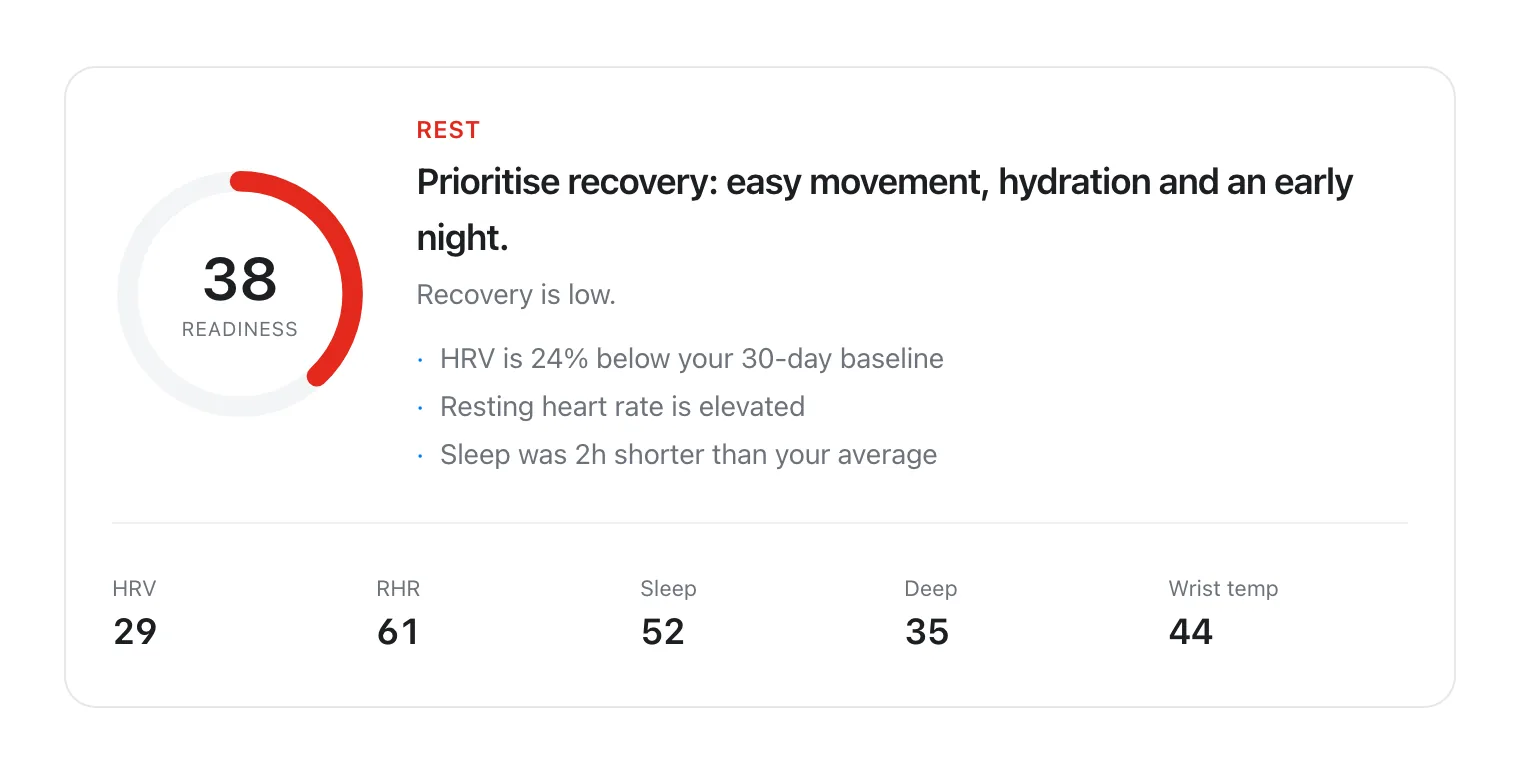
The practical lesson is to look at trends over a week or more, compared with your own baseline, and to read HRV together with resting heart rate, sleep, how training feels and your performance. A single low morning is normal after a hard session or a bad night. A trend that keeps sliding for a couple of weeks while workouts feel harder is worth acting on.
Training load spikes: what the 7-day vs 28-day ratio tells you
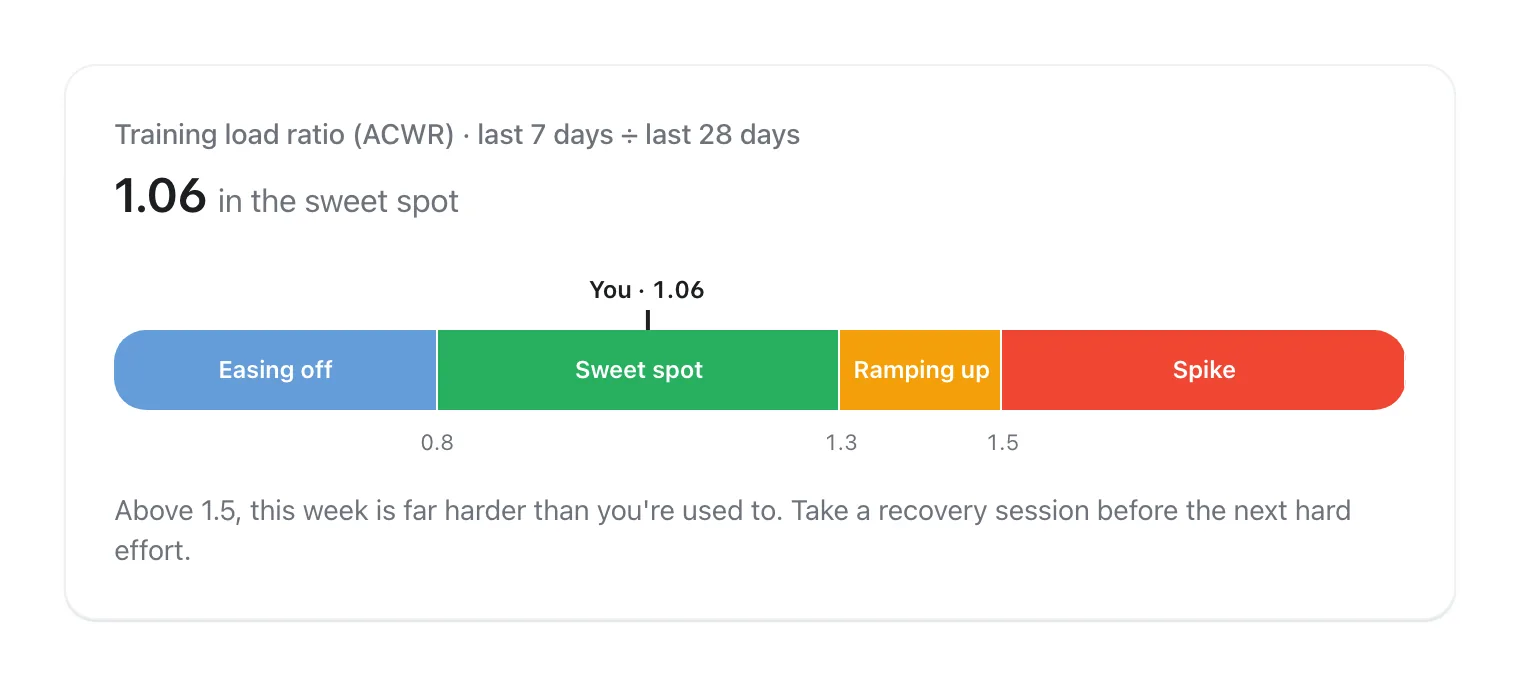
The checklist in the consensus statement asks whether training volume or intensity rose sharply, whether training was monotonous, and whether there were many competitions. A training load ratio is a simple way to see the first of those in your own data: your last 7 days divided by your last 28.
A ratio around 1.0 means this week looks like your recent normal. Many coaches use roughly 0.8 to 1.3 as a target range and treat anything above 1.5 as a big jump. Those cutoffs are a convention, not a proven injury line, and researchers have challenged the ratio on statistical grounds; our training load guide covers that debate. A spike doesn't mean you are overtrained. It means you are asking more of your body than usual, which is exactly when the other signs are worth watching.
Monotony matters too. The consensus statement lists training monotony as a training error and advises avoiding it. Doing the same moderately hard session every day gives your body no easy days to absorb the work, even if weekly volume looks sensible.
Signs of overtraining your watch can't see
Some of the most important signs never reach Apple Health. The consensus statement leans on mood questionnaires and performance records because the physical markers are inconsistent. Keep an honest note of these yourself, a line a day is enough:
- Mood and motivation: irritability, low mood, dreading sessions you normally enjoy, or losing interest in training.
- Effort: easy runs or usual weights feeling unusually hard. Rating your effort after each workout gives you a record over time.
- Soreness and niggles that linger for days instead of fading, or small injuries that keep coming back.
- Getting ill more often. The statement advises reducing or pausing training during an infection and allowing time to recover after illness.
- Appetite, weight and eating. Eating too little for your training load is one of the causes doctors have to rule out, and the statement encourages enough energy, carbohydrate and fluid during heavy training.
- Life stress. Work, family, money, travel across time zones and poor sleep add to training stress, and the statement lists them as confounding factors.
What to do if you think you're overtraining
If your signs point to a hard block that went a bit too far, the fix is usually less training, not a new supplement. This is a sensible order to work through, adapted from the consensus statement's advice for coaches. It is not a medical treatment plan.
- Days 1 to 3: cut intensity first. Swap hard sessions for easy ones or full rest. The statement recommends at least one passive rest day a week and says reduced training may be enough for recovery in some cases of overreaching.
- Protect sleep and eating. Aim for consistent, longer nights, and make sure you're eating enough on training days, including carbohydrate and protein.
- Watch the trend, not today's number. Over the next week, check whether resting heart rate is coming back toward your normal and whether your HRV trend is settling.
- After about a week: test lightly. Repeat a familiar easy session and compare heart rate and pace or load with your records. If it feels normal again, build back gradually instead of returning to the peak week.
- Fix the cause. Look back at what changed: a sudden jump in volume, extra races, the same hard workout every day, or life stress stacking up. Plan easier weeks in advance next time.
- If performance and fatigue haven't improved after about 2 weeks of easier training, stop treating it as a training problem and see a doctor.
When to see a doctor
Because overtraining syndrome is diagnosed by ruling everything else out, the most useful step for persistent fatigue and underperformance is a check-up, not more data. The consensus checklist lists conditions such as anemia, viral infections, thyroid and other hormonal problems, disordered eating, injury and heart symptoms.
See a doctor if you still feel exhausted or keep underperforming after a couple of weeks of reduced training, if you keep getting ill, if you lose weight without trying, or if your periods change. Get urgent care for chest pain, fainting, a racing or irregular heartbeat, or unusual breathlessness during exercise; don't wait to see if your recovery numbers improve.
How VedaWatch helps you spot overreaching early
VedaWatch reads the workouts, HRV, resting heart rate and sleep your Apple Watch saves to Apple Health and puts the overreaching clues side by side. Each morning's readiness score compares HRV, resting heart rate and sleep with your recent baseline and lists the reasons. When HRV is more than 10% below baseline, the reasons say so. A score of 70 or more is a Push day, 50 to 69 Hold and below 50 Rest, and a resting heart rate more than 3 bpm above baseline turns a Push day into Hold.
Training load works out a load for each workout from heart rate (Banister's TRIMP), or from the type of workout when there is no heart rate, and divides your 7-day average by your 28-day average. Above 1.3 it shows Spiking, above 1.5 it flags that load is well above your baseline, below 0.8 it warns that fitness may fade, and it also points out training that is too uniform.
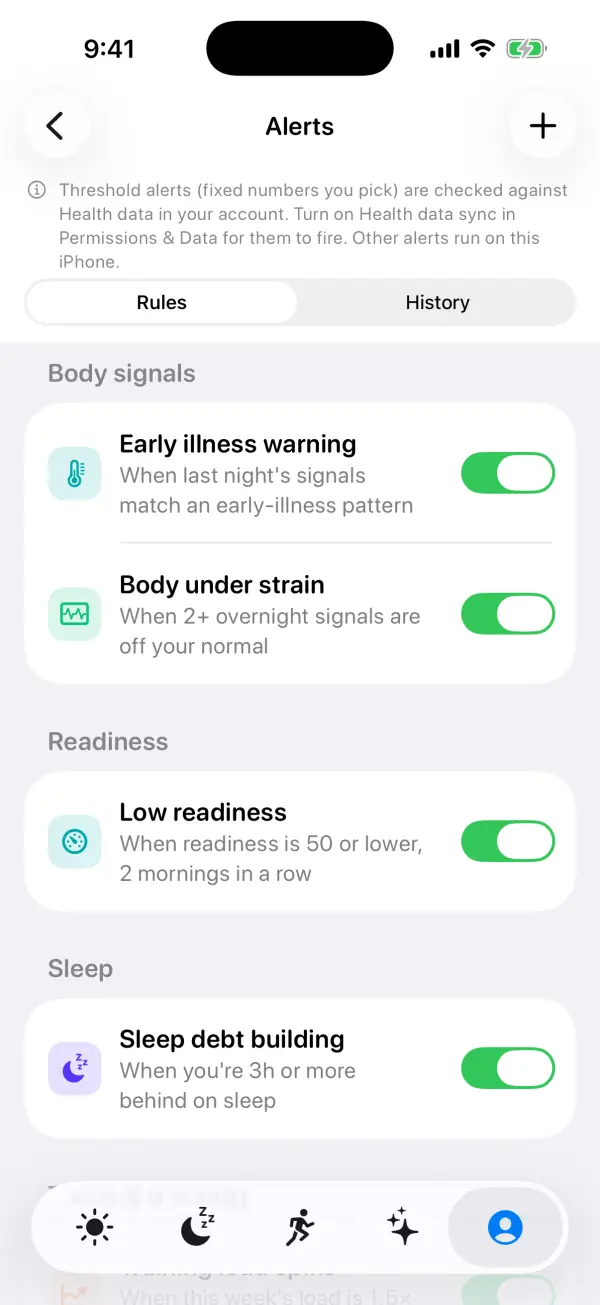
Smart alerts can tell you when it matters. Training load spike fires when your ratio reaches the level you pick (1.5 by default, adjustable from 1.3 to 2.0) after a few weeks of workouts. Body under strain fires when two or more of last night's resting heart rate, HRV, breathing rate and wrist temperature are off your normal from the last 28 nights. Low readiness can wait for several low mornings in a row so one bad night doesn't ping you.
None of this is a diagnosis. It shows the measurable half of the picture so you can pair it with how you feel, and see a professional when the pattern doesn't clear up.
Frequently asked questions
Can Apple Watch tell me if I'm overtraining?
No. It can show clues such as a resting heart rate above your normal, an HRV trend off your baseline, a high Training Load and short sleep, but overtraining syndrome is diagnosed by a doctor after ruling out other causes. Use the Watch to decide when to ease off, not to diagnose yourself.
How long does it take to recover from overtraining?
It depends on the stage. Functional overreaching can clear within about 2 weeks, nonfunctional overreaching takes weeks to months, and the consensus statement notes that overtraining syndrome may take months or possibly years.
Is overtraining common in recreational exercisers?
True overtraining syndrome is uncommon, and most tired recreational athletes are overreached, under-slept, under-fuelled or fighting an illness. In surveys of collegiate swimmers and other endurance athletes, about 10% (range 7% to 21%) reported nonfunctional overreaching or overtraining over a training cycle.
Should I train if my HRV is low but I feel fine?
One low morning after a hard day or a poor night is normal, so an easy or moderate session is usually reasonable. If HRV keeps trending down for a week or two and training feels harder, take it as a sign to reduce load.
Is overtraining the same as RED-S or under-eating?
Not the same, but they can look alike. Eating too little for your training can cause fatigue and underperformance, which is why the consensus statement lists energy restriction among the causes to rule out.
Related guides
- Apple Watch Training Load and ACWR, explained (and why sports scientists argue about it)
- Should you train or rest when HRV is low?
- Why is my resting heart rate high? Causes and when to worry
- Why is my HRV so low? Causes of a sudden drop and what to check
- Rest day vs active recovery: which one do you need today?
- Deload week: what it is, when to take one and how to do it
Sources & further reading
- Meeusen R et al. (2013). Prevention, diagnosis, and treatment of the overtraining syndrome: joint consensus statement of the European College of Sport Science and the American College of Sports Medicine. Medicine & Science in Sports & Exercise 45(1):186-205. doi:10.1249/MSS.0b013e318279a10a
- Bellinger P (2020). Functional overreaching in endurance athletes: a necessity or cause for concern? Sports Medicine 50(6):1059-1073. doi:10.1007/s40279-020-01269-w
- Plews DJ, Laursen PB, Kilding AE, Buchheit M (2012). Heart rate variability in elite triathletes, is variation in variability the key to effective training? A case comparison. European Journal of Applied Physiology 112(11):3729-3741. doi:10.1007/s00421-012-2354-4
- Manresa-Rocamora A et al. (2021). Heart rate-based indices to detect parasympathetic hyperactivity in functionally overreached athletes. A meta-analysis. Scandinavian Journal of Medicine & Science in Sports 31(6):1164-1182. doi:10.1111/sms.13932
- Apple Support: Track your training load on Apple Watch
- Apple Support: Vitals on Apple Watch
This guide is educational, not medical advice, and has not been clinically reviewed. VedaWatch is not a medical device. If you have symptoms or concerns about your heart or health, contact a qualified healthcare professional.
Put your trends in perspective.
Explore HRV, sleep, and recovery with VedaWatch on your iPhone.
Download VedaWatch on the App Store →