 VedaWatch
Workouts & Training
How to start running again after a break: a plan by break length
How to start running again after a break of 2 weeks to 6 months: a return plan by break length, a run/walk ladder, safe build-up rules, and using HR and HRV.
By VedaWatch editorial team · · 11 min read
The short answer
Restart below where you stopped and scale it to the break. After under two weeks, resume easy running and skip one hard week. After a month or more, start at about half your old weekly time, all easy, with walk breaks if needed. Keep each run within about 10% of your longest recent run, and build over several weeks.
How to start running again after a break
The safest way back is to start lower than your old routine, keep every run easy for the first weeks, and let the length of your break decide how far back you go. Your heart and lungs come back faster than your tendons, bones and calves, so the usual mistake is running old distances too soon because breathing feels fine.
In practice that means four things. Pick a starting point that matches how long you were off (the table in the next section). Use run/walk intervals if you've been away for more than a month or so. Grow your longest run in small steps rather than jumping back to your old long run. And use heart rate, the talk test and your morning recovery signals to keep easy days genuinely easy.
This guide is for healthy adults returning after time off for work, travel, a new baby, motivation or a minor niggle. If you stopped because of an injury, an illness that hit your chest or heart, surgery or pregnancy, read the last section first: your doctor or physio should set the starting line.
How much fitness do you lose, and where should you restart?
Less than many people fear. In a classic study by Coyle and colleagues, trained endurance athletes who stopped completely lost about 7% of their VO2 max in the first 21 days. The decline then levelled off at about 16% below their trained value by day 56, and after 84 days off they were still fitter than people who had never trained. Their muscles kept more capillaries than untrained people, too. A few weeks off sets you back; it doesn't erase years of running.
What that study can't show is how ready your legs are for impact. Muscles, tendons and bones adapt to the pounding of running more slowly than your aerobic system, and they are what usually complain on a comeback. So the starting points below are deliberately conservative. They're a common-sense rule of thumb, not thresholds from a study; adjust them to how you feel and to whether you stayed active with cycling, swimming or walking during the break.
- Under 2 weeks off (holiday, a cold that's fully gone): pick up your normal easy runs, but skip intervals and tempo for the first week and keep your first long run a little shorter than your last one.
- 2 to 4 weeks off: start at about half your usual weekly running time, all easy. Build back over 2 to 3 weeks, and add one quality session only once easy runs feel normal again.
- 1 to 3 months off: start at about a third to a half of your old weekly time, in 3 short easy runs a week with a rest day between. Use walk breaks if continuous running feels hard. Expect a month or more before you feel like a runner again, and leave speed work until then.
- More than 3 months off, or very little activity during the break: start again with the run/walk ladder below, like a beginner, even if you used to run marathons.
- Stayed fit with other cardio: your breathing will feel ready before your legs are. Start one step further along than your break length suggests, but keep the run time low for the first two weeks.
A run/walk progression to get back to 30 minutes
Run/walk isn't a step backwards: short walk breaks let your legs absorb impact in small doses and keep the running part easy. Do three sessions a week on non-consecutive days. Start each one with a 5-minute brisk walk and finish with a 5-minute walk. Move up a step only when you've finished the current step twice and the last one felt comfortable. If a step feels hard, repeat it.
You can save each step as a Custom Workout in the Apple Watch Workout app, with your running as Work intervals and your walking as Recovery intervals, so the watch tells you when to switch. Set them by time.
- Step 1: 1 min run, 1 min walk, 8 times. 8 minutes of running.
- Step 2: 2 min run, 1 min walk, 6 times. 12 minutes of running.
- Step 3: 3 min run, 1 min walk, 5 times. 15 minutes of running.
- Step 4: 5 min run, 1 min walk, 4 times. 20 minutes of running.
- Step 5: 8 min run, 1 min walk, 3 times. 24 minutes of running.
- Step 6: 12 min run, 1 min walk, twice. 24 minutes of running in two long blocks.
- Step 7: 25 to 30 minutes of continuous easy running. From here, follow the build-up rules in the next section.
How fast can you increase your running after time off?
Two Danish studies of runners wearing GPS watches give useful guardrails. The newer one, by Frandsen and colleagues in 2025, followed 5,205 runners for 18 months and looked at single runs. Runs longer than the runner's longest run of the previous 30 days by more than 10% were linked to a higher rate of overuse injury: about 1.6 times higher for spikes of 10 to 30%, and about 2.3 times higher for spikes of more than 100%. In the same study, weekly changes in volume weren't linked to injury in the expected way.
An earlier study of 874 novice runners by Nielsen and colleagues found that runners who increased their weekly distance by more than 30% over two weeks had more distance-related injuries, such as runner's knee and shin splints, than those who stayed under 10%. That result was exploratory and not statistically certain, but it points the same way.
Both are observational, so they show patterns, not proof. They still fit a comeback well, because after a break your longest run of the last 30 days is short. That automatically keeps you honest: your old 90-minute long run isn't your reference any more; your last two weeks are. Here's how it plays out for a runner who used to run four times a week, about 3 hours in total with a 75-minute long run, and then took 6 weeks off:
- Week 1: 3 easy runs of 20 to 25 minutes, walking for a minute whenever needed. About 70 minutes in total, a bit under half the old week.
- Week 2: 3 easy runs, with the longest at 27 minutes (about 10% more than week 1's longest). About 80 minutes.
- Week 3: add a fourth short run of 20 minutes, longest run 30 minutes. About 1 hour 40 minutes.
- Week 4: a lighter week. Back to 3 runs, nothing longer than 30 minutes, so your body can catch up.
- Weeks 5 to 8: keep growing the longest run by about 3 minutes a week (roughly 10%), add strides or a short tempo only if easy runs feel normal, and let weekly time creep back toward 2 to 2.5 hours.
- Months 3 and beyond: the long run gets back toward 75 minutes. Slow, but quicker than starting over after an injury.
Why comebacks get injured, and the warning signs
A systematic review of running injury studies by van der Worp and colleagues found strong evidence that a previous injury is a risk factor for the next one, and in men, restarting running was also linked to higher injury risk. The comeback risk is mostly load arriving faster than your tissues can adapt, especially if you stopped because something hurt.
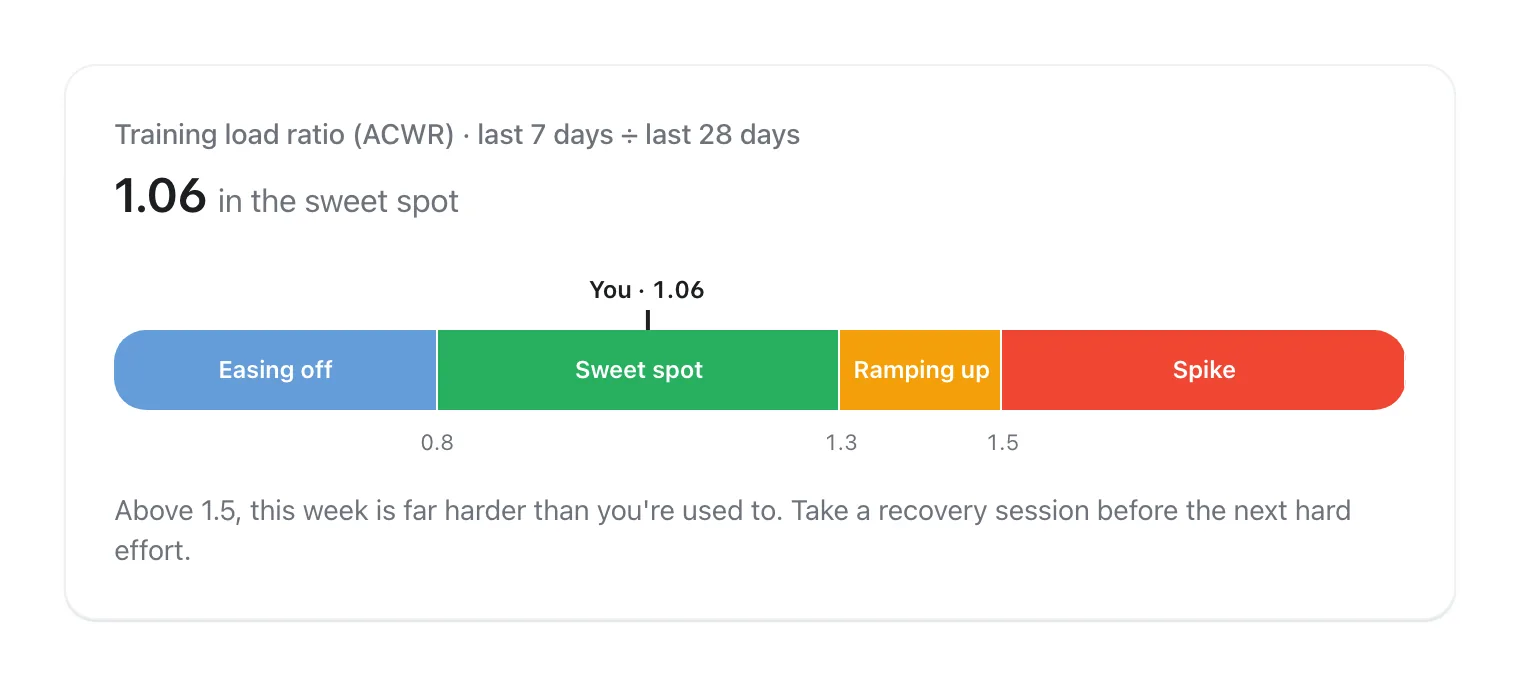
Many watches and apps also show an acute:chronic workload ratio (ACWR), your last 7 days of training load divided by your last 28. VedaWatch, for example, treats 0.8 to 1.3 as the sweet spot and above 1.5 as a spike. Be careful with it on a comeback. With almost nothing in the last 28 days, even a gentle first week can read as a spike, and the 2025 Frandsen study didn't find that higher ACWR predicted injury. Use it as a reminder to keep weeks smooth, not as a verdict.
Stop the run and give it a few days if you notice pain that is sharp, gets worse as you keep running, makes you change how you run or limp, sits on one spot of a bone, or is still there the next morning. Normal comeback soreness is a dull, general muscle ache that fades within a day or two. If pain doesn't settle with a few days of rest, see a doctor or physiotherapist rather than running through it.
Using heart rate to keep comeback runs easy
Expect your heart rate to be higher than it used to be at the same pace. That's normal detraining, and watching it come back down is one of the clearest signs of progress. The trap is trying to hold your old easy pace: you end up running your easy days in a moderate or hard zone.
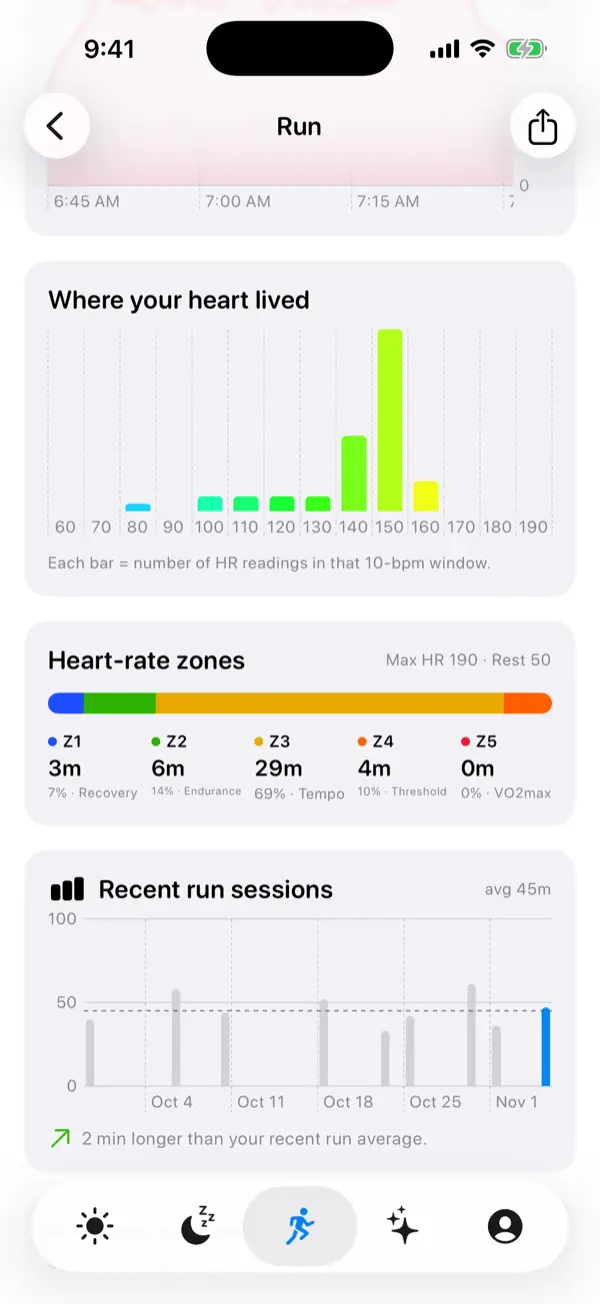
Use effort, not pace. The CDC's talk test is a good check: at a moderate effort you can talk but not sing, while at a vigorous effort you can't say more than a few words without pausing for breath. Comeback runs should sit at the easy end of moderate, where you could hold a conversation. On Apple Watch you can turn the Digital Crown during a run to the Heart Rate Zone view, and after the run the Fitness app shows estimated time in each zone. Apple calculates the zones from your health data, using the date of birth in the Health app.
A useful habit for the first month: pick one regular route and note your average heart rate on it each week at a relaxed effort. If the same loop costs fewer beats, your fitness is returning, whatever your pace says.
Using HRV and readiness when you return to running
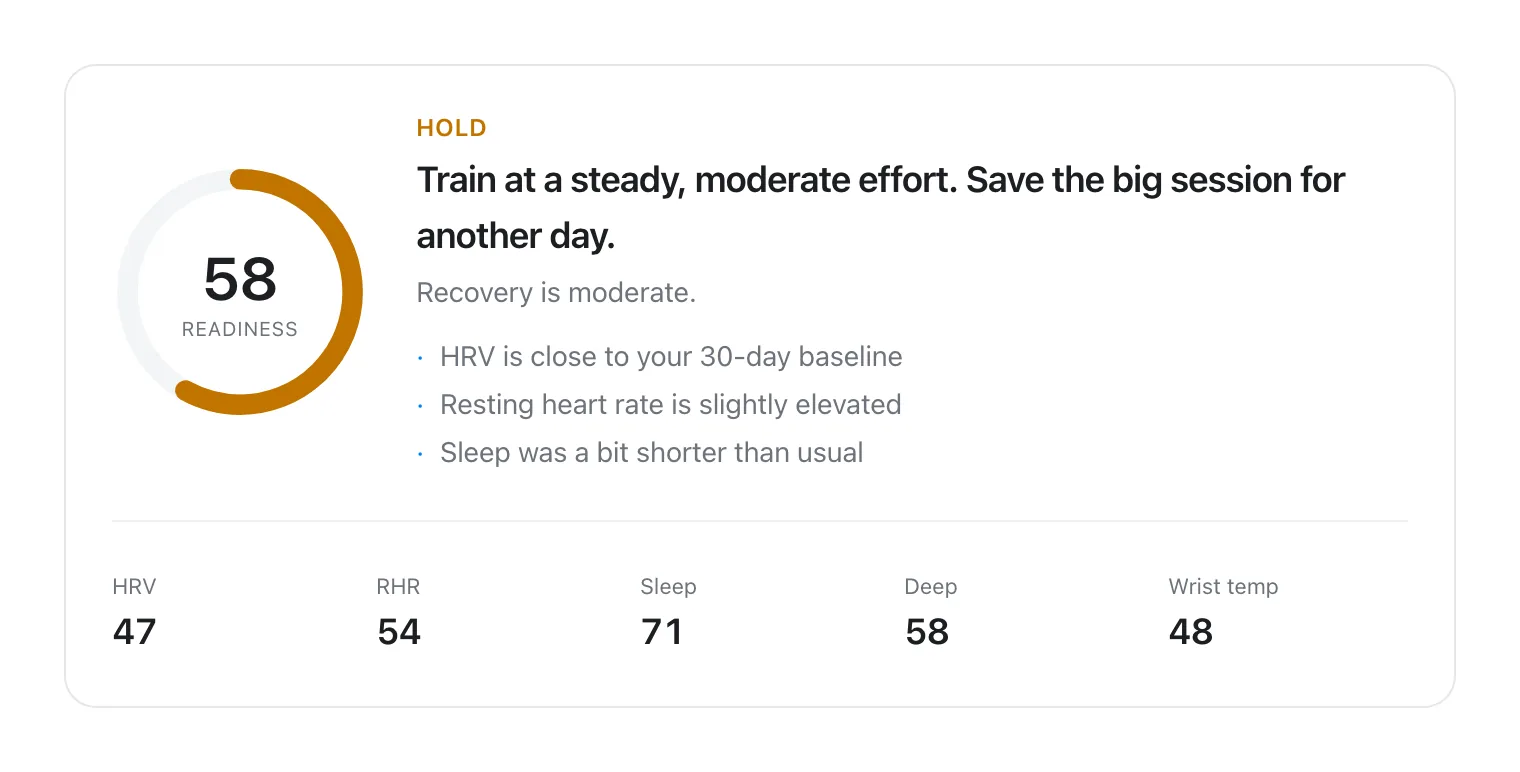
Overnight heart rate variability (HRV), resting heart rate and sleep tell you how well you're absorbing the new training. A clear dip in HRV together with a raised resting heart rate after your first few runs is a sign to keep the next session short and easy, or to take an extra rest day.
Two cautions. First, a readiness score often looks great during and right after a break, because you've been resting. That says your body is recovered, not that your calves and tendons are ready for your old mileage. Don't let a high score talk you into skipping steps. Second, research on training adjusted by HRV is still limited, so treat these numbers as a nudge alongside how your legs feel, not as a rule.
A simple way to use them: on a normal morning, do the planned run. On a clearly off morning, swap it for a walk or a shorter run/walk. If you feel unwell, have a fever or chest symptoms, don't run, and restart one step lower when you're better.
How VedaWatch can help you come back gradually
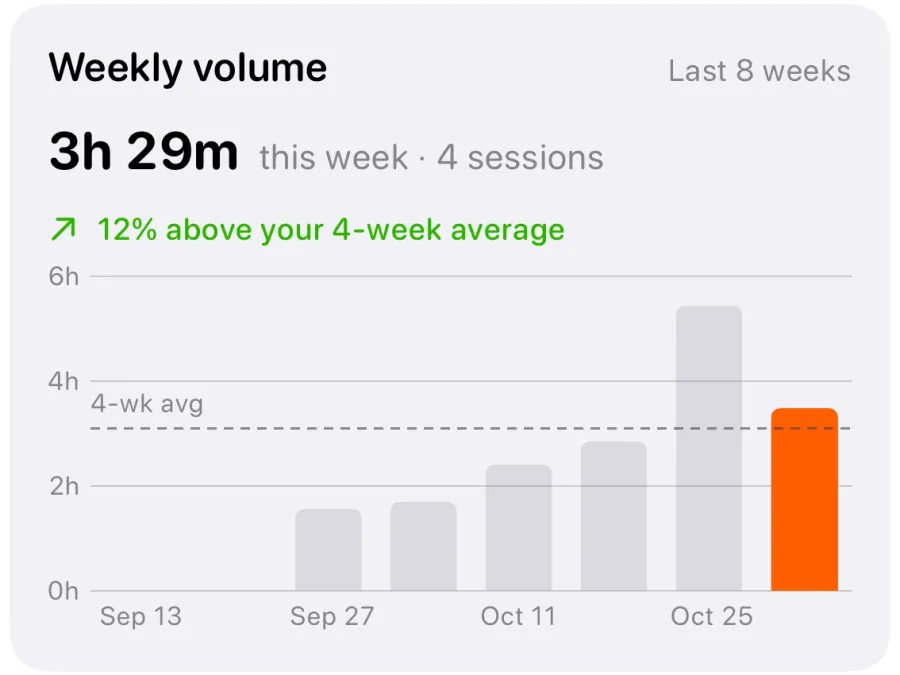
VedaWatch reads your workouts, heart rate, HRV and sleep from Apple Health, so it can show your comeback in one place. The Train tab's Weekly volume card shows your minutes for the last 8 weeks against your 4-week average, which makes a too-big jump easy to spot. Each workout's detail screen shows your heart rate zones, and the morning readiness score compares your HRV, resting heart rate and sleep with your recent baseline, with a Push, Hold or Rest verdict.
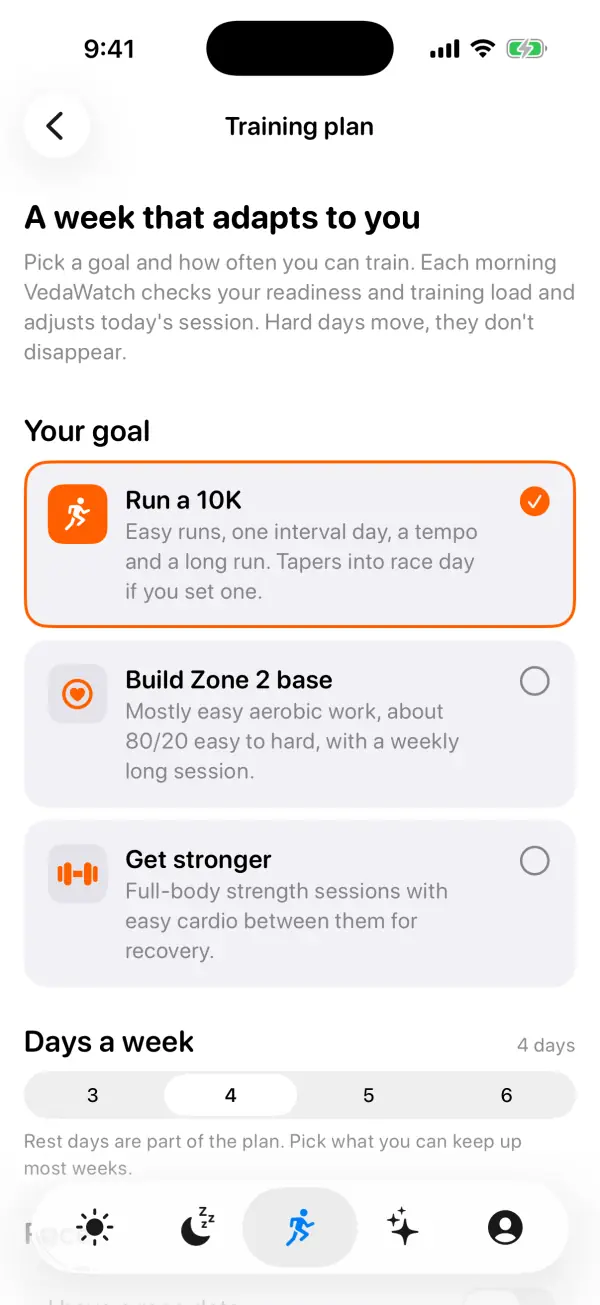
If you'd like structure, the Training plan (part of VedaWatch Pro, $6.99 a month or $59.99 a year on the US App Store) has goals that suit a comeback. Run my first 5K starts with easy run-walks of 2 minutes running and 1 minute walking, and Build Zone 2 base is mostly easy running with a weekly long session. You choose 3 to 6 days a week, sessions grow for three weeks and then ease off in a lighter week. Each morning the plan checks readiness and training load: on a Rest morning the session becomes very easy, on a Hold morning hard sessions become easy runs and the long session is cut by a quarter, and when your load is well above your usual, a key session turns into an easy run. While your readiness baseline is still forming, the plan tells you to follow it and go by feel.
You can also turn on the Training load spike alert under Profile, Alerts. It tells you when your last 7 days are well above your 4-week average, and it waits for a few weeks of workouts before it says anything, so a single first run after a break doesn't set it off. None of this replaces listening to your legs.
Coming back after injury, illness or pregnancy
If you stopped because of an injury, ask the person treating it when and how to restart, and expect a slower build than the table above. Being able to walk briskly and do everyday activities without pain is a sensible minimum before any running; your physio may give you specific strength or hopping tests too.
After an illness, wait until you feel fully well before running, and start lower than the break alone would suggest. Talk to a doctor first if the illness affected your chest or heart, if you had a high fever, or if you still feel breathless or tired doing ordinary things. After pregnancy or surgery, get clearance from your doctor or midwife and ask about pelvic floor and core recovery before you run.
Stop and get medical help straight away if you have chest pain, unusual shortness of breath, palpitations, dizziness or fainting during a run. This guide is general information, not medical advice, and watch readings are wellness signals, not a diagnosis.
Frequently asked questions
How long does it take to get running fitness back after a break?
It depends on how long you stopped and how fit you were, so there's no fixed number. Fitness fades gradually rather than vanishing, and aerobic fitness tends to feel normal before your legs do, so your old long run and weekly mileage are usually the last things to come back.
Should I run every day when I start again?
No. Keep at least one rest or cross-training day between runs for the first few weeks. Easy cycling, swimming or walking on the days between builds fitness without adding impact.
Is it better to run slower or shorter when coming back?
Both, at first. Keep the pace easy and the runs short, then add time before you add speed. Leave intervals and tempo runs until easy running feels normal again.
Why is my heart rate so high on easy runs after time off?
Some fitness, including the amount of blood your heart pumps per beat, fades in the first weeks off, so the same pace takes more beats. It usually comes down over several weeks of easy running; if it stays unusually high or you feel unwell, check with a doctor.
Should I stretch or do strength work before I start running again?
Simple strength work for calves, hips and thighs, two or three times a week, is a good companion and can start before your first run. It doesn't replace a gradual build.
Related guides
- Couch to 5K on Apple Watch: the 9-week plan, week by week
- Easy run pace: how slow should easy runs be?
- How to increase running mileage safely (and the 10% rule)
- Apple Watch Training Load and ACWR, explained (and why sports scientists argue about it)
- Should you train or rest when HRV is low?
- Apple Watch heart rate zones explained: what each zone means and how to set them
Sources & further reading
- Coyle et al. 1984, Journal of Applied Physiology: Time course of loss of adaptations after stopping prolonged intense endurance training
- Frandsen et al. 2025, British Journal of Sports Medicine: How much running is too much? Identifying high-risk running sessions in a 5200-person cohort study
- Nielsen et al. 2014, Journal of Orthopaedic & Sports Physical Therapy: Excessive progression in weekly running distance and risk of running-related injuries
- van der Worp et al. 2015, PLoS One: Injuries in runners; a systematic review on risk factors and sex differences
- CDC: Measuring Physical Activity Intensity (the talk test)
- Apple Support: View Heart Rate Zones on Apple Watch
- Apple Support: Create a custom workout on Apple Watch
This guide is educational, not medical advice, and has not been clinically reviewed. VedaWatch is not a medical device. If you have symptoms or concerns about your heart or health, contact a qualified healthcare professional.
Put your trends in perspective.
Explore HRV, sleep, and recovery with VedaWatch on your iPhone.
Download VedaWatch on the App Store →