 VedaWatch
Workouts & Training
Easy run pace: how slow should easy runs be?
Easy run pace with worked examples: the talk test, heart rate range, pace from your 5K time and effort scale, and how to keep easy runs easy on Apple Watch.
By VedaWatch editorial team · · 11 min read
The short answer
Easy runs should be slow enough that you can talk in full sentences the whole way. For most runners that means about 24 to 38% slower than 5K race pace, or a heart rate around 60 to 70% of your heart rate reserve. If you're unsure, go slower: an easy run that's too slow costs you almost nothing.
How slow should easy runs be?
Slower than most people run them. An easy run is one you finish feeling like you could have kept going for a long time, at an effort where you can hold a conversation in full sentences. Your breathing is deeper than when walking, but it never gets in the way of talking.
There are four practical ways to find that effort, and they work best together: the talk test, a heart rate range, a pace worked out from a recent race, and how hard it feels on a 0 to 10 scale. When two of them agree, you've found your easy pace for that day.
As a rough guide, a runner who can race 5K in 25 minutes (5:00 per km, about 8:03 per mile) will usually run easy somewhere around 6:10 to 6:55 per km, or 10:00 to 11:05 per mile. That can feel surprisingly slow. That's normal, and it's the point.
The talk test: the simplest easy pace check
The talk test needs no gadgets. Partway into your run, say a couple of full sentences out loud, or recite something you know by heart. If you can do it comfortably without stopping for breath, you're running easy. If you can only manage short phrases, you've drifted into a moderate, tempo-like effort. If you can only get out a few words, you're running hard.
The CDC uses the same idea to describe exercise intensity: at moderate intensity you can talk but not sing, and at vigorous intensity you can't say more than a few words without pausing for breath. Easy runs belong at the comfortable end of that moderate band, never in the vigorous one.
The talk test isn't just folk wisdom. In a 10-week study of 44 adults, people who trained at the highest effort that still allowed comfortable speech improved their VO2 max about as much as people training to heart rate reserve targets (10.6% vs 11.5%). A lab study comparing treadmill and cycle tests found that the point where speech first became difficult was almost exactly at the ventilatory threshold, and that uncomfortable speech meant the effort was consistently above it. Easy running sits comfortably below that point.
- Run for several minutes first. Breathing and heart rate need time to settle, so early checks can mislead.
- Say two or three full sentences out loud, or count steadily from 1 to 20.
- Comfortable, with no pause for breath: that's easy. Keep it there.
- You pause mid-sentence or between short phrases: slow down noticeably and test again in a few minutes.
- On hills, keep the effort the same and let the pace drop. Walk the steep ones if you need to.
Easy run heart rate: working out your range
Heart rate is useful because it responds to everything pace ignores: heat, hills, wind, a poor night's sleep. A common way to set an easy range is the heart rate reserve (Karvonen) method, with easy running at about 60 to 70% of your reserve, which is also how many apps define Zone 2. Your reserve is your maximum heart rate minus your resting heart rate.
Worked example: with a resting heart rate of 55 bpm and a maximum of 185 bpm, the reserve is 130. Sixty percent of 130 is 78 and seventy percent is 91. Add each back to the resting rate and your easy range is about 133 to 146 bpm.
Recovery runs, the very gentle ones the day after a hard session, can sit at or just below the bottom of that range.
The biggest source of error is your maximum heart rate. Age formulas describe averages and can be well off for any one person, which shifts the whole range. If you've seen a clearly higher reading at the end of a race or an all-out hill effort, use that. And if the watch says you're above range while the talk test says you're fine, trust the talk test and revisit your numbers.
- Find your resting heart rate in the Health app (Browse → Heart → Resting Heart Rate) and use a typical recent value.
- Use the highest heart rate you've reliably reached in a hard effort as your maximum, or an age estimate if you have nothing better.
- Subtract resting from maximum to get your reserve.
- Bottom of range = resting + 0.6 × reserve. Top of range = resting + 0.7 × reserve.
- Check the range against the talk test on your next three or four easy runs and adjust if they disagree.
Easy pace from your 5K time: worked examples
If you've raced or time-trialled a 5K recently, you can turn it into an easy pace range. The rule VedaWatch's training plans use is 24 to 38% slower than your 5K pace, rounded to the nearest 5 seconds. For a 25-minute 5K runner, that's about 1:10 to 1:55 per km, or 2:00 to 3:00 per mile, slower than race pace.
If your recent race was a 10K or half marathon instead, convert it to an equivalent 5K first. Plans commonly use Riegel's formula for this, which assumes you slow down a little as distance goes up. A 50-minute 10K, for example, works out to an easy range of roughly 5:55 to 6:35 per km.
Use the slow end of the range for the day after a hard session and the faster end only when you feel genuinely fresh. And treat the range as a ceiling, not a target: on a hot or hilly day, being slower than the range is fine.
- 20:00 5K (4:00 per km, about 6:26 per mile): easy at about 5:00 to 5:30 per km, or 8:00 to 8:55 per mile.
- 25:00 5K (5:00 per km, about 8:03 per mile): easy at about 6:10 to 6:55 per km, or 10:00 to 11:05 per mile.
- 30:00 5K (6:00 per km, about 9:39 per mile): easy at about 7:25 to 8:15 per km, or 12:00 to 13:20 per mile.
- To do your own: 5K pace in seconds per km × 1.24 gives the fast end, × 1.38 gives the slow end. Convert back to minutes and seconds.
What an easy run should feel like (RPE)
Rating of perceived exertion (RPE) is simply how hard the effort feels. On the CDC's 0 to 10 scale, where 0 is sitting still and 10 is maximal effort, moderate exercise is a 5 or 6 and vigorous exercise begins at 7 or 8. An easy run should feel no harder than the bottom of moderate, and on recovery days it should feel lighter than that.
Some useful signs you've got it right: you could easily run another 20 minutes at the end, your legs feel the same in the last kilometre as in the first, and you'd happily do it again tomorrow.
Why easy runs should be slow: the 80/20 idea
Endurance athletes in many sports train in a strikingly similar way. A widely cited review of how they spread their training describes roughly 80% of sessions at low intensity and the rest hard, which is where the 80/20 label comes from.
There's evidence for runners specifically too. In a six-month study of eight well-trained runners, those who spent more time at low intensity tended to race faster in cross-country championships. In a 10-week trial with 30 recreational runners, both a mostly easy program and a program with more moderate running improved 10K times, by 5.0% and 3.6% respectively. The difference wasn't statistically significant, and these are small studies, so treat them as supportive rather than conclusive.
The practical logic is simple. Easy running builds aerobic fitness while leaving you fresh enough to run often and to make your one or two hard sessions a week genuinely hard. Easy runs that creep into a moderate effort tire you out without adding much, and they take the edge off the workouts that matter. For most recreational runners, slowing the easy days down is the cheapest improvement available.
Can easy runs be too slow? And why your pace changes day to day
For almost everyone, too slow isn't a real risk. The main exception is when running so slowly changes your form, for example a shuffling stride that feels awkward. If that happens, run a little quicker with a relaxed, natural stride, or mix in short walk breaks, which are a normal part of many beginner plans.
Expect your easy pace to vary from day to day; run to effort, not the clock. Heat and humidity raise heart rate at the same pace, so summer easy runs are often noticeably slower. Hills, wind, trails, poor sleep, illness and accumulated fatigue all do the same.
Over weeks and months, the same easy effort should get faster as your aerobic fitness improves. Comparing your pace at a similar easy heart rate, on similar routes and in similar weather, is one of the most encouraging things you can track.
If your heart rate is unusually high on easy runs for several days in a row, or you feel unwell, short of breath, dizzy or have chest discomfort, stop and rest. Seek medical advice if symptoms persist or worry you, and talk to a doctor before starting a running program if you have a heart condition or other health concern.
How to keep easy runs easy with Apple Watch
Apple Watch has the tools built in. The Workout app calculates five heart rate zones from your health data, as long as your date of birth is in the Health app, and shows your current zone live during cardio workouts such as Outdoor Run. Apple's zones are based on a percentage of maximum heart rate, so they may differ by a few beats from a heart rate reserve range. If they don't match your own numbers, you can set them manually.
You can also add alerts to a workout, such as a heart rate alert, and they're used every time you start that workout. Set one for your easy heart rate range on Outdoor Run and the watch alerts you about your heart rate against that range, so you don't have to keep glancing down.
- Set your easy range as Zone 2: on Apple Watch, open Settings → Workout → Heart Rate Zones (or the Watch app on iPhone → My Watch → Workout → Heart Rate Zones), tap Manual, and enter your lower and upper limits for Zone 2.
- In the Workout app, turn the Digital Crown to Outdoor Run, tap the Alerts button, choose a heart rate alert and set it to your easy zone or range.
- During the run, turn the Digital Crown to the Heart Rate Zones view to see your current zone and time in it.
- Give it several minutes before reacting. Heart rate takes a while to rise at the start of a run.
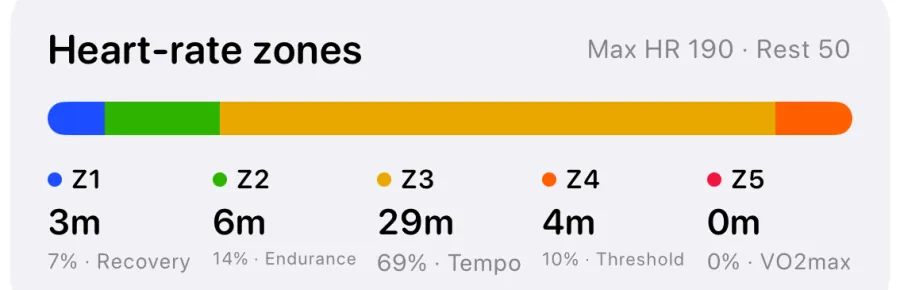
- Afterwards, open the Fitness app on iPhone, tap the run, then Show More next to Heart Rate to see time in each zone. Most of an easy run should be in Zones 1 and 2.
- Wear the watch snug, just above the wrist bone. Wrist sensors are generally reliable at steady efforts, and you can pair a Bluetooth chest strap if your readings jump around.
Checking afterwards: was your easy run actually easy?
Apple's Fitness app, like many running apps, shows how long a run spent in each heart rate zone. A quick look after an easy run tells you whether it stayed in Zones 1 and 2 or quietly crept into Zone 3, which is the most common way easy days go wrong.
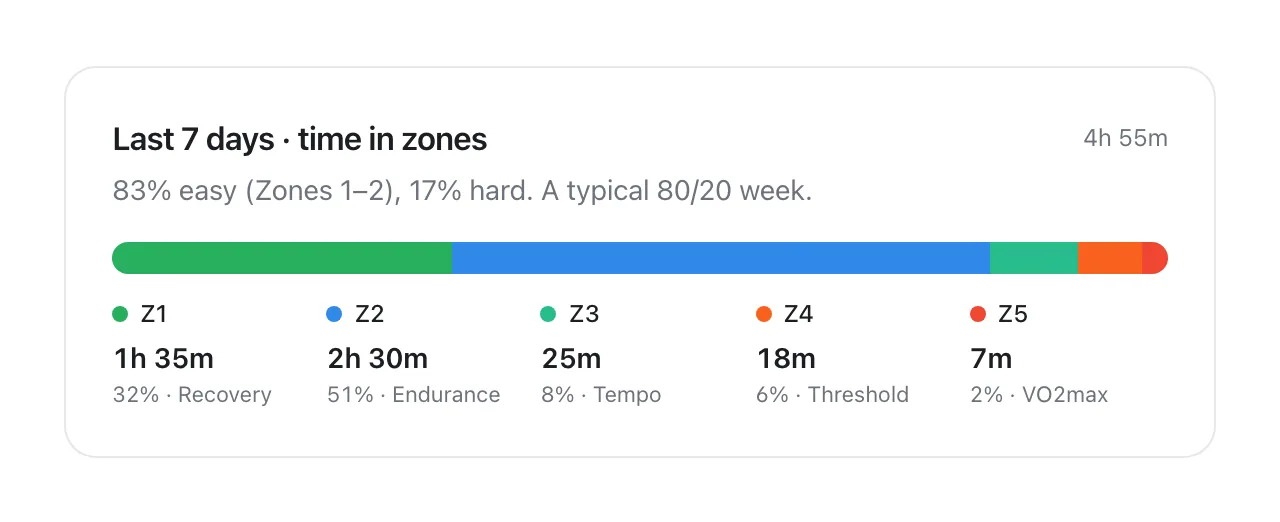
Looking across a week is more useful than any single run. If most of your running time is easy and only a small slice is hard, your balance is close to 80/20. If Zone 3 keeps showing up on days you meant to be easy, slow those days down before adding more mileage or another hard session.
How VedaWatch helps you keep easy days easy
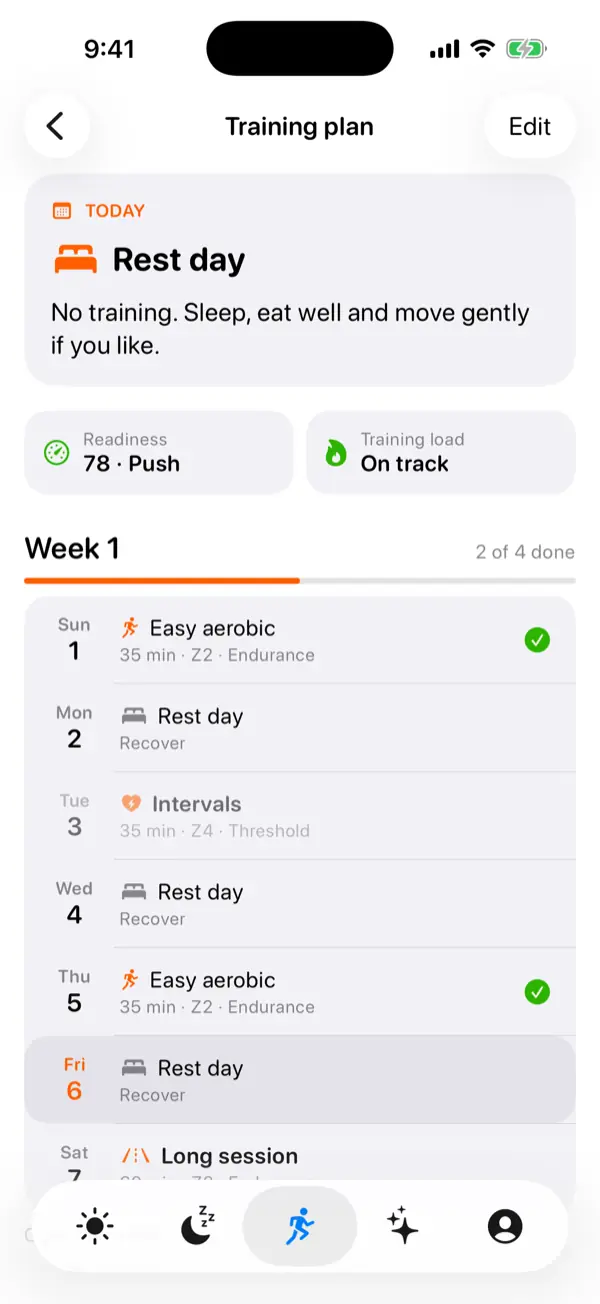
If you follow a VedaWatch Training plan, easy and long runs come with a pace range worked out from your target time (or your recent runs) using the 5K rule above, along with a Zone 2 heart rate target. Without a target time or recent runs, sessions go by heart rate zone. Most of each week is easy by design, and on low-readiness mornings a hard session can be swapped for an easy one.
When you start today's easy or long run from the plan at the top of the VedaWatch workout picker on your Apple Watch, Zone 2 coaching is switched on. The Now screen shows your Zone 2 range with a bar and a status: In zone, Ease off or Pick it up. After the first 5 minutes, if your heart rate stays out of range for 20 seconds, the watch gives a gentle haptic nudge, at most once a minute, and a light tap once you're back in zone. You can also say "Start a Zone 2 run in VedaWatch" to Siri.
The range uses the 60 to 70% heart rate reserve method with your latest resting heart rate from Apple Health. For maximum heart rate it uses 190 bpm, or a higher maximum seen in your workouts. If your true maximum is well below 190, the range will run high, so lean on the talk test. Afterwards, VedaWatch shows the time each run spent in every zone from your Apple Health heart rate data, and your runs feed its training load. The Training plan is part of VedaWatch Pro ($6.99 a month or $59.99 a year on the US App Store, as of November 2026).
Frequently asked questions
Is it OK to walk during an easy run?
Yes. Walking hills or taking short walk breaks keeps the effort easy and is a normal part of many beginner and trail plans. The aim is the right effort, not continuous running.
How long should an easy run be?
It depends on your weekly volume and experience. Start with a duration you can finish feeling fresh, and grow it gradually; the effort should stay easy however long the run is.
Should my long run be at easy pace?
For most runners, yes. Long runs are usually done at easy effort, often at the slower end of the easy range, with any race-pace work added only in specific phases of a plan.
Why is my easy heart rate higher in summer?
In heat your body sends more blood to the skin for cooling, so heart rate rises at the same pace. Slow down to keep the effort easy and drink enough, rather than holding your usual pace.
Will running slow make me a slower racer?
Not when it's paired with some faster sessions. Easy running builds aerobic fitness and lets you recover for the one or two harder workouts a week that sharpen race speed.
Does an easy run count as exercise for health guidelines?
Usually, yes. By the CDC's talk test, an easy run where you can talk but not sing is moderate-intensity activity, which is what most physical activity guidelines count.
Related guides
- Apple Watch running power explained: watts vs pace vs heart rate
- Zone 2 training with Apple Watch: find your heart rate range and stick to it
- Apple Watch heart rate zones explained: what each zone means and how to set them
- 80/20 running: polarized training made simple for 3 to 5 runs
- How to run a faster 5K: an 8-week plan with Apple Watch
- Training for a 5K, 10K or half marathon with Apple Watch: a plan that adapts to your recovery
- Rest day vs active recovery: which one do you need today?
Sources & further reading
- CDC: How to Measure Physical Activity Intensity (talk test and 0-10 effort scale)
- Kinesiology (2018): Comparison of the talk test and percent heart rate reserve for exercise prescription (Porcari et al.)
- International Journal of Sports Physiology and Performance (2010): What is best practice for training intensity and duration distribution in endurance athletes? (Seiler)
- Medicine & Science in Sports & Exercise (2004): Consistency of the talk test for exercise prescription (Persinger et al.)
- Medicine & Science in Sports & Exercise (2005): How do endurance runners actually train? Relationship with competition performance (Esteve-Lanao et al.)
- International Journal of Sports Physiology and Performance (2014): Does polarized training improve performance in recreational runners? (Muñoz et al.)
- Apple Watch User Guide: View Heart Rate Zones on Apple Watch
- Apple Watch User Guide: Create a Custom Workout on Apple Watch (workout alerts)
This guide is educational, not medical advice, and has not been clinically reviewed. VedaWatch is not a medical device. If you have symptoms or concerns about your heart or health, contact a qualified healthcare professional.
Put your trends in perspective.
Explore HRV, sleep, and recovery with VedaWatch on your iPhone.
Download VedaWatch on the App Store →