 VedaWatch
Workouts & Training
First marathon training plan: a 16-week beginner guide
A first marathon training plan in 16 weeks: the base you need, each phase, long-run progression, easy pace, fuelling, injury risk and taper.
By VedaWatch editorial team · · 10 min read
The short answer
Most first-time marathoners do well with about 16 weeks of training, once they can already run around 30 km (about 20 miles) a week. Keep most running easy, grow the long run in small steps to a peak of roughly 30 to 32 km or about 3 to 3.5 hours three weeks before race day, practise fuelling on long runs, then taper for two to three weeks.
What does a first marathon training plan look like?
A good first marathon plan is simpler than it looks. You run three to five times a week, almost all of it at an easy, conversational effort. One run a week, the long run, grows slowly until it covers most of the distance. Every few weeks a lighter week lets your body catch up, and the last two to three weeks get progressively easier so you start the race fresh.
The official TCS London Marathon beginner plan is a useful reference point. It lasts 16 weeks, uses three runs a week with a rest day after each run, builds the long run from 50 minutes of run–walk to a 3-hour-30-minute run in week 13, and then tapers for the last three weeks. It also includes a lighter week early on and an optional half marathon race in week 10.
The goal for a first marathon is to reach the start line healthy and finish feeling in control, not to hit a time. That changes the priorities: consistency beats intensity, and avoiding injury matters more than any single session.
Are you ready to start marathon training?
Plan length assumes a starting point. Runners who are new to the sport get injured far more often per hour of running: a 2015 meta-analysis found about 17.8 injuries per 1,000 hours in novice runners compared with 7.7 in recreational runners. A marathon build piles a lot of new running onto a body that may not be used to it yet.
Weekly volume before the race seems to matter too. In a study of 662 marathon finishers, runners who had averaged under 30 km a week before the race were about twice as likely to report a running injury afterwards as those who ran 30 to 60 km a week. Running more than 60 km a week brought no further clear benefit. The study was retrospective and relied on self-reports, so it shows an association rather than proof, but it fits common sense.
A sensible checklist before you start a 16-week plan:
- You've been running regularly, three or more times a week, for at least a few months.
- You can run about 25 to 30 km (15 to 20 miles) a week without unusual soreness or pain, or are close to it.
- Your longest comfortable run is around 13 to 16 km (8 to 10 miles), or 75 to 90 minutes.
- You aren't carrying a niggle that gets worse as you run.
- If you're not there yet, spend a few months building gradually first. If you have a heart condition, diabetes or another health condition, talk to your doctor before starting.
How long does it take to train for a marathon?
For someone who already has that base, about 16 weeks is a common and reasonable length, and it's what the London Marathon's official beginner plan uses. Shorter plans of 12 weeks leave little room for a missed week or a cold. Longer ones of 18 to 20 weeks give more breathing space and suit runners who want a gentler climb.
If you're starting from very little running, the honest answer is longer: build a regular running habit and a comfortable weekly base first, then begin the 16 weeks. That extra time costs nothing on race day and lowers the chance that an overuse injury ends the plan early.
If race day is fixed and you're short of time, don't squeeze the same peak into fewer weeks. Accept a shorter longest run, keep the taper, and plan to run the race more conservatively.
A 16-week beginner marathon training plan, phase by phase
Here is a simple structure for a runner starting at about 30 km a week with a long run of 16 km. The numbers are an example, not a prescription: shift them to your own starting point and keep the shape. Weekly totals here peak at roughly 45 to 50 km, which is plenty for a first marathon finish.
- Weeks 1 to 4, base: three or four easy runs a week, long run 16, 17.5 and 19 km, then a lighter week 4 with a 15 km long run. No hard sessions are needed yet; a few short, relaxed strides after an easy run are optional.
- Weeks 5 to 8, build: weekly distance grows a little; long runs of about 20.5, 22.5 and 24.5 km, then a lighter week 8 at around 19 km. One run a week can include a steady section, such as 15 to 20 minutes at a comfortably hard effort.
- Weeks 9 and 10, build: a long run of about 26.5 km in week 9, then an easier week 10 with a half marathon race or a 21 km run at controlled effort. A half marathon is a good test of your pacing, kit and fuelling.
- Weeks 11 to 13, peak: the biggest weeks. Long runs of about 29 km in week 11, a lighter 22 km in week 12, and the longest run of the plan, about 32 km (20 miles), in week 13, three weeks before the race. Include a few kilometres at your planned marathon pace late in one or two long runs.
- Weeks 14 and 15, taper: weekly distance drops to roughly 75 to 80% and then about 60% of your peak, with long runs of about 24 km and 16 to 18 km. Keep running on your usual days and keep a little marathon-pace running.
- Week 16, race week: two or three short, easy runs, plenty of sleep, and race day. Nothing new: no new shoes, gels or breakfast.
What's the longest run before a marathon?
Most beginner plans top out somewhere around 30 to 32 km (18 to 20 miles), or around 3 to 3.5 hours on your feet, about three weeks before race day. The London Marathon beginner plan's longest session is a 3-hour-30-minute run in week 13, with a distance goal of 18 to 20 miles. You don't need to run the full 42.2 km in training: the taper and race-day adrenaline carry you the rest of the way, and very long training runs take days to recover from.
How you get there matters more than the exact peak. A 2025 study that followed 5,205 runners using Garmin data found that the rate of overuse injury rose once a single run was more than 10% longer than the longest run in the previous 30 days. Larger jumps carried a higher rate still. So grow the long run in steps of about 10% or less over your longest of the past month, and count the cutback weeks as part of the plan, not as lost time.
Run long runs slowly, at the same easy effort as your other easy days or a little slower. If you plan a few kilometres at marathon pace, put them in the second half of the run and only once the long run is well established.
How slow should marathon training runs be?
Slower than most beginners expect. The London Marathon plan describes an easy run as one where you breathe comfortably and can hold a conversation throughout, and tells new runners to slow down or walk if needed. That conversational test works without a heart rate strap or a pace target.
Easy running is where most of the marathon fitness comes from: it builds aerobic capacity and gets bones, tendons and muscles used to the time on your feet, with much less fatigue than hard running. If your easy runs keep creeping faster, the long runs and the next week suffer. Our guide to easy run pace covers how to set it from heart rate or effort.
For a first marathon, one moderately hard session a week at most is enough. Many first-timers do well with none at all, just easy runs, the long run and the occasional steady section.
How to fuel long runs and race day
Your body stores only a limited amount of carbohydrate, and a marathon at a beginner's pace takes long enough to run low. Eating carbohydrate while you run helps keep your energy up. A widely cited 2011 review by Burke and colleagues suggests 30 to 60 g of carbohydrate per hour for longer events, and up to 90 g per hour for events lasting more than about 2.5 hours, using products that combine different sugars.
Your gut needs practice to handle that. A 2017 review by Jeukendrup describes evidence that the stomach and intestine adapt: regularly taking carbohydrate during exercise can improve how comfortably you tolerate and absorb it. In practice, start taking gels, chews or a sports drink on long runs from around 75 to 90 minutes, begin at the lower end of the range, and use the same products you'll use on race day. Check the label for the grams of carbohydrate per serving.
Drinking is about balance. Exercise-associated hyponatraemia, a dangerous fall in blood sodium, is mainly caused by drinking more fluid than you lose. Expert consensus advises drinking according to thirst rather than to a fixed schedule or a set number of litres. If you have diabetes or another medical condition, plan fuelling with your doctor or a registered dietitian.
For the days before the race, our guide on carb loading covers how much to eat and when.
How fast can you increase mileage for a marathon?
Gradually, and with the evidence held loosely. The study most often quoted here followed 874 novice runners with GPS watches for a year. Those who increased their weekly distance by more than 30% over a two-week period had a higher rate of distance-related injuries, such as runner's knee, iliotibial band syndrome and shin splints, than those who increased by less than 10% (hazard ratio 1.59). The result fell just short of statistical significance, and overall injury rates didn't differ across groups, so the authors called it exploratory.
The 2025 Garmin study points to single-run spikes as a clearer warning sign than week-to-week changes. Put together, the practical message for a marathon build is: grow weekly distance in small steps, take a lighter week every third or fourth week, and never let the long run leap far past what you've run in the past month. Our guide to increasing running mileage safely goes deeper on the 10% rule and acute:chronic workload.
Pain that changes how you run, gets worse during a run, or is still there the next morning is a signal to stop and rest, not to push through. If it doesn't settle within a few days, see a doctor or physiotherapist. Missing a week is far better than missing the race.
How long should you taper for a marathon?
Two to three weeks. A 2007 meta-analysis of tapering studies by Bosquet and colleagues found the largest performance gains with a taper of about two weeks in which training volume falls by roughly 41 to 60%, while intensity and how often you train stay the same. Many marathon plans, including the London beginner plan, start easing off three weeks out, right after the longest run.
The key is to cut distance, not to stop running. Keep your usual running days, make each run shorter, keep a little marathon-pace running so the effort feels familiar, and resist the urge to squeeze in a last long run to test yourself. Feeling restless or a little sluggish during the taper is normal.
Our half marathon taper guide covers taper week, sleep and race-week food in more detail, and most of it applies to the marathon too.
How VedaWatch can help with marathon training
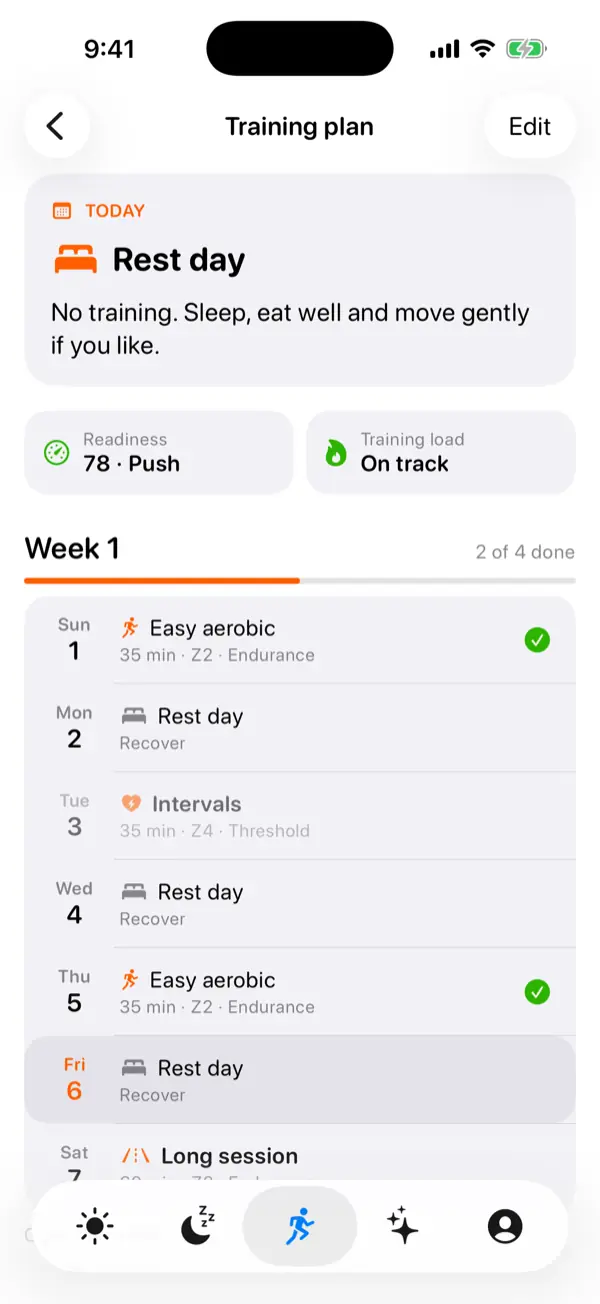
VedaWatch's Training plans currently cover a first 5K, a faster 5K, a 10K and a half marathon, plus Zone 2 and strength goals. There is no full marathon plan yet. The half marathon plan (12 weeks recommended, with a long run that grows to about two hours and a two-week taper) can be a sensible way to build the base you need before starting a marathon block. Training plans are part of VedaWatch Pro.
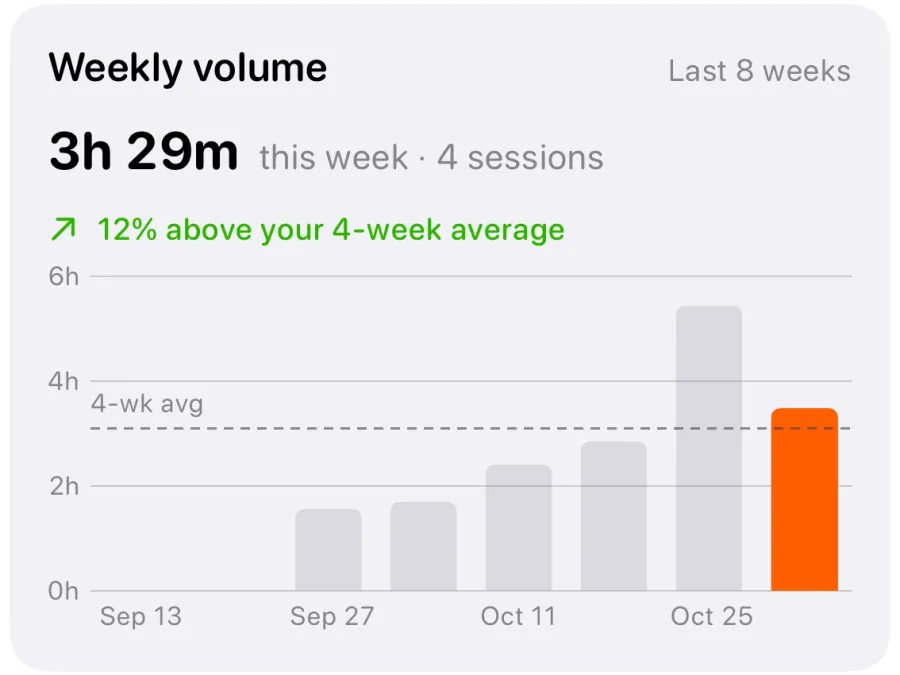
Whatever plan you follow, VedaWatch reads the runs your Apple Watch saves to Apple Health. The Weekly volume card on the Train tab shows your training time for each of the last 8 weeks against your 4-week average, and the Training load screen compares your last 7 days with your last 28. The optional Training load spike alert can tap you when the last week runs well above your usual. Your morning readiness score, built from HRV, resting heart rate and sleep, helps you decide whether to keep or soften a hard day.
VedaWatch doesn't check your longest single run against the 10% guide, so track that yourself. It shows patterns in your data and isn't medical advice.
Frequently asked questions
Is 16 weeks enough to train for a first marathon?
Yes, if you can already run about 25 to 30 km a week and a long run of 13 to 16 km. The official London Marathon beginner plan is 16 weeks. If you're starting from much less, add a few months of base building first.
How many days a week should I run for a first marathon?
Three to five. The London Marathon beginner plan uses three runs a week with a rest day after each. Four runs make it easier to spread the weekly distance so no single run carries too much.
Do I need to run 20 miles before a marathon?
Not exactly, but most plans peak at around 18 to 20 miles (30 to 32 km), or about 3 to 3.5 hours, three weeks before race day. Reaching it gradually matters more than the precise number.
Should I run the full 26.2 miles in training?
No. A full-distance training run takes a long time to recover from and adds injury risk without much benefit. The taper and race-day conditions get you through the last few miles.
How many gels do I need for a marathon?
Work it out from carbohydrate per hour: about 30 to 60 g per hour, and up to 90 g in races lasting more than about 2.5 hours, divided by the grams on your gel's label. Practise the exact plan on long runs first.
Can I walk during my first marathon?
Yes. Planned walk breaks are a legitimate strategy, and the London Marathon beginner plan starts with run–walk sessions. If you plan to walk on race day, practise it on your long runs.
What if I miss a week of training?
Don't try to make it up. Pick up where a slightly easier version of the plan would be, and if you were ill, ease back in over a few days. One missed week rarely changes the outcome of a 16-week plan.
Related guides
- How to increase running mileage safely (and the 10% rule)
- Half marathon taper: the final 7 days, day by day
- Training for a 5K, 10K or half marathon with Apple Watch: a plan that adapts to your recovery
- Easy run pace: how slow should easy runs be?
- Carb loading for a half marathon: how much, when and what to eat
- Strength training for runners: a 2-day plan and when to lift
Sources & further reading
- International Journal of Sports Physical Therapy (2013): Weekly running volume and risk of running-related injuries among marathon runners (Rasmussen et al.)
- Journal of Orthopaedic & Sports Physical Therapy (2014): Excessive progression in weekly running distance and risk of running-related injuries (Nielsen et al.)
- British Journal of Sports Medicine (2025): How much running is too much? Identifying high-risk running sessions in a 5200-person cohort study (Frandsen et al.)
- Sports Medicine (2015): Incidence of running-related injuries per 1000 h of running in different types of runners: a systematic review and meta-analysis (Videbæk et al.)
- Medicine & Science in Sports & Exercise (2007): Effects of tapering on performance: a meta-analysis (Bosquet et al.)
- Journal of Sports Sciences (2011): Carbohydrates for training and competition (Burke et al.)
- Sports Medicine (2017): Training the gut for athletes (Jeukendrup)
- Frontiers in Medicine (2017): Exercise-associated hyponatremia: 2017 update (Hew-Butler et al.)
- London Marathon Events: 2026 TCS London Marathon beginner's training plan (PDF)
This guide is educational, not medical advice, and has not been clinically reviewed. VedaWatch is not a medical device. If you have symptoms or concerns about your heart or health, contact a qualified healthcare professional.
Put your trends in perspective.
Explore HRV, sleep, and recovery with VedaWatch on your iPhone.
Download VedaWatch on the App Store →