 VedaWatch
Recovery & Apple Watch
HRV and stress: what your Apple Watch can and can't tell you
Does stress lower HRV? What research on mental stress shows, what Apple Watch can and can't measure about stress, and practical ways to use your HRV data.
By VedaWatch editorial team · · 10 min read
The short answer
Yes, stress tends to lower HRV. Under mental stress the parasympathetic branch of your nervous system pulls back, so beat-to-beat variation shrinks, even overnight after a stressful evening. But a low HRV reading can't tell stress apart from poor sleep, alcohol, illness or hard training, so read it as a trend against your normal, not a stress meter.
Does stress lower HRV?
Usually, yes. Heart rate variability (HRV) is the small variation in time between one heartbeat and the next. When you're relaxed, that gap changes a lot from beat to beat. When you're under pressure, your heart beats more like a metronome, and HRV drops.
A 2018 meta-analysis in Psychiatry Investigation pulled together 37 publications that used HRV as a measure of psychological stress and found that HRV changed with stress in most of them. The most common pattern was less parasympathetic activity, the "rest and digest" side of the nervous system.
Two caveats matter for anyone reading a watch. First, the effect is a direction, not a fixed amount: how far HRV falls differs a lot between people and situations. Second, many other things lower HRV too, so a dip is a reason to look closer, not proof that you're stressed. The rest of this guide explains why, and how to use the number anyway.
How stress and HRV are connected: the autonomic nervous system
Your heart rate is steered all day by the autonomic nervous system, which runs without you thinking about it. It has two branches that pull in opposite directions.
The sympathetic branch is the accelerator. It speeds the heart up and gets you ready to act, which is what you want before a sprint or a difficult conversation. The parasympathetic branch, carried largely by the vagus nerve, is the brake. It slows the heart and can change the timing of each beat very quickly, which is where most short-term beat-to-beat variation comes from.
You can see the brake at work in every breath. Heart rate rises slightly as you breathe in and falls as you breathe out. When the parasympathetic side is active, that rhythm is pronounced and HRV is higher. When stress takes your foot off the brake, the rhythm flattens and HRV falls, often alongside a slightly higher heart rate.
Researchers describe this with a few measures. RMSSD and high-frequency (HF) power mostly reflect the parasympathetic brake. SDNN reflects overall variability from all sources. Apple Health stores HRV as SDNN in milliseconds, so the number on your iPhone is a broad measure rather than a pure vagal one. That's fine for tracking your own trend, but it's one reason the same person can get different numbers from different devices.
What research says about mental stress and HRV
Lab studies usually create stress on purpose: a timed arithmetic test, a speech in front of evaluators, or an exam. A 2015 systematic review with meta-analysis (Castaldo and colleagues) combined 12 such studies with 758 healthy adults. During acute mental stress, time-domain variability and high-frequency power were both significantly lower, and the ratio of low- to high-frequency power was higher, which the authors read as the parasympathetic brake easing off. They also flagged large differences between studies and that not all followed standard HRV methods.
The finding that matters most for a watch, which measures you mostly at rest and overnight, comes from sleep. In a 2004 study in Psychosomatic Medicine, 59 healthy adults were randomly assigned either to a normal evening or to prepare a speech before bed. The stressed group had lower parasympathetic (high-frequency) activity during both non-REM and REM sleep, and the usual rise in parasympathetic activity across the night was blunted. In that group, a more sympathetic balance during non-REM sleep also went with poorer sleep maintenance.
In plain terms: stress you carry to bed can show up in the HRV your watch records while you sleep, even if you feel fine by morning. That's the link most people notice in their own data after a hard day.
Short-term stress vs stress that goes on for weeks
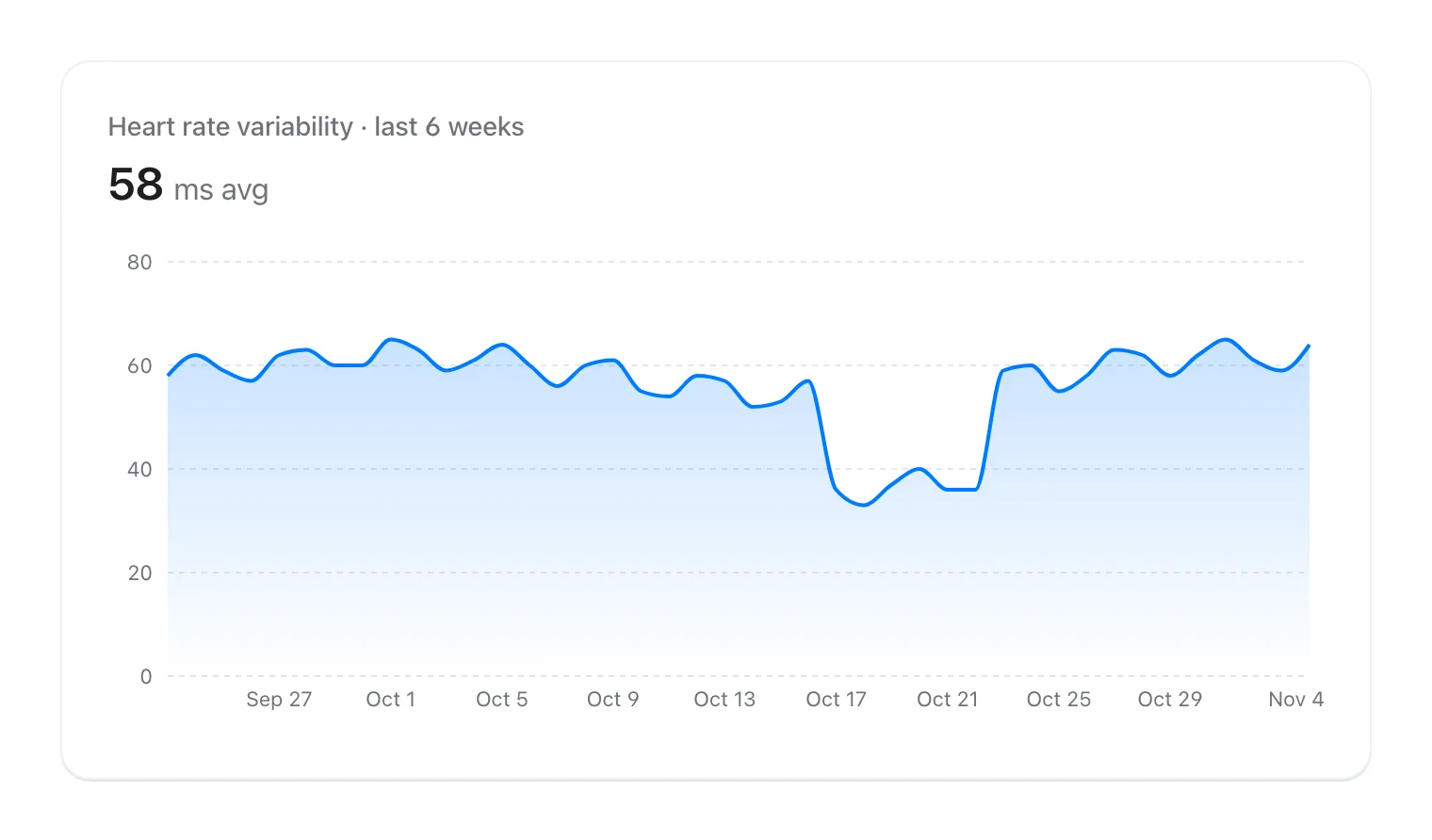
A single stressful event, like a presentation or a tense phone call, typically lowers HRV while it's happening and for a while afterwards. If it spills into the evening, the next night's reading may be lower too. Once things settle and you sleep normally, HRV usually comes back to your usual range.
Longer stretches of pressure, such as weeks of deadlines, caring for someone who is unwell, or money worries, are more likely to show up as a run of below-normal mornings rather than a single dip. That pattern is more worth paying attention to than any one night, because a single low reading is often just everyday noise.
Be careful not to read too much into it either way. A run of low HRV during a tough period isn't a diagnosis of anything, and a normal HRV doesn't mean you aren't stressed. How you feel, how you're sleeping and how you're coping are the main signals; HRV is supporting evidence.
Does Apple Watch track stress?
As of November 2026, Apple Watch has no dedicated stress score or stress meter. What it does have are several pieces you can put together yourself.
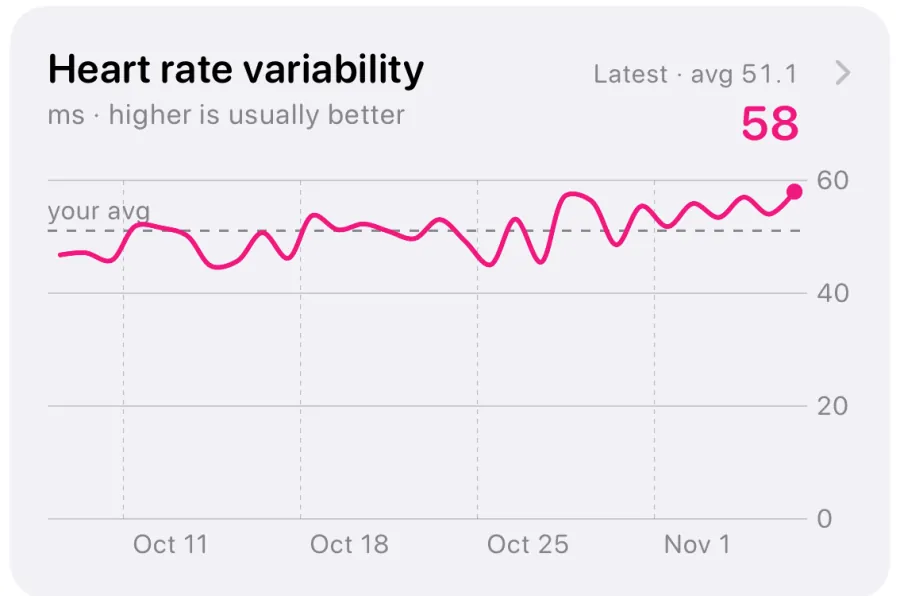
HRV in the background. Apple Watch samples HRV while you're still, so the number of readings you get each day depends on how active you are. Readings are saved to the Health app on iPhone, under Heart.
Recovery HRV. On Apple Watch Series 12 and Apple Watch Ultra 4, the Heart Rate app shows Recovery HRV. Apple's own description says it "can be an indicator of stress and recovery", which is the closest Apple gets to a stress reading. Turn the Digital Crown in the Heart Rate app to find it.
Readiness. On the same two models, Apple's Readiness app gives a 0 to 10 score from Activity, Vitals and Sleep, and overnight HRV is one of the vitals it compares with your history. Apple notes that it doesn't account for all health factors and is a general wellness feature.
State of Mind. In the Mindfulness app you can log how you feel right now or how you've felt overall today, and add words for what is affecting you. On iPhone, Health shows these entries under Mental Wellbeing alongside life factors such as sleep, exercise, daylight and mindful minutes. This is the only place Apple records how stressed you actually feel, and it's the piece most people skip.
Why a low HRV reading doesn't prove you're stressed
HRV responds to anything that pushes your nervous system away from rest. Before blaming stress, run through the usual suspects. If one of these fits, it's the more likely explanation for a single low morning.
- Alcohol the evening before: one of the most common reasons for a low overnight reading.
- A short or broken night: less sleep, or a night of waking up, often goes with lower HRV the next morning.
- A hard workout in the last day or two, or a sudden jump in weekly training.
- Getting ill: HRV often drops together with a rise in resting heart rate, breathing rate or wrist temperature.
- A late, heavy meal, late caffeine, heat, travel or a different time zone.
- Measurement noise: a loose band, few readings that day, or simply the ordinary spread of your numbers.
- If none fit and the day was genuinely stressful, stress is a reasonable guess. If several fit, you can't separate them from one reading.
How to use HRV data to manage stress: a practical routine
The aim isn't to watch your HRV all day. Checking it constantly can make you more anxious, not less. A short weekly routine works better.
A worked example, with made-up numbers. Say your usual overnight HRV sits around 50 ms. On Tuesday night it's 38 ms, and you'd had a tense day at work, no alcohol, a normal workout and a full night's sleep. You logged the day as stressful. Wednesday it's 47 ms, Thursday 51 ms. That's a typical one-off dip that recovered on its own, and the useful lesson is about protecting the evening after a hard day, not about the number. If instead you saw six or seven mornings in a row below your usual range during a heavy month, with resting heart rate creeping up and sleep getting worse, that's a signal to reduce load where you can.
- Wear your watch to bed most nights so you get comparable overnight readings, and give it a few weeks to learn your normal.
- Log stress honestly and briefly: a State of Mind entry or a simple tag at the end of the day, including the ordinary days.
- Look at the trend weekly, not each morning. Compare a 7-day average with your longer-term normal.
- When HRV is low, check the list above before deciding stress is the cause.
- On low days, choose easier training, protect bedtime, and skip the late drink or coffee rather than forcing a hard session.
- After a few weeks, compare mornings after stressful days with mornings after ordinary ones. That comparison, not any single reading, tells you how stress shows up for you.
Can slow breathing raise HRV and lower stress?
Slow breathing is the most direct way to work the parasympathetic brake on purpose. In heart rate variability biofeedback, people breathe at their resonance frequency, where heart rate and breathing swing most strongly together. Lehrer and Gevirtz's 2014 review places this at about 0.1 Hz, or six breaths a minute, refined in later work to an average of about 5.5, varying from person to person.
Does it help with stress? A 2017 meta-analysis in Psychological Medicine combined 24 studies with 484 participants and found a large reduction in self-reported stress and anxiety after HRV biofeedback training, with a between-group effect size (Hedges' g) of 0.83. The authors also called for more well-controlled studies, so treat it as promising rather than settled.
Two practical notes. HRV rises during slow breathing almost by design, so a high reading taken during a Breathe session isn't the same as a higher overnight baseline. And if you want to try it, a few minutes of slow, comfortable breathing, for example about five seconds in and five out, is a reasonable starting point. If slow breathing makes you dizzy or more anxious, stop and breathe normally.
How VedaWatch helps you see stress in your own data
VedaWatch gives you a daily 0 to 100 stress estimate on the Today screen, built from your overnight HRV and resting heart rate against your own normal plus your heart rate during still hours (workouts aren't counted), with an optional nudge to take a breather when it stays high. It's a wellness estimate, not a measurement of stress itself. Alongside it, VedaWatch helps you connect the stress you notice with what your Apple Watch measured.
Stressful day tag. In Daily tags (from Recover, or from the "How was today?" card on Today) you can mark a day as a Stressful day, or log it from the Watch app. Once you have at least 5 tagged days, 5 logged days without the tag and 30 mornings of overnight HRV, VedaWatch shows how your next-morning HRV differs after stressful days, or says No clear effect. When a clear pattern exists, Recover can warn you the next morning to expect a dip after yesterday's stress. It's a pattern in your data, not proof of cause.
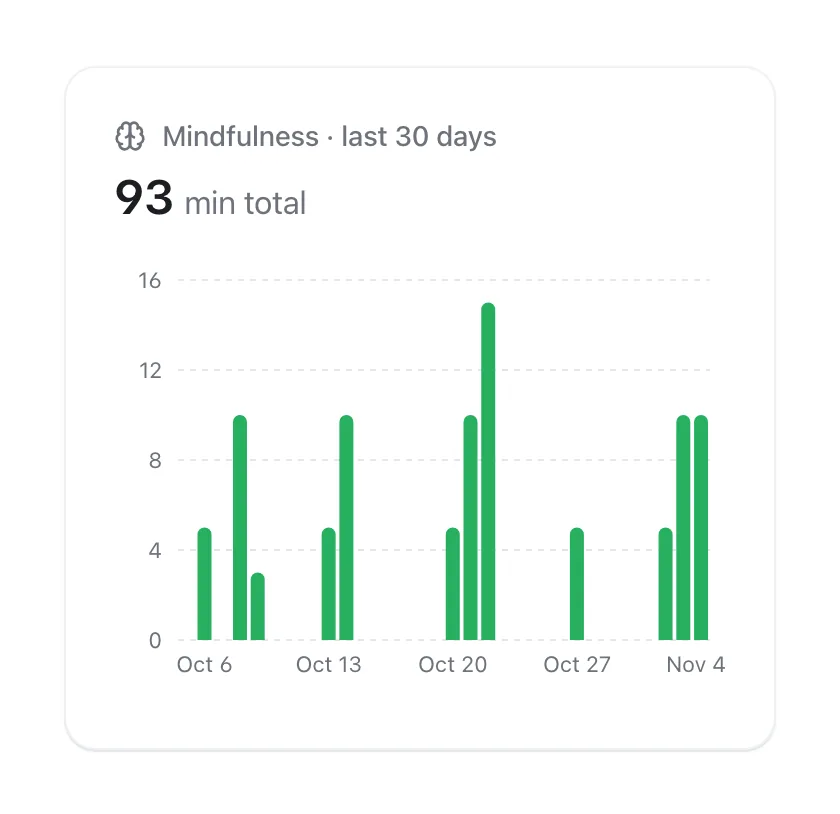
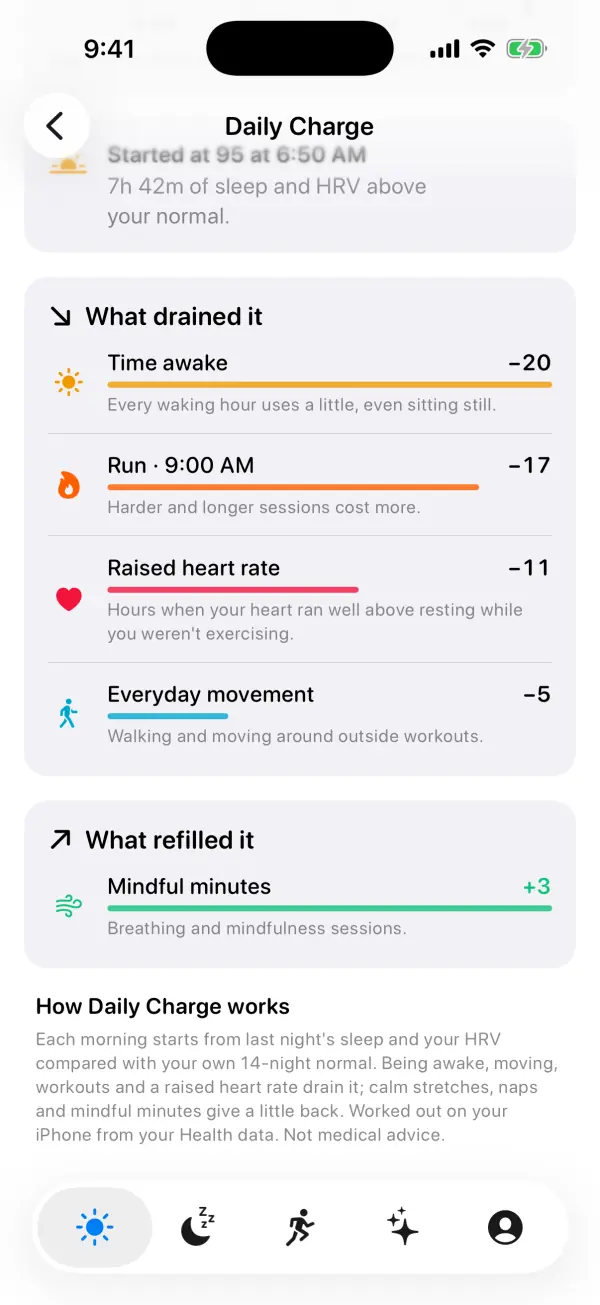
Daily Charge. Your 0 to 100 Daily Charge starts each morning from last night's sleep and HRV compared with your recent normal, then drains through the day. One of the drains is Raised heart rate: hours when your heart ran well above resting while you weren't exercising. Calm stretches, naps and mindful minutes give a little back, so you can see a tense afternoon and a breathing session side by side.
Readiness and alerts. The readiness score compares HRV, resting heart rate and sleep with your recent baseline and lists the reasons. The optional Body under strain alert compares last night's resting heart rate, HRV, breathing rate and wrist temperature with your last 28 nights, because two or more off at once is more meaningful than one.
Winding down. The guided library includes a 15-minute Evening wind-down session of slow breathing and floor stretches, and the AI Coach goal templates include Reduce stress and improve HRV, which asks the coach to watch HRV, resting heart rate, breathing rate and wrist temperature with you. None of this is medical advice.
When to talk to a doctor
HRV is a wellness signal, not a diagnostic test, and a watch can't tell you whether stress is harming your health. Talk to a doctor or another qualified professional if stress, anxiety or low mood is getting in the way of sleep, work or relationships, or has lasted for weeks.
Get medical advice promptly for chest pain, fainting, a racing or irregular heartbeat, or breathlessness that's new or unexplained, whatever your HRV says. If you're on medication that affects heart rate, such as beta blockers, your HRV may not behave like the patterns described here. If you're in crisis or thinking about harming yourself, contact your local emergency number or a crisis line straight away.
Frequently asked questions
How long does it take HRV to recover after a stressful event?
For a one-off stressor, HRV often returns to your usual range within a night or two once you sleep normally. There's no fixed timeline, and long-running stress can keep it lower for longer.
Can anxiety lower HRV even when I'm sitting still?
It can. Worry and rumination can keep the parasympathetic brake eased off without any physical effort, which is why Apple Watch readings taken at rest can still dip on anxious days.
Is a high HRV always good?
Not always. A sudden jump well above your normal can come with some heart rhythm irregularities or measurement errors. Look at the trend, and mention unusual readings to a doctor if you also have symptoms.
Should I skip a workout when my HRV is low from stress?
You don't have to skip it, but an easier session is often the better choice on a low day. Gentle exercise can help with stress, while a very hard session adds more load to a system that's already under pressure.
Why does my HRV look higher after a Breathe session?
Slow breathing makes heart rate rise and fall more with each breath, which raises HRV while you're doing it. That short-term boost is real but isn't the same as a higher overnight baseline.
Related guides
- Does Apple Watch track stress? What it measures and how to check
- What lowers your HRV? Use a tag journal to find out
- Why is my HRV so low? Causes of a sudden drop and what to check
- How to improve your HRV: habits that actually move the number
- Mindful Minutes on Apple Watch: how tracking works, and what the research actually shows
- Body battery on Apple Watch: how VedaWatch's Daily Charge energy score works
- Breathing exercises to increase HRV: a 6-breaths-a-minute routine
Sources & further reading
- Kim HG et al. (2018). Stress and heart rate variability: a meta-analysis and review of the literature. Psychiatry Investigation 15(3):235-245. doi:10.30773/pi.2017.08.17
- Castaldo R et al. (2015). Acute mental stress assessment via short term HRV analysis in healthy adults: a systematic review with meta-analysis. Biomedical Signal Processing and Control 18:370-377. doi:10.1016/j.bspc.2015.02.012
- Hall M et al. (2004). Acute stress affects heart rate variability during sleep. Psychosomatic Medicine 66(1):56-62. doi:10.1097/01.psy.0000106884.58744.09
- Lehrer PM, Gevirtz R (2014). Heart rate variability biofeedback: how and why does it work? Frontiers in Psychology 5:756. doi:10.3389/fpsyg.2014.00756
- Goessl VC, Curtiss JE, Hofmann SG (2017). The effect of heart rate variability biofeedback training on stress and anxiety: a meta-analysis. Psychological Medicine 47(15):2578-2586. doi:10.1017/S0033291717001003
- Apple Support: Monitor your heart rate with Apple Watch
- Apple Support: Understand your readiness score on Apple Watch
- Apple Watch User Guide: Log your state of mind
This guide is educational, not medical advice, and has not been clinically reviewed. VedaWatch is not a medical device. If you have symptoms or concerns about your heart or health, contact a qualified healthcare professional.
Put your trends in perspective.
Explore HRV, sleep, and recovery with VedaWatch on your iPhone.
Download VedaWatch on the App Store →