 VedaWatch
Recovery & Apple Watch
Why is my HRV so low? Causes of a sudden drop and what to check
Why is my HRV so low? A checklist of the usual causes of a sudden HRV drop, how to tell a one-off dip from a real trend, and when to see a doctor.
By VedaWatch editorial team · · 11 min read
The short answer
A sudden HRV drop usually has an ordinary cause: alcohol, a short or broken night, a hard workout, stress, travel or an illness starting. Check those first, then rule out measurement problems. One low morning means little. A drop that holds for several days, especially alongside a higher resting heart rate or symptoms, is worth acting on.
Why is my HRV so low all of a sudden?
Heart rate variability (HRV) is the small, constantly changing gap between one heartbeat and the next. When your body is relaxed and recovering, that gap varies more. When it's dealing with something, whether that's a bottle of wine, a deadline, a virus or yesterday's intervals, your nervous system shifts toward a more alert state and the variation shrinks. So a sudden drop is usually your body telling you it's busy with something, not that something is wrong with your heart.
Low also only means low for you. Cleveland Clinic points out that HRV that's normal in one person may not be normal for someone else, and that it naturally declines with age. A reading of 30 ms can be a rough morning for one person and an ordinary one for another. The useful question is not whether your number is low, but whether it's low compared with your own recent normal, and for how long.
Most sudden drops trace back to a handful of everyday causes: alcohol, poor sleep, hard training, stress, travel and the start of an illness. A smaller share are measurement quirks rather than real changes.
Checklist: common causes of a sudden HRV drop
Work down this list the morning you see a low reading. For each cause, the clue tells you how to recognise it and the second half tells you what usually happens next. Often more than one applies.
- Alcohol the evening before. Clue: the drop shows up the very next morning, often with a higher resting heart rate. Usually eases once you've had a night or two without drinking.
- A short or broken night. Clue: less sleep than usual, a late bedtime, a noisy room, a baby or a pet. Usually recovers with one or two better nights.
- A hard or unusually long workout. Clue: a race, a big interval session, a heavy leg day or a much bigger week than usual. Expected after hard efforts; it should bounce back as you recover.
- Stress. Clue: a deadline, conflict, worry or a big life event, sometimes with poor sleep on top. Tends to last as long as the stress does.
- Travel. Clue: a flight, a new time zone, a hot or unfamiliar room, or being at altitude. Usually settles once your routine and sleep do.
- An illness starting. Clue: the drop arrives with a higher resting heart rate, a higher breathing rate or wrist temperature, and maybe a scratchy throat or aches. Can come before you feel ill and last until you recover.
- A late heavy meal, a hot room or a sauna. Clue: you slept but felt warm or restless. Usually a one-night effect.
- A measurement problem. Clue: you feel completely fine and nothing above applies, or there were only one or two readings that day. Covered in its own section below.
- Something else that's new. Clue: a new medication, a dose change, or a cycle phase where your numbers usually shift. Apple notes that medications can affect your overnight readings. Worth noting, and worth raising with your doctor if it persists.
Alcohol and poor sleep: the most common overnight culprits
If you're looking for one usual suspect, it's alcohol. In a real-world study of 4,098 Finnish employees who wore heart rate monitors through everyday life, Pietilä and colleagues compared each person's nights after drinking with their own nights without it. Alcohol was linked with less relaxed, less recovered heart rhythms during the first three hours of sleep, and the effect grew with the dose: an HRV-based recovery measure fell by an average of 9.3, 24.0 and 39.2 percentage units after low, moderate and high intake. Even low intake had a measurable effect, and being physically active didn't protect people from it.
Sleep is the other big one. Cleveland Clinic lists poor sleep, meaning shorter or lower quality sleep, among the things that lower HRV. And if you sleep less, your watch also has fewer quiet, still hours in which to take its readings, which can make a single day's number less reliable.
The practical test is simple: if the low reading follows a night of drinking, a late night or a bad night's sleep, that's the most likely explanation. Give it a night or two of normal sleep without alcohol before reading anything else into it. If you want to know how strongly drinking affects your own numbers, the alcohol guide goes into it in depth.
Hard training, stress and travel
A low reading after a hard session is your body doing its job. Training is a stress, and recovery is when you adapt to it. In a study of trained triathletes, Plews and colleagues saw HRV move during a deliberate overload block, which is why coaches watch it. What matters is the pattern: a dip after a big day that recovers in a day or two is normal. A drop that keeps sliding over a week or more of hard training, along with heavy legs, poor sleep or flat performance, suggests you're piling on more than you're absorbing.
Psychological stress lowers HRV too. A 2018 review by Kim and colleagues of 37 studies found that HRV changed in response to stress in most of them, most often as a fall in the parasympathetic, rest-and-digest side of the nervous system. Unlike a single workout, stress can be ongoing, so it tends to show up as several low days in a row rather than one. If your HRV has been down all week and so has your mood, this may be the link.
Travel stacks several causes at once: a broken night, a new time zone, alcohol and a different bedroom. Apple lists elevation alongside alcohol, medications and illness as things that can push overnight readings outside your typical range, so a ski trip or a mountain holiday can lower HRV even if you sleep well. Expect it to recover once you're home and back in your routine.
Can a low HRV mean you're getting sick?
Sometimes, yes. Infections push the nervous system into a more alert state, and that can show up in HRV before you notice symptoms. In the Warrior Watch study, Hirten and colleagues followed health care workers wearing Apple Watch and found that HRV patterns differed in the 7 days around a positive COVID-19 test, and on the first day people reported symptoms, compared with healthy periods. Changes were already visible before the test confirmed the infection.
The giveaway is that illness rarely moves HRV alone. Look for a resting heart rate a few beats above normal, a higher breathing rate, a warmer wrist temperature, and how you actually feel. Apple's Vitals app does something similar: when several overnight metrics fall outside your typical range, it notifies you and suggests possible factors, including illness.
If HRV is down and those other signals are up too, treat it as a reason to take the day easy, sleep more and drink plenty, not as a diagnosis. A watch can't tell a cold from a hard week.
Is it a real drop or a measurement problem?
If you feel great and none of the usual causes apply, check the measurement before you worry. Wrist sensors estimate heartbeats from blood flow, and Cleveland Clinic notes that an EKG is more accurate than a smartwatch for HRV. Some days the reading is simply off.
Run through these: Was the watch snug? A loose band lets light in and adds noise. Did you wear it to bed? Apple Watch takes HRV readings in the background rather than continuously, so a day with only one or two readings, taken soon after a walk or while you were moving, can look low. Did you change something, such as a new watch, a restored phone, a different wrist or a new band? Any of these can shift readings for a while, and a new device needs time to learn your normal: Apple says to wear your watch to sleep for 7 days before Vitals has a typical range for you.
Also check you're comparing like with like. Apple Watch reports HRV as SDNN, while many other wearables and apps report RMSSD, and the two give different numbers for the same heart. A number from your Apple Watch that looks low next to a friend's ring or a chest-strap app may not be low at all.
How to tell a one-off dip from a real trend
Single readings are noisy, so sports scientists look at averages. Plews and colleagues tested how many days of HRV you need to average to get the same picture as a full week, and concluded that you need at least 3 valid readings a week. In practice that means: judge your HRV by its weekly average against your own longer-term normal, and treat any single morning as a clue rather than a verdict.
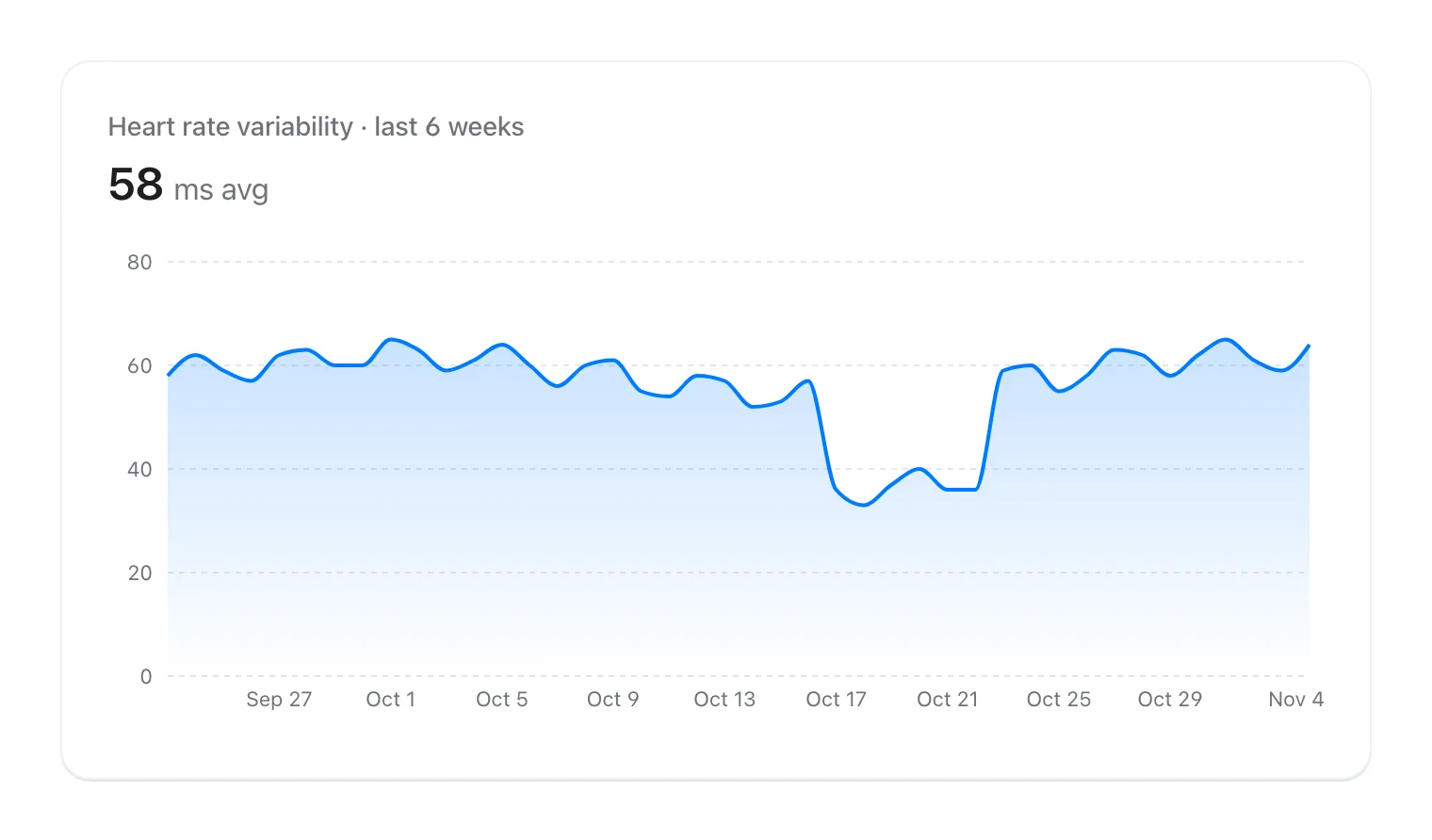
Here's a worked example. Say your HRV usually sits between about 52 and 64 ms, with a typical value near 58 ms. One morning it reads 41 ms after a friend's birthday dinner, then 55 and 60 on the next two mornings. That's a one-off dip: it had an obvious cause and it came back inside your normal range. Now picture a different week: 50, 47, 45, 44 and 42 ms over five mornings, with your resting heart rate creeping up and no obvious reason. Each reading on its own isn't dramatic, but the direction is consistent and the weekly average has dropped well below your normal. That's a trend, and it deserves a look at sleep, training load, stress and how you feel.
A few rules of thumb help: one low day with a clear cause, ignore it; two or three low days, ease off and look for the cause; a week or more below your normal, or a steady slide over several weeks, change something, and talk to a doctor if you can't explain it or you have symptoms. Compare against your own baseline, never against age charts or someone else's number.
What to do on a low HRV day
You don't need to do anything dramatic. A low morning is a good reason to choose an easier workout or a rest day if you also feel flat, to skip alcohol that evening, and to protect your sleep with an earlier bedtime. If you feel fine and your other signals look normal, a planned easy session is usually reasonable; our guide on training with low HRV covers how to weigh it.
Avoid chasing the number: checking it several times a day adds stress without helping. Raising your HRV over weeks is a different job, covered in our guide on how to improve HRV.
When should you see a doctor about low HRV?
HRV from a watch is a wellness signal, not a medical test, and a low number on its own is not a diagnosis. Cleveland Clinic says a healthcare provider is the best person to help you understand your HRV, and low HRV is associated with conditions such as diabetes, high blood pressure, abnormal heart rhythms, anxiety and depression, so persistent unexplained changes are worth mentioning.
Book a routine appointment if your HRV has stayed well below your normal for a couple of weeks or more with no clear cause, if it keeps falling over several weeks, if it changed after starting or changing a medication, or if it comes with ongoing fatigue, poor sleep, low mood or a resting heart rate that stays high.
Get help urgently if the low reading comes with symptoms. The NHS advises calling 999 or going to A&E if palpitations don't go away, or come with chest pain, shortness of breath, or feeling faint or fainting, and seeing a GP if palpitations keep coming back, last longer than a few minutes, or you have a heart condition or a family history of heart problems. Outside the UK, use your local emergency number.
How VedaWatch helps you find the cause
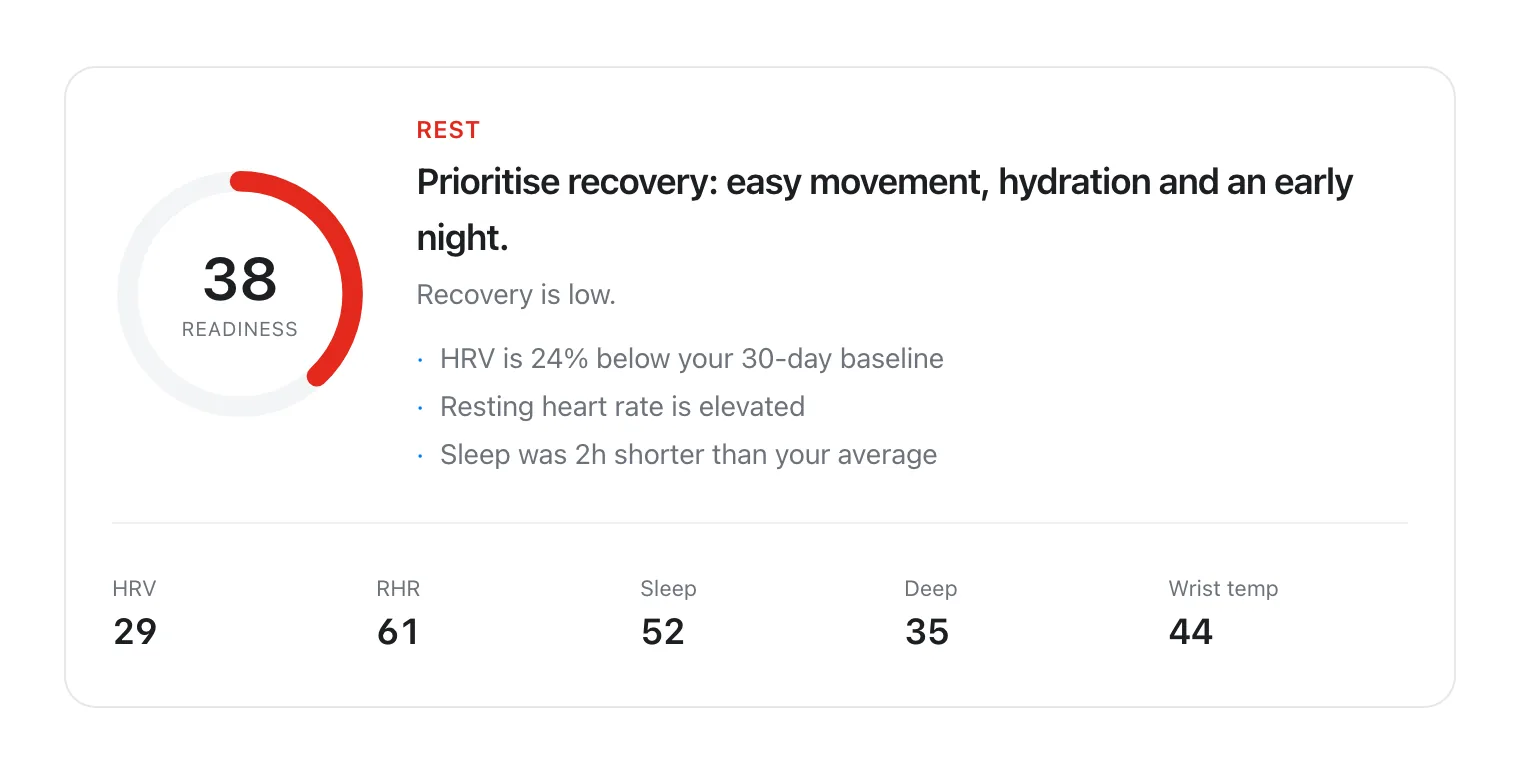
VedaWatch reads the HRV, resting heart rate, breathing rate, wrist temperature and sleep your Apple Watch saves to Apple Health, and compares each morning with your own normal rather than a population chart. Your normal is a band built from the median of your recent nights, so one party or red-eye flight doesn't drag it around. Your readiness score's breakdown lists the reasons behind it, such as how far HRV is from your baseline, whether resting heart rate is up and how long you slept, so a low day usually explains itself.
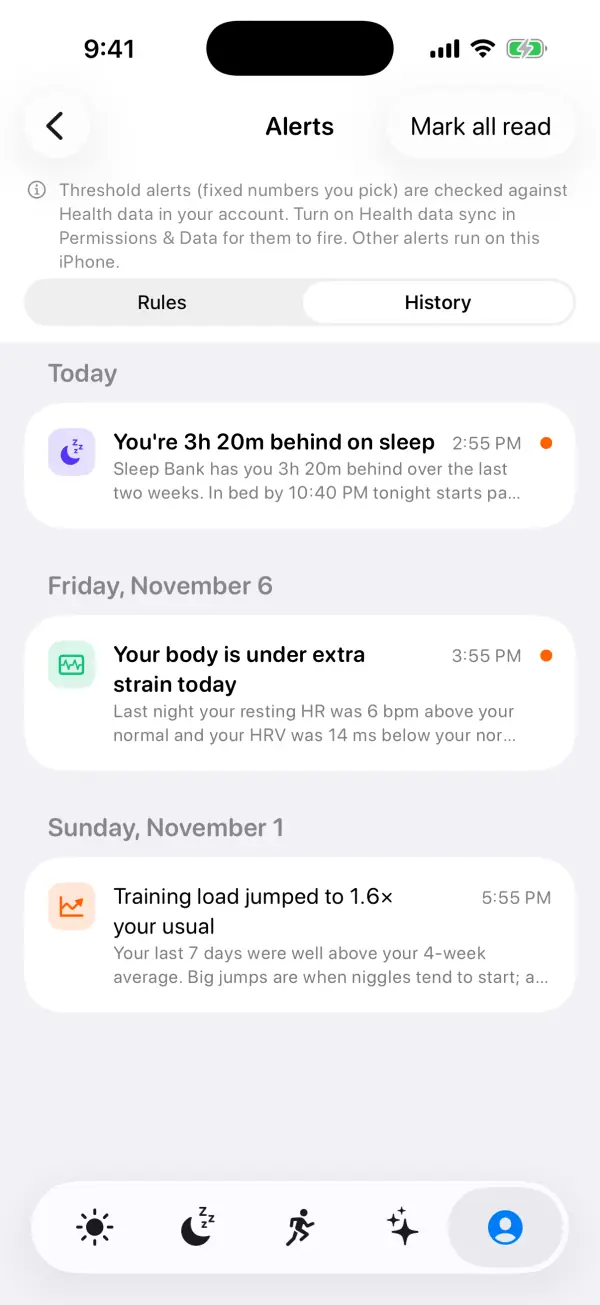
When two or more overnight signals are off your normal at once, the Recover tab shows a Body signals card, and if the pattern looks fever-like it becomes an early warning. You can turn either into a notification with the Body under strain and Early illness warning alerts. When HRV comes back inside your normal range after a dip, Recover tells you that too, which is a useful nudge that the dip was a one-off.
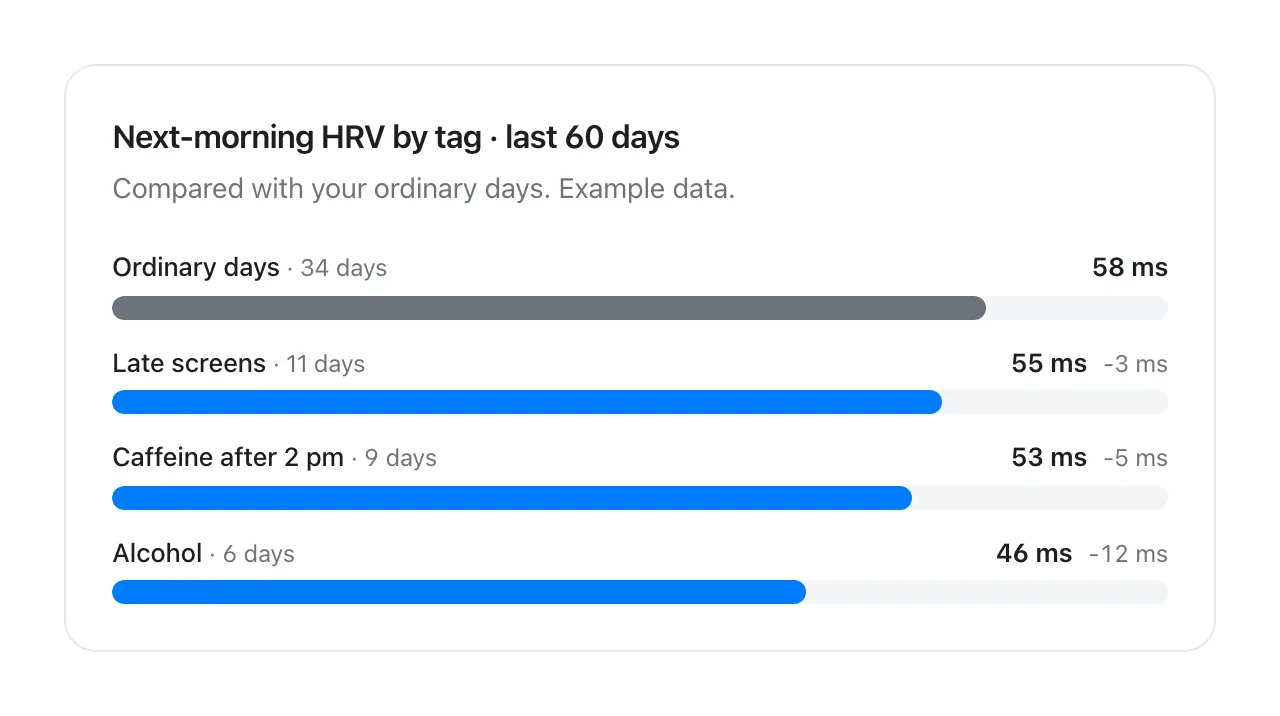
To find your own causes, tag your days in the Daily tags journal with Alcohol, Stressful day, Travel, Feeling ill, Late meal and the rest, or your own tags. Once a tag has at least 5 logged days with it and 5 without, and your watch has 30 mornings of overnight HRV, VedaWatch shows how your next-morning HRV differs after tagged days. It's a pattern in your data, not proof of cause, and none of it is a diagnosis.
Frequently asked questions
Why is my HRV low but I feel fine?
Your body can register a stressor, such as alcohol, a late meal or a virus you're fighting off, before you notice it. It can also be a measurement quirk. If you feel fine and it's back to normal within a day or two, it's usually nothing to act on.
How long does it take for HRV to recover after a drop?
It depends on the cause. A dip from one night of drinking or poor sleep often recovers within a night or two, while illness, ongoing stress or a hard training block can keep it down for longer. If it hasn't recovered after a couple of weeks and you can't explain it, mention it to your doctor.
Is a low HRV dangerous?
A low reading from a watch is not dangerous by itself, and it isn't a diagnosis. What matters is a lasting change from your own normal and any symptoms that come with it, such as chest pain, palpitations, breathlessness or fainting, which need prompt medical attention.
Can caffeine or dehydration lower HRV?
They can play a part, mainly by disturbing sleep or adding to the body's load, but they're usually smaller effects than alcohol, sleep loss or illness. Tagging late coffee in a journal is the easiest way to see whether it matters for you.
Why is my Apple Watch HRV lower than my friend's?
HRV varies a lot between people because of age, genetics and fitness, and different devices measure it differently, so comparing numbers isn't meaningful. Compare your readings with your own baseline instead.
Related guides
- How to improve your HRV: habits that actually move the number
- Should you train or rest when HRV is low?
- Does alcohol lower HRV? Dose, timing and how long it lasts
- HRV when sick: what your Apple Watch shows before symptoms
- Is Apple Watch HRV accurate? What the validation studies actually show
- What lowers your HRV? Use a tag journal to find out
Sources & further reading
- Cleveland Clinic: Heart Rate Variability (HRV)
- Pietilä J et al. (2018). Acute effect of alcohol intake on cardiovascular autonomic regulation during the first hours of sleep in a large real-world sample of Finnish employees. JMIR Mental Health 5(1):e23. doi:10.2196/mental.9519
- Plews DJ et al. (2014). Monitoring training with heart-rate variability: how much compliance is needed for valid assessment? International Journal of Sports Physiology and Performance 9(5):783-790. doi:10.1123/ijspp.2013-0455
- Kim HG et al. (2018). Stress and heart rate variability: a meta-analysis and review of the literature. Psychiatry Investigation 15(3):235-245. doi:10.30773/pi.2017.08.17
- Hirten RP et al. (2021). Use of physiological data from a wearable device to identify SARS-CoV-2 infection and symptoms and predict COVID-19 diagnosis: observational study. Journal of Medical Internet Research 23(2):e26107. doi:10.2196/26107
- Apple Support: Track your overnight and daytime vitals
- NHS: Heart palpitations
- Shaffer F, Ginsberg JP (2017). An overview of heart rate variability metrics and norms. Frontiers in Public Health 5:258. doi:10.3389/fpubh.2017.00258
This guide is educational, not medical advice, and has not been clinically reviewed. VedaWatch is not a medical device. If you have symptoms or concerns about your heart or health, contact a qualified healthcare professional.
Put your trends in perspective.
Explore HRV, sleep, and recovery with VedaWatch on your iPhone.
Download VedaWatch on the App Store →