 VedaWatch
Recovery & Apple Watch
Breathing exercises to increase HRV: a 6-breaths-a-minute routine
Breathing exercises to increase HRV: what resonance breathing research shows, a step-by-step 6-breaths-a-minute routine, and how to use Apple Watch Breathe.
By VedaWatch editorial team · · 10 min read
The short answer
Slow breathing at about 6 breaths a minute, for example 4 seconds in and 6 seconds out, reliably raises HRV while you do it and shortly after. A 2022 meta-analysis of 223 studies also found higher HRV after weeks of regular practice. Start with 5 minutes a day, build to 10 to 15, and judge it by your overnight HRV trend.
Can breathing exercises really increase HRV?
Yes, at least while you are doing them. Heart rate variability (HRV) is the small beat-to-beat change in the gap between heartbeats, and breathing is one of its biggest everyday drivers. Your heart speeds up a little as you breathe in and slows as you breathe out. Slow that breathing down and the swings get larger, so HRV goes up.
The best summary of the evidence is a 2022 systematic review and meta-analysis in Neuroscience and Biobehavioral Reviews by Laborde and colleagues. They screened 1,842 abstracts and included 223 studies of voluntary slow breathing. Vagally mediated HRV, the part linked to the calming parasympathetic branch of the nervous system, was higher during slow breathing (172 studies), immediately after a single session (16 studies), and after multi-session programmes (49 studies).
Notice how lopsided those numbers are. Most of the research measures HRV during the breathing itself. Far fewer studies look at what happens to your resting HRV after weeks of practice, which is the number most Apple Watch owners actually care about. So the honest answer is: breathing exercises raise HRV in the moment almost every time, and they probably nudge your resting HRV up with regular practice, but the long-term effect is smaller and less certain than many wellness articles suggest.
What is resonance breathing, and why 6 breaths a minute?
Resonance breathing (also called resonance frequency breathing, or coherent breathing) means breathing at the pace where your heart rate and breathing rhythms line up and reinforce each other. In their 2014 review in Frontiers in Psychology, Lehrer and Gevirtz explain that at this pace heart rate and blood pressure oscillate 180 degrees out of phase, so the baroreflex, the reflex that steadies blood pressure, amplifies each heart-rate swing instead of damping it.
For most adults this happens at roughly 0.1 Hz, or about six breaths a minute, which is one breath every 10 seconds. Lehrer and Gevirtz report that the average across people is closer to 0.09 Hz, about 5.5 breaths a minute, and that it varies between individuals. They also found that taller people and men tend to have a lower resonance frequency, which they put down to larger blood volume.
A 2020 practical guide by Shaffer and Meehan in Frontiers in Neuroscience gives the adult range as 4.5 to 6.5 breaths a minute (6.5 to 9.5 for children). That is why six a minute is a sensible default: it sits in the middle of the adult range, and it's easy to count.
A step-by-step resonance breathing routine
You don't need special equipment. A timer, a pacing app or the Breathe session on your Apple Watch is enough. Here is a simple routine built from the protocols in the research above.
- Pick a time you can repeat daily, such as after waking, after training, or 30 minutes before bed. Consistency matters more than the time of day.
- Sit upright or lie on your back with knees bent. Rest one hand on your belly so you can feel it rise.
- Breathe in gently through your nose for 4 seconds, letting your belly expand rather than lifting your shoulders.
- Breathe out slowly for 6 seconds, through the nose or pursed lips. That's 10 seconds per breath, or 6 breaths a minute.
- Keep each breath easy and not too deep. If you feel lightheaded or tingly, you're over-breathing: take smaller, smoother breaths at the same pace.
- Start with 5 minutes (30 breaths). Over two to three weeks, build up to 10 to 15 minutes in one or two sittings.
- Finish by breathing normally for a minute before you stand up.
Does a longer exhale matter?
It seems to. In a 2014 study in Applied Psychophysiology and Biofeedback, Van Diest and colleagues had 30 people breathe at 6 or 12 breaths a minute with either a short inhale and long exhale (an inhale-to-exhale ratio of 0.42) or the reverse (2.33). The long-exhale pattern left people feeling more relaxed, less stressed and more mindful. It also raised high-frequency HRV, but only when combined with slow breathing.
Shaffer and Meehan likewise recommend an exhale longer than the inhale, while noting that two studies found no difference in resting HRV between 1:1 and 1:2 ratios. In practice: slow pace first, longer exhale second. If 4 in and 6 out feels forced, 5 in and 5 out is fine.
Here's how a few common patterns compare at a glance. 4 seconds in, 6 out: 6 breaths a minute with a longer exhale, the routine above. 5 in, 5 out: 6 breaths a minute, equal ratio. 5 in, 6 out: about 5.5 breaths a minute, close to the average resonance rate Lehrer and Gevirtz describe. 4 in, 4 out: 7.5 breaths a minute, slower than normal breathing but above the typical adult resonance range.
How to find your own resonance frequency
Clinicians find a person's resonance frequency by having them breathe at several paces while recording heart rate. Shaffer and Meehan's protocol tests 6.5, 6.0, 5.5, 5.0 and 4.5 breaths a minute for 2 minutes each, with 2 minutes of rest between, then picks the pace where heart rate rises and falls most smoothly in step with the breath and swings the widest. Even this has limits: the only test-retest study they cite involved 21 students tested two weeks apart.
Without a chest strap and biofeedback software, you can do a rough home version. Try a few days each at 6, 5.5 and 5 breaths a minute and notice which feels most comfortable and calming without strain. If a slower pace leaves you short of air or lightheaded, go back up. Shaffer and Meehan note that 4.5 breaths a minute can cause over-breathing in some people.
Don't over-engineer it. In a 2017 trial in Frontiers in Public Health, Steffen and colleagues randomised 95 students to 15 minutes at their measured resonance rate, 15 minutes at one breath a minute faster, or sitting quietly. Both breathing groups had lower blood pressure than the quiet group during the session. Only the exact-resonance group showed a rise in positive mood and in the LF/HF frequency measure of HRV. Interestingly, the time-domain measures RMSSD and SDNN did not change significantly in any group. SDNN is the measure Apple Health shows, so even a well-run session won't always show up in Apple Watch numbers.
How to do resonance breathing with Apple Watch Breathe
Apple Watch already has a paced breathing guide built in. Breathe lives in the Mindfulness app, and its pace is adjustable. According to Apple's App Store listing for Mindfulness, you can set a breath rate from 4 to 10 breaths a minute, and completed sessions are tracked as mindful minutes in the Health app on iPhone.
Set it up for resonance breathing like this, following Apple's Watch User Guide.
- On your Apple Watch, open Settings, then Mindfulness, then Breath Rate, and choose 6 breaths a minute (try 5 later if 6 feels quick).
- In Settings, Mindfulness, Haptics, choose Prominent if you want to follow the pace with your eyes closed, or Minimal for gentler taps.
- Open the Mindfulness app, tap the More Options button next to Breathe, tap Duration and pick up to 5 minutes.
- Tap Breathe. Inhale as the animation grows and exhale as it shrinks. For 10 minutes, simply run two sessions back to back.
- Afterwards, your heart rate appears on the Summary screen. You can review it later in Health on iPhone under Heart, Heart Rate, Show More Heart Rate Data, Breathe.
Acute vs long-term effects: what to expect, and when
It helps to separate two different effects, because they show up in different places.
The acute effect is the big, reliable one. During slow breathing your heart-rate swings grow and HRV rises, and the Laborde meta-analysis found it stays higher immediately after a session too. On Apple Watch, any HRV reading taken during a Breathe session will usually look high for this reason. That's useful feedback that you're breathing slowly, but it isn't evidence that your recovery improved, so keep it out of your mental baseline.
The long-term effect is what changes your resting HRV, the overnight number your Watch collects while you sleep. Here the evidence is thinner. Lehrer and Gevirtz describe higher resting baroreflex gain after about three months of twice-daily home practice. Lehrer and colleagues' 2020 meta-analysis of 58 randomised controlled trials of HRV biofeedback found small to moderate overall benefits, largest for anxiety, depression, anger and athletic or artistic performance, and smallest for PTSD, sleep and quality of life. Those benefits were not different from other effective treatments.
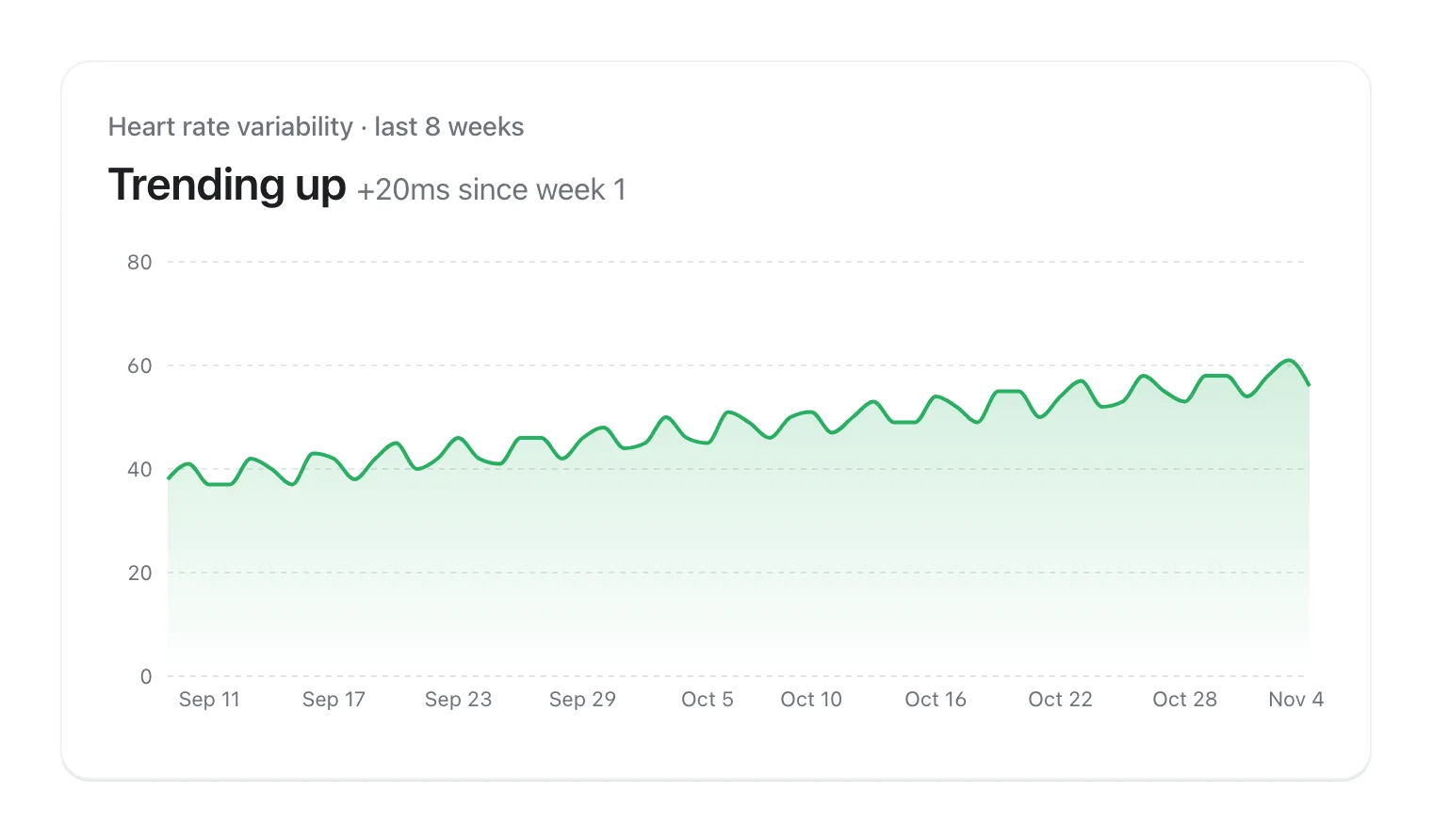
A realistic plan is to practise daily for at least four weeks before judging. Compare your average overnight HRV for the four weeks before you started with the four weeks after, rather than day to day. HRV also responds to sleep, alcohol, illness, training load and stress, so a busy month can hide a real benefit, and an easy month can fake one.
Worked example: you do 10 minutes a day at 6 breaths a minute. That's 60 slow breaths daily and 280 minutes over four weeks. If your four-week overnight average moves from 42 ms to 45 ms while your sleep and training stayed similar, that's a modest but plausible change. If it doesn't move, the practice may still be worthwhile for how calm it makes you feel.
Who should be careful with slow breathing
Slow, gentle breathing is low-risk for most people, and Laborde and colleagues expected few adverse effects. The main problem is over-breathing: breathing too deeply while you slow down, which can cause lightheadedness, tingling or a racing feeling. Shaffer and Meehan advise breathing more shallowly and smoothly if that happens.
Check with your doctor before starting a regular breathing practice if you have a heart or lung condition, a pacemaker, kidney disease, or panic attacks that breathing exercises tend to trigger. Shaffer and Meehan list a pacemaker that controls heart rhythm as a contraindication for resonance frequency testing.
Breathing exercises are a wellness habit, not a treatment. If you have chest pain, fainting, shortness of breath or a persistently irregular or racing heartbeat, contact a doctor or emergency services rather than trying to breathe it away. And if a low HRV comes with feeling unwell, rest and get checked.
How VedaWatch helps you see whether breathing work is paying off
VedaWatch reads your mindful minutes and HRV from Apple Health and puts them side by side with the rest of your recovery data, so you can judge your breathing practice by your own numbers instead of a single session.
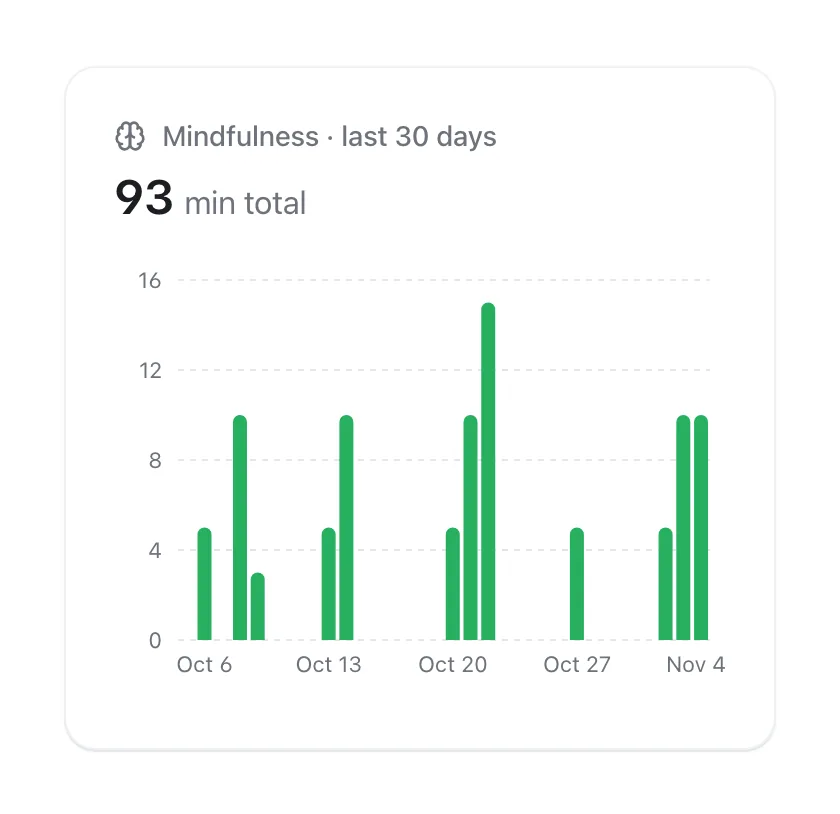
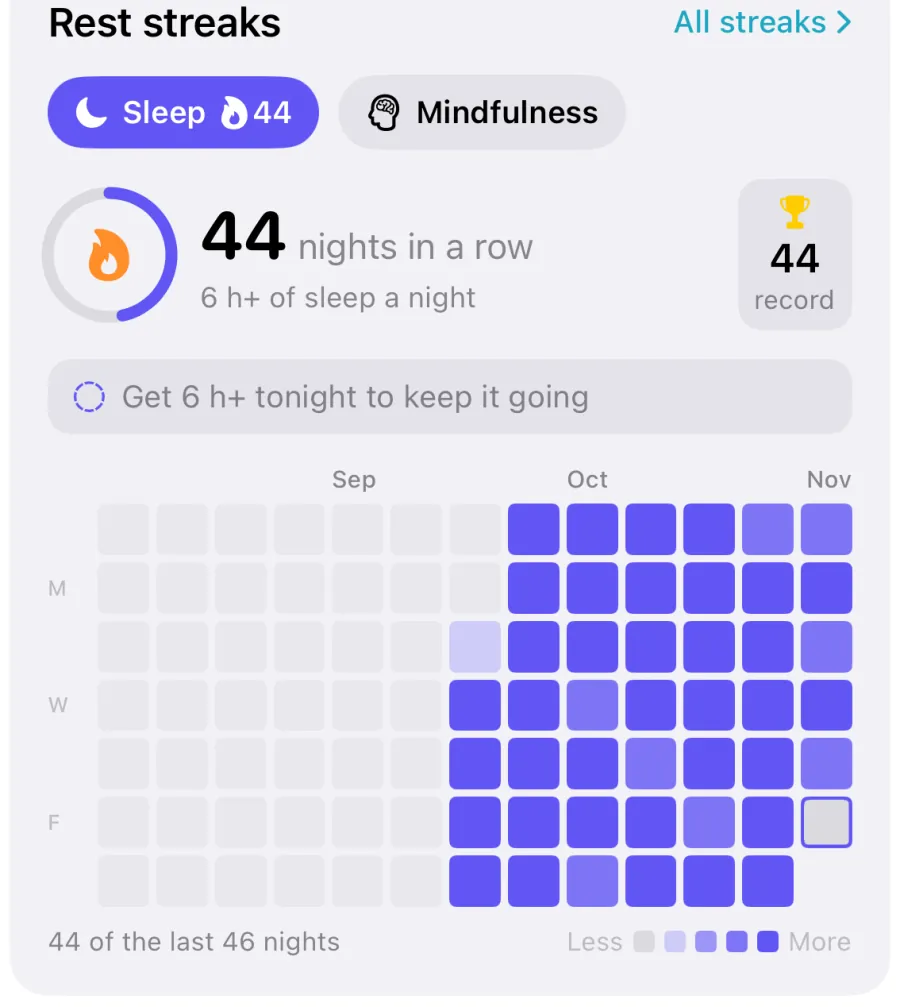
Mindfulness and Rest streaks. Under Recover, the Mindfulness view shows today's mindful minutes, sessions today, your current streak and a 30-day chart, whether the minutes came from Apple's Breathe or another app that writes mindful minutes to Health. The Rest streaks card has a Mindfulness tab, and one mindful minute keeps that streak going.
Test it with a tag. In Daily tags you can add your own tag, such as "Breathing session", and tap it on the days you practise. Once it has at least 5 logged days with the tag, 5 logged days without it and 30 mornings of overnight HRV, VedaWatch compares your next-morning HRV after tagged and untagged days, or tells you there's no clear effect. It's a pattern in your data, not proof of cause.
Follow-along sessions. The guided library's Evening wind-down is a 15-minute session of slow belly breathing and floor stretches, with the belly breathing paced at 4 seconds in and 6 out. Mindful minutes also give a little back to your Daily Charge energy score, and your readiness score compares HRV with your recent baseline so you can watch the longer trend. None of this is medical advice.
Frequently asked questions
Is box breathing good for HRV?
Box breathing uses an equal inhale, hold, exhale and hold. At 4 seconds per side, a common way to teach it, that's 16 seconds per breath, or under 4 breaths a minute. It can be calming, but resonance research is built on smooth, continuous breathing near 6 breaths a minute, so that's the better-supported choice if raising HRV is your goal.
What time of day is best for breathing exercises?
There's no clear best time in the research. Many people pick the evening to wind down, but any time you can repeat daily works. Avoid judging the effect from an HRV reading taken during or right after a session.
Should I breathe through my nose or mouth?
Breathing in through the nose makes it easier to keep breaths slow and gentle, and exhaling through the nose or pursed lips helps lengthen the out-breath. What matters most is the slow pace and not over-breathing.
Why did my HRV jump during a Breathe session and then drop overnight?
Slow breathing enlarges heart-rate swings, so HRV during the session is high almost by design. Overnight HRV reflects sleep, stress, alcohol, illness and training, and changes far more slowly.
Can breathing exercises replace exercise or sleep for HRV?
No. Regular aerobic exercise, enough sleep and less alcohol all affect resting HRV. Breathing practice is a useful addition alongside them, not a substitute.
Related guides
- Box breathing vs 4-7-8 breathing: which to use and when
- How to improve your HRV: habits that actually move the number
- HRV and stress: what your Apple Watch can and can't tell you
- Mindful Minutes on Apple Watch: how tracking works, and what the research actually shows
- How to get more HRV readings on Apple Watch (and fix gaps)
- What lowers your HRV? Use a tag journal to find out
- Apple Watch HRV: how to check it and understand your trends
Sources & further reading
- Laborde S et al. (2022). Effects of voluntary slow breathing on heart rate and heart rate variability: A systematic review and a meta-analysis. Neuroscience & Biobehavioral Reviews 138:104711
- Lehrer PM, Gevirtz R (2014). Heart rate variability biofeedback: how and why does it work? Frontiers in Psychology 5:756
- Shaffer F, Meehan ZM (2020). A practical guide to resonance frequency assessment for heart rate variability biofeedback. Frontiers in Neuroscience 14:570400
- Steffen PR et al. (2017). The impact of resonance frequency breathing on measures of heart rate variability, blood pressure, and mood. Frontiers in Public Health 5:222
- Van Diest I et al. (2014). Inhalation/exhalation ratio modulates the effect of slow breathing on heart rate variability and relaxation. Applied Psychophysiology and Biofeedback 39:171-180
- Lehrer P et al. (2020). Heart rate variability biofeedback improves emotional and physical health and performance: a systematic review and meta analysis. Applied Psychophysiology and Biofeedback 45:109-129
- Apple Watch User Guide: Start a Reflect or Breathe session on Apple Watch
- App Store: Mindfulness by Apple
This guide is educational, not medical advice, and has not been clinically reviewed. VedaWatch is not a medical device. If you have symptoms or concerns about your heart or health, contact a qualified healthcare professional.
Put your trends in perspective.
Explore HRV, sleep, and recovery with VedaWatch on your iPhone.
Download VedaWatch on the App Store →