 VedaWatch
Sleep
How alcohol affects sleep: REM, waking at 3 am and your heart
How alcohol affects sleep: what drinks before bed do to falling asleep, REM, the second half of the night and heart rate, and how it shows on Apple Watch.
By VedaWatch editorial team · · 11 min read
The short answer
Alcohol can make you fall asleep a little faster, especially after several drinks, but it delays and cuts REM sleep and makes the second half of the night lighter and more broken as your body clears it. Heart rate stays higher and HRV lower while you sleep. The more you drink, and the closer to bed, the bigger the effect.
How does alcohol affect sleep?
Alcohol changes sleep in two phases. In the first few hours, while blood alcohol is high, it acts as a sedative: falling asleep can be quicker, and the early night tends to be more settled, with more deep (slow-wave) sleep. Later, as your body clears the alcohol, sleep gets lighter and more broken, and that is when many people wake at 3 or 4 am and struggle to drift off again.
Underneath that, REM sleep, the stage linked with vivid dreams, takes the most consistent hit. A 2013 review of studies in healthy volunteers, by Ebrahim and colleagues, found that the first REM period is delayed at every dose tested and that total REM falls in most studies at moderate and high doses. A 2025 meta-analysis of 27 studies by Gardiner and colleagues found REM was disrupted from about two standard drinks and got worse as the dose went up.
Your heart doesn't rest as fully either. In a study of 4,098 Finnish employees, heart rate during the first three hours of sleep was higher and heart rate variability (HRV) lower after drinking, more so with each extra drink. So the short answer is that a drink may help you nod off, but it gives you a less restorative night.
Does alcohol help you fall asleep?
A little, and less than many people think. The 2013 review concluded that alcohol shortens the time to fall asleep at all doses. The 2025 meta-analysis, which pooled the numbers, was more cautious: across all studies, time to fall asleep was only about 2 minutes shorter, which wasn't statistically significant, and a clear shortening appeared only from around 0.85 g of alcohol per kg of body weight. That is roughly four US standard drinks for a 62 kg person and five for an 80 kg person.
One reason for the small effect is that most healthy volunteers already fall asleep quickly. The meta-analysis notes that in one study where people fell asleep in about 7 minutes without alcohol, neither a moderate nor a high dose made a significant difference. Alcohol may matter more for people who normally lie awake, which is exactly why it is tempting as a sleep aid.
It doesn't stay effective for long. Roehrs and Roth, in a review for the US National Institute on Alcohol Abuse and Alcoholism (NIAAA), describe studies showing that tolerance to alcohol's sedative and sleep-stage effects develops within 3 nights. They also report that 30 percent of people with persistent insomnia have used alcohol to help them sleep. A nightly drink can end up giving you the broken second half of the night without much of the easier start.
Alcohol and REM sleep: delayed, then shortened
REM is where the evidence is clearest. In the 2025 meta-analysis, the first REM period started on average 18 minutes later after drinking, and total REM was 11.3 minutes shorter. As a share of the night, REM fell by 2.8 percentage points. Both effects grew with the dose: for every 1 g/kg of alcohol, the first REM period came about 30 minutes later and total REM was about 40 minutes shorter.
The delay showed up from a low dose, around 0.35 g/kg, and the drop in REM time from around 0.50 g/kg. In real terms, for a 62 kg person that is about one and a half US standard drinks for the delay and a little over two drinks for less REM. For an 80 kg person, it's about two drinks and just under three drinks.
There's a twist later in the night. Roehrs and Roth describe studies in which, after the alcohol has been cleared, REM periods in the second half of the night run longer than normal, a rebound. That can mean vivid dreams or nightmares in the early morning, on top of more waking. The night's total REM is still usually lower, and its timing is shifted toward the morning, which is also the part of the night you lose if your alarm goes off early. One night with less REM isn't a crisis; drinking before bed most nights is the pattern worth noticing.
Why you wake up at 3 am after drinking
The broken second half of the night follows from how quickly your body clears alcohol. Roehrs and Roth give a typical rate as a fall in breath alcohol of 0.01 to 0.02 percent per hour, and estimate that at the levels used in lab studies, alcohol would be gone within 4 to 5 hours of falling asleep. As the level drops, the sedative effect wears off and sleep becomes lighter, with more waking and more light sleep, which they describe as a rebound effect.
Here's a worked example using that rate. If your breath alcohol is 0.08 percent at an 11 pm bedtime, clearing it takes 4 hours at the faster rate (0.08 / 0.02) and 8 hours at the slower one (0.08 / 0.01). So the alcohol runs out somewhere between 3 am and 7 am, right in the part of the night when REM is normally richest. Starting from a lower level, it clears sooner.
Other things pile on. Alcohol can make you need the bathroom, and it relaxes the muscles of the airway. A 2018 meta-analysis of 14 controlled trials, led by Kolla at the Mayo Clinic, found that alcohol increased the apnea-hypopnea index (breathing pauses and shallow breaths per hour) by about 2.3 events an hour on average, by about 4.2 in people who snore, and by about 7.1 in people with diagnosed obstructive sleep apnea. Average blood oxygen was slightly lower too.
Pooled lab data don't show a big change in total sleep or time awake, though. In the 2025 meta-analysis, total sleep was about 10 minutes shorter and time awake after falling asleep about 4 minutes longer, neither statistically certain, with wide ranges between studies. Your own night can be better or worse than that average, which is why your own data helps.
What alcohol does to your heart rate and HRV while you sleep
During normal sleep, heart rate drops and HRV rises as the rest-and-digest side of the nervous system takes over. Alcohol blunts that. In the Finnish study of 4,098 employees and 12,411 recorded days, average heart rate in the first three hours of sleep was 1.4 bpm higher after a low dose (up to 0.25 g/kg), 4.0 bpm higher after a moderate dose (0.25 to 0.75 g/kg) and 8.7 bpm higher after a high dose. A score of physiological recovery based on HRV fell by 9.3, 24.0 and 39.2 percentage points for the same three doses.
That's why a night of drinking often shows up as a higher overnight resting heart rate and a lower HRV the next morning, even if you slept for your usual hours. For how big the HRV dip tends to be, how long it lasts and how age and timing change it, see our separate guide on whether alcohol lowers HRV.
How many drinks before bed affect sleep?
There's no clear safe amount for sleep. The meta-analysis found REM changes from a low dose, and the Finnish study found higher heart rate even after a single drink. Because the research doses alcohol by body weight, the same number of drinks counts for more in a smaller body.
Here's what the 2025 meta-analysis thresholds mean in US standard drinks, which contain about 14 g of pure alcohol each (12 fl oz of 5% beer, 5 fl oz of 12% wine, or 1.5 fl oz of 40% spirits). The paper's own drink counts use a 10 g drink and a 62 kg person, so its numbers look a little higher:
- First REM period delayed, from about 0.35 g/kg: about 22 g of alcohol (1.5 US drinks) at 62 kg, about 28 g (2 drinks) at 80 kg.
- Less total REM, from about 0.50 g/kg: about 31 g (2.2 drinks) at 62 kg, about 40 g (2.9 drinks) at 80 kg.
- Falling asleep measurably faster, from about 0.85 g/kg: about 53 g (3.8 drinks) at 62 kg, about 68 g (4.9 drinks) at 80 kg.
- Reaching deep sleep faster, from about 0.95 g/kg: about 59 g (4.2 drinks) at 62 kg, about 76 g (5.4 drinks) at 80 kg.
- To work out your own figure, multiply the threshold by your weight in kg, then divide by 14. For a 70 kg person and less REM: 0.50 x 70 = 35 g, or 2.5 drinks.
- Check the size of real drinks. A large 250 ml glass of 13% wine holds about 26 g of alcohol, close to two standard drinks, and a pint of strong craft beer can be similar.
How long before bed should you stop drinking?
The honest answer is that timing is the least studied part. The 2025 meta-analysis couldn't pin down the effect of timing, because nearly every lab study gave alcohol within 3 hours of bedtime, and none tested the same dose at different times. Roehrs and Roth note that sleep studies typically gave alcohol 30 to 60 minutes before bed, so peak levels landed right at lights-out.
What the clearance rate does tell you is simple: the less alcohol still in your blood at bedtime, the less there is to wear off in the middle of the night. Using the 0.01 to 0.02 percent per hour rate, each hour between your last drink and sleep removes some of what would otherwise be cleared while you sleep. Finishing with an early dinner rather than a nightcap is a reasonable, low-cost change.
Real-world wearable data point the same way for the heart. A large 2026 study of WHOOP users, discussed in our HRV guide, found that finishing drinks earlier, for the same amount, went with a lower overnight heart rate and higher HRV. A gap helps, but it doesn't cancel a large amount: if you drink a lot, even an early finish leaves plenty to clear overnight.
What alcohol looks like on your Apple Watch the next morning
Apple Watch can't tell you that you drank, but the night after often has a recognizable shape. Wear it to bed with sleep tracking on, and compare the morning after drinking with your own usual nights. Things to look for:
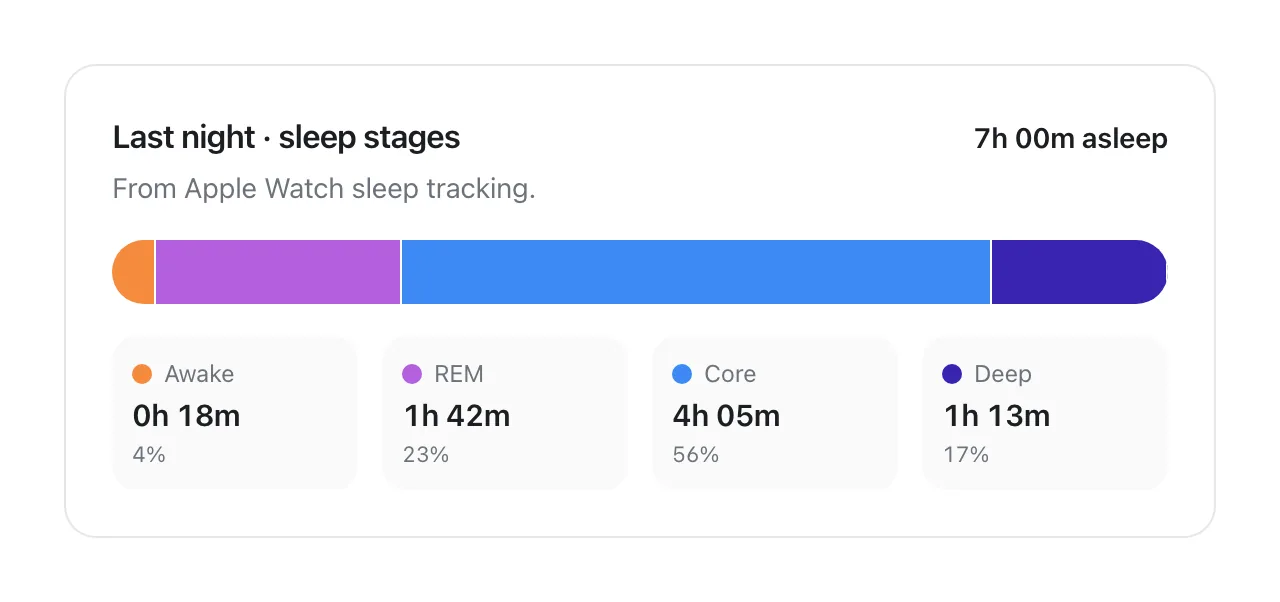
- Sleep stages: in Health, under Browse, then Sleep, the Stages view shows time and percentage in Awake, REM, Core and Deep. After drinking, look for less REM, a later first REM block, and more Awake time in the early morning. Apple Watch estimates stages from wrist movement rather than brainwaves, so treat one night as a hint, not a measurement.
- Sleep Score: Apple's score from 0 to 100 gives up to 50 points for duration, 30 for bedtime consistency and 20 for interruptions. A late night out plus more waking can cost you on all three.
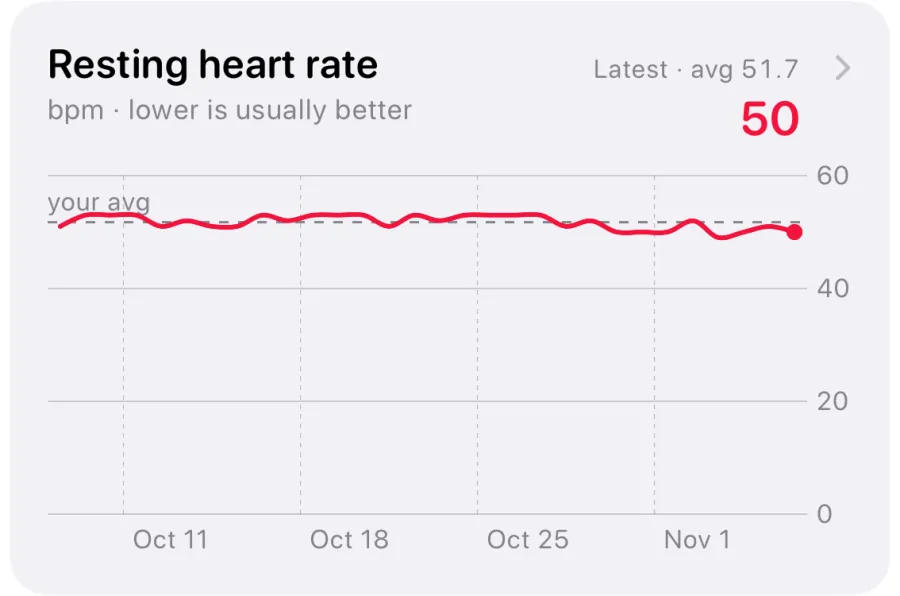
- Resting heart rate: often a few beats above your usual overnight level, in line with the Finnish data.
- HRV: often below your usual range. Apple Health stores HRV as SDNN in milliseconds, so compare it with your own history rather than with numbers from studies or other devices.
- Compare like with like. One low morning can be noise, a hard workout or a cold. A pattern across several drinking nights, against several ordinary ones, tells you far more.
How VedaWatch helps you see your own alcohol pattern
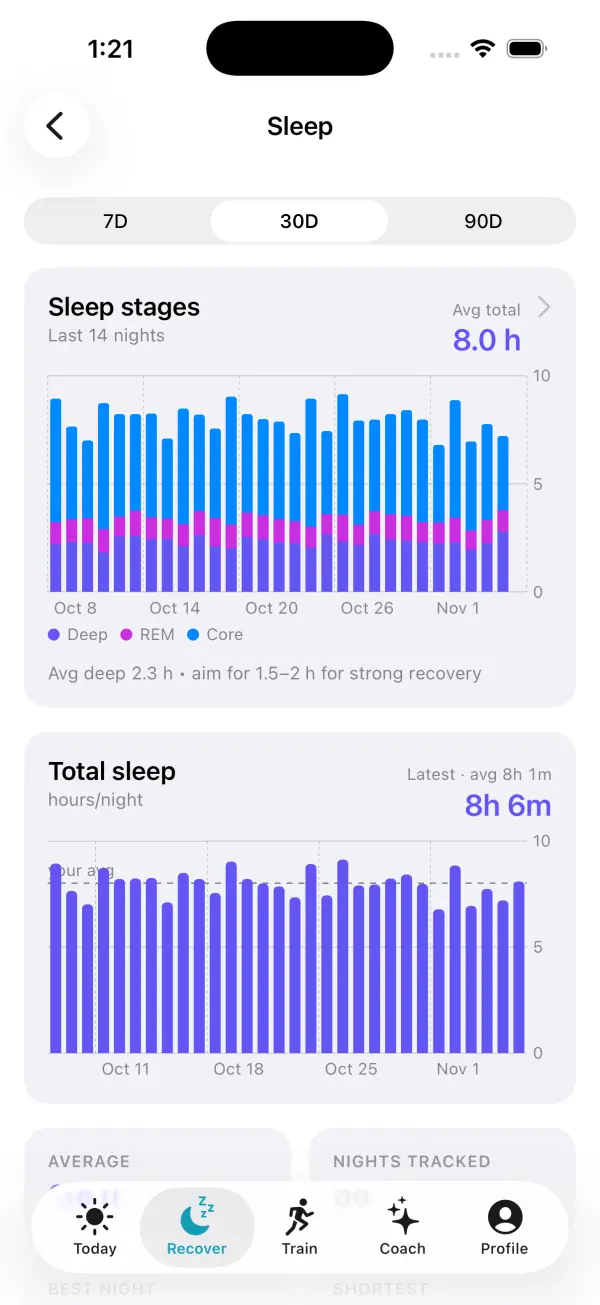
VedaWatch reads your sleep, resting heart rate and HRV from Apple Health and shows them against your own normal. The Sleep screen charts deep, REM and core sleep night by night, and Sleep Bank on the Recover tab keeps a running two-week sleep balance with a suggested bedtime, so a late night out shows up as a debt to pay back rather than a forgotten blip.
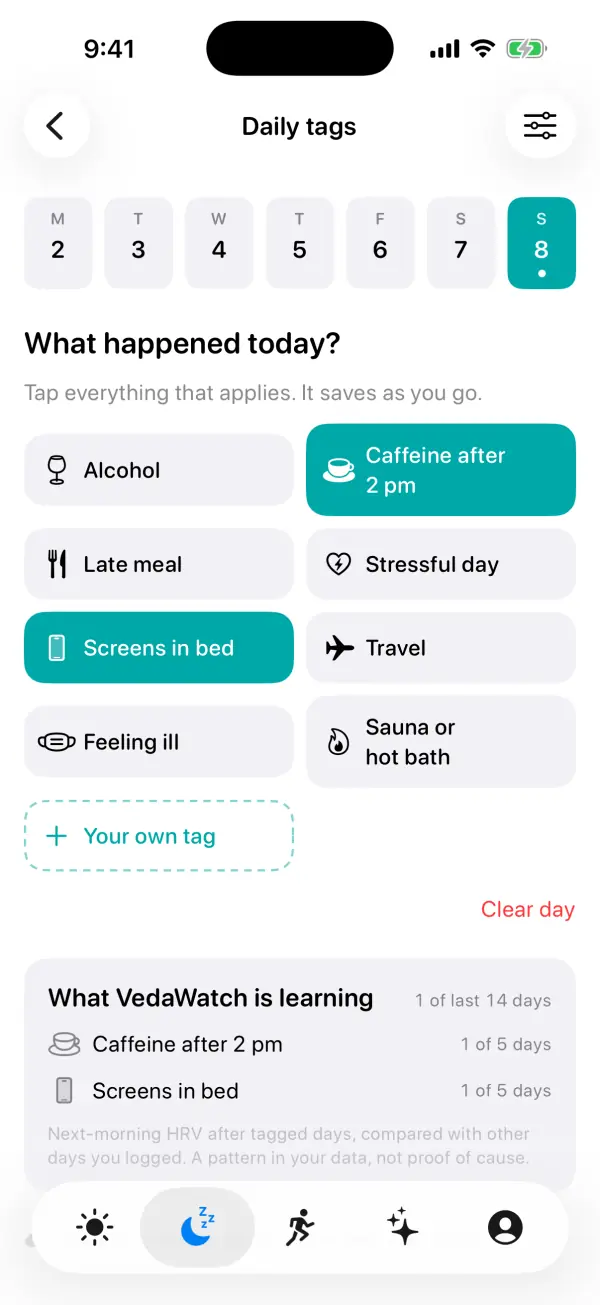
What Health can't see is the drink itself. VedaWatch's Daily tags journal has a built-in Alcohol tag, which you can tap on iPhone, fill in for the last week, or log from the Watch app. Tap Nothing notable on ordinary days, because unanswered days never count as no alcohol. Once you have at least 5 logged days with the tag, 5 without, and 30 mornings of overnight HRV, What VedaWatch is learning shows whether next-morning HRV is clearly lower after drinking days for you, or says No clear effect.
When alcohol shows a clear pattern for you, the Recover tab can say Expect a dip after yesterday's drinks the morning after you tag it. VedaWatch's illness warning leaves out nights after logged alcohol, so a night out isn't mistaken for the start of a cold. These are patterns in your own data, not medical advice.
When poor sleep after drinking is worth a doctor's visit
A rough night after a few drinks that settles within a day or two is common and expected. It's worth talking to a doctor if you often rely on alcohol to fall asleep, if your sleep stays poor on nights you don't drink, or if someone tells you that you snore loudly or stop breathing in your sleep, especially since alcohol can make breathing pauses worse.
Also get checked if you wake with a racing or irregular heartbeat, feel very sleepy during the day, or are worried about how much you drink. A doctor can help, and NIAAA has free resources for cutting back. Apple Watch and apps like VedaWatch can show patterns, but they don't diagnose sleep disorders.
Frequently asked questions
Does one glass of wine affect sleep?
Possibly a little. In the pooled lab data, clear REM changes started from around one and a half to two US standard drinks for an average-sized adult, and heart rate during early sleep was already slightly higher after a single drink in the Finnish study. A large glass of wine can hold close to two standard drinks.
Is beer, wine or spirits worse for sleep?
The research mostly looks at the amount of pure alcohol, not the type of drink. What matters most is how many grams of alcohol you take in and how close to bedtime, so a large glass of wine and two beers can have a similar effect.
Why do I have vivid dreams after drinking?
Alcohol holds REM back early in the night, and once it has been cleared, REM periods in the second half can run longer than normal. More REM in the early morning, plus more waking, can make dreams more vivid and easier to remember.
Does drinking water before bed stop alcohol disrupting sleep?
There isn't good evidence that water cancels alcohol's effects on REM or heart rate, and extra fluid late in the evening can add bathroom trips. Drinking less and finishing earlier are the changes the research supports.
Do I sleep worse the night after a heavy night out, too?
The studies here measured the same night as the drinking. A heavy night that also cuts your sleep short leaves you with a sleep debt, so the next night or two often feel heavier; tracking your own sleep and resting heart rate over the following days is the best way to see how long it takes you to bounce back.
Related guides
- Why do I wake up at 3am? Causes and how to get back to sleep
- Does alcohol lower HRV? Dose, timing and how long it lasts
- Apple Watch sleep stages: what Awake, REM, Core, and Deep mean
- How much REM sleep do you need? Normal amounts by age
- What lowers your HRV? Use a tag journal to find out
- Sleep debt calculator for Apple Watch: how VedaWatch's Sleep Bank works
- Apple Watch Sleep Score explained: what's good and how to raise it
Sources & further reading
- Gardiner C et al. (2025). The effect of alcohol on subsequent sleep in healthy adults: a systematic review and meta-analysis. Sleep Medicine Reviews 80:102030. doi:10.1016/j.smrv.2024.102030
- Ebrahim IO et al. (2013). Alcohol and sleep I: effects on normal sleep. Alcoholism: Clinical and Experimental Research 37(4):539-549. doi:10.1111/acer.12006
- Roehrs T, Roth T (2001). Sleep, sleepiness, and alcohol use. Alcohol Research & Health 25(2):101-109
- Pietilä J et al. (2018). Acute effect of alcohol intake on cardiovascular autonomic regulation during the first hours of sleep in a large real-world sample of Finnish employees. JMIR Mental Health 5(1):e23. doi:10.2196/mental.9519
- Kolla BP et al. (2018). The impact of alcohol on breathing parameters during sleep: a systematic review and meta-analysis. Sleep Medicine Reviews 42:59-67. doi:10.1016/j.smrv.2018.05.007
- Grosicki GJ et al. (2026). Real-world effects of alcohol on heart rate, sleep, and physical activity by age and sex. PLOS Digital Health 5(3):e0001284. doi:10.1371/journal.pdig.0001284
- National Institute on Alcohol Abuse and Alcoholism: What is a standard drink?
- Apple Support: Track your sleep on Apple Watch and use Sleep on iPhone
This guide is educational, not medical advice, and has not been clinically reviewed. VedaWatch is not a medical device. If you have symptoms or concerns about your heart or health, contact a qualified healthcare professional.
Put your trends in perspective.
Explore HRV, sleep, and recovery with VedaWatch on your iPhone.
Download VedaWatch on the App Store →