 VedaWatch
Recovery & Apple Watch
Does caffeine affect HRV? Coffee, sleep and your cutoff time
Does caffeine affect HRV? What studies on coffee and heart rate variability really show, why timing before sleep matters most, and how to test your own cutoff.
By VedaWatch editorial team · · 9 min read
The short answer
Sometimes, but less directly than most people think. In regular coffee drinkers, 100 to 200 mg of caffeine showed no measurable HRV change within 90 minutes. The bigger effect is indirect: caffeine late in the day shortens and lightens sleep, and Apple Watch measures HRV mostly while you sleep. Test your own cutoff time.
Does caffeine affect HRV?
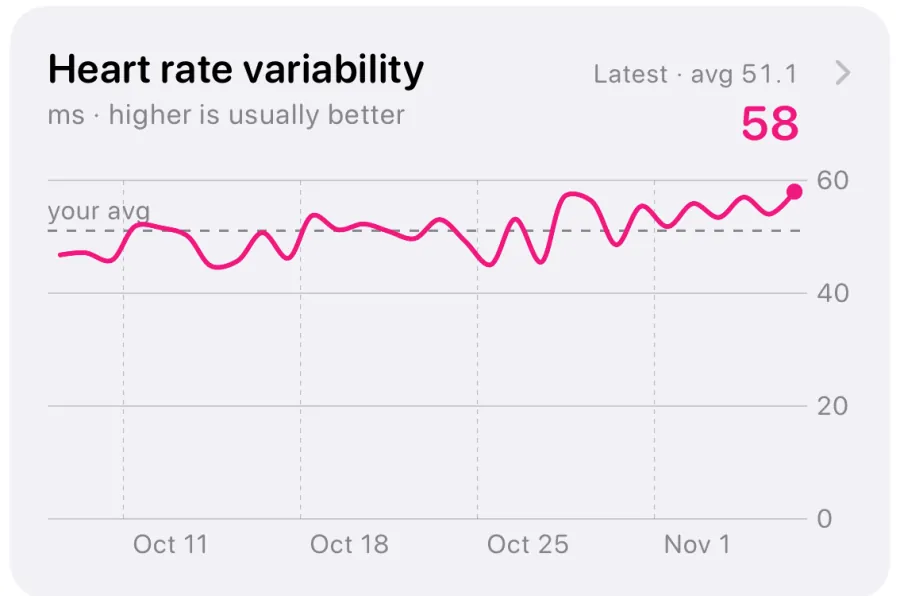
Heart rate variability (HRV) is the small variation in time between heartbeats. Caffeine is a stimulant, so it seems obvious that a coffee would lower it. The research doesn't back that simple story. Studies of caffeine's direct effect on HRV point in different directions: some find no change, some find higher HRV, and a few find signs of more stress-type (sympathetic) activity.
What is much more consistent is caffeine's effect on sleep. Caffeine taken in the afternoon or evening reliably shortens sleep and makes it lighter, and poor sleep is one of the things most likely to pull your HRV down. That matters a lot if you use an Apple Watch, because it takes most of its HRV readings while you sleep.
So the practical answer for most people: your morning coffee is unlikely to be what's moving your HRV. Your late coffee might be, through your sleep. And because people differ a lot in how fast they clear caffeine, the only way to know for you is to compare your own nights.
What the research on coffee and HRV actually shows
The studies are small, use different doses and timings, and measure HRV in different ways, which is why headlines contradict each other. Here is what a few well-designed trials found, and how far each one can be stretched.
- No change in regular coffee drinkers: in a randomized, double-blind crossover trial, 30 young men who habitually drank caffeine took a placebo, 100 mg or 200 mg. Resting HRV showed no significant difference at any point up to 90 minutes later (Rauh et al., 2006).
- Higher HRV during sleep: 21 healthy young men took 160 mg of slow-release caffeine or a placebo at bedtime and slept 4.5 hours later, so caffeine peaked during sleep. Caffeine lowered heart rate by an average of 3.24 beats per minute and raised high-frequency HRV, a marker of parasympathetic (rest) activity, in non-REM sleep, while also reducing deep-sleep brain activity (Baur et al., 2024).
- More sympathetic balance in REM sleep: 15 young adults took 400 mg of caffeine 30 minutes before bed. During REM sleep, the ratio of low- to high-frequency HRV power was higher than with placebo, which the authors read as a sympathetic effect (Bonnet et al., 2005).
- Slower recovery after exercise: 32 young men ran 30 minutes at 60% of peak oxygen uptake with caffeine or placebo. RMSSD, a common HRV measure, returned toward resting values faster with placebo (Gonzaga et al., 2017).
Acute vs habitual intake: why your daily coffee may not show up
Most HRV-and-caffeine headlines blur two different questions. The acute question is what happens to your HRV in the hour or two after a dose. The habitual question is whether drinking coffee every day changes your typical, baseline HRV.
For the acute question, the best-matched trial for everyday life is the one in habitual drinkers: a normal 100 to 200 mg dose made no detectable difference to HRV within 90 minutes. People who rarely use caffeine, or who take much larger doses such as the 400 mg used in some sleep studies, may respond differently, and those situations have been studied less.
For the habitual question, the honest answer is that we don't have good trials. That is less of a problem than it sounds for anyone tracking HRV with a watch, because your baseline already includes your usual coffee. If you drink two cups every morning, those cups are baked into your normal. What can move you away from that normal is a change: an extra afternoon espresso, a pre-workout drink in the evening, or a sudden stop.
The practical rule that follows: judge caffeine by its timing and by changes from your routine, not by whether you drink coffee at all.
The bigger effect: late caffeine, sleep and overnight HRV
Caffeine's effect on sleep is well established. A 2023 meta-analysis pooling 24 studies found that caffeine reduced total sleep time by 45 minutes and sleep efficiency by 7%, made falling asleep take about 9 minutes longer, and added about 12 minutes awake during the night. Deep sleep fell by 11.4 minutes, while light sleep went up (Gardiner et al., 2023).
The most telling study for evening coffee drinkers gave 400 mg of caffeine at bedtime, 3 hours before, or 6 hours before. Even at 6 hours before bed it cut sleep by more than an hour on an objective sleep monitor, yet participants' own sleep diaries showed a smaller drop of 41 minutes that didn't reach statistical significance (Drake et al., 2013). In other words, you may not feel how much a 4 pm coffee costs you.
Apple Watch records HRV several times a day but mostly overnight, and the Health app reports it as SDNN in milliseconds. If late caffeine gives you a shorter, lighter, more broken night, that can show up the next morning as lower overnight HRV and a higher resting heart rate, even if the caffeine never touched your HRV directly. That indirect route is why timing matters more than the cup itself.
How long does caffeine stay in your system?
Caffeine's half-life, the time it takes your body to clear half of a dose, is typically quoted as three to six hours, but across healthy adults it ranges from about two to ten hours. Factors such as smoking, oral contraceptives, some antidepressants, liver function, age and genetics all shift it, and the U.S. Food and Drug Administration notes wide variation in both how sensitive people are to caffeine and how fast they eliminate it.
A simple worked example shows why that range matters. Say you have a 200 mg coffee at 3 pm and go to bed at 11 pm, eight hours later. These figures are arithmetic, not measurements:
- Half-life of 4 hours: two half-lives pass before bed, so about 50 mg is still in your body at 11 pm.
- Half-life of 5 hours: a bit over one and a half half-lives pass, leaving roughly 66 mg at 11 pm, and still about 33 mg at 4 am.
- Half-life of 8 hours: only one half-life passes, so about 100 mg is still active as you fall asleep, the same as drinking half that coffee at bedtime.
What time should you stop drinking caffeine?
The 2023 meta-analysis went further and estimated how long before bed different drinks must be finished to avoid a significant loss of total sleep. Using its figures and a 10 pm bedtime as the example:
- Cup of coffee (about 107 mg per 250 mL): at least 8.8 hours before bed, so before about 1:12 pm.
- Standard serve of pre-workout supplement (about 217.5 mg): at least 13.2 hours before bed, so before about 8:50 am.
- Cup of black tea: no cutoff was found; it didn't significantly reduce total sleep time at any time before bed.
- Different bedtime: subtract the same number of hours. For an 11:30 pm bedtime, that is coffee before about 2:42 pm and pre-workout before about 10:18 am.
How to test your own caffeine cutoff
Because half-lives differ so much, a published cutoff is only a starting point; the meta-analysis authors say the same. A simple self-experiment tells you far more than any average. Plan on three to six weeks, because day-to-day HRV noise is larger than most single-day effects.
- Pick one question to test, for example "Does coffee after 2 pm lower my next-morning HRV?" Keep the dose roughly the same each time, such as one regular cup.
- Keep everything else as steady as you reasonably can: similar bedtime, no change in your usual morning coffee, and note days with alcohol, illness, travel or hard training, since those move HRV too.
- Wear your Apple Watch to bed every night so it records overnight HRV and sleep.
- Mix late-caffeine days and no-late-caffeine days across the weeks instead of doing one block of each, so a stressful week or a training block doesn't land on only one side.
- Record honestly every day, including the ordinary days. The comparison only works if you know which mornings followed which days.
- Compare the average next-morning HRV, resting heart rate and sleep duration after late-caffeine days with the averages after the other days. Look for a difference that holds across many mornings, not one striking night.
- If you see a clear dip, move your cutoff two hours earlier and repeat. If you see nothing after several weeks, your afternoon coffee probably isn't your HRV problem, and the answer lies elsewhere.
How VedaWatch helps you run the test
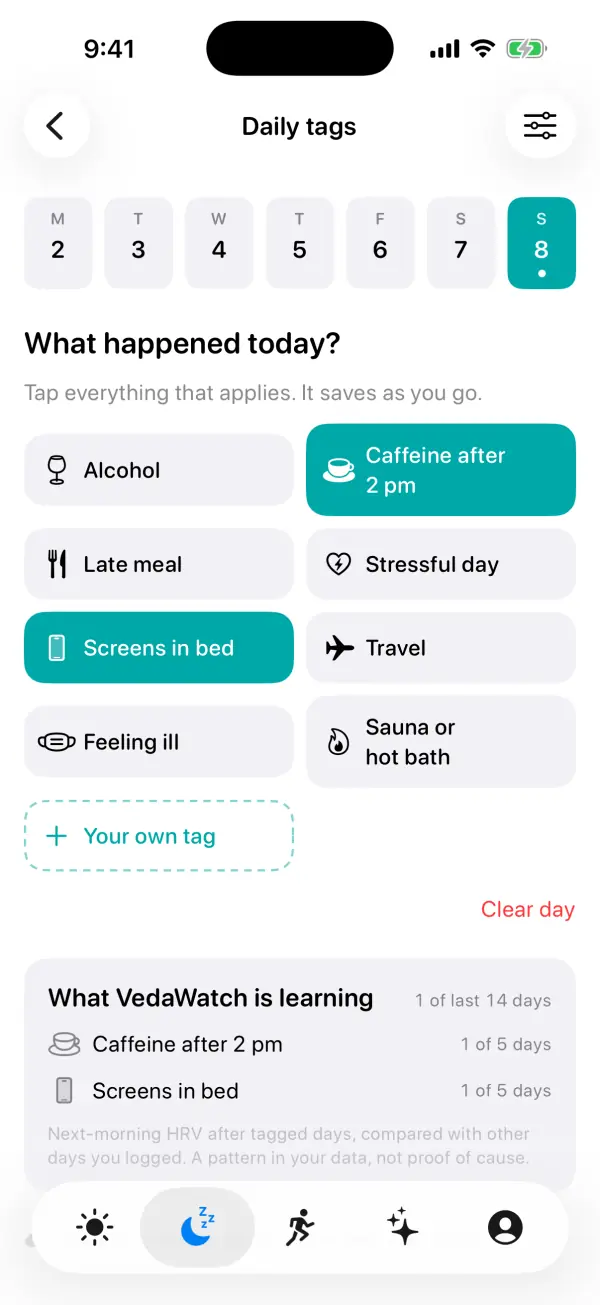
VedaWatch's Daily tags journal is built for exactly this experiment. One of its built-in tags is Caffeine after 2 pm. You tap it on days it applies, or tap Nothing notable on ordinary days so they count as the comparison group. You can log from the iPhone, for any of the last six days, or from the Log page in the Apple Watch app. If you want to test a different cutoff, add your own tag, such as Coffee after noon or Pre-workout after 4 pm.
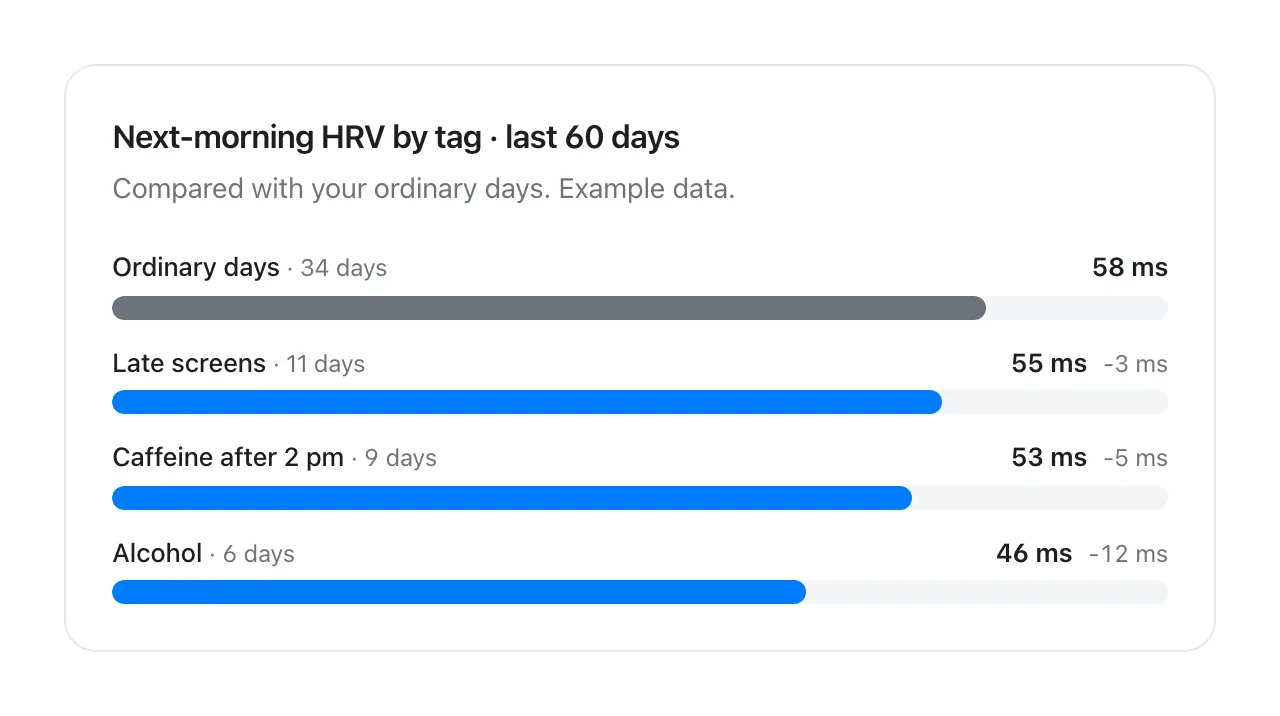
Under What VedaWatch is learning, each tag shows its progress until there's enough data: at least 5 logged days with the tag, 5 without it, and 30 mornings of overnight HRV from your Watch. It then compares next-morning HRV, as a percentage above or below your own normal, after tagged days with logged days without the tag over the last 60 days. A result appears only when the difference is at least 4% and clearly larger than chance; otherwise you'll see No clear effect.
If late caffeine does show a clear cost for you, the Recover tab can flag it the next morning, with a note such as "Expect a dip after yesterday's late coffee", alongside your readiness breakdown of HRV, resting heart rate and sleep against your baseline. Like any pattern in personal data, it's a correlation to act on sensibly, not proof of cause.
When caffeine and heart readings are worth a doctor's visit
HRV from a watch is a wellness signal, not a diagnosis, and this guide isn't medical advice. For most healthy adults, the FDA describes up to 400 mg of caffeine a day as an amount not generally associated with negative effects, and it notes wide variation in how sensitive people are. If you're pregnant, have a heart condition or take regular medication, ask your doctor what amount suits you.
Talk to a doctor if caffeine brings on palpitations, a racing or irregular heartbeat, chest discomfort, dizziness or marked anxiety, or if your resting heart rate or HRV changes a lot and stays changed for reasons you can't explain. Seek urgent care for chest pain, fainting or severe shortness of breath.
Frequently asked questions
Does decaf coffee affect HRV?
Decaf isn't caffeine-free, but it's close: the FDA lists 2 to 15 mg in an 8-ounce cup, a small fraction of a regular coffee. Switching afternoon cups to decaf is an easy way to keep the habit while testing whether caffeine timing matters for your sleep and HRV.
Should I quit coffee to raise my HRV?
There's no good evidence that quitting coffee raises HRV in people who drink it regularly. Moving caffeine earlier in the day is a more targeted first step, and it leaves your usual morning routine, which is already part of your baseline, untouched.
Does caffeine raise resting heart rate on Apple Watch?
Not reliably in the studies above; one even found slightly lower heart rate during sleep after caffeine. But if late caffeine costs you sleep, a higher resting heart rate the next day is a common side effect, so watch both numbers together.
Does a pre-workout drink affect HRV after training?
In one trial, HRV returned to resting levels more slowly after a run with caffeine than with placebo. Pre-workout products often contain about twice the caffeine of a cup of coffee, so an evening workout with one is the riskiest combination for that night's sleep.
Is energy drink or tea caffeine different from coffee?
Caffeine is the same molecule; what differs is the dose. A cup of black tea had no measurable effect on total sleep time at any hour in the 2023 meta-analysis, while larger doses such as pre-workout servings needed a much earlier cutoff.
Related guides
- What lowers your HRV? Use a tag journal to find out
- Why is my HRV so low? Causes of a sudden drop and what to check
- How to improve your HRV: habits that actually move the number
- Does alcohol lower HRV? Dose, timing and how long it lasts
- HRV after a workout: the normal dip and how long recovery takes
- Apple Watch HRV: how to check it and understand your trends
Sources & further reading
- Gardiner C et al. (2023). The effect of caffeine on subsequent sleep: A systematic review and meta-analysis. Sleep Medicine Reviews 69:101764. doi:10.1016/j.smrv.2023.101764
- Drake C, Roehrs T, Shambroom J, Roth T (2013). Caffeine effects on sleep taken 0, 3, or 6 hours before going to bed. Journal of Clinical Sleep Medicine 9(11):1195-1200. doi:10.5664/jcsm.3170
- Rauh R, Burkert M, Siepmann M, Mueck-Weymann M (2006). Acute effects of caffeine on heart rate variability in habitual caffeine consumers. Clinical Physiology and Functional Imaging 26(3):163-166. doi:10.1111/j.1475-097X.2006.00663.x
- Baur DM, Dornbierer DA, Landolt HP (2024). Concentration-effect relationships of plasma caffeine on EEG delta power and cardiac autonomic activity during human sleep. Journal of Sleep Research 33(5):e14140. doi:10.1111/jsr.14140
- Bonnet M, Tancer M, Uhde T, Yeragani VK (2005). Effects of caffeine on heart rate and QT variability during sleep. Depression and Anxiety 22(3):150-155. doi:10.1002/da.20127
- Gonzaga LA, Vanderlei LCM, Gomes RL, Valenti VE (2017). Caffeine affects autonomic control of heart rate and blood pressure recovery after aerobic exercise in young adults: a crossover study. Scientific Reports 7:14091. doi:10.1038/s41598-017-14540-4
- U.S. Food and Drug Administration. Spilling the Beans: How Much Caffeine is Too Much?
This guide is educational, not medical advice, and has not been clinically reviewed. VedaWatch is not a medical device. If you have symptoms or concerns about your heart or health, contact a qualified healthcare professional.
Put your trends in perspective.
Explore HRV, sleep, and recovery with VedaWatch on your iPhone.
Download VedaWatch on the App Store →