 VedaWatch
Sleep
Why do I wake up at 3am? Causes and how to get back to sleep
Why do I wake up at 3am? How normal sleep cycles, alcohol, stress, caffeine and sleep apnoea cause night waking, what to do, and how it shows on Apple Watch.
By VedaWatch editorial team · · 9 min read
The short answer
Waking around 3am is often normal: sleep gets lighter in the second half of the night, and brief awakenings between sleep cycles are common, especially with age. Alcohol, stress, late caffeine, a warm room, needing the toilet and sleep apnoea make it more likely. If you can't get back to sleep after about 20 minutes, get up, do something calm in dim light and return when sleepy.
Why do I wake up at 3am?
Mostly because of how a night of sleep is built. Sleep runs in repeating cycles of non-REM and REM sleep, the first lasting about 70 to 100 minutes and later ones about 90 to 120. A 2006 Institute of Medicine report on sleep physiology describes most deep, slow-wave sleep happening in the first third of the night, while REM sleep, a lighter and more easily disturbed state, is longest in the last third. By 3am you've usually used up most of your deep sleep, so you spend more time in lighter stages that are easier to wake from.
Short awakenings at the end of a cycle are a normal part of that pattern. Apple's sleep-staging paper puts it plainly: brief awakenings are common in normal sleep, and the sleeper often doesn't recognise them. Most are forgotten by morning. The ones you notice are the ones where something keeps you awake long enough to look at the clock.
That's where the usual suspects come in. Alcohol wearing off, a busy mind, caffeine from the afternoon, a warm bedroom, a full bladder or disturbed breathing can all turn a normal, brief stir into a stretch of lying awake. The time on the clock is less important than whether this happens most nights and how you feel the next day.
Is it normal to wake up in the middle of the night?
Yes, within limits. Even healthy young adults have short awakenings during the night, and the Institute of Medicine report notes that they're usually minor and tend to cluster around the transitions into and out of REM sleep. Your sleep is still considered consolidated if you drift back off quickly.
Age changes the picture. A 2004 meta-analysis of 65 sleep studies in healthy people aged 5 to 102 found that time awake after first falling asleep increased with age in adults, while deep sleep and sleep efficiency decreased. The Institute of Medicine report links this to the decline in slow-wave sleep: it's the stage that's hardest to wake from, so with less of it, older adults wake more often during the night.
So a 60-year-old who wakes twice a night and falls back asleep is usually seeing normal ageing, not a disorder. What matters more is how long you're awake, how often it happens, and whether you're tired, irritable or struggling to concentrate during the day.
What causes waking up in the middle of the night?
Several common causes make night waking more likely. Often more than one is at play on the same night:
- Alcohol. It helps you fall asleep, but a 2013 review of studies in healthy volunteers found it consolidates the first half of the night and increases sleep disruption in the second half, as the alcohol wears off. That's the classic 3am wake-up after a few drinks.
- Stress, worry and low mood. The NHS lists stress, anxiety and depression among the common causes of insomnia, and waking very early and not being able to get back to sleep is one of its listed insomnia symptoms. A mind that starts planning or replaying the day the moment you stir makes it hard to drift off again.
- Caffeine too late in the day. The NHS advises no tea or coffee in the 6 hours before bed. Caffeine taken later than that can still be affecting your sleep in the early hours.
- A room that's too hot or too cold, noise or an uncomfortable bed, all of which the NHS names as common causes of poor sleep.
- Needing the toilet. Drinking a lot in the evening, and alcohol, make this more likely. The US National Heart, Lung, and Blood Institute (NHLBI) also lists waking often at night to urinate as a possible sign of sleep apnoea.
- Sleep apnoea. Breathing that repeatedly stops and starts during sleep can wake you many times a night, often without you knowing why. The NHLBI lists loud snoring, gasping for air and daytime sleepiness among its symptoms, and many people only learn about them from a bed partner.
- Your schedule. Going to bed very early to catch up, napping late in the day, shift work or jet lag can all leave you awake at 3am because your body has had enough sleep, or thinks it's daytime.
Woke up and can't go back to sleep? What to do
The most useful advice comes from cognitive behavioural therapy for insomnia (CBT-I), which the American Academy of Sleep Medicine (AASM) strongly recommends for chronic insomnia. One of its parts, stimulus control, includes the instruction to get out of bed when you're unable to sleep. The goal is to stop your brain linking bed with being awake and frustrated.
How long to wait? The Royal National Orthopaedic Hospital NHS Trust's sleep advice is to get up and do something calm if you've lain awake for 20 minutes or more. Go by how long it feels rather than checking a clock: the same advice warns that frequent clock-watching can wake you up further and feed negative thoughts.
If you wake in the night, try this:
- Stay still and relaxed for a few minutes first. Many awakenings end on their own if you don't start thinking about them.
- Don't check the time, your phone or your watch. Knowing it's 3:12am rarely helps you sleep.
- If roughly 20 minutes pass, or you feel restless or frustrated, get up and go to another room.
- Do something quiet and dull in dim light, such as reading a paper book, slow breathing or listening to calm audio. Avoid bright screens, work and food.
- Go back to bed only when you feel sleepy again. Repeat if needed.
- Get up at your usual time the next morning, however the night went. The NHS advises not sleeping in after a bad night, because a lie-in makes the next night harder.
- Skip naps the next day if you can, so you build enough sleep pressure for the following night.
How waking up at night shows on Apple Watch
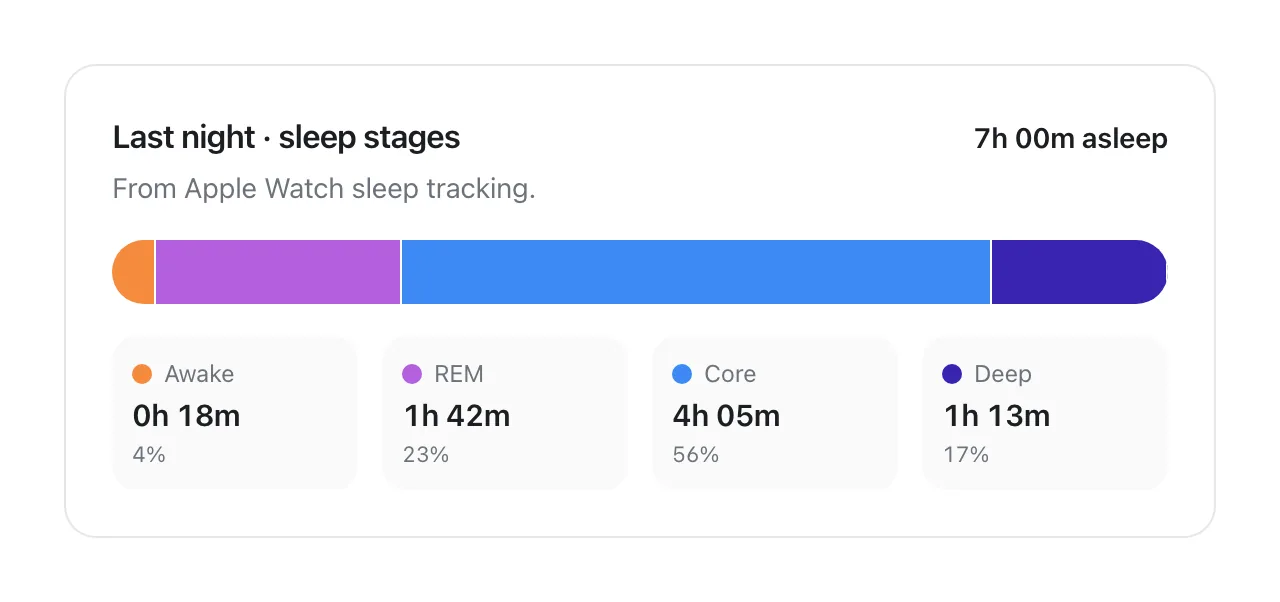
If you wear your Apple Watch to bed with sleep tracking on, the Health app shows each night split into Awake, REM, Core and Deep sleep, with the time and percentage in each. Night-time awakenings appear as Awake segments between stretches of sleep. In the Health app, open Browse, then Sleep, and pick a night to see when they happened.
Apple's technical paper explains how this works. The Watch uses its motion sensor, including the small movements of breathing, to classify every 30-second window of your night. It's very good at spotting sleep: in Apple's validation, 97.9% of true sleep epochs were labelled as sleep. It's weaker at spotting wake: about 75% of true awake epochs were labelled correctly, and the rest were counted as sleep. In practice that means the Watch is more likely to miss a quiet awakening than to invent one, especially if you lie very still.
Apple's 2025 update targeted exactly this. With iOS 26 and watchOS 26, it improved detection of "quiet wake", when you're awake but very still, and correct classification of wake rose from 70% to 79% in its validation set. Even so, if you remember lying awake for an hour and the Watch shows 25 minutes, believe your experience as much as the chart. Apple also says its sleep stages aren't intended for clinical use.
The most useful thing the Watch gives you is the pattern over weeks: whether Awake time is rising, whether awakenings cluster at the same time of night, and whether bad nights line up with drinks, late coffee or stressful days.
How to find out what's waking you up
Night waking usually has a pattern, and a couple of weeks of notes will often show it. Pair what your Watch records with what you did that day:
- Wear your Apple Watch to bed every night for at least two weeks, charged to at least 30%, so you have a steady record of Awake time.
- Each morning, note roughly when you woke and how long you think you were awake, alongside the Watch's Awake total.
- Write down the likely suspects for the day before: drinks and when you finished them, caffeine after lunch, a late meal, a hard evening workout, a stressful day, how warm the bedroom was.
- Note whether you got up to use the toilet, and whether anyone has heard you snore or stop breathing.
- After two weeks, compare your worst nights with your best. A cause that keeps showing up before bad nights is worth changing first. Change one thing at a time and give it a week or two.
How VedaWatch helps you track night waking
VedaWatch reads the sleep your Apple Watch writes to Apple Health. On the Recover tab, the Last night card shows your total sleep with a bar split into Deep, REM, Core and Awake time, your bedtime and wake time, and a note when you went to bed 20 minutes or more earlier or later than usual. Tap it to open your sleep history.
Daily tags let you record what Health can't see, including Alcohol, Caffeine after 2 pm, Late meal, Stressful day and Screens in bed. Once a tag has enough logged days, VedaWatch shows whether next-morning HRV tends to differ after those days, which is a useful pointer to what disturbs your nights. It describes patterns in your own data; it isn't a diagnosis or medical advice.
When waking at night means you should see a doctor
A few broken nights during a stressful week, after travel or after drinking are common and usually pass. The NHLBI describes chronic insomnia as trouble sleeping on 3 or more nights a week for more than 3 months that can't be fully explained by another health problem. The NHS suggests seeing a GP if changing your sleep habits hasn't helped, if you've had trouble sleeping for months, or if it's affecting your daily life in a way that makes it hard to cope. CBT-I, delivered by a trained clinician or a structured programme, is the treatment the AASM strongly recommends.
See a doctor sooner if you snore loudly, someone notices you stop breathing or gasp in your sleep, or you're very sleepy during the day. These can be signs of sleep apnoea, which needs a proper sleep study to diagnose. The same applies if you often wake very early with low mood, or you get up several times a night to pee. An Apple Watch can help you describe what's happening, but it can't diagnose a sleep disorder.
Frequently asked questions
Is waking up at 3am a sign of anything?
Usually not on its own. Sleep is naturally lighter in the second half of the night, so that's when awakenings are most likely. It's worth checking with a doctor if it happens most nights for months, or comes with loud snoring, low mood or heavy daytime tiredness.
Why do I wake up at the same time every night?
Sleep cycles and your body clock are fairly regular, so if something reliably disturbs you, such as alcohol wearing off, a full bladder or a room that heats up, it tends to happen at a similar point in the night. Noticing the habit of waking can also make you more alert each time it happens.
Should I get up if I can't go back to sleep?
Yes, if you've been awake for roughly 20 minutes or feel frustrated. Go to another room, do something calm in dim light and go back to bed when you feel sleepy. This is part of stimulus control, a core part of CBT-I.
Should I check the time when I wake up at night?
Better not. Clock-watching tends to wake you up further and feed worry about how much sleep you're losing. Judge the 20 minutes by feel rather than by the clock.
Why does Apple Watch show less awake time than I remember?
The Watch is better at detecting sleep than wake, so quiet awakenings, when you're lying still, can be counted as sleep. Use the Watch for trends over weeks rather than exact minutes.
Does alcohol make you wake up in the night?
Often, yes. Alcohol tends to make the first half of the night more solid and the second half more broken as it wears off. Our guide on how alcohol affects sleep covers timing and dose.
Is waking up at night worse as you get older?
It becomes more common. Studies find that time awake during the night rises with age while deep sleep falls, so more awakenings are expected later in life. Long awakenings with daytime tiredness are still worth raising with a doctor.
Related guides
- How alcohol affects sleep: REM, waking at 3 am and your heart
- How to fall asleep faster: CBT-I techniques that work
- Apple Watch sleep stages: what Awake, REM, Core, and Deep mean
- Apple Watch sleep apnea notifications: what they mean
- Sleep consistency: why a regular bedtime matters, and how much
- Apple Watch sleep tracking: how accurate is it, and what to do when it's wrong
Sources & further reading
- Institute of Medicine (US) Committee on Sleep Medicine and Research; Colten HR, Altevogt BM, eds. (2006). Sleep Disorders and Sleep Deprivation: An Unmet Public Health Problem. Chapter 2: Sleep Physiology
- Apple: Estimating Sleep Stages from Apple Watch (white paper, updated October 2025)
- Ohayon MM et al. (2004). Meta-analysis of quantitative sleep parameters from childhood to old age in healthy individuals. Sleep 27(7):1255-1273. doi:10.1093/sleep/27.7.1255
- Ebrahim IO et al. (2013). Alcohol and sleep I: effects on normal sleep. Alcoholism: Clinical and Experimental Research 37(4):539-549. doi:10.1111/acer.12006
- Edinger JD et al. (2021). Behavioral and psychological treatments for chronic insomnia disorder in adults: an American Academy of Sleep Medicine clinical practice guideline. J Clin Sleep Med 17(2):255-262. doi:10.5664/jcsm.8986
- NHS: Insomnia
- Royal National Orthopaedic Hospital NHS Trust: Sleep (patient information)
- National Heart, Lung, and Blood Institute: Insomnia
- National Heart, Lung, and Blood Institute: Sleep apnea symptoms
This guide is educational, not medical advice, and has not been clinically reviewed. VedaWatch is not a medical device. If you have symptoms or concerns about your heart or health, contact a qualified healthcare professional.
Put your trends in perspective.
Explore HRV, sleep, and recovery with VedaWatch on your iPhone.
Download VedaWatch on the App Store →