 VedaWatch
Sleep
How much REM sleep do you need? Normal amounts by age
How much REM sleep do you need? Typical REM share by age, why short nights cut REM most, what suppresses it, and how accurately Apple Watch measures REM.
By VedaWatch editorial team · · 9 min read
The short answer
Most healthy adults spend roughly 20 to 25% of their sleep in REM, which works out to about 1.5 to 2 hours on a 7 to 8 hour night. You don't need to chase a number: REM comes mostly in the second half of the night, so getting enough total sleep is the main way to protect it.
How much REM sleep do you need?
There is no official REM target, but sleep research gives a clear typical range. The Sleep Foundation puts REM at around 25% of sleep in adults and says most adults need about two hours a night. In the healthy adults Apple used to validate its sleep-stage algorithm, measured with lab-grade polysomnography (PSG), REM averaged 21.4% of total sleep, with a standard deviation of 7 percentage points. That spread matters: plenty of healthy people sit well above or below the average.
A practical way to read those numbers is as a share of whatever you slept, not as a fixed number of minutes. The table below uses a 20 to 25% band, which covers the averages above. If your own figure regularly lands somewhere in or near it, there's little to read into on any single night.
Because REM is a share of total sleep, the most reliable way to get more of it is simply to sleep long enough. The American Academy of Sleep Medicine and Sleep Research Society recommend that adults get at least 7 hours a night on a regular basis.
- 6 hours asleep: 20 to 25% REM is about 72 to 90 minutes.
- 7 hours asleep: 20 to 25% REM is about 84 to 105 minutes.
- 8 hours asleep: 20 to 25% REM is about 96 to 120 minutes.
- 9 hours asleep: 20 to 25% REM is about 108 to 135 minutes.
What REM sleep is, and why it matters
REM stands for rapid eye movement. During REM your eyes move quickly behind closed lids, brain activity looks closer to waking, breathing becomes faster and less regular, and heart rate and blood pressure rise toward daytime levels. Most vivid dreaming happens in REM, while the arm and leg muscles are temporarily paralyzed so you don't act dreams out.
The US National Institute of Neurological Disorders and Stroke (NINDS) notes that memory consolidation most likely needs both non-REM and REM sleep. That's a good reason not to think of REM as the "good" stage and the rest as filler: a normal night needs light, deep and REM sleep together, in cycles.
How REM sleep changes with age
The biggest change happens early in life. According to the Sleep Foundation, newborns spend around eight hours a day in REM, which researchers link to rapid brain development. REM's share falls through childhood toward adult levels.
In adults, the picture is more modest than many articles suggest. NINDS says you spend less of your time in REM as you age, and a large 2004 meta-analysis by Ohayon and colleagues (65 studies, 3,577 people aged 5 to 102) found that the percentage of REM sleep decreases with age in adults. But a 2019 meta-analysis of 169 studies and 5,273 healthy adults scored under current rules (Boulos and colleagues) found no significant change in REM percentage per decade of age. What did change was total sleep: about 10 minutes less per decade, with more time awake during the night.
Put together, an older adult usually keeps a similar REM share but may get somewhat fewer REM minutes because total sleep is shorter and more broken. A 65-year-old with a bit less REM than at 30 is usually seeing normal aging, not a problem to fix.
When REM happens in the night, and why short sleep cuts it most
Sleep runs in cycles of non-REM and REM. NINDS says REM first occurs about 90 minutes after falling asleep, and that REM periods get longer later in the night. The Sleep Foundation describes full cycles of about 90 to 120 minutes and notes that most REM takes place in the second half of the night. Deep sleep is the opposite: it is concentrated in the first half.
That timing is why the way you lose sleep matters. Going to bed late but waking at your usual time, or setting an early alarm, trims the end of the night, where the longest REM periods sit. So a night that is 20% shorter can lose noticeably more than 20% of its REM. Deep sleep, front-loaded in the night, tends to be better protected.
Here's a simple worked example. If you normally sleep from 11 pm to 7 am and set a 5:30 am alarm for an early flight, you lose the last 90 minutes of sleep. That window is typically one of the most REM-rich parts of the night, so your REM total for that night is likely to drop by much more than your deep sleep. The Sleep Foundation also notes that after a night short on REM, the brain may make up some of it the next night, a REM rebound, which is one reason a single low night isn't worth worrying about.
What lowers REM sleep: alcohol, medications and more
Alcohol. A review of studies in healthy volunteers by Ebrahim and colleagues found that alcohol delays the first REM period at all doses, and that total-night REM percentage falls in most studies at moderate and high doses, with no clear trend at low doses. Alcohol also tends to make the first half of the night more consolidated and the second half more disrupted. If you want to see this in your own data, compare nights with and without a drink rather than a single night.
Medications. Many antidepressants change sleep stages, and the most consistent effect is on REM. A review by Wilson and Argyropoulos found that antidepressants reduce REM and delay its onset, in both healthy volunteers and people with depression, with the strongest effect from drugs that boost serotonin, such as SSRIs. The reduction is usually largest early in treatment and eases over time, except with MAO inhibitors, which can suppress REM for months. A lower REM figure on these medications is an expected effect, not a sign that the medicine is harming you. Never stop or change a prescription because of a sleep tracker; talk to your prescriber if sleep is bothering you.
Other factors. The Sleep Foundation lists excess stress, alcohol or cannabis at night, certain medications including some sleep aids, and sleep disorders such as insomnia and sleep apnea as things that can disrupt REM. An irregular schedule and short nights do the same simply by cutting into later cycles.
How to get more REM sleep
There's no proven trick to raise REM on its own. What helps is removing the things that cut it short. These steps follow directly from when REM happens and what suppresses it.
- Protect the end of the night. Moving bedtime earlier usually does more for REM than anything else, because it stops the alarm from cutting off your longest REM periods.
- Aim for at least 7 hours asleep, not just in bed. Time awake in the night doesn't count toward REM.
- Keep a regular sleep and wake time, including weekends, so your cycles aren't repeatedly cut short.
- Leave a gap between alcohol and bed, and notice what more than one or two drinks does to your night.
- If you take a medication that affects sleep, don't change it yourself. Ask your doctor or pharmacist whether timing or alternatives are worth discussing.
- Judge changes over two weeks or more. One night with low REM, especially after a short or late night, is normal variation.
How accurate is REM sleep on Apple Watch?
Apple Watch has no brainwave sensor. It estimates stages every 30 seconds from the wrist accelerometer, including the small movements of breathing, and labels each one Awake, REM, Core or Deep. Apple published how this compares with PSG scored by sleep technologists.
For REM specifically, Apple's original 2022 algorithm correctly labelled 78% of true REM epochs in its validation set, and the updated algorithm described in the October 2025 appendix raised that to 82%. The most common mistake was calling REM Core: 21% of true REM with the original algorithm and 16% with the update. Mistaking REM for Deep was rare, at well under 1%. In the other direction, about 5 to 6% of true Core sleep was labelled REM.
What that means in practice: your watch is more likely to slightly undercount REM than to invent it, and a few minutes up or down on any night are within the watch's error. Trends over weeks are far more trustworthy than single nights. Apple also says full stage data is only written when a detected sleep session is longer than three hours, so short naps won't show REM, and that its sleep stages aren't intended for clinical use. Other wearables use different sensors and algorithms, so compare each device with itself rather than with another brand.
When low REM is worth talking to a doctor about
A low REM number on a wearable isn't a diagnosis, and consumer trackers can't diagnose sleep disorders. What matters more is how you feel and what others notice. It's worth talking to a doctor if you're regularly very sleepy in the day despite enough time in bed, someone hears you snore loudly or stop breathing, you act out dreams by shouting, punching or kicking in your sleep, or you have frequent nightmares or disturbed sleep after starting a new medication.
Bring a few weeks of your sleep data if it helps the conversation, but expect a clinician to rely on your symptoms and, if needed, a proper sleep study.
Seeing your REM trend with VedaWatch
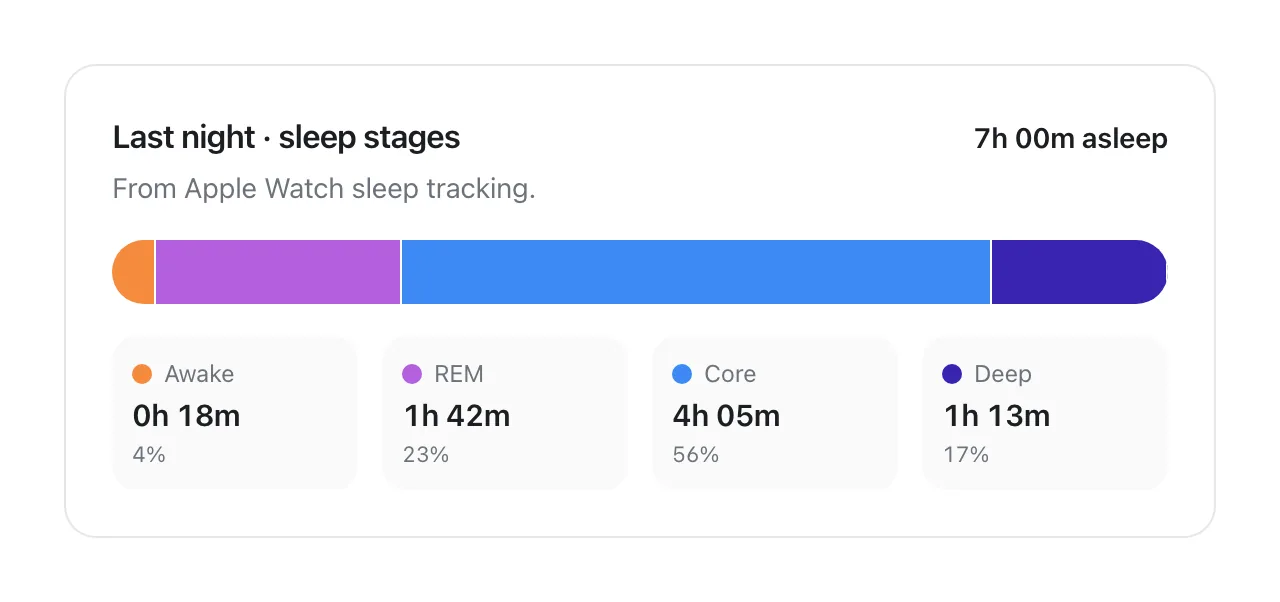
VedaWatch reads the sleep stages your Apple Watch already writes to Apple Health, with your permission. On the Recover tab, the Last night card splits the night into Deep, REM, Core and Awake time, and shows your bedtime and wake time, noting when you went to bed noticeably later or earlier than usual. That makes it easy to connect a low-REM night with a late bedtime or an early alarm.
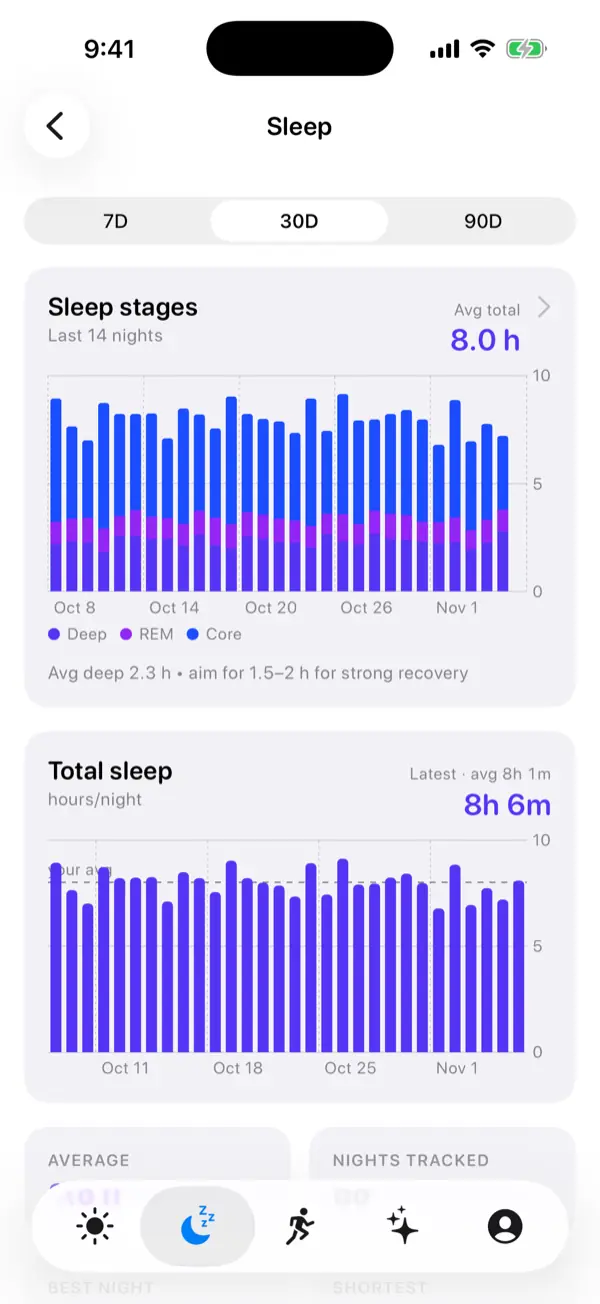
Tap through to the Sleep screen to see the Sleep stages chart, with Deep, REM and Core stacked night by night for the last 14 nights next to your total sleep. Looking at REM as part of the whole bar keeps one odd night in proportion.
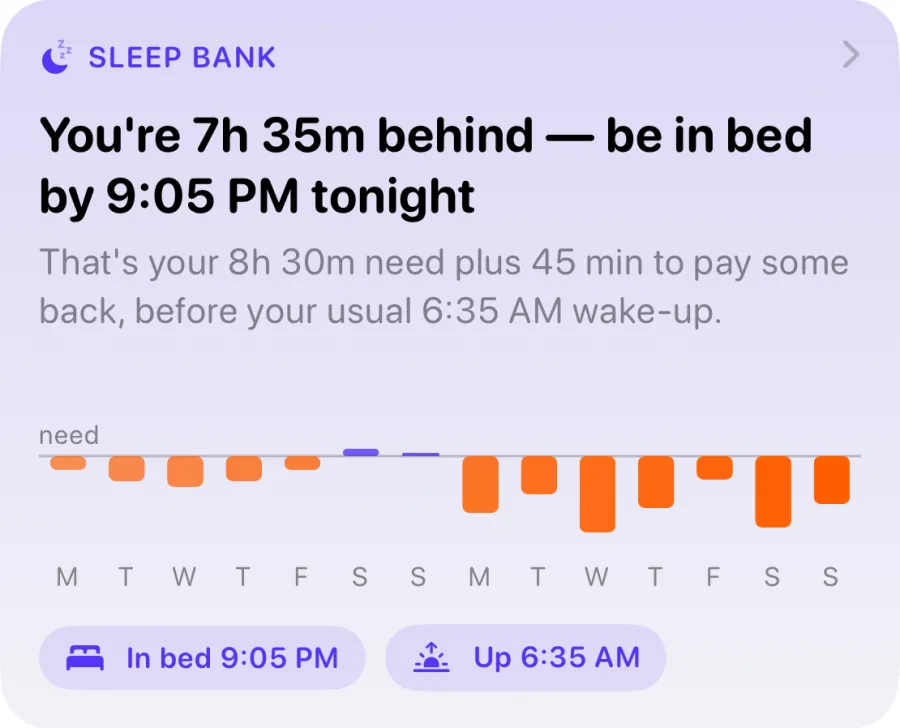
Because short sleep is the main thing that cuts REM, Sleep Bank is the most useful lever. It compares your last 14 nights with your sleep need and suggests a bedtime for tonight, paying back any debt in small steps of no more than 45 extra minutes a night. VedaWatch can't add stage data for nights your watch didn't record, and like Apple's own figures, its numbers are wellness estimates, not medical measurements.
Reading REM across two weeks
When you look at your own chart, check three things. First, whether REM sits in a broadly steady band from night to night. Second, whether the low-REM nights are also the short ones, which points to sleep length rather than anything specific to REM. Third, whether a dip lines up with something you can name, such as a late night out, a drink before bed or travel.
If your REM share stays low for weeks even on long nights, and you also feel unrested, that's the point to mention it to a doctor rather than to keep adjusting habits on your own.
Frequently asked questions
Is 1 hour of REM sleep enough?
On a 7 to 8 hour night, an hour is below the typical 20 to 25% share, but one night means little given night-to-night variation and tracker error. If it's a regular pattern on full-length nights and you feel unrested, mention it to a doctor.
Can you get too much REM sleep?
A higher-than-usual REM night often follows a short night, as the brain makes up some of what it missed, which the Sleep Foundation calls a REM rebound. On its own that's not a concern; persistent unusual sleep with daytime symptoms is worth discussing with a clinician.
Is REM or deep sleep more important?
Neither replaces the other. Deep sleep dominates the first half of the night and REM the second, so a full night of sleep is the only way to get enough of both.
Why does my Apple Watch show no REM some nights?
Apple only writes full stages when a detected sleep session is longer than three hours, so short or fragmented sleep may show only asleep and awake. A loose band or a watch that ran out of battery can also leave gaps.
Does a nap give you REM sleep?
Usually not much. REM typically first appears about 90 minutes after falling asleep, so a short nap tends to end before it starts, while a longer nap may include some.
Related guides
- Apple Watch sleep stages: what Awake, REM, Core, and Deep mean
- How much deep sleep do you need? Minutes by age, Apple Watch
- Apple Watch sleep tracking: how accurate is it, and what to do when it's wrong
- How alcohol affects sleep: REM, waking at 3 am and your heart
- How much sleep do I need? By age, for athletes, and for you
- Sleep debt calculator for Apple Watch: how VedaWatch's Sleep Bank works
Sources & further reading
- Sleep Foundation: REM Sleep: What It Is and Why It Matters
- NINDS (NIH): Brain Basics: Understanding Sleep
- Apple: Estimating Sleep Stages from Apple Watch (white paper, updated October 2025)
- Ohayon et al. (2004), Sleep: Meta-analysis of quantitative sleep parameters from childhood to old age in healthy individuals
- Boulos et al. (2019), Lancet Respiratory Medicine: Normal polysomnography parameters in healthy adults
- Ebrahim et al. (2013), Alcoholism: Clinical and Experimental Research: Alcohol and sleep I: effects on normal sleep
- Wilson and Argyropoulos (2005), Drugs: Antidepressants and sleep: a qualitative review of the literature
- Watson et al. (2015), Journal of Clinical Sleep Medicine: Recommended Amount of Sleep for a Healthy Adult
This guide is educational, not medical advice, and has not been clinically reviewed. VedaWatch is not a medical device. If you have symptoms or concerns about your heart or health, contact a qualified healthcare professional.
Put your trends in perspective.
Explore HRV, sleep, and recovery with VedaWatch on your iPhone.
Download VedaWatch on the App Store →