 VedaWatch
Recovery & Apple Watch
Does alcohol lower HRV? Dose, timing and how long it lasts
Does alcohol lower HRV? What studies show on dose and timing, how long the dip lasts, how it shows in Apple Watch HRV and resting HR, and how to test it.
By VedaWatch editorial team · · 10 min read
The short answer
Yes. Studies consistently find that alcohol lowers HRV and raises heart rate during the night after drinking, and the effect grows with each extra drink. In a study of 4,098 Finnish employees, even low-dose days reduced sleep-time recovery. Drinking later in the evening tends to make the dip bigger, and it usually shows up in next-morning Apple Watch readings.
Does alcohol lower HRV?
Yes, for most people and in a fairly predictable way. Heart rate variability (HRV) is the small variation in time between heartbeats. It tends to be higher when the parasympathetic, rest-and-digest side of your nervous system is in charge, which is normally the case during sleep. Alcohol pushes the other way: in lab and real-world studies, nights after drinking show lower HRV and a higher heart rate than nights without it.
The best real-world evidence comes from two large studies. A 2018 study of 4,098 Finnish employees, covering 12,411 recorded days, measured HRV during the first three hours of sleep and found that alcohol reduced physiological recovery in a dose-dependent way, in both women and men. A 2026 study of 20,968 WHOOP users found that drinking more than your own usual amount went with a higher overnight resting heart rate and lower HRV, again growing with each extra drink.
A small controlled lab study points the same way. In 2011, Sagawa and colleagues gave ten healthy young men either no alcohol, 0.5 g or 1.0 g of alcohol per kilogram of body weight before bed, and recorded their heart overnight. The high-frequency part of HRV, a marker of parasympathetic activity, fell as the dose rose, and heart rate climbed.
So the honest answer to "does alcohol lower HRV" is yes, and the more useful questions are how much, for how long, and how big the effect is for you.
How many drinks does it take to lower HRV?
There's no clear safe line below which HRV is untouched. In the Finnish study, drinking was grouped by grams of alcohol per kilogram of body weight, and recovery during the first three hours of sleep fell by about 9.3 percentage points on low-dose days, 24.0 points on moderate days and 39.2 points on high days, compared with nights without alcohol. Low-dose days were mostly a single drink.
The WHOOP study described it per drink, relative to each person's own habits. One drink more than usual, compared with one less, went with a resting heart rate about 2.8 bpm higher in women and 2.4 bpm higher in men, and HRV (measured as RMSSD) about 3.8 ms lower in women and 3.3 ms lower in men. Going from three to five drinks more than usual lowered HRV by a further 5.6 ms in women and 5.1 ms in men. The authors describe small steps that add up at higher intakes.
Because the Finnish study used grams per kilogram, the same number of drinks counts for more in a lighter person. Here is what its cut-offs mean in US standard drinks, which contain about 14 g of pure alcohol each (12 fl oz of 5% beer, 5 fl oz of 12% wine, or 1.5 fl oz of 40% spirits):
- Low dose, up to 0.25 g/kg: about 15 g of alcohol for a 60 kg person (roughly 1 standard drink), about 20 g for 80 kg (roughly 1.4 drinks).
- Moderate dose, 0.25 to 0.75 g/kg: for a 60 kg person, about 1 to 3.2 drinks; for an 80 kg person, about 1.4 to 4.3 drinks.
- High dose, above 0.75 g/kg: more than about 3.2 drinks at 60 kg, or more than about 4.3 drinks at 80 kg. The study's own example: five 12 g portions for an 80 kg person is 0.75 g/kg.
- Real drinks are often bigger than standard drinks. A 250 ml glass of 13% wine, or a pint of strong craft beer, can hold two standard drinks or more.
Does it matter when you drink?
Yes. The WHOOP study looked at the time between the last drink and sleep. In women, finishing 60 minutes earlier, for the same amount of alcohol, went with a resting heart rate about 0.87 bpm lower and HRV about 1.5 ms higher. Men showed similar effects, and younger adults gained the most: about 3.7 ms of HRV in people aged 20 to 29.
That fits what the lab studies show about when the effect happens. Your body clears alcohol over several hours, and the heart rate and HRV changes are clearest early in the night, while alcohol is still circulating. In the Finnish data, after low-dose days heart rate and recovery were already moving back toward normal by the third hour of sleep. In the Sagawa study, people drank 100 minutes before bed, and the dip was still clearly visible.
Two practical takeaways follow. A drink with an early dinner is likely to cost you less overnight recovery than the same drink just before bed. And a gap between your last drink and sleep helps, but it doesn't remove the effect of a large amount.
How long does alcohol affect HRV?
The well-measured part is the night after drinking. All three studies above measured the same night's sleep, and that is the window that matters for the HRV and resting heart rate your Apple Watch reports the next morning. After small amounts, the Finnish data suggest much of the effect fades within the first few hours of sleep. After high-dose days, the dip was bigger and recovery didn't climb through the night the way it normally does, at least across the three hours that were measured.
What happens on the second or third night is much less studied. None of these papers estimated how many days the effect lasts, and the multi-day figures you'll see quoted online mostly come from company analyses rather than peer-reviewed research. A reasonable expectation is that a single drink shows up as a modest dip the next morning, and that a heavy night, especially one that also cuts your sleep short, can keep HRV below normal and resting heart rate above it for longer.
The good news is that this is easy to check in your own data. Look at the mornings after a few nights of drinking and count how many mornings it takes for HRV and resting heart rate to return to your usual range. That recovery curve is personal, and it's more useful than any average.
How alcohol shows up in Apple Watch HRV and resting heart rate
Apple Health stores Apple Watch HRV as SDNN, the standard deviation of the gaps between heartbeats, in milliseconds. The studies above used RMSSD, a different HRV measure, so their millisecond figures don't translate directly to your Health numbers. Compare your own readings with your own history, as a percentage above or below your usual level, rather than against someone else's.
Apple says the Watch samples HRV while you're still, so the number of readings varies with how active you are. Many readings come overnight, which is why the morning after drinking is when a dip is easiest to see. On a single night, though, one low reading can be noise. A pattern across several drinking nights is far more convincing than one bad morning.
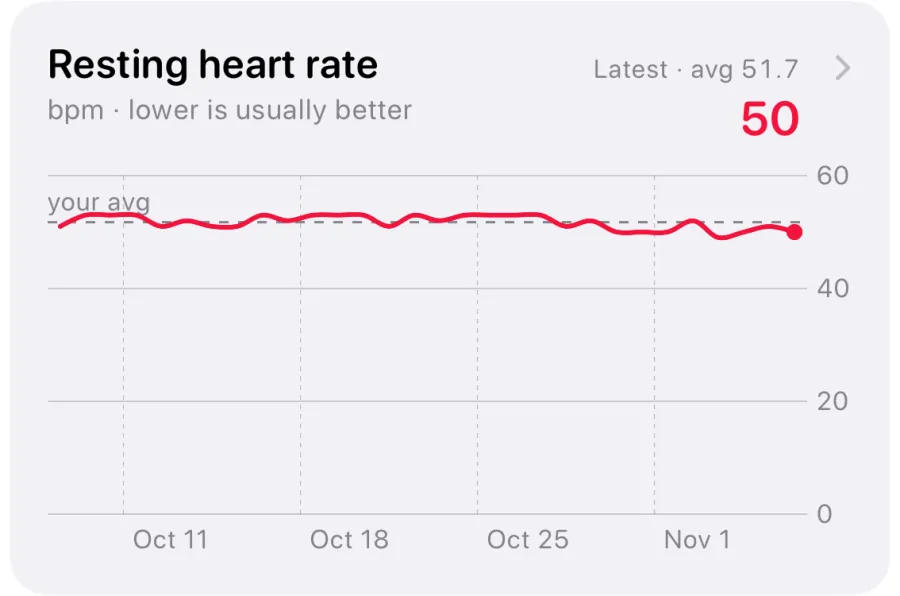
Resting heart rate is often the clearer signal. Both large studies found resting heart rate rose after drinking, and it moves in whole beats per minute that are easy to read. A typical after-drinking morning looks like HRV below your usual range and resting heart rate a few beats above it, often with shorter or more broken sleep.
If you see that pattern on a day you didn't drink, other things can cause it too: a hard workout, a late meal, stress, heat or the start of an illness.
Why alcohol lowers some people's HRV more than others
Averages hide a lot of spread. Both large studies found that age matters: younger people saw bigger drops. In the Finnish data, at 0.75 g/kg, RMSSD fell by about 10.9 ms for a 30-year-old but about 4.7 ms for a 60-year-old. In the WHOOP data, the HRV hit after five drinks grew in each younger age group, with little difference between people in their 50s and those over 60.
Sex made a small difference in the WHOOP study, with somewhat larger changes in women. Body weight matters because the same drink means a higher blood alcohol level in a smaller body. Being fit did not protect people: in the Finnish study, physically active and sedentary people saw similar effects on recovery.
Sleep seems to matter too. In the WHOOP data, on nights after drinking five more than usual, longer-sleep nights went with HRV about 7.2 ms higher and resting heart rate about 2.9 bpm lower than shorter-sleep nights. That's an association, not proof that sleeping in undoes alcohol, but it does mean a late night out with drinks combines two things that both pull recovery down.
Because of this spread, your own numbers are the only reliable guide to how much alcohol moves your HRV.
How to test alcohol's effect on your own HRV
You don't need a lab, just a few weeks of honest notes and a Watch worn to bed. The aim is to compare mornings after drinking with ordinary mornings, not to judge any single night.
- Wear your Apple Watch to bed every night for at least a month so you have a stable picture of your normal HRV and resting heart rate.
- Each day, note whether you drank, roughly how many standard drinks, and when your last drink was. Also note ordinary days with no alcohol: they're your comparison group.
- Each morning, write down last night's HRV and resting heart rate from Apple Health, or let an app do it for you.
- Work out your normal: the median HRV over the previous few weeks is less thrown by odd nights than the average.
- Turn each morning into a percentage. If your normal HRV is 58 ms and the morning after two drinks reads 49 ms, that's (49 - 58) / 58, about 16% below normal.
- After at least 5 drinking mornings and 5 ordinary ones, compare the averages. A consistent gap of several percent, in the same direction as resting heart rate rising, is a real pattern for you. A gap that flips around is probably noise.
- Then try one change, such as finishing drinks earlier or keeping to one, and repeat the comparison for a few more weeks.
How VedaWatch helps you see your own alcohol effect
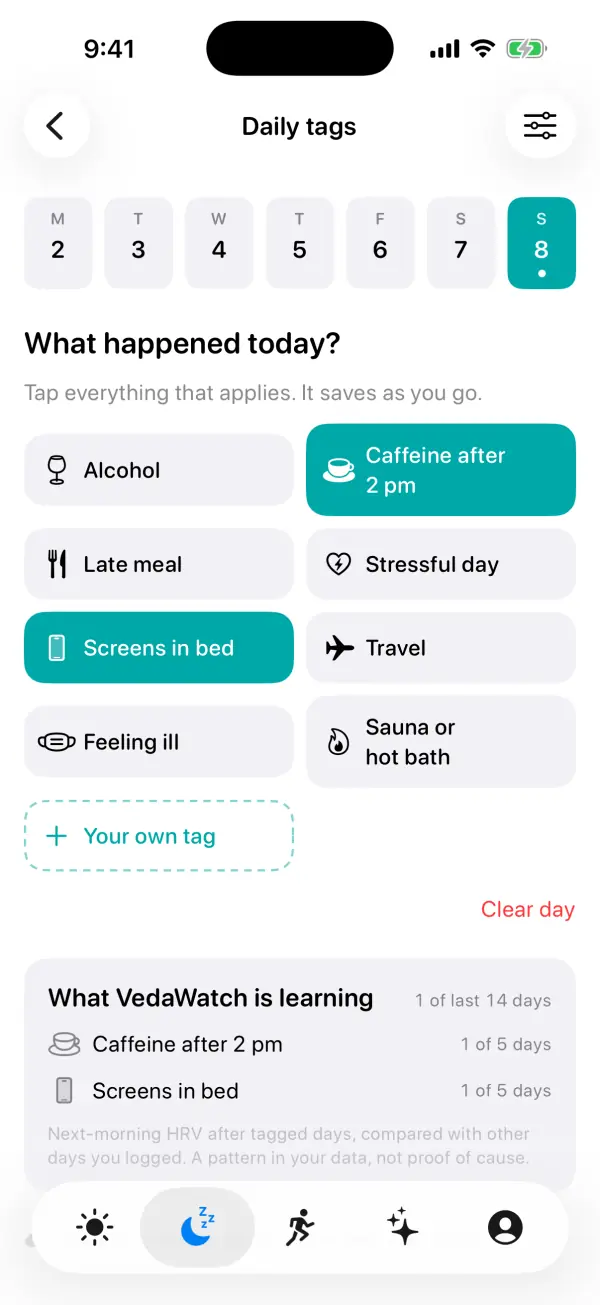
VedaWatch reads your HRV and resting heart rate from Apple Health and adds the part Health can't see: a Daily tags journal. Alcohol is one of the built-in tags, alongside things like late caffeine, a late meal, a stressful day and screens in bed. You can tag on iPhone, fill in the last week if you forgot, or tap Alcohol on the Log page of the Watch app. Tapping Nothing notable on an ordinary day matters, because unanswered days never count as no alcohol.
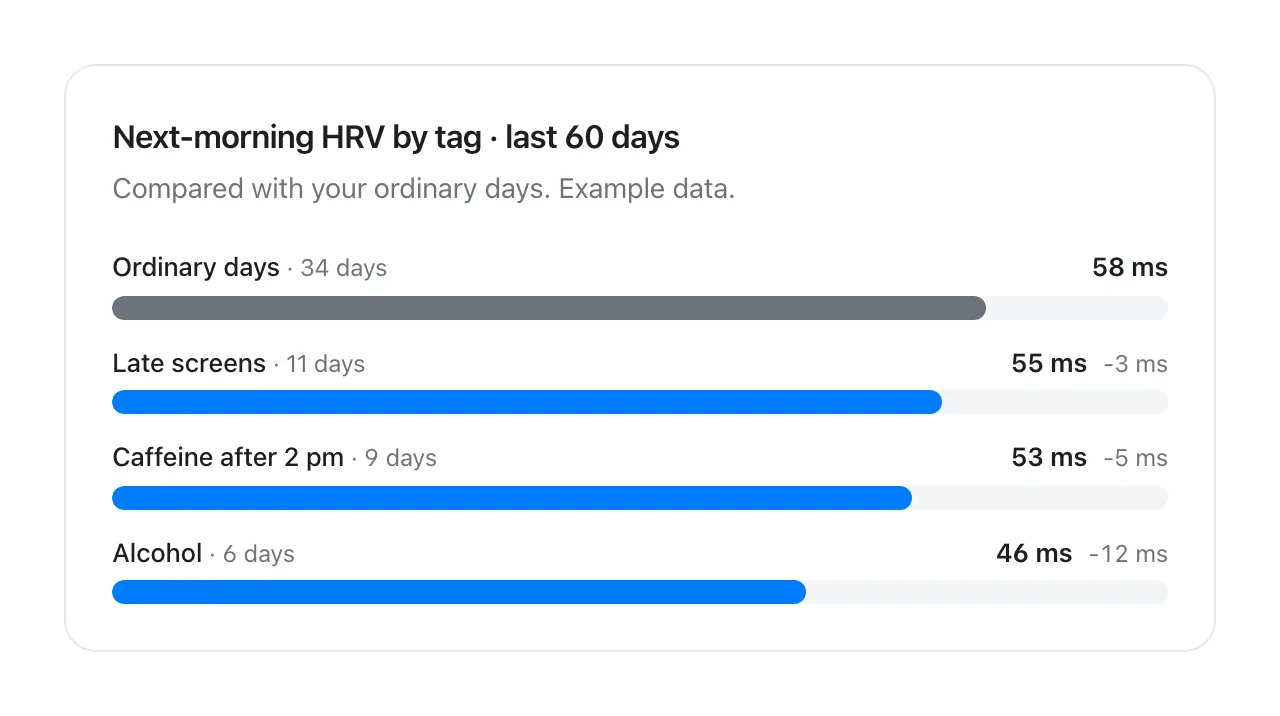
Under What VedaWatch is learning, each tag shows how next-morning HRV, as a percentage of your normal (the median of the previous 28 days), compares after tagged days versus other logged days over the last 60 days. It waits for 5 days with the tag, 5 without, and 30 mornings of overnight HRV, and only names a result when the gap is at least 4% and clearly bigger than its uncertainty. Otherwise it says No clear effect. A higher HRV after alcohol is never shown as a benefit, because that's far more likely to be chance.
Once alcohol shows a clear pattern for you, the Recover tab can warn you the morning after you tag it, with a note like Expect a dip after yesterday's drinks. VedaWatch's illness warning also leaves out nights after logged alcohol, so a night out isn't mistaken for the start of a cold. It describes patterns in your data; it isn't medical advice.
When a low HRV is about more than last night's drinks
A dip the morning after drinking that recovers within a day or two is the expected, common pattern. It's worth looking further if HRV stays low or resting heart rate stays high for many days without an obvious reason, if you notice a racing, pounding or irregular heartbeat, or if you feel unwell. Those are reasons to talk to a doctor, not to wait for a better reading.
It's also worth being clear about what HRV can't tell you. A higher HRV on a drinking night isn't a sign that alcohol is good for you, and a small dip isn't a diagnosis. If you're finding it hard to cut back, or you're worried about how much you drink, a doctor or a service such as the NIAAA's resources can help. HRV is a useful mirror for habits, not a measure of overall health.
Frequently asked questions
Does one glass of wine lower HRV?
Often a little. In the Finnish study, low-dose days, mostly a single drink, still reduced recovery during the first hours of sleep. The effect was much smaller than after several drinks and tended to fade earlier in the night.
How long after drinking does HRV return to normal?
After a small amount, usually by the next night, and much of the effect fades within the first hours of sleep. After a heavy night, it can take longer, but there's little peer-reviewed data on multi-day effects, so check how many mornings your own HRV and resting heart rate take to return to normal.
Does drinking water or eating help my HRV after alcohol?
There isn't good evidence that water or food cancels the overnight effect on HRV. What the data do support is drinking less and finishing earlier before bed.
Can I train the morning after drinking if my HRV is low?
One low reading isn't a ban on exercise, but an easier session is a sensible default when HRV is down and resting heart rate is up. Our guide on working out with low HRV covers how to decide.
Why did my HRV go up after drinking?
Single readings are noisy, and other things that night, such as a rest day or a long sleep, can outweigh a small drink. Compare many drinking mornings with many ordinary ones before concluding anything.
Is the WHOOP or Oura alcohol effect the same as on Apple Watch?
The direction should be the same, but the numbers aren't directly comparable. Devices measure HRV at different times and with different formulas, and Apple Health stores SDNN, while many studies and some devices use RMSSD.
Related guides
- What lowers your HRV? Use a tag journal to find out
- How alcohol affects sleep: REM, waking at 3 am and your heart
- Resting heart rate on Apple Watch: what's high, low, and why it changes
- Why is my HRV so low? Causes of a sudden drop and what to check
- Should you train or rest when HRV is low?
- Does caffeine affect HRV? Coffee, sleep and your cutoff time
Sources & further reading
- Pietilä J et al. (2018). Acute effect of alcohol intake on cardiovascular autonomic regulation during the first hours of sleep in a large real-world sample of Finnish employees. JMIR Mental Health 5(1):e23. doi:10.2196/mental.9519
- Grosicki GJ et al. (2026). Real-world effects of alcohol on heart rate, sleep, and physical activity by age and sex. PLOS Digital Health 5(3):e0001284. doi:10.1371/journal.pdig.0001284
- Sagawa Y et al. (2011). Alcohol has a dose-related effect on parasympathetic nerve activity during sleep. Alcoholism: Clinical and Experimental Research 35(11):2093-2100. doi:10.1111/j.1530-0277.2011.01558.x
- Shaffer F, Ginsberg JP (2017). An overview of heart rate variability metrics and norms. Frontiers in Public Health 5:258. doi:10.3389/fpubh.2017.00258
- National Institute on Alcohol Abuse and Alcoholism: What is a standard drink?
- Apple Support: Heart rate on Apple Watch
- Apple Developer: heartRateVariabilitySDNN (HealthKit)
This guide is educational, not medical advice, and has not been clinically reviewed. VedaWatch is not a medical device. If you have symptoms or concerns about your heart or health, contact a qualified healthcare professional.
Put your trends in perspective.
Explore HRV, sleep, and recovery with VedaWatch on your iPhone.
Download VedaWatch on the App Store →