 VedaWatch
Workouts & Training
Half marathon taper: the final 7 days, day by day
A half marathon taper that cuts volume but keeps intensity: a day-by-day plan for race week, plus sleep, carbs, and what HRV and readiness do while you taper.
By VedaWatch editorial team · · 10 min read
The short answer
Taper for about two weeks: cut weekly running volume by roughly 40 to 60% of your peak, but keep some short race-pace or faster work and run on most of your usual days. In race week, keep runs short and easy with one sharpener, bank sleep early, and raise carbs over the last day or two.
How should you taper for a half marathon?
A taper is a planned drop in training before a race so that fatigue clears while fitness stays. The best evidence we have is a 2007 meta-analysis of 27 tapering studies in competitive athletes. Its most effective pattern was a taper of about two weeks in which training volume fell progressively by 41 to 60%, while intensity and the number of sessions per week stayed the same.
An earlier review of tapering research reached the same shape: keep intensity, cut volume (in that review, by anywhere from 60 to 90% in some sports), and drop frequency by no more than about 20%. Tapers that step down gradually tended to beat one sudden cut, and performance improved by about 3% on average, within a usual range of 0.5 to 6%.
For a half marathon, that translates into three rules. Run less in total, mostly by shortening your runs and your long run. Keep a little quality, such as a few minutes at half marathon pace or a set of strides, so your legs remember race speed. And keep running on most of your usual days, so race week doesn't feel strange.
These studies were done mostly in trained and competitive athletes, often in swimming, cycling and running, so treat the numbers as a well-supported starting point rather than an exact prescription for every runner.
How long should a half marathon taper be?
Most runners do well with 10 to 14 days. The meta-analysis found two weeks most effective overall, and the earlier review noted that useful tapers ranged from 4 days to more than 4 weeks, depending on how hard the training block had been.
Lean toward the full two weeks if your peak weeks were your biggest ever, you're tired going into the taper, or this race really matters to you. A shorter taper of about a week suits runners whose training was moderate, or who are running the half as a step toward a marathon and don't want to lose two weeks of training.
A practical way to lay it out: in the second-to-last week, run about 75 to 80% of your peak volume and shorten the long run by a third or so. In race week, run about half of your peak volume, counting the race itself separately. Keep one short quality session in each week.
Half marathon race week, day by day
Here is a final 7 days for a Sunday race. Shift the days if your race is on another day. Minutes are a guide for a runner who usually runs four to five times a week; scale them to your own training, and keep the easy runs truly easy, at a pace you could hold a conversation.
- Monday (6 days out): rest, or 20 to 30 minutes very easy. If last Sunday's long run left you sore, take the rest.
- Tuesday (5 days out): the sharpener. 10 minutes easy, then 4 or 5 repeats of 3 minutes at half marathon pace with 2 minutes easy between, then 10 minutes easy. It should feel controlled, not hard.
- Wednesday (4 days out): 30 to 40 minutes easy. Nothing new: no new shoes, no new strength exercises, no hill session to test yourself.
- Thursday (3 days out): 25 to 30 minutes easy, with 4 relaxed strides of about 20 seconds near the end. If you'll be running for longer than 90 minutes on Sunday, start raising your carbohydrates from Thursday evening or Friday.
- Friday (2 days out): rest or 20 minutes very easy. This is the night's sleep that matters most, so aim for an early, normal bedtime. Carbs stay high.
- Saturday (1 day out): optional 15 to 20 minute shakeout jog. Lay out your kit, pin your bib, check the start time and transport, and eat familiar food. Go to bed at your usual time and don't worry if sleep is light.
- Sunday (race day): eat a carb-based breakfast you've practised 2 to 4 hours before the start, warm up with 10 minutes of easy jogging, and run the first few kilometres a little slower than goal pace.
Should you still do speed work in a taper?
Yes, in small doses. Keeping intensity was one of the clearest findings in the taper research, while cutting volume was what actually removed the fatigue. The mistake runners often make is the opposite: they cut the quality sessions entirely and keep the easy mileage, which removes the sharpness but not much of the tiredness.
In the week two weeks out, a normal tempo or interval session can stay, just shorter. A runner who did 3 x 10 minutes at threshold in peak weeks might do 2 x 10 minutes. In race week, the Tuesday session above is enough: about 12 to 15 minutes of work at race pace.
What you shouldn't do is test yourself. A hard time trial in race week won't add fitness by Sunday, and it can leave you flat. If the sharpener feels sluggish, that's common during a taper and usually passes once you're rested.
What to eat in half marathon taper week
You're running less, so you don't need to eat more overall until the last day or two. Keep protein steady and eat normal meals early in the week; there's no need to cut carbs.
Carbohydrate loading matters most for long events. A 2022 Gatorade Sports Science Institute review, drawing on the 2016 joint position stand of the American College of Sports Medicine, gives 10 to 12 g of carbohydrate per kg of body weight per day for 36 to 48 hours before competition, and notes that for events under 90 minutes such aggressive intakes may not be necessary. If you'll finish in well under 90 minutes, a carb-rich day before the race is usually enough. If you expect to be out longer than that, a fuller carb load is what that guidance is aimed at.
Worked example: a 65 kg runner loading at 10 g/kg aims for about 650 g of carbohydrate a day on Friday and Saturday. That's a lot of food, so get it from easy sources like rice, pasta, bread, potatoes, cereal, juice and sports drinks, and go lighter on fibre and fat so you don't feel stuffed.
On race morning, the same review suggests 1 to 4 g/kg of carbohydrate in the 1 to 4 hours before exercise lasting over an hour; for the 65 kg runner, 65 to 260 g depending on how early you eat. During the race, a 2011 review puts 30 to 60 g per hour as an appropriate target for events lasting longer than about an hour. Practise all of it in training first, and if you have diabetes or a medical condition, plan race nutrition with your doctor or a registered dietitian.
Sleep before a half marathon
Expect the night before to be imperfect. In a survey of 283 elite Australian athletes, 64% reported sleeping worse on at least one night before an important competition in the past year. The most common problem was falling asleep, blamed mostly on thoughts about the race and nerves.
That's why the two nights before matter more than the last one. Use the lighter training of taper week to get to bed a little earlier on most nights. In a small Stanford study, basketball players who extended their sleep for 5 to 7 weeks slept about 111 more minutes a night and sprinted faster. That study wasn't in runners and was much longer than a taper, but it fits the idea that more sleep supports performance.
Practical steps: keep your usual wake time all week so the early race alarm isn't a shock, cut caffeine after early afternoon, and don't try a new sleep aid in race week. If you lie awake the night before, rest quietly in bed; one short night rarely ruins a race when the nights before it were good.
What happens to HRV and readiness during a taper?
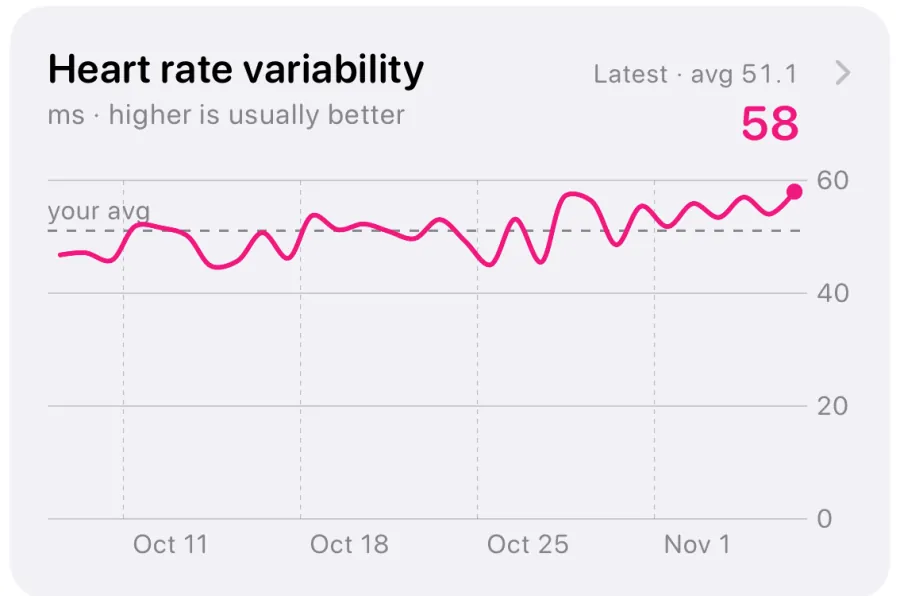
Often HRV drifts up and resting heart rate settles as the fatigue of peak weeks clears, so readiness scores tend to look better in taper week. But the research is more mixed than wearable marketing suggests. In a 2013 study of triathletes followed through 3 weeks of overload and a 1-week taper, heart rate variability actually rose during the overload in those who became overreached, and those changes reversed during the taper, when performance bounced back. A higher HRV isn't always fresher, and a lower one isn't always worse.
The same study found that a single weekly reading missed these changes, while daily readings averaged over a week caught them. A case study of two elite triathletes showed the other side: in the athlete who became badly overreached and raced poorly, the 7-day rolling HRV average fell steadily toward the event. The lesson for taper week is to watch your trend over several days, not one morning.
Race week also brings things that lower overnight HRV on their own: nerves, short sleep, travel, a late meal or a celebratory drink, and the start of a cold. A dip on Thursday or Friday after a bad night is common and usually means little. A dip that lasts several days together with a sore throat, a raised resting heart rate and feeling unwell is different. If you might be ill, rest, and see a doctor if symptoms are significant or you have chest pain, breathlessness or a fever; racing with a fever isn't worth it.
Common half marathon taper mistakes
Cramming. A long run or hard workout in the last 10 days to prove you're ready only adds fatigue. Your fitness for Sunday was built weeks ago.
Doing nothing. Stopping completely for a week can leave you sluggish. Short, regular runs with a little pace keep you sharp.
Trying something new. New shoes, gels, breakfast, supplements or a deep-tissue massage two days out all carry risk with little upside. Race week is for things you've already practised.
Reading too much into how you feel. Heavy legs, small aches and restlessness, sometimes called taper madness, are common as training drops. Sharp pain or pain that changes how you run is different and is worth getting checked before the race.
How VedaWatch helps you taper
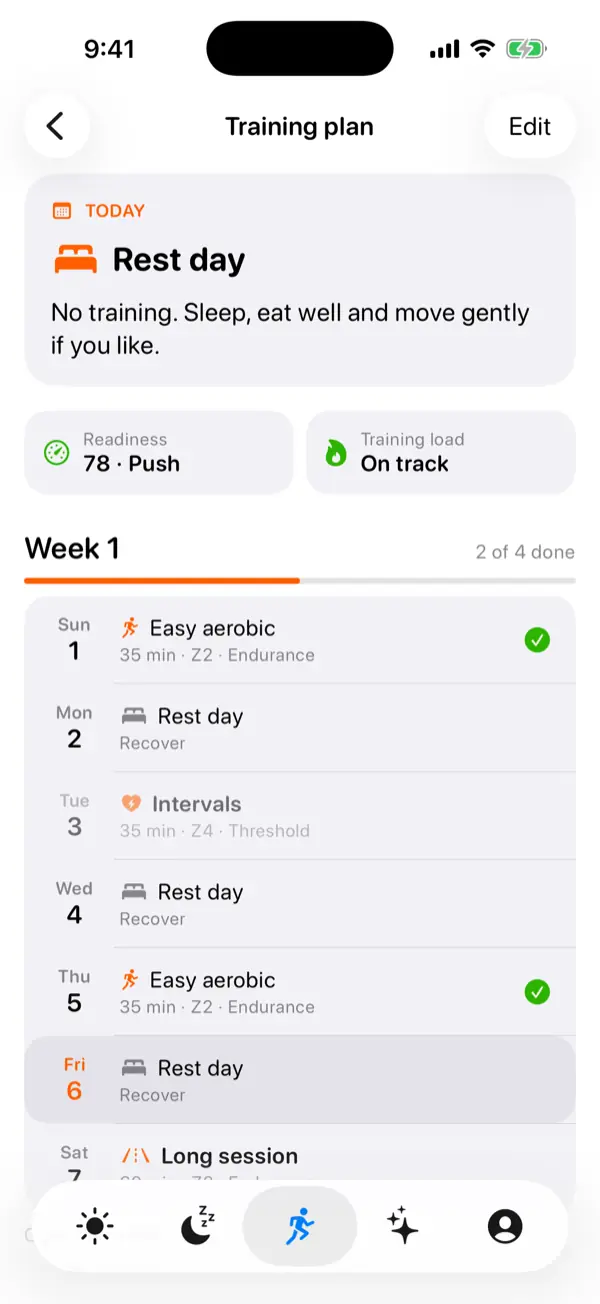
If you set up a half marathon goal in VedaWatch's Training plan (a Pro feature, $6.99 a month or $59.99 a year), the taper is built in. A plan of 10 weeks or more ends with two taper weeks and race week. The taper weeks run at about 82% and then 70% of your peak volume, and race week drops to 60%. Your interval and tempo sessions stay in the taper weeks, just shorter. In race week, the long run and tempo become easy runs, one short sharpener stays, and the two days before the race become very easy recovery or rest.
Each morning the plan checks your readiness and your training load. Readiness compares your HRV, resting heart rate and sleep with your recent baseline. A Hold verdict turns a hard session into an easy one and moves it to a later day if there's room; a Rest verdict makes the day very easy. Race day never moves. On a low-readiness race morning you get a note to start easier and run by feel.
Expect the training load band on the plan to read Dropping during the taper. That's the point of a taper, not a problem. On a Push day while load is dropping, VedaWatch can add about 10% to an easy run; in race week you can simply stick to the planned time.
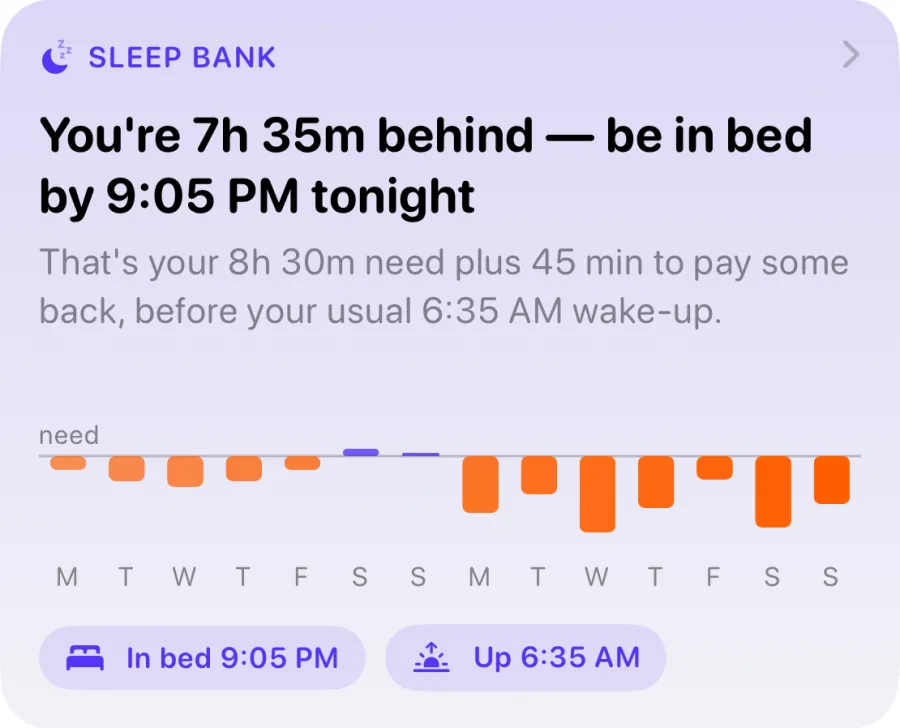
Sleep Bank shows whether you're carrying sleep debt into race week and suggests a bedtime, paying debt back by no more than 45 extra minutes a night. Nutrition targets rise and fall with the session on your plan: carbs are set from 3 g/kg on a rest day to 7 g/kg on a hard day. They aren't a carb-loading plan, so on the two days before a long race, treat the carb number as a floor and eat more.
Frequently asked questions
Do I need a taper for a half marathon if I'm not racing it hard?
If you're running it as a training run or a step toward a marathon, a few easier days beforehand is usually enough. A full two-week taper is for when you want your best time.
When should I do my last long run before a half marathon?
Many plans put the last true long run about two weeks out, then a shorter one of roughly two-thirds the distance the weekend before race week. Nothing long in the final 7 days.
Is it normal to gain weight during a taper?
A small rise on the scale in the last few days is common when you carb load, because the body stores water along with glycogen. It's fuel, not fat, and it usually settles after the race.
Should I run the day before a half marathon?
It's optional. Many runners like a 15 to 20 minute shakeout to loosen up; others feel better resting. Do whatever you've done before your best long runs.
My readiness score dropped two days before the race. Should I worry?
One low morning after a short or restless night is common in race week and usually doesn't predict your race. Look at the trend over several days and how you feel; if you have signs of illness, put your health ahead of the race.
Related guides
- First marathon training plan: a 16-week beginner guide
- Training for a 5K, 10K or half marathon with Apple Watch: a plan that adapts to your recovery
- Carb loading for a half marathon: how much, when and what to eat
- What to eat before a morning run: by run length and timing
- Should you train or rest when HRV is low?
- Sleep debt calculator for Apple Watch: how VedaWatch's Sleep Bank works
- Apple Watch Training Load and ACWR, explained (and why sports scientists argue about it)
Sources & further reading
- Medicine & Science in Sports & Exercise (2007): Effects of tapering on performance: a meta-analysis (Bosquet et al.)
- Medicine & Science in Sports & Exercise (2003): Scientific bases for precompetition tapering strategies (Mujika and Padilla)
- Medicine & Science in Sports & Exercise (2013): Evidence of parasympathetic hyperactivity in functionally overreached athletes (Le Meur et al.)
- European Journal of Applied Physiology (2012): Heart rate variability in elite triathletes, is variation in variability the key to effective training? (Plews et al.)
- Journal of Science and Medicine in Sport (2015): Understanding sleep disturbance in athletes prior to important competitions (Juliff et al.)
- Sleep (2011): The effects of sleep extension on the athletic performance of collegiate basketball players (Mah et al.)
- Gatorade Sports Science Institute, Sports Science Exchange #231 (2022): Dietary carbohydrate and the endurance athlete, contemporary perspectives (Wallis and Podlogar)
- Journal of Sports Sciences (2011): Carbohydrates for training and competition (Burke et al.)
This guide is educational, not medical advice, and has not been clinically reviewed. VedaWatch is not a medical device. If you have symptoms or concerns about your heart or health, contact a qualified healthcare professional.
Put your trends in perspective.
Explore HRV, sleep, and recovery with VedaWatch on your iPhone.
Download VedaWatch on the App Store →