 VedaWatch
Nutrition
Carb loading for a half marathon: how much, when and what to eat
Carb loading for a half marathon: who needs it by finish time, g/kg targets with a worked example, a sample loading day, and a race-morning breakfast.
By VedaWatch editorial team · · 10 min read
The short answer
If you'll finish in under about 90 minutes, you don't need a formal carb load: a carb-rich day before is enough. If you'll be out longer, the guidance is 10 to 12 g of carbs per kg of body weight a day for the 36 to 48 hours before the race, then 1 to 4 g/kg in the 1 to 4 hours before the start.
Do you need to carb load for a half marathon?
It depends on how long you'll be running, not on the distance itself. Carb loading means eating extra carbohydrate in the day or two before a race so your muscles start with more stored glycogen than usual. That extra fuel matters when an event is long enough to run your glycogen low. For shorter efforts, normal stores already last the distance.
A 1997 review by Hawley and colleagues summed up the evidence this way: raising muscle glycogen above normal resting levels makes little or no difference to moderate-intensity running or cycling lasting 60 to 90 minutes, because plenty of glycogen is still left at the end. For endurance events longer than 90 minutes, higher starting glycogen delayed fatigue by about 20% in time-to-exhaustion tests, and improved performance over a set distance by about 2 to 3%.
The half marathon sits right on that line. A 2022 Gatorade Sports Science Institute review notes that for events under 90 minutes, aggressive carbohydrate intakes may not be necessary, and points to an early study in which extra carbohydrate raised muscle glycogen but didn't improve half-marathon performance on a treadmill. Elite and fast club runners finish well inside 90 minutes. Most recreational runners take longer, often closer to two hours or more, which puts them in the range where loading guidance applies.
So the honest answer is: if you'll be out longer than about 90 minutes, a proper carb load is a reasonable, low-risk way to start with full tanks. If you'll be faster than that, eat well and include plenty of carbs the day before, and save the effort for race-morning breakfast and pacing.
Carb loading by finish time: when it's needed
Use your realistic goal time, not your dream time, and pick the band you fall into. The amounts below come from the sports nutrition guidance in the sources: a 2025 review in Nutrients describes 6 to 12 g of carbs per kg of body weight in the 24 hours before events under 90 minutes, and 10 to 12 g/kg per day, started 36 to 48 hours out, for events longer than 90 minutes.
- Under about 75 minutes (fast and elite runners): no formal load. Eat your usual training diet with a carb-rich day before the race, in the 6 to 12 g/kg range for that 24 hours. Your race is too short to run glycogen low if you start rested and fed.
- About 75 to 90 minutes: the grey zone. A carb-rich final 24 hours is enough for most runners. If you know you fade late in long runs, or you'll be close to 90 minutes, a lighter 36-hour load does no harm when you've practised it.
- About 90 minutes to 2 hours: carb loading is reasonable. Aim for the 10 to 12 g/kg guidance over the 36 to 48 hours before the start, or as close to it as your stomach comfortably allows.
- Over 2 hours: load as above, and plan carbs during the race too. You'll be running long enough that both the starting tank and topping it up matter.
- Any finish time: the race-morning breakfast still counts. Liver glycogen drops overnight, and a pre-race meal of 1 to 4 g/kg in the 1 to 4 hours before the start is recommended for exercise lasting more than an hour.
How many grams of carbs per kg? A worked example
The targets are given per kilogram of body weight, so start there. To convert from pounds, divide by 2.2. Then multiply by the target for the band you're in.
Worked example for a 70 kg (154 lb) runner aiming for about 1 hour 55 minutes. They're in the over-90-minute band, so the guidance is 10 to 12 g/kg a day for the last 36 to 48 hours. At 10 g/kg that's 700 g of carbohydrate a day; at 12 g/kg it's 840 g. At about 4 kcal per gram, 700 g of carbs alone is roughly 2,800 kcal, which is why loading means changing what's on the plate, not just adding a bigger pasta bowl.
Same runner, if they ran 1 hour 25 minutes instead: 6 to 12 g/kg in the final 24 hours works out to 420 to 840 g, and the lower half of that range is plenty for most people at this pace. A 55 kg runner loading at 10 g/kg needs 550 g a day; an 85 kg runner needs 850 g.
In practice, 10 g/kg is a lot of food, and many recreational runners land somewhat below it. That's fine. The aim is to make carbohydrate the bulk of every meal and snack for a day or two while total food stays close to normal, by trading some fat and fibre for starchy and sugary foods. A load you can eat comfortably beats an aggressive one that leaves you bloated on the start line.
When to start carb loading before a half marathon
For a Sunday race, the usual window is Friday and Saturday: 36 to 48 hours of higher carbs, with the bulk of it eaten by Saturday dinner. There's no need for the old week-long protocol with a depletion phase of hard training and low carbs. Current guidance pairs loading with a taper instead.
The body can top up glycogen quickly when you're resting. In a 2002 study by Bussau and colleagues, eight trained male athletes ate about 10 g/kg of high-glycemic carbohydrate while inactive. Their muscle glycogen nearly doubled after one day, from about 95 to 180 mmol/kg, and didn't rise further over the next two days. It's a small study in men, but it's why one or two days of loading after easy training is enough for a half marathon.
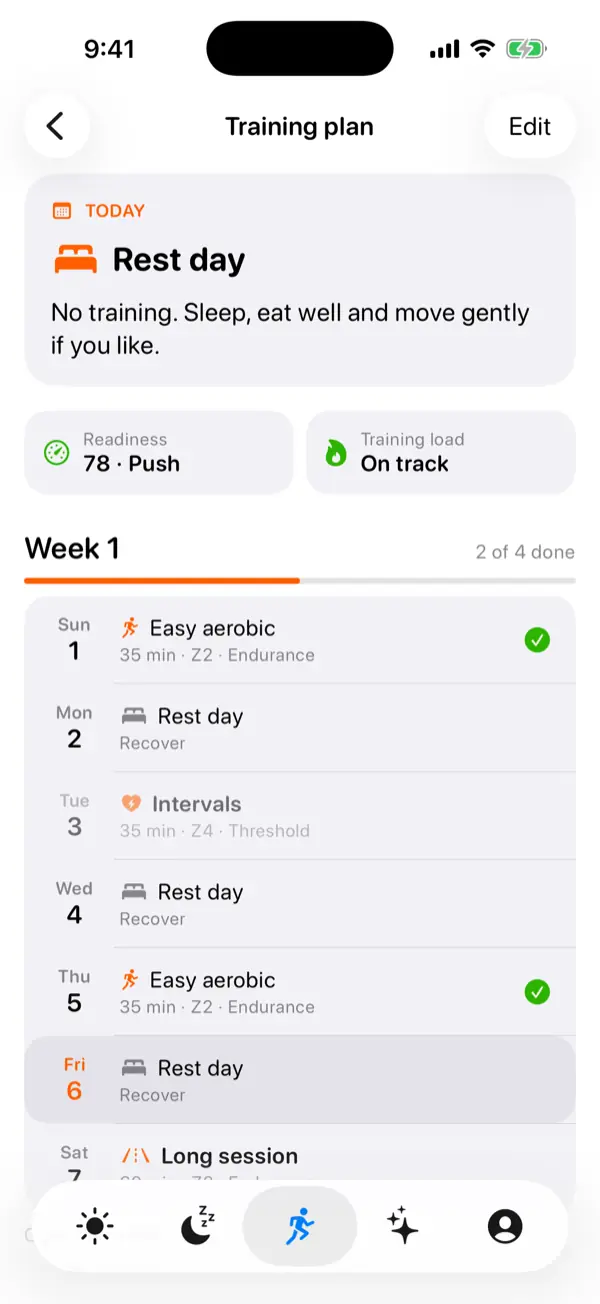
The easy training matters as much as the food. Glycogen tops up best when you're not burning through it, so the loading days should line up with your shortest, easiest runs or rest days. For the full race week schedule, including the sharpener and shakeout, see our half marathon taper guide.
Sample carb loading day for a half marathon
Here is a Saturday for the 70 kg runner above, with the race on Sunday morning. Carb amounts are worked out from USDA FoodData Central values, so they're approximate and depend on the exact product. Add protein you normally eat, such as chicken, fish, eggs, tofu or yogurt, in moderate portions, and keep fat and fibre lower than usual. The day lands at about 560 g of carbs, or 8 g/kg:
- Breakfast, about 120 g: a plain bagel (100 g, about 52 g of carbs) with 20 g of honey (about 16 g), a medium banana (about 27 g) and a cup of orange juice (248 g, about 26 g).
- Mid-morning, about 60 g: 40 g of dates (about 30 g) and 40 g of plain rice cakes (about 32 g).
- Lunch, about 95 g: 300 g of cooked white rice (about 85 g) with a moderate portion of chicken or tofu, plus 100 g of unsweetened applesauce (about 11 g).
- Afternoon, about 70 g: two slices of white bread (about 28 g) with 20 g of honey (about 16 g) and another cup of orange juice (about 26 g).
- Dinner, about 140 g: 400 g of cooked white rice (about 113 g) with fish or chicken in a low-fat sauce, and a banana (about 27 g). Eat dinner early enough that you're not going to bed stuffed.
- Evening, about 70 g: a second bagel (about 52 g) with honey (about 16 g).
- To reach the full 10 g/kg (700 g), add about 140 g more: another bagel with honey (about 68 g) and three more glasses of juice (about 77 g), or sports drinks, which make it easier to get carbs in without feeling full. Check the label for grams per bottle.
What to eat on half marathon race morning
Muscle glycogen from the load is still there in the morning, but liver glycogen falls overnight, so breakfast still matters. The 2016 joint position statement from the American College of Sports Medicine, the Academy of Nutrition and Dietetics and Dietitians of Canada recommends 1 to 4 g of carbs per kg in the 1 to 4 hours before exercise lasting more than an hour, with foods that are low in fat and fibre and low to moderate in protein. For the 70 kg runner that's 70 to 280 g. The more time before the start, the more you can eat.
Example, 3 hours before an 8 am start (so eaten around 5 am): a plain bagel with 20 g of honey, a medium banana and a cup of orange juice, about 120 g of carbs or 1.7 g/kg. With only 90 minutes, go smaller: two slices of white bread with honey and a banana, about 70 g or 1 g/kg. A sports drink sipped in the last hour can add more without much bulk.
During the race, a 2011 review by Burke and colleagues suggests 30 to 60 g of carbs per hour for events of longer than about an hour. For a 2-hour finisher, that could be a gel at around 40 to 45 minutes and another at around 80 minutes, plus sips of sports drink at aid stations; check the grams on each product. Runners under about 75 minutes often skip in-race fuel or use a little sports drink.
Whatever you choose, practise it before a long training run first. Race morning is the wrong time to find out a new gel or a big breakfast doesn't agree with you. For more on timing, quick foods and coffee, see our guide to what to eat before a morning run.
Common carb loading mistakes (and the weight on the scale)
One giant pasta dinner the night before. A single huge meal late on Saturday is more likely to leave you heavy and unsettled on race morning than to fill your muscles. Spread the carbs across two days and eat the biggest meal at lunch or an early dinner.
Eating more of everything. Loading is about the share of carbs, not doubling your food. Creamy sauces, cheese, fried food and big salads add fat and fibre that fill you up without adding much carbohydrate, and fibre-heavy foods can mean extra toilet stops on race morning. White rice, white bread, bagels, potatoes without the skin, juice and sports drinks are easier.
Panicking about the scale. Water is stored along with glycogen, so a small rise in body weight over the loading days is expected. That's fuel, not fat, and it's one reason runners who finish well under 90 minutes may prefer a lighter approach.
Trying new foods. Race week is for familiar meals. If you're travelling, plan where your carbs are coming from rather than relying on whatever's near the hotel.
Skipping the taper. Hard or long runs during the loading days burn the glycogen you're trying to store. Keep those days easy or rest.
Who should get advice first: if you have diabetes, a gastrointestinal condition, are pregnant, follow a medically prescribed diet, or have a history of disordered eating, plan race nutrition with your doctor or a registered dietitian rather than following general g/kg targets.
How VedaWatch helps you fuel race week
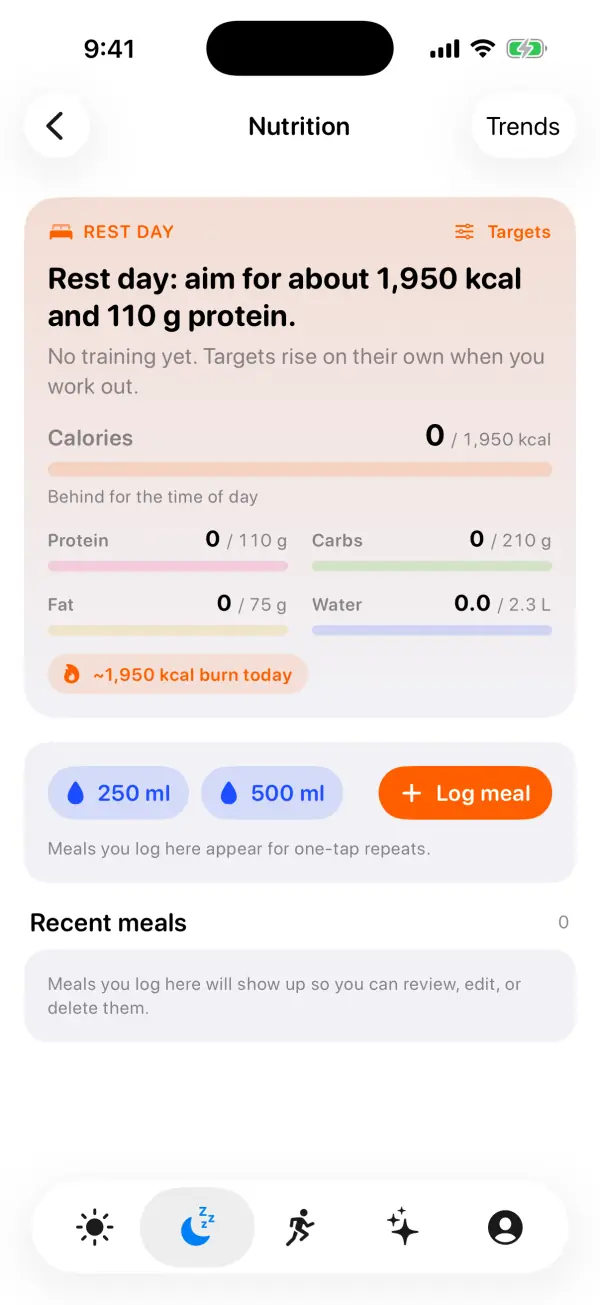
VedaWatch's Nutrition screen, under the Recover tab on iPhone, has a Fuel card with daily targets for calories, protein, carbs, fat and water. Carbs are set from your Apple Health body weight according to the day: 3 g/kg on a rest day, 4 g/kg on a light day, 5 g/kg on a training day and 7 g/kg on a hard day. If you follow a VedaWatch race plan (a Pro feature, $6.99 a month or $59.99 a year), the card reads the day from your plan in the morning, and race day itself counts as a hard day.
One thing to know: the card isn't a carb-loading plan. On a VedaWatch race plan, the two days before the race are rest or very easy recovery days, so the Fuel card shows a rest or light-day carb target, around 3 to 4 g/kg. On your loading days, treat that number as a floor and use the g/kg targets above instead. Carbs can also come in lower if you've set a weight-loss goal, since carbs give way when the calorie target can't hold them.
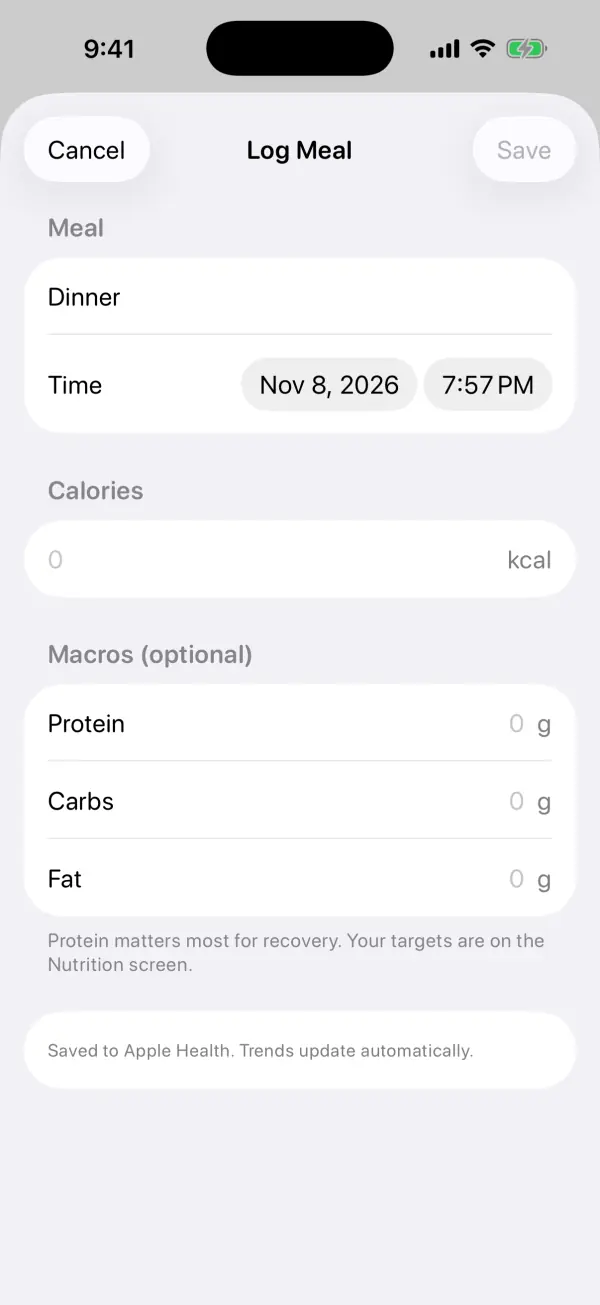
Where it does help is in keeping score. Meals you log with Log Meal, with carbs if you know them, are saved to Apple Health, and food logged in other apps that write to Apple Health counts too, so you can see on Friday and Saturday whether you're really near 500 or 700 g, not guessing. The water target, about 33 ml per kg plus 0.6 L per hour of training, sits on the same card with one-tap 250 ml and 500 ml buttons. These are general targets for healthy adults who train, not medical or dietetic advice.
Frequently asked questions
Is pasta the night before a half marathon enough?
For runners finishing in under about 90 minutes, a carb-rich dinner as part of a carb-rich day usually is. For longer races, one meal can't hold enough carbohydrate on its own, so spread extra carbs over the last 36 to 48 hours.
Should I carb load for a 10K?
Generally no. Most runners finish a 10K well inside 90 minutes, which is shorter than the events loading is meant for. Eat normally with good carbs the day before and a familiar breakfast on race morning.
Can I carb load on a low-carb or keto diet?
Switching suddenly to 10 g/kg can be hard on the gut if you normally eat few carbs. If you train low-carb, try your loading days before a long training run first, and talk to a dietitian if you have a medical reason for your diet.
Do women need to carb load differently?
The g/kg targets in the guidance apply to everyone, so a lighter runner simply needs fewer grams in total. Hitting 10 g/kg can be harder if your usual energy intake is low, so focus on making carbs the bulk of each meal rather than eating far more food.
Should I stop drinking alcohol before a half marathon?
Skipping alcohol for the last couple of days is sensible. It can disturb sleep, and drinks don't replace the starchy and sugary foods that make up a carb load.
Related guides
- Half marathon taper: the final 7 days, day by day
- What to eat before a morning run: by run length and timing
- How much to eat on training vs rest days: calorie and protein targets from your Apple Watch
- How much water should I drink when working out?
- Training for a 5K, 10K or half marathon with Apple Watch: a plan that adapts to your recovery
- Logging nutrition to Apple Health: what actually syncs, and why your numbers might be off
Sources & further reading
- Gatorade Sports Science Institute, Sports Science Exchange #231 (2022): Dietary carbohydrate and the endurance athlete, contemporary perspectives (Wallis and Podlogar)
- Sports Medicine (1997): Carbohydrate-loading and exercise performance, an update (Hawley et al.)
- European Journal of Applied Physiology (2002): Carbohydrate loading in human muscle, an improved 1 day protocol (Bussau et al.)
- Nutrients (2025): A review of carbohydrate supplementation approaches and strategies for optimizing performance in elite long-distance endurance (Cao et al.)
- Medicine & Science in Sports & Exercise (2016): American College of Sports Medicine Joint Position Statement. Nutrition and Athletic Performance (Thomas, Erdman, Burke)
- Journal of Sports Sciences (2011): Carbohydrates for training and competition (Burke, Hawley, Wong, Jeukendrup)
- USDA FoodData Central: nutrient values for bagels, honey, bananas, orange juice, dates, rice cakes, cooked white rice, white bread and applesauce
This guide is educational, not medical advice, and has not been clinically reviewed. VedaWatch is not a medical device. If you have symptoms or concerns about your heart or health, contact a qualified healthcare professional.
Put your trends in perspective.
Explore HRV, sleep, and recovery with VedaWatch on your iPhone.
Download VedaWatch on the App Store →