 VedaWatch
Recovery & Apple Watch
Should you train or rest when HRV is low?
A lower-than-usual HRV reading isn't a verdict on your workout. Here's what the actual research on HRV-guided training shows, and how to weigh one number against sleep, soreness, and how you feel before deciding to train or rest.
By VedaWatch editorial team · · 6 min read
The short answer
Research on HRV-guided training is real but modest: it tends to reduce how much hard training people do without hurting performance, not guarantee better results. One low reading isn't a stop sign on its own—weigh it against sleep, recent training load, symptoms, and how you actually feel, and watch for a pattern across several days before changing your plans.
The short version
A single low HRV reading is information, not an instruction. Apple's own guidance on its Readiness feature puts it plainly: it "should not be solely relied on to determine whether it is safe to exercise." The same logic applies whether the number comes from Apple Watch, a third-party app, or any other wearable—one reading is a data point, not a verdict.
What the research on HRV-guided training actually shows
A 2020 systematic review (Düking et al., Scandinavian Journal of Medicine & Science in Sports) looked at five studies—166 participants, six interventions—comparing HRV-guided training against a fixed, predefined training plan in runners. Four of the HRV-guided interventions significantly reduced how much moderate- and high-intensity training participants did, and performance gains leaned slightly in favor of the HRV-guided approach in five of the interventions.
The authors' own conclusion was measured: evidence was "limited and inconsistent," with both approaches improving performance and the HRV-guided one tending to produce somewhat larger effects. A follow-up 2021 meta-analysis by the same lead author (8 studies, 198 participants) found the overall performance benefit was small and not statistically significant, though HRV-guided training did show a meaningful positive effect on submaximal measures—how your body handles a given, easier effort.
The honest takeaway: training around your HRV trend tends to mean training a bit less hard on the days it matters, without giving up results. It's not a magic performance unlock, and it's not proven to prevent injury on its own—it's a reasonable way to modulate intensity.
One reading vs. a pattern
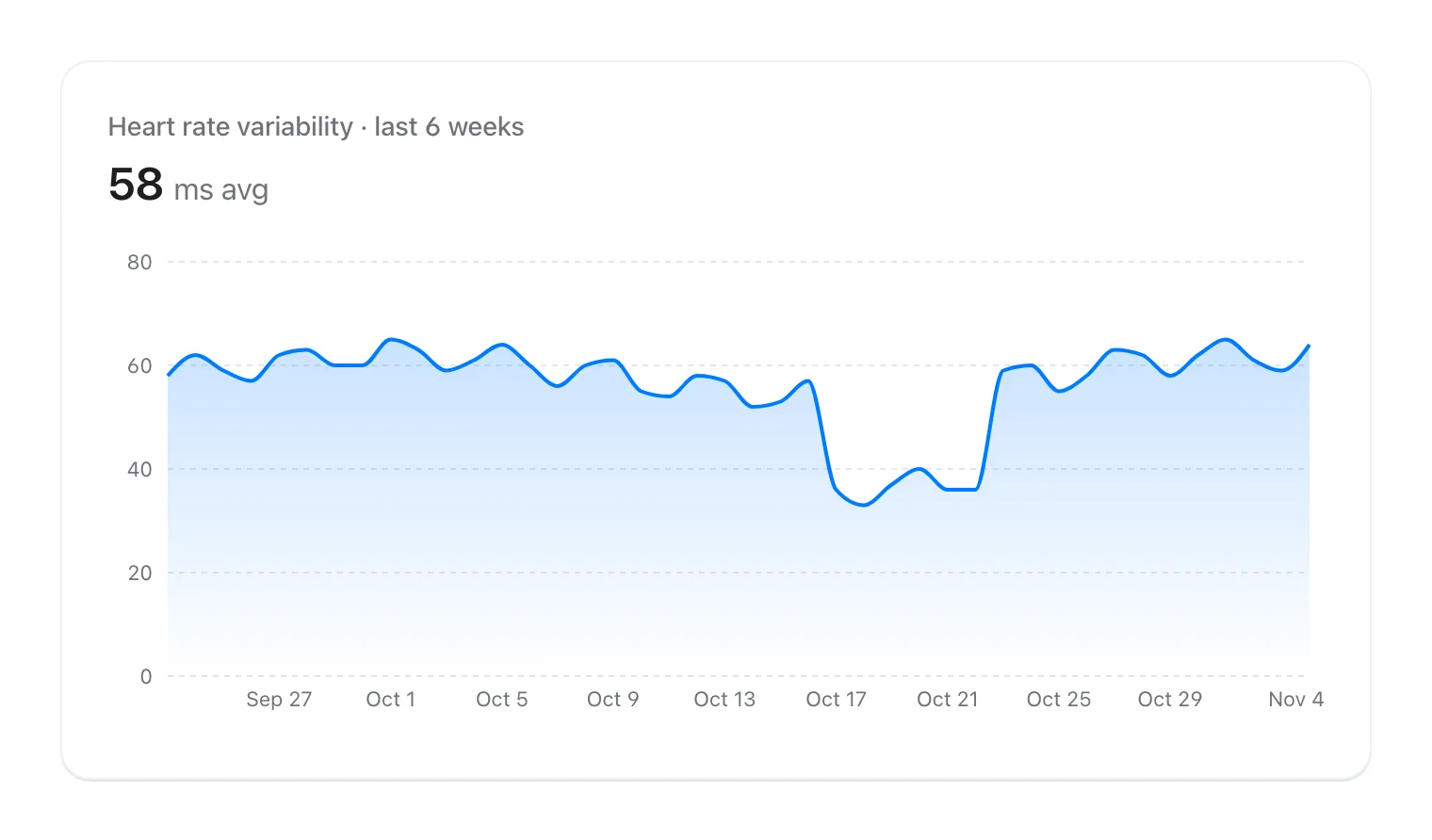
HRV naturally varies day to day—a 2026 analysis of wearable data found even something as common as a night of drinking measurably lowers next-night HRV and raises resting heart rate, and that's just one of many ordinary things that move the number temporarily. A single dip after a late night, a stressful day, or a hard workout is expected, not alarming.
What's worth paying attention to is a sustained drop that holds across several days, especially alongside other signals moving the same direction. Compare your recent readings to your own baseline, not to a friend's number or an arbitrary threshold.
What to weigh alongside the number
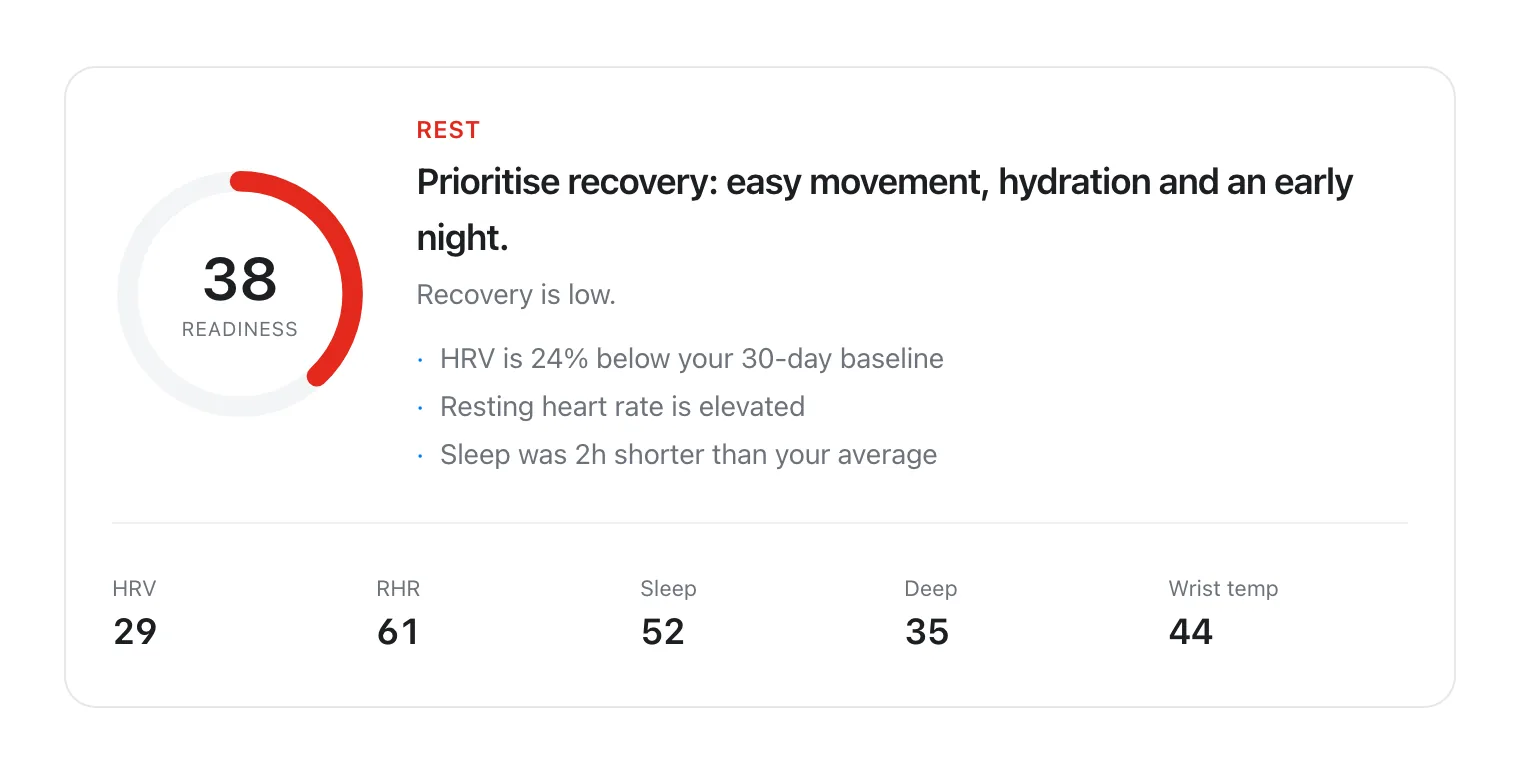
Sleep: did you get meaningfully less than usual, or was it fragmented? Resting heart rate: is it elevated alongside the lower HRV? Recent training: have the last several days been unusually hard, long, or back-to-back without rest? Symptoms: soreness, fatigue, or feeling run-down matter even when a reading looks borderline.
If several of these point the same direction—short sleep, elevated resting heart rate, a demanding recent training block, and you genuinely feel off—that's a more trustworthy signal than any single number.
When it's reasonable to scale back
Consider an easier session, a shorter workout, or a rest day when a lower HRV reading lines up with poor sleep, elevated resting heart rate, and how you feel—and especially if you have any symptoms. Apple's own guidance on exercise-related wellness features recommends considering discontinuing a workout or seeking medical attention if you experience concerning symptoms, regardless of what any score says.
When it's reasonable to go ahead
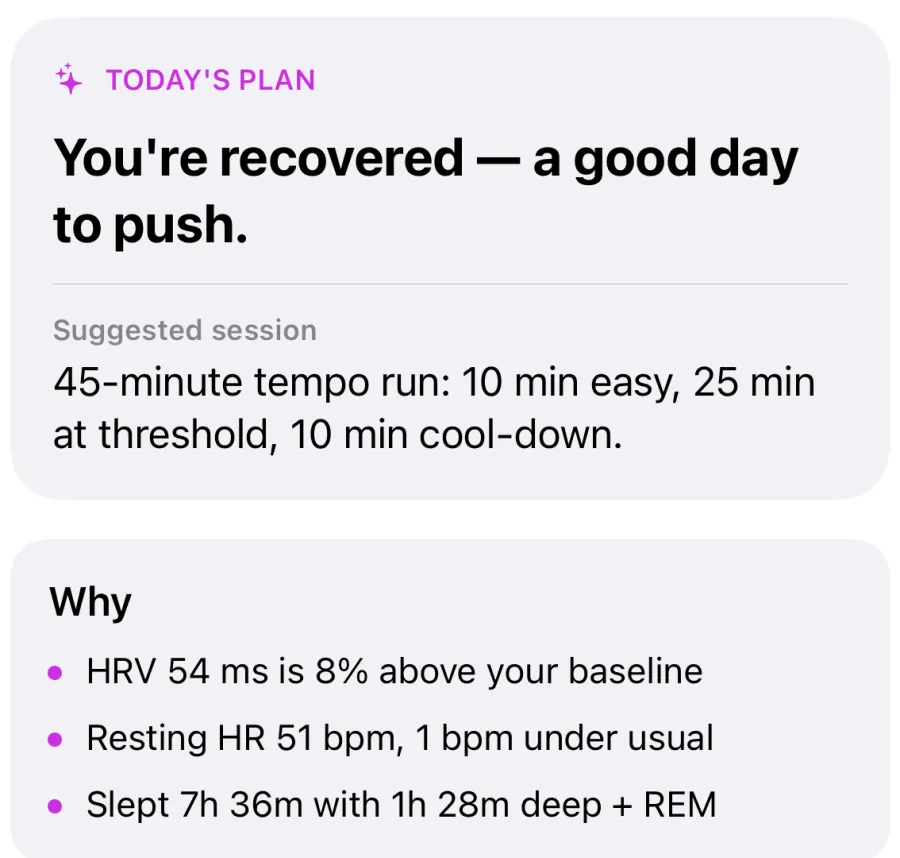
If your HRV dipped a bit but sleep was normal, resting heart rate is steady, and you feel fine, there's little reason to scrap your plan over one number—particularly if the broader trend over the past couple of weeks has been stable or improving. A single noisy reading inside your normal range of variation isn't a reason to change course.
Common questions
Does a low HRV reading mean I'm overtraining? Not on its own. Overtraining is a pattern across weeks—persistently low HRV, elevated resting heart rate, poor sleep, and declining performance together—not a single day's number.
Should I let an app decide for me? Treat any automated readiness or recovery score as one input, not an instruction. The research supports using HRV trends to inform training intensity, not to replace judgment entirely.
What if I feel terrible but my HRV looks normal? Trust how you feel. HRV is one signal among several, and it doesn't capture everything—symptoms and subjective fatigue matter regardless of what the number says.
See HRV alongside the rest of the picture
VedaWatch's Recovery view reads HRV, resting heart rate, sleep, and wrist temperature together from Apple Health, so a single low HRV reading shows up next to the context that actually determines whether it's worth acting on.
With permission, it works off the data your watch already collects. AI coaching is optional, requires your permission to share relevant data for processing, and is subject to your plan's limits.
Sources & further reading
- Düking et al. 2020, Scandinavian Journal of Medicine & Science in Sports: Predefined vs. data-guided training prescription based on autonomic nervous system variation: A systematic review
- Apple Support: Understand your readiness score on Apple Watch
- PLOS Digital Health: Real-world effects of alcohol on heart rate, sleep, and physical activity by age and sex (Grosicki et al.)
This guide is educational, not medical advice, and has not been clinically reviewed. VedaWatch is not a medical device. If you have symptoms or concerns about your heart or health, contact a qualified healthcare professional.
Put your trends in perspective.
Explore HRV, sleep, and recovery with VedaWatch on your iPhone.
Download VedaWatch on the App Store →