 VedaWatch
Nutrition
What to eat before a morning run: by run length and timing
What to eat before a morning run, from fasted easy jogs to long runs: carb amounts by body weight, quick foods by timing, hydration, coffee and gut comfort.
By VedaWatch editorial team · · 10 min read
The short answer
For an easy run under about an hour, you can run fasted or have a small carb snack like a banana 30 to 60 minutes before. For runs over an hour or hard sessions, eat a low-fat, low-fiber, carb-based breakfast: about 1 to 4 g of carbs per kg of body weight, 1 to 4 hours before.
What should you eat before a morning run?
It depends mostly on two things: how long and how hard the run is, and how much time you have between waking up and heading out. An overnight fast draws down the carbohydrate stored in your liver, which a pre-run meal can top up. A short, easy run usually goes fine without it, while a long run or a hard workout tends to go better with some fuel first.
When you do eat, carbohydrate is the part that matters. The joint position statement on nutrition and athletic performance from the American College of Sports Medicine, the Academy of Nutrition and Dietetics and Dietitians of Canada suggests 1 to 4 g of carbohydrate per kilogram of body weight, eaten 1 to 4 hours before exercise lasting more than 60 minutes. It also says foods that are low in fat and fiber and low to moderate in protein are usually preferred before exercise, because they are less likely to upset your stomach and they leave the stomach faster.
Most morning runners don't have 4 hours, so the practical version is simple: the less time you have, the smaller and simpler the snack. Below you'll find how to decide between fasted and fed, how many grams to aim for at your weight, quick foods with their carb counts, and how to handle water, coffee and a sensitive stomach.
Can you run on an empty stomach in the morning?
Often, yes. A 2018 systematic review and meta-analysis of 46 studies (Aird and colleagues) found that eating before exercise improved performance in prolonged aerobic exercise, but made no significant difference for shorter aerobic exercise. The same review noted that fasted exercise can change some metabolic signals in muscle and fat tissue, though the authors say more research is needed before drawing practical conclusions from that.
So fasted running isn't harmful for most healthy people on short easy runs, and it isn't a performance trick either. The question is whether the run is long or hard enough to need fuel. Use this as a starting point and adjust to how you feel:
- Easy run under 45 minutes: fasted is fine if you feel good. Water is enough. If you get lightheaded or sluggish, try 15 to 30 g of fast carbs beforehand.
- Easy run of 45 to 75 minutes: a small snack of about 20 to 40 g of carbs 30 to 60 minutes before helps most people, especially if dinner was early or light.
- Long run over 75 to 90 minutes: eat a proper carb breakfast (1 to 2 g per kg) 1.5 to 3 hours before if you can, and plan to take carbs during the run.
- Intervals, tempo or a race: eat something even if the run is short. Hard efforts burn mostly carbohydrate, and most runners feel better and push harder with fuel on board. Test your breakfast on training days, never for the first time on race day.
- Anyone with diabetes, a history of low blood sugar, pregnancy, or a history of disordered eating: talk to your doctor or a registered dietitian before running fasted.
How many carbs before a run? Worked examples by body weight
The 1 to 4 g per kg range is wide on purpose. A sensible way to use it is to eat toward the low end when breakfast is close to the run and toward the higher end only when you have several hours to digest. Very few people want a large meal at 5:30 am.
Example for a 70 kg runner: the low end, 1 g per kg, is 70 g of carbs. Eaten 1.5 to 2 hours before a long run, that could be a plain bagel (about 52 g) with a 20 g spoonful of honey (about 16 g). With 3 hours or more, for example before a late-morning race, 2 g per kg (140 g) is reasonable if your stomach tolerates it.
Example for a 55 kg runner with only 45 minutes: 1 g per kg would be 55 g, which is a lot to eat that close to a run. Something smaller works better, such as a medium banana (about 27 g) or two slices of white bread with honey, then carbs during the run if it goes long.
The position statement adds a useful detail: in some people, carbohydrate eaten shortly before exercise causes a dip in blood sugar early in the run. Ways around it include eating at least 1 g per kg in the pre-run meal, adding a little protein, including a few short faster efforts in your warm-up, and taking carbs during the run. In practice, most runners who eat a snack 30 to 60 minutes before an easy run notice nothing at all.
Quick pre-run foods with timing and carb amounts
Carb amounts below are worked out from USDA FoodData Central values per 100 g, so they are approximate and depend on the exact product and portion. Check labels for packaged foods, gels and sports drinks, since their carb content varies by brand.
Pick the line that matches the time you have. If your stomach is sensitive, stay with the lower-fiber choices nearer the run.
- 5 to 15 minutes before: a sports drink or a gel, or a few sips of juice. Liquids and gels empty from the stomach fastest. Check the label for grams of carbs.
- 30 to 45 minutes before: a medium banana (118 g), about 27 g of carbs. Or 100 g of unsweetened applesauce, about 11 g, if you only want a little.
- 30 to 60 minutes before: 40 g of dates, about 30 g of carbs. Dates are higher in fiber than a banana (about 6.7 g vs 2.6 g per 100 g), so test them on an easy day first.
- 45 to 60 minutes before: two slices of white bread (29 g each, about 14 g of carbs per slice) with 20 g of honey (about 16 g), roughly 45 g in total. Or 20 g of plain rice cakes, about 16 g.
- 1.5 to 2 hours before: a plain bagel (100 g, about 52 g of carbs) with honey or jam and a thin layer of nut butter, or a bowl of cereal with milk and a banana.
- 2 to 3 hours before: a fuller breakfast such as oatmeal with fruit, toast with eggs, or rice with a little protein. This is the window where higher-fiber foods and more protein usually sit fine.
How much water should you drink before a morning run?
Most people go the whole night without drinking, so it's worth thinking about fluid as well as food. The ACSM position stand on exercise and fluid replacement says the goal of drinking before exercise is to start the session normally hydrated, and that it should begin at least several hours ahead when it's needed, so your body has time to absorb the fluid and pass any extra.
The 2016 nutrition position statement gives a number: about 5 to 10 ml per kg of body weight in the 2 to 4 hours before exercise, aiming for pale yellow urine. For a 70 kg runner that's 350 to 700 ml. A little sodium in food or drink before the run may help you hold on to that fluid.
Early runs don't leave 2 to 4 hours, so do what you can. Drink a glass of water as soon as you wake up, sip a bit more while you get ready, and stop large amounts 15 to 30 minutes before you leave so you're not running with a sloshing stomach or looking for a toilet. Drinking well the evening before helps too. Sweat rates vary widely between people and with the weather, so on hot mornings or long runs, carry fluid. For how much to drink during and after training, see our guide to how much water to drink when training.
Is coffee before a morning run a good idea?
For many runners, yes. The International Society of Sports Nutrition position stand on caffeine says aerobic endurance shows the most consistent benefit from caffeine, with doses of 3 to 6 mg per kg of body weight, most often taken about 60 minutes before exercise. For a 70 kg runner, 3 mg per kg is 210 mg. Caffeine in coffee varies a lot by brew and cup size, so check the figures for the coffee you actually drink.
Responses vary from person to person. Coffee gets the gut moving for some people, which can be helpful if you have time to use the bathroom before you leave and unhelpful if you don't. It can also cause jitters, and caffeine late in the day can affect sleep. More is not better: the same position stand notes that very high doses, around 9 mg per kg, bring more side effects without needing them for a benefit. If coffee is part of your routine, have it with or soon after your pre-run snack, at least 30 to 60 minutes before you go.
How to avoid stomach problems on morning runs
Stomach and gut problems are common in running. A review by de Oliveira, Burini and Jeukendrup reports that studies generally find 30 to 50% of endurance athletes experience them. Most symptoms are mild, but running reduces blood flow to the gut, especially when you're dehydrated, and that is thought to be one of the main causes.
What you eat is the part you can control. These habits help most runners:
- Keep the last meal or snack before the run low in fat, fiber and protein. Save the eggs, avocado, beans and bran for after the run or for meals 2 to 3 hours before.
- Leave more time before hard or fast runs than before easy ones. Intensity, not just distance, tends to make symptoms worse.
- Try liquids if solid food sits badly: a smoothie, a sports drink or a liquid meal. The position statement mentions liquid options for athletes with pre-event nerves.
- Change one thing at a time and keep a note, so you can tell which food caused trouble.
- Practice your race-day breakfast and in-run fuel on long training runs. The review notes that training with nutrition is one of the ways to reduce gut discomfort.
- Be careful with sugar alcohols, very sweet drinks on an empty stomach, and new supplements before a run.
Do you need to eat during a long morning run?
Breakfast is only half the plan for longer runs, especially if you ate little or nothing beforehand. The 2016 position statement summarizes carbohydrate during exercise by duration. Jeukendrup, whose work these bands draw on, notes that the amounts may need to come down when the pace is easy, because you burn carbohydrate more slowly. The ISSN position stand on nutrient timing adds that the benefit of carbs during long exercise is most consistent when you start the session fed rather than fasted, which is one more reason to eat breakfast before a long run:
- Under 45 minutes: not needed.
- 45 to 75 minutes of sustained hard running: small amounts, even just rinsing a sports drink around your mouth.
- 1 to 2.5 hours: 30 to 60 g of carbs per hour.
- Longer than 2.5 to 3 hours: up to 90 g per hour, using products that mix different sugars such as glucose and fructose.
How VedaWatch helps you fuel around your runs
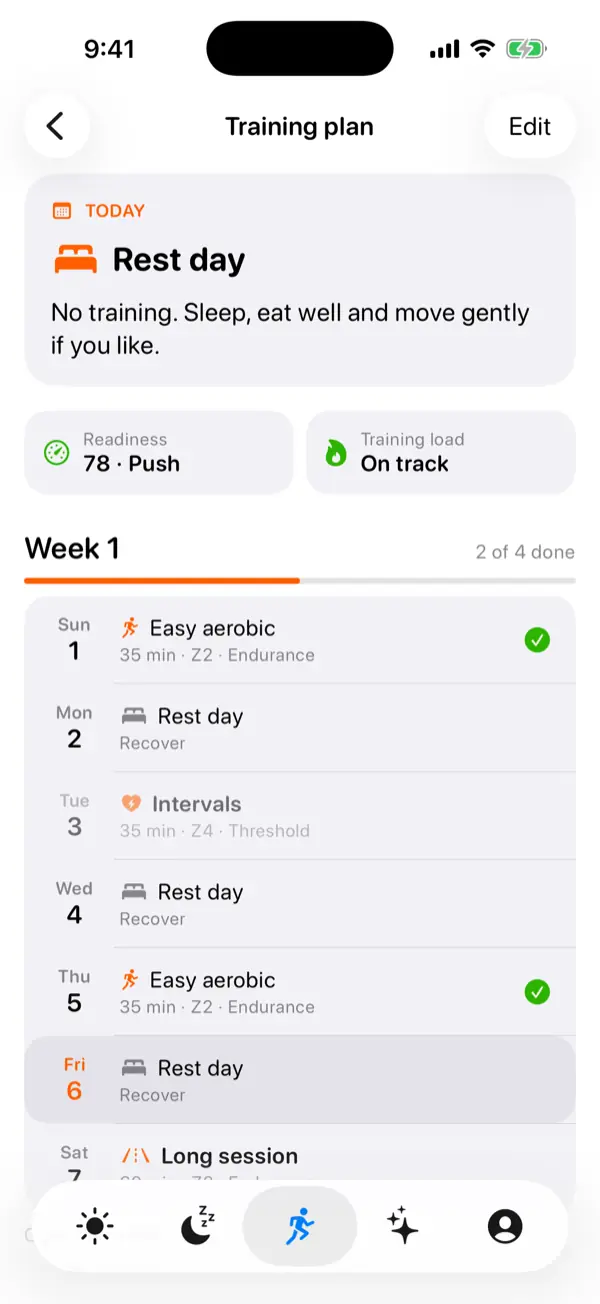
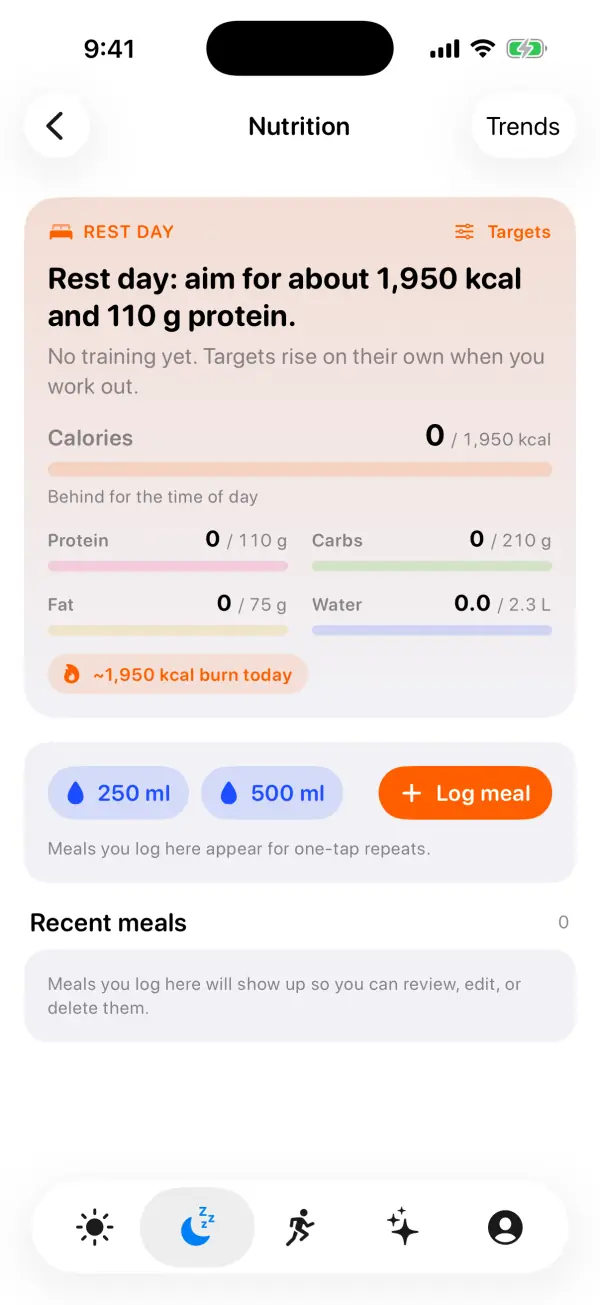
VedaWatch's Nutrition screen, under the Recover tab on iPhone, has a Fuel card with daily targets for calories, protein, carbs, fat and water. If you follow a VedaWatch training plan, the card reads today's session in the morning, before you've run: an Easy aerobic session makes it a training day with carbs at 5 g per kg, and a Long session, Tempo, Intervals or Race day makes it a hard training day at 7 g per kg. Without a plan, targets rise on their own once your Apple Watch records a workout. Protein stays the same every day.
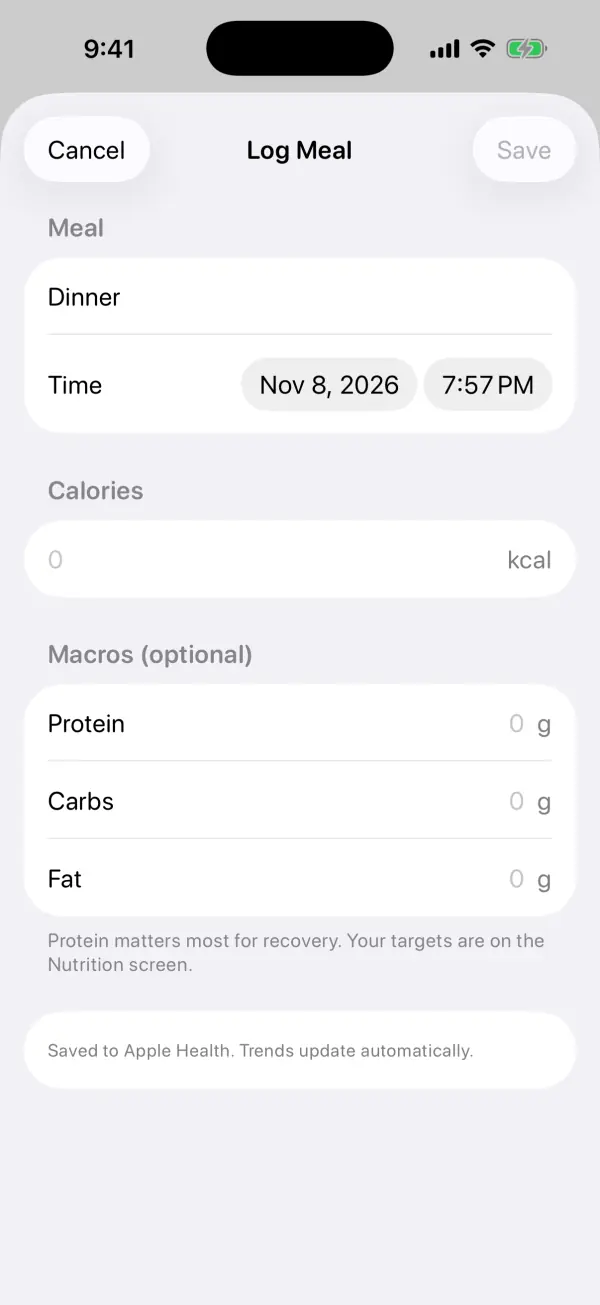
Water works the same way: the target is about 33 ml per kg plus 0.6 L per hour of planned or completed training, capped at 5 L, and 250 ml and 500 ml buttons log a glass in one tap. Meals you log, with carbs if you know them, are saved to Apple Health, and food from other apps that write to Apple Health counts toward your targets too. On a training or hard day, if you're well behind on calories from 1 pm, the card suggests eating some carbs soon so you recover. You can also ask Siri, "How's my fuel in VedaWatch".
These are daily totals, not a pre-run prescription. VedaWatch doesn't tell you what to eat in the hour before your run; use the guidance above for that, and the Fuel card to make sure the rest of the day covers what the run cost. The targets are general guidance for healthy adults who train, not medical or dietetic advice.
Frequently asked questions
Is a banana enough before a morning run?
For an easy run up to about an hour, a medium banana (about 27 g of carbs) 30 to 45 minutes before is enough for most people. For a long run or a hard session, it's a good start but you'll likely want more carbs, either earlier or during the run.
How long should I wait after eating before I run?
Roughly 30 to 60 minutes after a small carb snack, 1.5 to 2 hours after a light breakfast, and 2 to 3 hours after a full meal with fat, fiber or protein. Leave longer before fast running than before easy jogging.
Does running fasted burn more fat?
Fasted exercise raises the fat circulating in your blood afterwards and changes some metabolic signals, according to a 2018 meta-analysis. Whether that leads to more fat loss over time is not settled, and the same review found that eating first helps performance in longer runs.
Can I eat peanut butter or eggs before running?
Yes, if you leave enough time. Fat and protein slow digestion, so keep them small or eat them 2 to 3 hours before. A thin layer of nut butter on toast 1.5 to 2 hours before usually sits fine.
What if I feel dizzy or shaky on fasted runs?
Stop, eat or drink some carbs, and don't run fasted again until you've worked out why. If it keeps happening, or you have diabetes or take medication that affects blood sugar, talk to your doctor.
Related guides
- How much to eat on training vs rest days: calorie and protein targets from your Apple Watch
- How much water should I drink when working out?
- Carb loading for a half marathon: how much, when and what to eat
- What to eat after a workout: protein, carbs and timing
- Does caffeine affect HRV? Coffee, sleep and your cutoff time
- Training for a 5K, 10K or half marathon with Apple Watch: a plan that adapts to your recovery
Sources & further reading
- Medicine & Science in Sports & Exercise (2016): American College of Sports Medicine Joint Position Statement. Nutrition and Athletic Performance (Thomas, Erdman, Burke)
- Scandinavian Journal of Medicine & Science in Sports (2018): Effects of fasted vs fed-state exercise on performance and post-exercise metabolism: a systematic review and meta-analysis (Aird, Davies, Carson)
- Medicine & Science in Sports & Exercise (2007): American College of Sports Medicine position stand. Exercise and fluid replacement (Sawka et al.)
- Journal of the International Society of Sports Nutrition (2021): ISSN position stand: caffeine and exercise performance (Guest et al.)
- Sports Medicine (2014): Gastrointestinal complaints during exercise: prevalence, etiology, and nutritional recommendations (de Oliveira, Burini, Jeukendrup)
- Sports Medicine (2014): A step towards personalized sports nutrition: carbohydrate intake during exercise (Jeukendrup)
- Journal of the International Society of Sports Nutrition (2017): ISSN position stand: nutrient timing (Kerksick et al.)
- USDA FoodData Central: nutrient values for bananas, white bread, bagels, honey, dates, rice cakes and applesauce
This guide is educational, not medical advice, and has not been clinically reviewed. VedaWatch is not a medical device. If you have symptoms or concerns about your heart or health, contact a qualified healthcare professional.
Put your trends in perspective.
Explore HRV, sleep, and recovery with VedaWatch on your iPhone.
Download VedaWatch on the App Store →