 VedaWatch
Recovery & Apple Watch
Rest day vs active recovery: which one do you need today?
Rest day vs active recovery: what the research says, a simple readiness and HRV decision guide, Zone 1 session ideas, and how many rest days a week to take.
By VedaWatch editorial team · · 9 min read
The short answer
Both are recovery. Take a full rest day when you're ill, exhausted, injured or your HRV and resting heart rate have been off for several days. Choose active recovery, 20 to 40 minutes of very easy Zone 1 movement, when you're just sore or a bit flat. Most people training hard benefit from one or two full rest days a week.
Rest day vs active recovery: what's the difference?
A rest day (sometimes called passive recovery) means no planned exercise. You still walk around, do chores and live your life, but you don't train. Active recovery means doing something deliberately easy, such as a relaxed walk, an easy spin on a bike, a gentle swim or mobility work, on a day you'd otherwise rest or after a hard session.
Neither is a day off from getting fitter. Training is the stress; the adaptation happens while you recover. The question isn't whether to recover, but which kind of recovery fits your body today.
The short version: active recovery is a good default when you're sore, stiff or slightly flat but otherwise well. A full rest day is the better call when you're ill, injured, exhausted, sleeping badly, or your recovery signals have been down for several days in a row. If in doubt, rest. You lose nothing measurable from one easy day.
What the research says about active recovery
The best summary of the evidence is a 2018 systematic review with meta-analysis by Dupuy and colleagues in Frontiers in Physiology, which pooled 99 studies on post-exercise recovery methods. Active recovery reduced delayed onset muscle soreness (DOMS) compared with doing nothing, a moderate-to-large effect (standardised mean difference of -0.94, from 8 study groups and 90 people). It did not significantly change how fatigued people felt, though that analysis was small (4 groups, 33 people).
So easy movement probably helps sore muscles feel better, but it isn't a fatigue eraser. The same review found massage was the most effective method for both soreness and perceived fatigue, and that the authors could not show active recovery was better than other techniques. Most studies looked at the hours and days after a single hard bout, not at whole training weeks, so treat the effect as modest.
On the other side, the joint European College of Sport Science and American College of Sports Medicine consensus on overtraining is clear that successful training must avoid "excessive overload plus inadequate recovery". Short dips in performance after hard training are normal and lead to gains once you recover. When recovery keeps falling short, that can slide into non-functional overreaching, where performance stays down and fatigue lingers. Rest days are how you stay on the right side of that line.
There's also evidence for letting daily HRV steer the choice. In a 2007 study by Kiviniemi and colleagues, men who trained hard only when their morning HRV was normal or rising, and switched to low-intensity training or rest when it dropped, improved maximal running speed more than a group following a fixed plan. It was a small four-week study of 26 people, so it supports the idea rather than proving it.
A simple decision guide using readiness and HRV
Use your watch data as one input alongside how you feel, not as an instruction. Apple's own readiness guidance says a score "should not be solely relied on to determine whether it is safe to exercise." Work down this list and stop at the first line that fits you today.
- Fever, chest symptoms, feeling unwell, an injury that changes how you move, or pain that gets worse with activity: full rest, and see a doctor if symptoms are significant or don't settle.
- HRV clearly below your normal range and resting heart rate above it for two or more mornings, or a low readiness score several days running: full rest, or at most a short walk.
- A single low reading after a hard session, a late night or alcohol, and you feel fine: active recovery in Zone 1, or keep your plan but make it easy.
- Sore or stiff from training two days ago, sleep normal, HRV inside your usual range: active recovery or mobility. Skip the hard session on the sore muscles.
- Sleep was short but other signals are normal: an easy or moderate day rather than a hard one, and an earlier bedtime.
- Signals at or above your normal and you feel good: train as planned. You don't need a rest day just because the calendar says so, unless it's your planned weekly rest.
How easy should active recovery be? Zone 1 explained
Active recovery only works if it's genuinely easy. The most common mistake is turning a recovery jog into a medium-hard run because you feel fine once you warm up. That adds fatigue instead of clearing it.
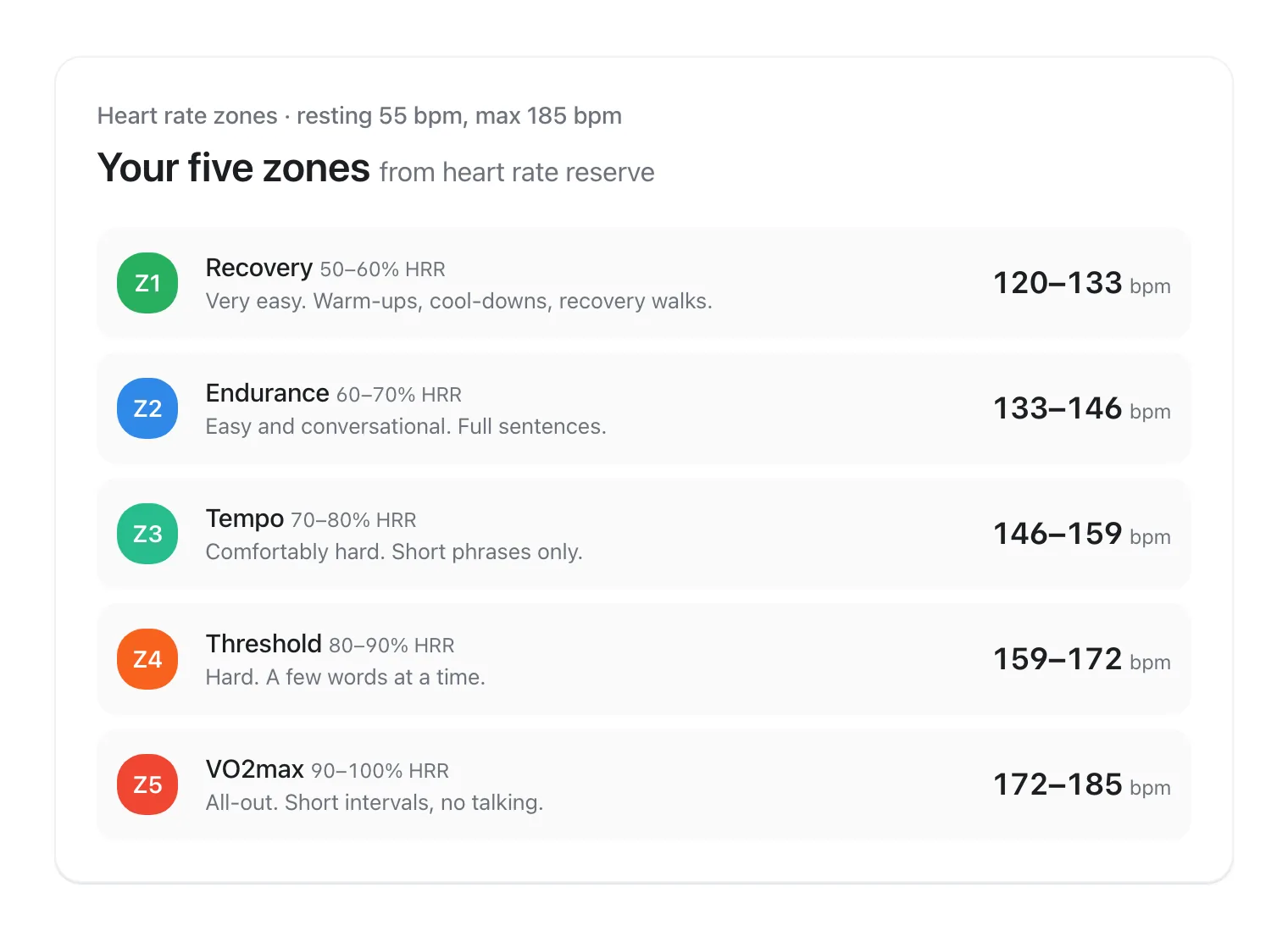
In the common five-zone model based on heart rate reserve (the gap between your resting and maximum heart rate), Zone 1 is about 50 to 60% of that reserve. To work it out, subtract resting heart rate from max, take 50% and 60% of the result, and add your resting heart rate back. With a resting heart rate of 55 bpm and a maximum of 185 bpm, the reserve is 130 beats, so Zone 1 runs from about 120 to 133 bpm.
Apple Watch shows five heart rate zones in the Workout app, calculated from your health data as a percentage of maximum heart rate, so its numbers may differ a little from this formula. Either way, Zone 1 should feel very easy: you can breathe through your nose and talk in full, relaxed sentences, and you finish feeling better than when you started.
If your heart rate drifts into Zone 2 on hills or in the heat, slow down or walk. If you can't stay that easy doing your usual sport, pick a gentler one: cycling or swimming instead of running, for example.
Example active-recovery sessions
Pick one, keep it to 20 to 40 minutes, and stay in Zone 1. Shorter is fine; there's no extra benefit to doing more on a recovery day.
- Recovery walk, 20 to 40 minutes: flat route, conversational pace, Zone 1. The easiest option after a long run or a heavy leg day.
- Easy spin, 20 to 30 minutes: indoor or outdoor bike, light gear, high cadence, Zone 1. Moves the legs without impact.
- Easy swim, 15 to 30 minutes: relaxed laps with rests at the wall, mixed strokes. Good after running-heavy weeks.
- Mobility session, 15 to 20 minutes: hip openers, thoracic rotations, ankle and calf work, cat-cow, slow controlled ranges of motion. No straining into end range.
- Walk plus mobility, 30 minutes: 20 minutes of easy walking, then 10 minutes of the mobility moves above.
- Gentle yoga, 20 to 30 minutes: a restorative or slow-flow class, not a power or hot class.
How many rest days a week do you need?
There's no single evidence-based number, because it depends on how much and how hard you train. Official guidelines give the shape of a week. The World Health Organization recommends 150 to 300 minutes a week of moderate aerobic activity, or 75 to 150 minutes of vigorous activity, plus muscle-strengthening on two or more days. The American College of Sports Medicine recommends resistance exercise for each major muscle group on 2 to 3 days a week, and either moderate cardio on 5 or more days or vigorous cardio on 3 or more.
Those targets leave plenty of room for rest and easy days. As a practical starting point, which you should adjust to how you respond:
- Beginners or returning after a break, 2 to 4 sessions a week: rest or walk on the days in between. You'll likely have 3 or more non-training days.
- Regular exercisers, 4 to 5 sessions a week: 1 to 2 full rest days, and no more than two hard sessions in a row.
- Strength training: avoid training the same muscle group hard on back-to-back days. A full-body routine works well on non-consecutive days; a split lets you train more often while each muscle rests.
- Endurance training, 5 to 6 sessions a week: at least one full rest day, with most other days easy. Place active recovery the day after the hardest sessions.
- Anyone: take an extra rest day, or a lighter week, when sleep, stress, illness or travel pile up.
What to do on a full rest day
A rest day isn't a day in bed. Normal daily movement, such as walking to the shops or playing with your kids, is fine and helps you feel less stiff. What you skip is anything that feels like training.
Sleep is the biggest lever. Aim for your usual amount or a bit more, at a regular time. Keep eating normally, including protein and carbohydrate; the overtraining consensus lists too little energy, carbohydrate or protein among the factors to check when recovery stalls. Drink to thirst, and keep alcohol low, since it tends to lower overnight HRV.
Use the time for the things training crowds out: a few minutes of breathing or mindfulness, some light stretching if it feels good, and planning the week ahead.
Signs you need more rest days
One hard week can leave you tired; that's normal. The signs worth acting on are the ones that persist for more than a week or two despite easy days: performance that keeps getting worse at the same effort, unusual fatigue, poor sleep, irritability or low mood, frequent minor illnesses, a resting heart rate that stays above your normal, and HRV that stays below it.
If several of these show up together, take a few days of rest and easy movement and cut your training back for a week or two. If you still feel unwell, or you have symptoms such as chest pain, dizziness, breathlessness out of proportion to the effort, or an unusually high resting heart rate, stop training and speak to a doctor. Watch data and recovery scores are wellness tools, not a diagnosis.
How VedaWatch helps you choose
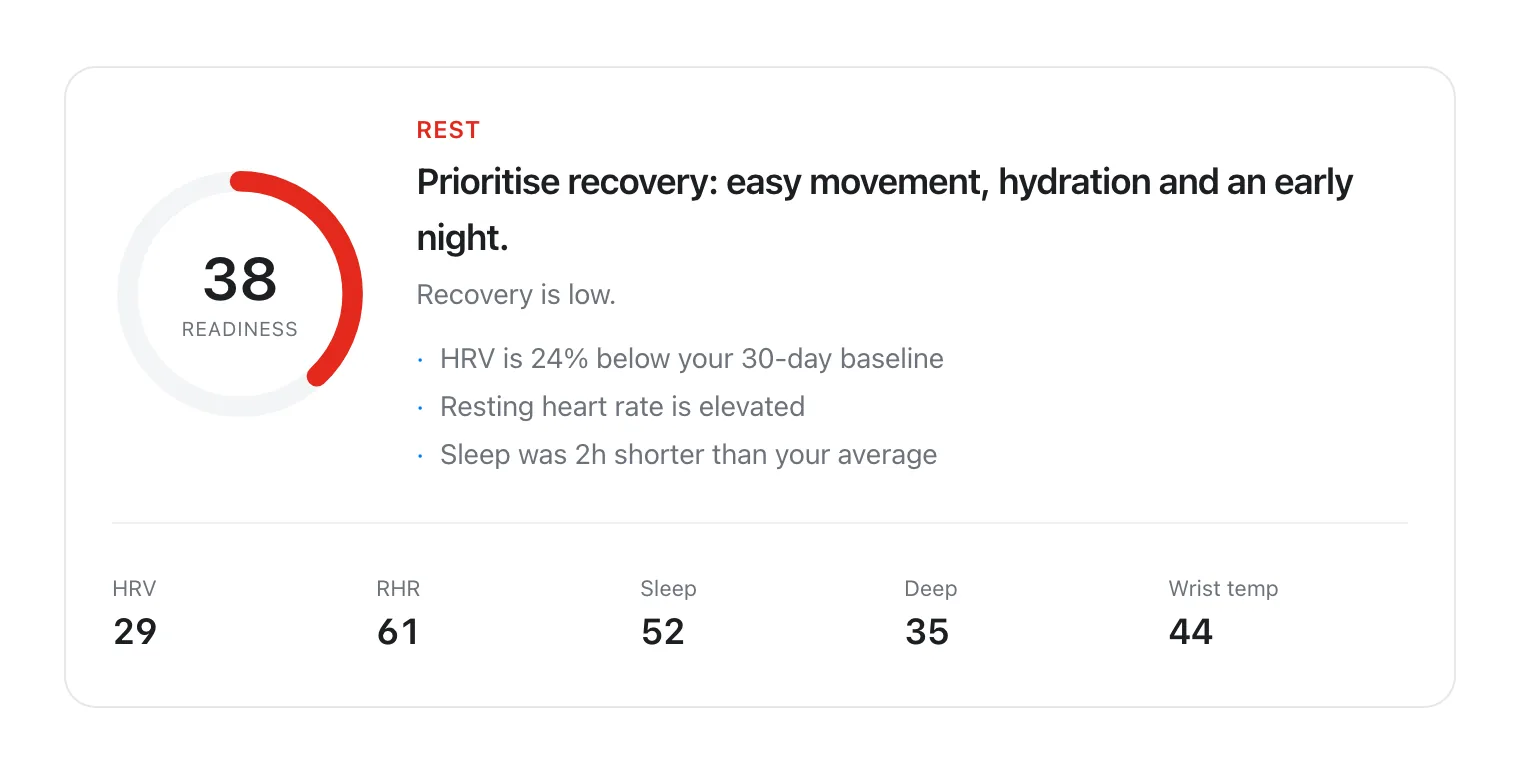
VedaWatch gives you a daily readiness score from 0 to 100 that compares your HRV, resting heart rate and sleep from Apple Watch with your recent baseline. A score of 70 or more is a Push day, 50 to 69 is Hold, and under 50 is Rest, with the reasons listed underneath. On a Rest day the advice is to prioritise recovery: easy movement, hydration and an early night.
Today's session on the Train tab follows the same call. On a Rest day it suggests gentle mobility of 20 minutes or less instead of a workout. If you have a week plan, a planned hard session becomes easy mobility, and the reasons say so. Recovery days in a plan become a very easy Zone 1 walk, and if training load is spiking the coach switches a hard day to easy Zone 2.
It also tells you when to stop. Once you have 10 or more exercise minutes on a Rest day, the Today screen says you've moved enough for a rest day and suggests protecting tonight's sleep. Over time, an insight can show which workout type lowers your next-morning HRV most compared with rest days, which helps you decide where to put your rest days in the week.
Frequently asked questions
Is walking on a rest day OK?
Yes. Everyday walking doesn't undo a rest day, and an easy walk is one of the best forms of active recovery. Just keep it relaxed rather than turning it into a long or brisk workout.
Should I stretch on a rest day?
Gentle stretching or mobility work is fine if it feels good, and the ACSM recommends flexibility exercises on at least two days a week. Avoid forcing deep stretches on very sore muscles.
Can active recovery replace all my rest days?
For many recreational exercisers, a mix works best: easy days most of the time and at least one full rest day a week. If you train hard on most days, a full rest day gives your body a break that even easy sessions don't.
Is a rest day after every workout too much?
Not if you're new to exercise or training two to three times a week; that's a sensible pattern. As fitness grows, you can add easy sessions between hard ones rather than more rest.
Will one rest day make me lose fitness?
No. A day or two off won't measurably reduce fitness, and you're often stronger after it. Fitness falls only after much longer breaks.
Should I eat less on rest days?
You may need a little less energy, but keep protein steady because muscle repair continues on rest days. Cutting food sharply on rest days can work against recovery.
Related guides
- Should you train or rest when HRV is low?
- Apple Watch Readiness score: what Recover, Pace Yourself, Ready, and Go For It mean
- Signs of overtraining: what your Apple Watch can and can't show
- Apple Watch heart rate zones explained: what each zone means and how to set them
- Train by readiness: how VedaWatch picks today's workout from your Apple Watch data
- HRV after a workout: the normal dip and how long recovery takes
Sources & further reading
- Frontiers in Physiology (2018): An evidence-based approach for choosing post-exercise recovery techniques to reduce markers of muscle damage, soreness, fatigue, and inflammation (Dupuy et al.)
- Medicine & Science in Sports & Exercise (2013): Prevention, diagnosis, and treatment of the overtraining syndrome, joint consensus statement of the ECSS and ACSM (Meeusen et al.)
- European Journal of Applied Physiology (2007): Endurance training guided individually by daily heart rate variability measurements (Kiviniemi et al.)
- Medicine & Science in Sports & Exercise (2011): ACSM position stand. Quantity and quality of exercise for developing and maintaining fitness in healthy adults (Garber et al.)
- World Health Organization: Guidelines on physical activity and sedentary behaviour (2020)
- Apple Support: Understand your readiness score on Apple Watch
- Apple Watch User Guide: View Heart Rate Zones on Apple Watch
This guide is educational, not medical advice, and has not been clinically reviewed. VedaWatch is not a medical device. If you have symptoms or concerns about your heart or health, contact a qualified healthcare professional.
Put your trends in perspective.
Explore HRV, sleep, and recovery with VedaWatch on your iPhone.
Download VedaWatch on the App Store →