 VedaWatch
Workouts & Training
80/20 running: polarized training made simple for 3 to 5 runs
80/20 running explained: what Seiler's polarized training research found, how to split your week, sample weeks for 3 to 5 runs, and how to check it on Apple Watch.
By VedaWatch editorial team · · 10 min read
The short answer
80/20 running means doing about 80% of your training at an easy, conversational effort and about 20% hard, with little in the moderate middle. For most runners that's one hard session in every four or five runs. Count it by sessions; your watch's time in zones will usually show 85 to 90% easy.
What is 80/20 running?
80/20 running is a simple rule for how hard your runs should be across a week. About 80% of your training is easy, at a pace where you can talk in full sentences, and about 20% is genuinely hard, such as intervals that leave you breathing heavily. Very little is spent in the comfortably hard middle that many runners default to.
The idea is also called polarized training, because the effort sits at the two ends of the scale. Easy days are easier than most people run them, and hard days are harder. The middle, sometimes called the grey zone or no man's land, is used sparingly.
It isn't a special plan with fixed workouts. It's a way of checking any plan, including the one you already follow: count your easy and hard sessions, and if most of your runs feel moderately hard, you're probably not doing 80/20.
Where 80/20 comes from: Seiler's research
The 80/20 label comes largely from the work of exercise physiologist Stephen Seiler, who studied how successful endurance athletes actually train. In a 2006 study, he and Glenn Øvrevik Kjerland tracked 11 well-trained junior cross-country skiers for 32 days. Measured by heart rate, about 75% of their endurance sessions were in the easy zone, 8% in the middle zone and 17% in the hard zone. Session ratings of effort gave almost the same split.
In a 2010 review, Seiler pulled together observations across endurance sports and described a recurring pattern: athletes training 10 to 13 times a week did about 80% of their sessions at low intensity and about 20% as high-intensity work, such as intervals. He also noted that pushing more high-intensity work onto already well-trained athletes hadn't convincingly improved long-term performance.
Seiler's research uses three intensity zones set by two physiological thresholds. Zone 1 is below the first threshold, roughly where blood lactate stays under about 2 mmol/L and you can chat easily. Zone 3 is above the second threshold, roughly above 4 mmol/L, where you can only say a few words. Zone 2 in this model is the band between them. That three-zone "Zone 2" is not the same as Zone 2 on your Apple Watch, which uses five zones, a common source of confusion.
Does polarized training work for recreational runners?
There is good evidence that a mostly easy approach works, and mixed evidence that it beats every alternative. In a 5-month study of 12 sub-elite runners, the group whose training was mostly low intensity improved a 10.4 km cross-country race time by about 157 seconds, against about 121 seconds for a group doing more moderate work, with similar amounts of hard training in both.
In a 10-week study of 30 recreational runners, a polarized group improved 10K time by about 5.0% and a group training mostly between the thresholds by about 3.6%. The overall difference wasn't statistically significant, but among runners who stuck most closely to their assigned mix, the polarized group improved more.
A 9-week trial in 48 well-trained endurance athletes found the largest gains in the polarized group: peak oxygen uptake rose about 11.7% and time to exhaustion about 17.4%. Its polarized group spent about 68% of training time easy, 6% in the middle and 26% hard, a reminder that "80/20" is a rough guide, not an exact ratio.
The most balanced summary is a 2024 meta-analysis of 17 studies (437 athletes). Polarized training had a small advantage for VO2 peak, mainly in highly trained athletes and in programmes shorter than 12 weeks, and no advantage for time-trial performance. The practical takeaway: 80/20 is a sensible, sustainable default, not a magic formula. Its biggest benefit for most runners is stopping easy days from drifting into tiring middle efforts.
Do you count 80/20 by sessions, time or distance?
This is where most guides go vague, and it changes what you should expect to see on your watch. Seiler's descriptions mostly count sessions: a session is called hard if its main work is hard, even though it includes a warm-up, easy recoveries and a cool-down.
Count by time in zones and the same week looks much easier. Take a 45-minute interval run with 5 × 3 minutes hard. Only 15 of those 45 minutes are hard. So a week where one run in five is hard (80/20 by sessions) usually shows only about 8 to 12% of total time in the hard zones, and 85 to 90% easy.
Both are fine, as long as you know which one you're using. A practical rule: plan by sessions (one hard run in four or five), then check by time. If your time in zones shows 85 to 90% easy, around 10% hard and little in the middle, your week is polarized. If the middle zone is your biggest slice, it isn't, whatever your plan says.
Distance is the least useful measure, because easy kilometres take longer than hard ones. If you count by distance, expect the easy share to look a little smaller than it does by time.
How to split your week for 80/20 running
You don't need a lab test to start. Use effort first and heart rate as a check. Easy means you can talk in full sentences. Hard means you can only manage a few words, held for minutes at a time in repeats. The middle, where you can talk in short phrases, is the zone to keep small.
- Count your runs per week. With 3 to 5 runs, plan one hard session. Add a second only if you run 5 or more times a week, have been training consistently for months, and recover well.
- Make the hard session truly hard: repeats of 2 to 5 minutes at an effort where you can't hold a conversation, with easy jogging between them. Start with about 12 to 15 minutes of hard work in total.
- Make every other run easy, including the long run. Slow down on hills and in heat rather than letting the effort climb.
- Never put two hard days back to back. Leave at least one easy or rest day between them.
- Add 4 to 6 short strides (about 20 seconds, relaxed and quick) to one or two easy runs if you like. They barely move the 80/20 numbers.
- After a week, add up your time in zones. Aim for about 85 to 90% easy, roughly 10% hard and less than 10% in the middle.
Example 80/20 weeks for 3, 4 and 5 runs
These sample weeks show how the arithmetic works. The minutes are examples, not prescriptions: scale them to what you already run comfortably, and increase total time gradually. Hard minutes count only the hard repeats, not the warm-ups and recoveries around them.
Three runs a week, about 140 minutes. Tuesday: intervals, 45 minutes (15 minutes easy, 5 × 3 minutes hard with 2 minutes easy jog between, 5 minutes easy). Thursday: easy, 35 minutes. Saturday: long easy run, 60 minutes. That's 1 hard session in 3, but only 15 of 140 minutes hard, about 11% by time and 89% easy. With only three runs, keeping just one hard session is what keeps the week polarized.
Four runs a week, about 200 minutes. Tuesday: intervals, 50 minutes including 6 × 3 minutes hard. Wednesday: easy, 35 minutes. Friday: easy, 40 minutes with 4 to 6 strides. Sunday: long easy run, 75 minutes. That's 1 hard session in 4 (75/25 by sessions) and 18 of 200 minutes hard, about 9% by time.
Five runs a week, about 235 minutes. Monday: easy, 35 minutes. Tuesday: intervals, 50 minutes including 6 × 3 minutes hard. Thursday: easy, 40 minutes. Friday: easy, 30 minutes with strides. Sunday: long easy run, 80 minutes. That's exactly 80/20 by sessions and 18 of 235 minutes hard, about 8% by time. Once this feels routine, you can make every second week's Friday a short hill session, such as 8 × 1 minute hard uphill with an easy jog down.
If you're new to running or coming back after a break, run everything easy for the first few weeks before adding a hard session. 80/20 is a way to organise training you can already handle, not a reason to add intensity.
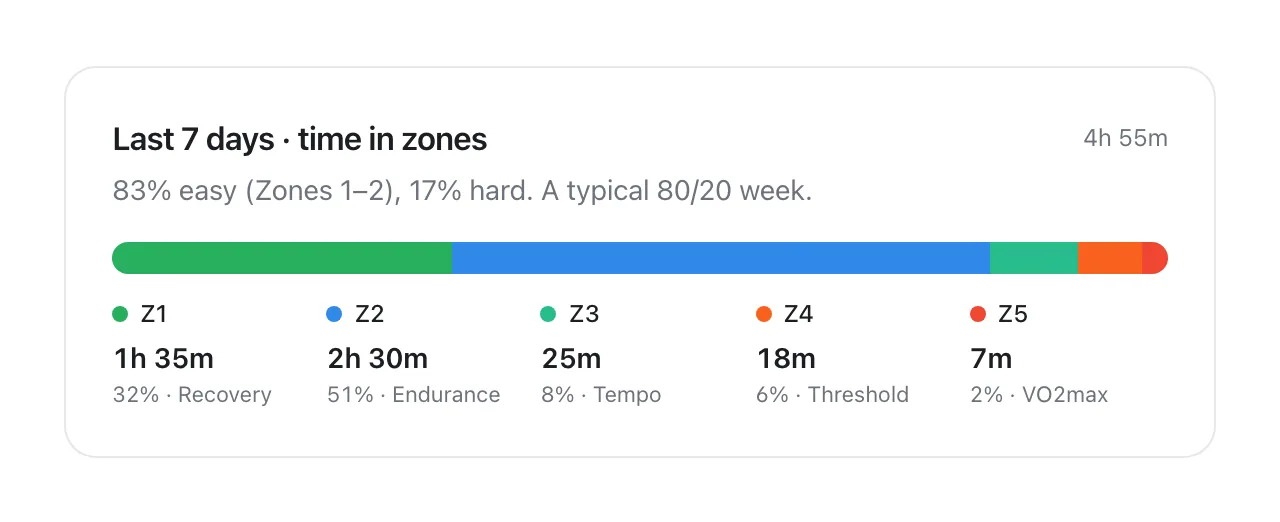
How to check your 80/20 split with Apple Watch time in zones
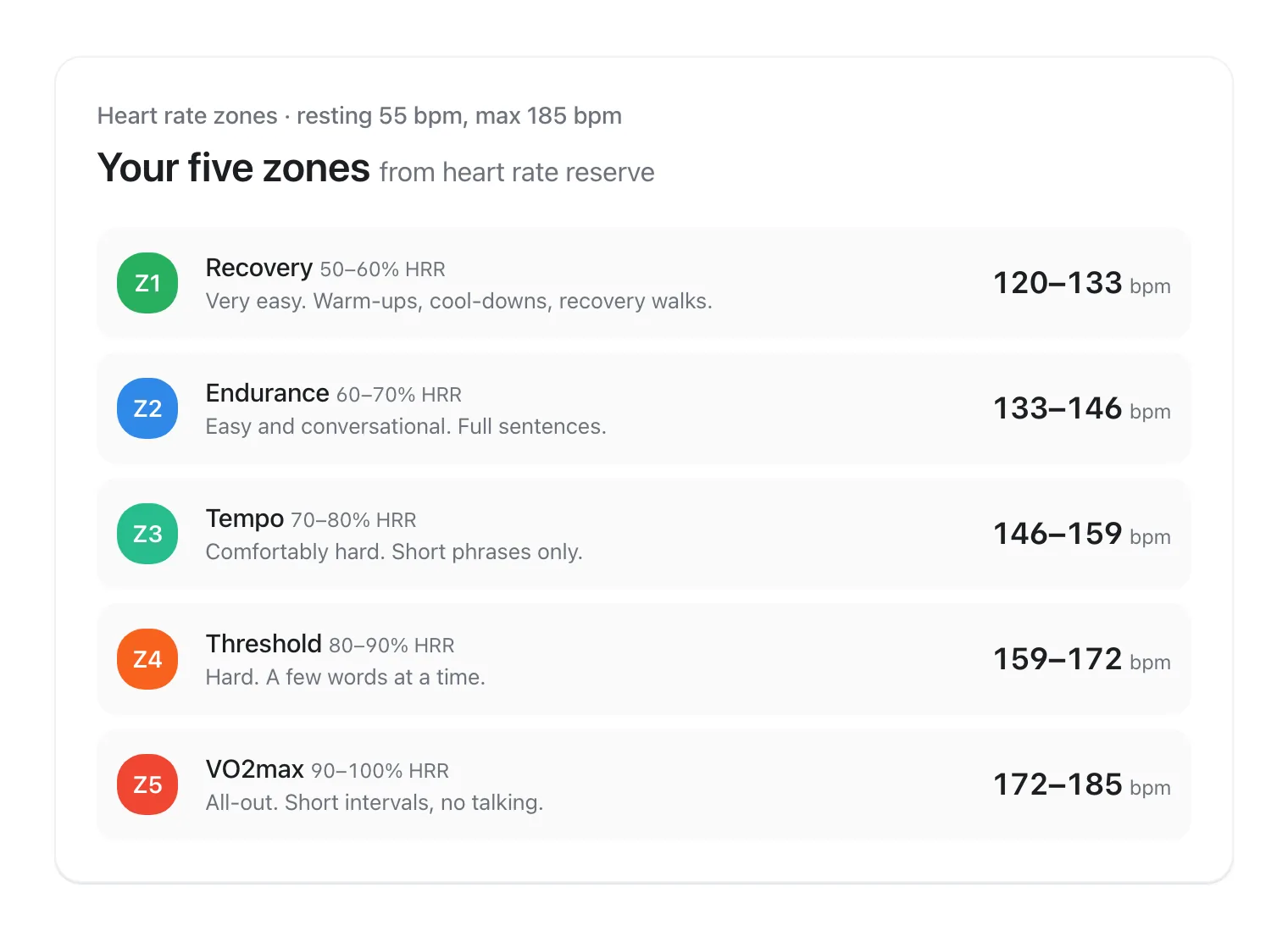
Apple Watch shows five heart rate zones during cardio workouts such as an outdoor run, and the Fitness app on iPhone shows the estimated time you spent in each zone afterwards. Apple calculates the zones automatically as percentages of your maximum heart rate, which needs your date of birth in the Health app, and lets you set Zones 2 to 4 manually.
To turn five zones into the three-part 80/20 picture, a practical mapping is: Zones 1 and 2 are easy, Zone 3 is the middle, and Zones 4 and 5 are hard. It's an approximation, because your real thresholds don't line up exactly with any formula, but it's close enough to spot a week that has drifted.
Heart rate lags behind effort. In a 3-minute repeat, the first minute or so may show as Zone 3 even when you're running hard, so short intervals tend to look less hard on the watch than they felt. Judge hard sessions mostly by effort and pace, and use zones to keep easy runs honest. If your zones look wrong overall, your maximum heart rate is the usual culprit.
- Start an Outdoor Run in the Workout app. Turn the Digital Crown to the Heart Rate Zones view to see your current zone during the run.
- On easy runs, glance at it every few minutes. If you're in Zone 3 and can only speak in short phrases, slow down until you're back in Zone 2.
- After each run, open the Fitness app on iPhone, tap Sessions, tap the workout, then tap Show More next to Heart Rate to see time in each zone.
- At the end of the week, add up the minutes in Zones 1 to 2, Zone 3 and Zones 4 to 5 across all your runs, and divide each by the total.
- Compare with the target: about 85 to 90% easy, around 10% hard and a small middle slice. A large Zone 3 share usually means easy runs are too fast.
Common 80/20 running mistakes
Running easy days too fast is the big one. If your easy pace leaves you able to speak only in short phrases, it's a middle effort, and a week full of those can leave you tired without building speed. Slowing down often feels wrong at first; it's supposed to.
Making hard days too soft is the mirror image. A tempo run at a comfortably hard pace is mostly a middle-zone session. Tempo runs aren't bad, and many good plans include them, but if you want a polarized week, the hard session should be clearly hard.
Treating 80/20 as an exact weekly quota leads to fiddling. A race week, a sick week or a holiday will skew the numbers. Look at the pattern over several weeks.
Ignoring how you feel is the last one. If you're unusually tired, sore or sleeping poorly, turn the hard session into an easy one. If you have chest pain, faintness or unusual breathlessness while running, stop and see a doctor, and talk to one before starting hard training if you have a heart condition or other health concern.
How VedaWatch helps you keep easy days easy
VedaWatch reads your workouts and heart rate from Apple Health and shows a heart rate zones card for each workout: minutes and percentage in each of five zones, named Recovery, Endurance, Tempo, Threshold and VO2max. Its zones use heart rate reserve with your resting heart rate from Health and a maximum of 190 bpm, or the workout's own peak if higher, so they can differ slightly from Apple's. Those per-run percentages are what you add up for the weekly check above.
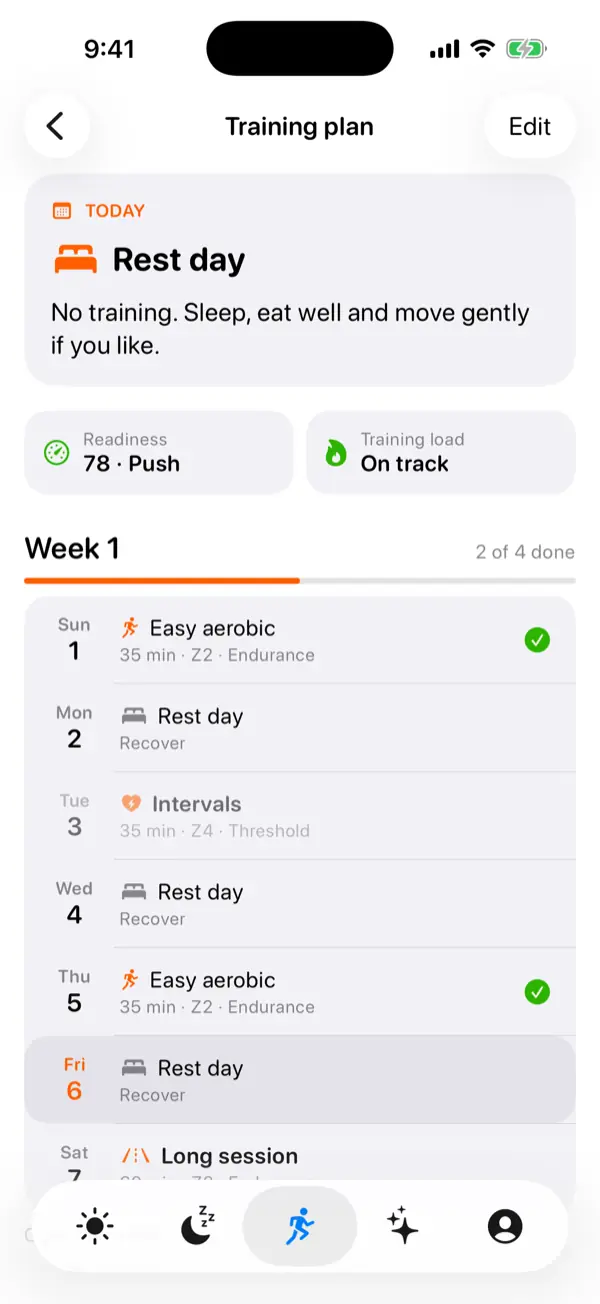
If you'd rather have the week laid out for you, the Training plan (a Pro feature, $6.99 a month or $59.99 a year on the US App Store) labels every session with a target zone: recovery runs in Zone 1, easy and long runs in Zone 2, tempo in Zone 3 and intervals in Zone 4. The Build Zone 2 base goal is described in the app as mostly easy aerobic work, about 80/20 easy to hard, with a weekly long session. Race plans for a 5K, 10K or half marathon also include tempo runs, so they're mostly easy but not strictly polarized.
The plan also checks your readiness and training load each morning. On a low-readiness day it can turn intervals into an easy run and move the hard session to a later day that week, which is the 80/20 principle applied day by day: protect the hard sessions, and keep everything else easy.
Frequently asked questions
Is 80/20 running good for beginners?
The mostly easy part is ideal for beginners, because it builds fitness with less strain. Hold off on the hard 20% for your first few weeks of running and add one short interval session once easy runs feel comfortable.
Is the long run part of the 80% or the 20%?
It's usually part of the easy 80%. Run it at a conversational effort; if you add a fast finish, count only those faster minutes as hard.
Is 80/20 the same as Zone 2 training?
Not quite. Zone 2 training focuses on easy aerobic running, while 80/20 adds a deliberate hard slice. Most of an 80/20 week is Apple Watch Zones 1 and 2, but the hard sessions are what make it polarized.
Does cross-training or walking count toward 80/20?
You can count it if you track it with heart rate. Easy cycling or brisk walking usually adds to the easy side; just apply the same zones and look at the whole week.
How long before 80/20 running makes me faster?
Studies of polarized training ran for roughly 9 weeks to 5 months, and runners improved in that time. Expect easy pace at the same heart rate to creep up over months rather than weeks.
Related guides
- Apple Watch heart rate zones explained: what each zone means and how to set them
- Easy run pace: how slow should easy runs be?
- Zone 2 training with Apple Watch: find your heart rate range and stick to it
- Training for a 5K, 10K or half marathon with Apple Watch: a plan that adapts to your recovery
- How to run a faster 5K: an 8-week plan with Apple Watch
- Apple Watch Training Load and ACWR, explained (and why sports scientists argue about it)
Sources & further reading
- Scandinavian Journal of Medicine & Science in Sports (2006): Quantifying training intensity distribution in elite endurance athletes: is there evidence for an "optimal" distribution? (Seiler & Kjerland)
- International Journal of Sports Physiology and Performance (2010): What is best practice for training intensity and duration distribution in endurance athletes? (Seiler)
- Journal of Strength and Conditioning Research (2007): Impact of training intensity distribution on performance in endurance athletes (Esteve-Lanao et al.)
- International Journal of Sports Physiology and Performance (2014): Does polarized training improve performance in recreational runners? (Muñoz et al.)
- Frontiers in Physiology (2014): Polarized training has greater impact on key endurance variables than threshold, high intensity, or high volume training (Stöggl & Sperlich)
- Sports Medicine (2024): Comparison of polarized versus other types of endurance training intensity distribution on athletes' endurance performance: a systematic review with meta-analysis (Oliveira et al.)
- Apple Watch User Guide: View Heart Rate Zones on Apple Watch
This guide is educational, not medical advice, and has not been clinically reviewed. VedaWatch is not a medical device. If you have symptoms or concerns about your heart or health, contact a qualified healthcare professional.
Put your trends in perspective.
Explore HRV, sleep, and recovery with VedaWatch on your iPhone.
Download VedaWatch on the App Store →