 VedaWatch
Workouts & Training
How to run a faster 5K: an 8-week plan with Apple Watch
How to run a faster 5K in 8 weeks: one interval day, one tempo, easy runs and a long run, realistic time goals, race-day pacing and Apple Watch pace alerts.
By VedaWatch editorial team · · 10 min read
The short answer
To run a faster 5K, keep most of your running easy and add one interval session, one tempo run and a slightly longer long run each week for about 8 weeks. Set training paces from a realistic goal time, lighten the last week, and race at an even pace instead of starting fast.
How do you run a faster 5K?
A 5K is mostly an aerobic race, but it's run close to your limit, so getting faster takes two things at once: a bigger aerobic engine and the ability to hold a hard pace for the whole race. Running every run at the same medium-hard effort, which is what most people do, trains neither very well.
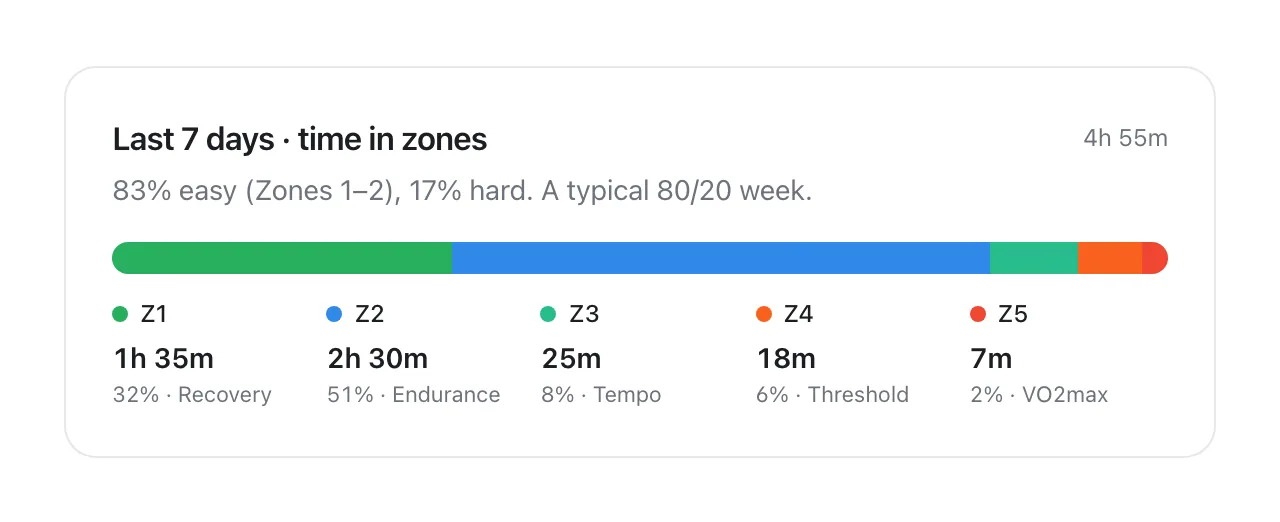
A plan that works for most runners has four kinds of session each week. Intervals teach you to run at or slightly faster than 5K pace. A tempo run builds the pace you can hold while comfortably uncomfortable. Easy runs add volume without leaving you tired. A long run, longer than the race itself, builds endurance so the last kilometre doesn't fall apart.
Research on how endurance athletes train supports this mix. In a 9-week randomized study of well-trained runners, cyclists, triathletes and skiers, a polarized program (mostly easy work plus a small amount of very hard work) improved peak oxygen uptake by 11.7% and time to exhaustion by 17.4% in lab tests, more than threshold-only or high-volume training. Those were trained athletes and lab measures, not 5K times, but the lesson carries over: keep easy days easy so hard days can be hard.
How much faster can you get in 8 weeks?
There's no honest single number. Gains depend on where you start, how consistently you train and how you pace the race. Newer runners usually improve faster than experienced ones; a meta-analysis of 28 controlled trials found that both interval and continuous training raised VO2 max, with larger gains in people who started less fit and in longer programs.
A practical way to set a goal is to start from a recent effort instead of a wish. VedaWatch's race planner, for example, estimates your current 5K from runs in the last 8 weeks (and your Apple Watch VO2 max, if you have one), then allows for about 0.6% improvement per week of training, capped at 8%. That's a planning rule, not a promise. Over 8 weeks it works out to roughly 5%.
Here's what that means in practice. If your recent running points to 28:00 today, about 26:39 is a fair race-day estimate after 8 weeks. A target up to about 3% faster than that (around 25:50) still counts as realistic. Up to about 8% faster (around 24:30) is ambitious and possible with a strong block. Anything quicker is a big jump for one 8-week cycle, and a later race or a second block makes more sense.
If you have no recent runs to go on, run a solo 5K time trial at a hard but controlled effort in week 1. It gives you a baseline, a set of training paces and a real number to beat.
How to set your training paces from a goal time
Pace targets turn a vague plan into sessions you can actually run. Start with your goal 5K pace (goal time divided by 5 for kilometres, or by 3.1 for miles), then set the other paces relative to it. The ratios below are the ones VedaWatch uses, rounded to the nearest 5 seconds so they don't look falsely precise.
Worked example for a 25:00 goal, which is 5:00 per km (about 8:03 per mile). Treat these as guardrails, not orders. On a hot, hilly or tired day, run the effort and let the pace slip.
- Race pace: goal pace itself, 5:00 per km (8:05 per mile when rounded).
- Intervals: about 2% faster than goal pace, plus or minus 5 seconds: 4:50 to 5:00 per km (7:45 to 8:00 per mile). Hard, but you could run one more rep.
- Tempo: about 8% slower than goal pace, plus or minus 5 seconds: 5:20 to 5:30 per km (8:35 to 8:50 per mile). Comfortably hard, a pace you could hold for close to an hour.
- Easy and long runs: 24% to 38% slower than goal pace: 6:10 to 6:55 per km (10:00 to 11:05 per mile). You can talk in full sentences.
- Check your easy pace against heart rate: if Zone 2 comes out slower than this range, go with the heart rate. Easy only works if it's really easy.
The 8-week faster 5K plan, week by week
This is a four-day week: intervals, an easy run, a tempo and a long run, with a rest or easy day between each one, so hard sessions are never back to back. Eight weeks split into 2 weeks of base, 2 of build, 2 of peak, a taper week and race week. Volume grows for three weeks, then the fourth is lighter so your body can absorb the work. Minutes include a 10-minute warm-up and a cool-down.
- Week 1 (base): intervals 4 x 3 min hard with 2 min easy jogs (35 min total). Easy run 35 min. Tempo 35 min with 15 min steady, just below comfortably hard. Long run 50 min.
- Week 2 (base): intervals 4 x 3 min (40 min). Easy 40 min. Tempo 40 min with 20 min steady. Long run 55 min.
- Week 3 (build): intervals 5 x 3 min hard (40 min). Easy 40 min. Tempo 40 min with 20 min at tempo pace. Long run 60 min.
- Week 4 (build, lighter week): intervals 4 x 3 min (25 min). Easy 25 min. Tempo 25 min with 10 min at tempo pace. Long run 40 min.
- Week 5 (peak): intervals 4 x 1 km at goal 5K pace with 2 min easy between (35 min). Easy 35 min. Tempo 35 min with 15 min at tempo pace. Long run 55 min.
- Week 6 (peak): intervals 5 x 1 km at goal 5K pace (40 min). Easy 40 min. Tempo 40 min with 20 min at tempo pace. Long run 55 min.
- Week 7 (taper, about 70% of peak): intervals 30 min. Easy 30 min. Tempo 30 min with 10 min at tempo pace. Long run 40 min.
- Week 8 (race week, about 60%): one short sharpener, such as a few short reps, early in the week, a couple of easy 20-minute runs, two calm days, then race.
Intervals, tempo, easy and long runs: what each one does
Intervals are where 5K speed is built. Reps of 3 minutes, or 1 km in the peak weeks, are long enough to push your heart rate into Zone 4 and short enough to hold good form. Jog the recoveries rather than standing still. If the last rep is much slower than the first, you started too fast; slow the first two next time.
The tempo run trains the pace just below where effort starts to climb quickly. It should feel controlled. If you can't speak a few words at a time, ease off. In the base weeks keep it a notch gentler, steady rather than hard.
Easy runs and the long run make up most of your weekly time and carry most of the aerobic benefit. A 50- to 75-minute long run is far longer than the race, which is the point: it makes 5 km feel shorter. If the long run's heart rate drifts upward in the second half, slow down rather than pushing through.
Strength training is worth keeping if you already do it. A systematic review of 24 studies found that adding strength or plyometric work often improved running economy by 2% to 8% and tended to improve 1.5 to 10 km time-trial results, although not in every study. The review's authors suggest two to three sessions a week; keep them away from the day before intervals.
How to pace a 5K on race day
The most common 5K mistake is the first kilometre. Adrenaline, a crowd and fresh legs make goal pace feel easy, and it's easy to go out well faster than you can hold, then pay for it in the second half. Research on pacing suggests that for efforts longer than about two minutes, a more even pace tends to give better times than a fast start.
A simple plan: warm up with 10 minutes of easy jogging and a few short pickups to goal pace. Run the first kilometre at goal pace or a few seconds slower. Settle and hold that pace through the middle 3 km, which is where the race is won or lost. With 1 km left, start pushing, and save the all-out effort for the final stretch.
Use your watch as a check, not a boss. GPS distance often drifts a little from the official course, so your watch may beep a kilometre before or after the marker. If your pace says one thing and your breathing says another in the first half, trust your breathing. And if you slept badly or feel off, start a little slower than planned and let the second half decide.
Apple Watch pace alerts, Pacer and heart rate zones
Apple's built-in Workout app has the tools to run this plan as of November 2026. Pacer, under the Goals button for Outdoor Run, lets you set a distance and a target time, such as 5 km in 25:00, and shows whether you're ahead of or behind that pace. It's ideal for practicing even pacing in a time trial or on race day.
For interval days, create a Custom workout on the watch: tap Goals next to Outdoor Run, tap Custom, then add a warm-up, work and recovery intervals by time or distance, and a cooldown. For example, a 10-minute warm-up, 5 x 1 km work with 2 minutes of recovery, and a 10-minute cooldown. With the Alerts button you can add alerts, such as a pace or a heart rate range, that apply every time you do that workout.
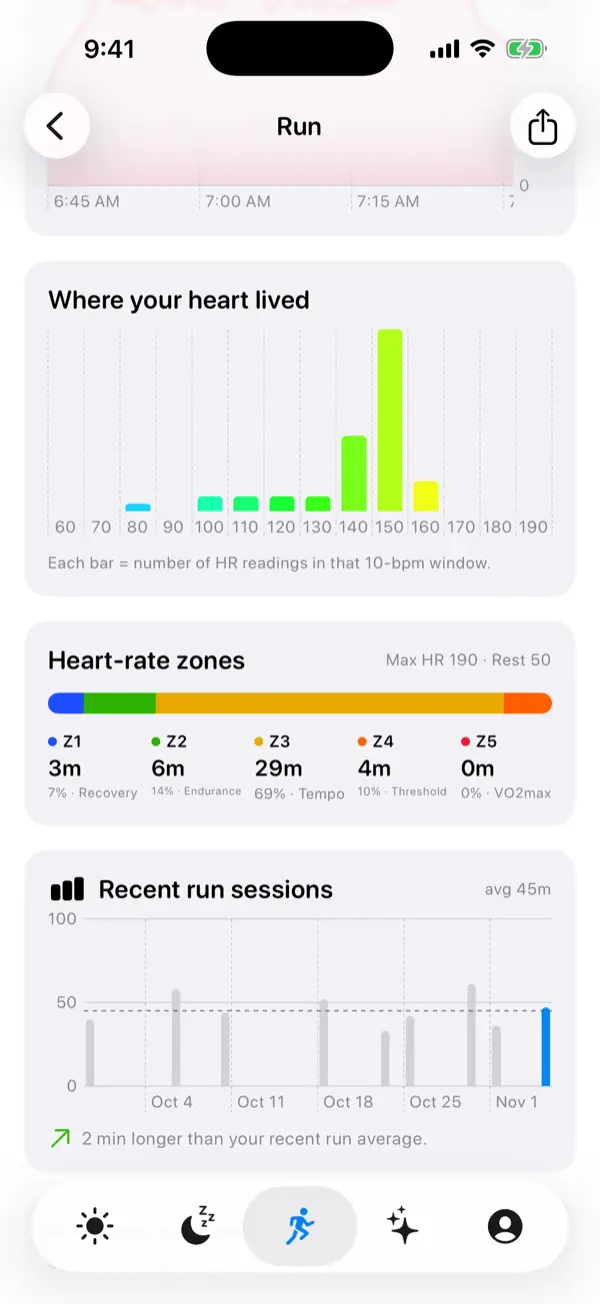
Heart rate zones work best for easy runs, long runs and tempo, where pace changes with hills and heat. Apple Watch calculates five zones from a percentage of your maximum heart rate once your date of birth is in the Health app, and you can set them manually under Settings, Workout, Heart Rate Zones. Different apps calculate zones differently, so your Zone 2 in one app may not match another's exactly.
Race Route, also under Goals, lets you race your last or best effort on a route you've run at least twice. A regular 5K loop makes a good benchmark every few weeks.
How VedaWatch helps you train for a faster 5K
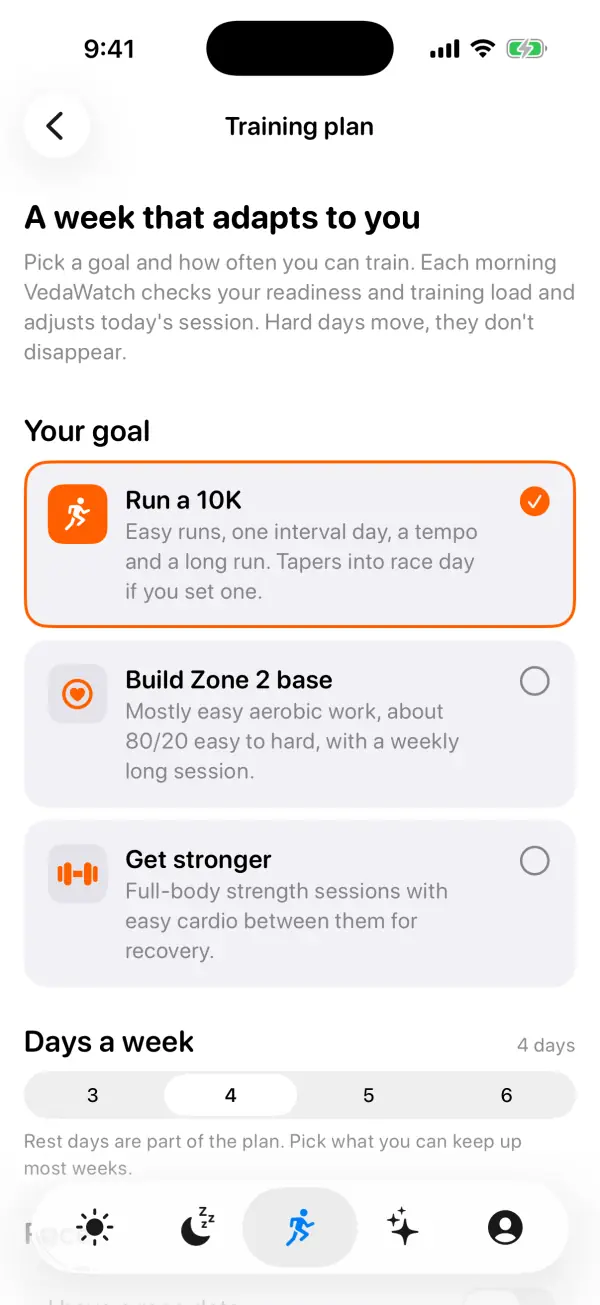
VedaWatch's Training plan has a Run a faster 5K goal. You pick a race day (8 weeks is recommended, 4 is the minimum), choose 3 to 6 days a week and optionally set a target time. The plan builds the phases above, shows Easy & long, Tempo, Intervals and Race pace from your target, and tells you kindly if the target looks like a big jump compared with your recent runs and VO2 max. The Training plan is part of VedaWatch Pro ($6.99 a month or $59.99 a year).
Each morning it checks your readiness and training load. On a low-readiness day, intervals or a tempo turn into an easy run, and the hard session moves to a later day in the week instead of disappearing. Today's session is sent to your Apple Watch as a one-tap start with a duration target. During the run the watch shows current and average pace, splits every kilometre or mile and time in each heart rate zone. Easy and long runs started from the plan also get gentle Zone 2 taps when your heart rate stays out of range.
When you run a quick one, your fastest 5 km run shows up in Personal records, worked out from the average pace of any run that covered close to 5 km or more, and you can share it as a card.
When to back off
Faster 5K plans add intensity, so they deserve some caution. In a study of 874 novice runners, those who increased weekly distance by more than 30% over two weeks seemed more prone to overuse injuries like runner's knee and shin splints than those who increased by less than 10%. Increase gradually, and keep the lighter week even if you feel great.
Swap a hard day for an easy one if you're unusually sore, slept badly, are getting ill, or your resting heart rate is clearly above normal. Missing one interval session costs you almost nothing; running through a niggle can cost you the race.
This guide is general training information, not medical advice. Stop and get checked if you have pain that changes how you run, chest pain, unusual breathlessness, dizziness or palpitations. If you have a heart condition or other health issue, talk to your doctor before adding hard running.
Frequently asked questions
Is 8 weeks enough to improve my 5K time?
For most people, yes. Eight weeks fits base, build, peak and taper phases. With fewer than 4 weeks, focus on arriving rested rather than getting fitter.
How many days a week should I run for a faster 5K?
Four is a good default: intervals, tempo, an easy run and a long run. Three can still work if you drop the tempo, and five or six adds more easy running rather than more hard sessions.
Should I run 5K every day to get faster?
No. Racing the same distance every day keeps you in the medium-hard zone and leaves you too tired for quality sessions. An occasional full-effort 5K or time trial, every few weeks at most, is plenty for a check-in.
What is a good 5K time?
It depends on age, sex and experience. The most useful benchmark is your own previous best. Improving it by a realistic margin each training block counts as a good time.
Do hill repeats help a 5K?
They can replace one interval session now and then. Short uphill reps work your legs hard with less pounding than flat speedwork, but keep the total weekly hard work about the same.
Related guides
- Training for a 5K, 10K or half marathon with Apple Watch: a plan that adapts to your recovery
- Easy run pace: how slow should easy runs be?
- Apple Watch heart rate zones explained: what each zone means and how to set them
- 80/20 running: polarized training made simple for 3 to 5 runs
- How to improve your VO2 max, and get Apple Watch to show it
- Strength training for runners: a 2-day plan and when to lift
Sources & further reading
- Frontiers in Physiology (2014): Polarized training has greater impact on key endurance variables than threshold, high intensity, or high volume training (Stöggl & Sperlich)
- Sports Medicine (2015): Effectiveness of high-intensity interval training (HIT) and continuous endurance training for VO2max improvements: a systematic review and meta-analysis (Milanović, Sporiš & Weston)
- Sports Medicine (2018): Effects of strength training on the physiological determinants of middle- and long-distance running performance: a systematic review (Blagrove, Howatson & Hayes)
- Journal of Orthopaedic & Sports Physical Therapy (2014): Excessive progression in weekly running distance and risk of running-related injuries (Nielsen et al.)
- Sports Medicine (2008): Describing and understanding pacing strategies during athletic competition (Abbiss & Laursen)
- Apple Support: Start an outdoor run workout on Apple Watch
- Apple Support: Create a custom workout on Apple Watch
- Apple Support: View heart rate zones on Apple Watch
This guide is educational, not medical advice, and has not been clinically reviewed. VedaWatch is not a medical device. If you have symptoms or concerns about your heart or health, contact a qualified healthcare professional.
Put your trends in perspective.
Explore HRV, sleep, and recovery with VedaWatch on your iPhone.
Download VedaWatch on the App Store →