 VedaWatch
Recovery & Apple Watch
Box breathing vs 4-7-8 breathing: which to use and when
Box breathing vs 4-7-8 breathing: step-by-step for each, what studies show, and when to use box, 4-7-8, resonance breathing or a cyclic sigh for stress and sleep.
By VedaWatch editorial team · · 9 min read
The short answer
Box breathing (4 in, 4 hold, 4 out, 4 hold) is a steady, focusing rhythm for nerves and stress. 4-7-8 (4 in, 7 hold, 8 out) has a long hold and longer out-breath and is popular before sleep, though it has little direct sleep research. In the best head-to-head trial, all breathing styles helped mood, but an exhale-focused cyclic sigh did best, and resonance breathing at 6 breaths a minute is the best-studied choice for HRV.
Box breathing vs 4-7-8 breathing: what's the difference?
Both are paced breathing patterns with breath holds, and both slow your breathing far below the usual 10 to 20 breaths a minute. The difference is the shape of each breath. Box breathing has four equal sides: breathe in for 4 seconds, hold for 4, breathe out for 4, hold for 4. 4-7-8 breathing is lopsided: breathe in for 4, hold for 7, then breathe out for 8, with no hold at the end.
That shape changes the pace and the feel. A 4-4-4-4 box takes 16 seconds, so you breathe about 3.75 times a minute. A 4-7-8 breath takes 19 seconds, about 3.2 breaths a minute, and more than 40% of each cycle is a slow out-breath. Box breathing feels even and controlled, which is why people use it to steady themselves and focus. 4-7-8 feels heavier and more sedating, which is why it's usually suggested for winding down before bed.
The honest summary of the research is that neither has strong evidence of being better than the other, or than simpler slow breathing. Both are low-risk ways to calm down. If you're choosing, pick by situation and by which one you can do comfortably, and consider two other patterns that have better evidence: resonance breathing at about 6 breaths a minute, and the cyclic sigh.
How to do box breathing, step by step
Box breathing is also called square breathing. The 4-second count is the common version, but the count isn't fixed: in the study described below, researchers set each person's count between 3 and 10 seconds based on how long they could comfortably breathe out. Use a count that feels steady rather than strained.
- Sit upright, feet flat, shoulders relaxed. Breathe out gently to empty your lungs.
- Breathe in quietly through your nose for a count of 4.
- Hold your breath, lungs comfortably full, for a count of 4. Keep your throat and shoulders soft rather than clamping down.
- Breathe out slowly through your nose or mouth for a count of 4.
- Hold, lungs empty, for a count of 4. Then start the next breath.
- Repeat for 3 to 5 minutes. If the holds feel uncomfortable, shorten every side to 3 seconds. If 4 feels easy and you want it slower, try 5.
- Finish with a minute of normal breathing before you get up.
How to do 4-7-8 breathing for sleep
4-7-8 is usually taught with an emptying breath out through the mouth first, then the 4-7-8 counts. Because the hold is long, it's normally done for only a few rounds at a time. A 2022 study used three sets of six breaths with a minute of normal breathing between sets, and that's a sensible template.
- Lie on your back or sit comfortably, with your eyes closed if you like.
- Breathe out fully through your mouth.
- Close your mouth and breathe in quietly through your nose for a count of 4.
- Hold your breath for a count of 7.
- Breathe out slowly through your mouth for a count of 8, as if gently blowing through a straw.
- That's one breath. Do 4 to 6 breaths, then breathe normally for a minute. Repeat once or twice if you feel comfortable.
- Count at whatever speed suits you. The ratio (4:7:8) matters more than real seconds, so a faster count is fine while you get used to the hold.
What does the research say about box breathing and 4-7-8?
The most useful study is a 2023 randomised trial in Cell Reports Medicine by Balban and colleagues at Stanford. 108 adults did 5 minutes a day for 28 days of one of four practices: cyclic sighing (a double in-breath then a long out-breath), box breathing, cyclic hyperventilation with breath holds, or mindfulness meditation. All four groups reported less anxiety and less negative mood after each session, with no clear differences between them.
Where they differed was positive mood. Box breathing raised it by about the same amount as the other breathing styles, but only cyclic sighing beat mindfulness meditation by a statistically clear margin, and its benefit grew over the month. Cyclic sighing also lowered resting breathing rate more than mindfulness. The authors note the groups were small (21 people did box breathing), so the trial can't really rank box breathing against sighing. Resting HRV and resting heart rate didn't change in any group.
4-7-8 has much less research. A 2022 study in Physiological Reports by Vierra and colleagues had 43 young adults do 18 rounds of 4-7-8 lying down. Ten minutes later, heart rate had fallen by about 3 to 5 bpm and systolic blood pressure by about 3 to 4 mmHg, and a high-frequency HRV measure linked to the calming parasympathetic system rose in people who were sleeping normally. But the study didn't measure sleep at all, and there was no comparison group doing a different pattern. We couldn't find controlled trials showing 4-7-8 helps you fall asleep faster.
The wider evidence supports slow breathing in general. A 2022 meta-analysis of 223 studies by Laborde and colleagues found that voluntary slow breathing raises vagally mediated HRV during and right after a session, and with regular practice. Most of that research uses smooth breathing near 6 breaths a minute, not breath-hold patterns.
Resonance breathing at 6 breaths a minute, and the cyclic sigh
Resonance breathing means breathing at roughly 6 breaths a minute with no holds, for example 4 seconds in and 6 out. At about this pace, heart rate and blood pressure rhythms line up so that each breath produces the biggest swing in heart rate, which is why it's the pattern most used in HRV biofeedback. If raising HRV is your main goal, our guide to breathing exercises to increase HRV covers it in depth, including how to find your own best pace.
The cyclic sigh, sometimes called the physiological sigh, is the pattern that did best for mood in the Balban trial. Breathe in through your nose, take a second short sip of air on top to fully fill your lungs, then breathe out slowly and completely through your mouth. Repeat for a few minutes. It's easy to do without counting, which makes it practical when you're stressed.
Here's how the four patterns compare at a glance. Resonance, 4 in and 6 out: 6 breaths a minute, no holds, best studied for HRV. Cyclic sigh: self-paced double in-breath and long out-breath, best mood result in the 2023 trial. Box, 4-4-4-4: 3.75 breaths a minute with two holds, steady and focusing. 4-7-8: about 3.2 breaths a minute with one long hold, popular before bed but little studied.
Which breathing technique should you use, and when?
There's no proven best pattern for each situation, so treat this as a sensible starting point and keep what works for you.
- Acute stress, such as after a difficult message or in a busy moment: a minute of cyclic sighing. It has the best direct evidence for mood and needs no counting.
- Pre-workout or pre-race nerves, a presentation or an exam: box breathing for 2 to 3 minutes. The even count gives your mind something to hold on to without making you drowsy.
- Winding down before sleep: 4-7-8 for a few rounds, or resonance breathing for 5 to 10 minutes if the long hold feels uncomfortable. A daily wind-down routine matters more than which pattern you pick.
- A daily practice for calm and HRV: resonance breathing at about 6 breaths a minute, 5 to 15 minutes a day, judged over weeks.
- Feeling lightheaded, or holds make you anxious: skip the holds and use resonance breathing or a cyclic sigh instead.
Can you do box or 4-7-8 breathing with the Apple Watch Breathe app?
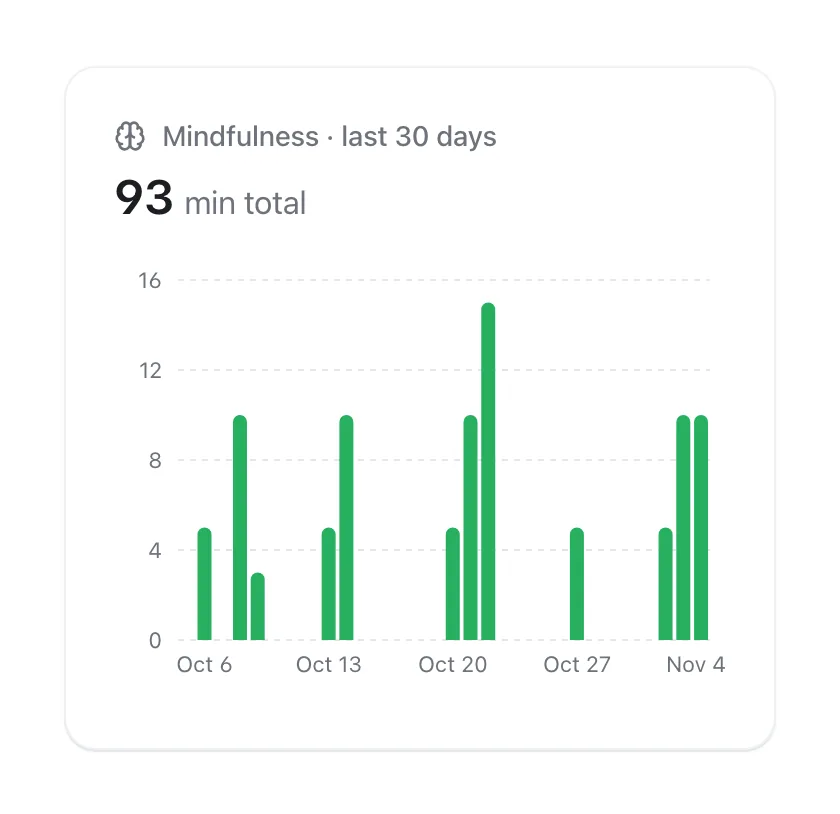
Apple's Breathe session, in the Mindfulness app on Apple Watch, guides a simple rhythm: you breathe in as the animation grows and out as it shrinks. In Settings, Mindfulness, you can change the breath rate and choose None, Minimal or Prominent haptics, and a session can last 1 to 5 minutes. Your heart rate appears on the summary screen afterwards, and sessions are saved to Apple Health as mindful minutes.
That makes Breathe a good fit for resonance breathing: set the rate to 6 breaths a minute. It doesn't guide breath holds, though, so for box or 4-7-8 breathing you'd need to count the holds yourself or use an app that paces each phase.
Whichever app you use, don't read much into an HRV or heart rate number taken during a session. Slow breathing raises HRV and changes heart rate in the moment almost by design. The longer-term signal is your overnight HRV trend over several weeks.
Is breath holding safe? Who should be careful
For most healthy adults, short breath holds at rest are low-risk. The most common problem is over-breathing: taking breaths that are too big, which can cause lightheadedness, tingling in the hands or face, or a racing feeling. If that happens, stop, breathe normally, and come back with smaller, gentler breaths or shorter counts.
Never practise breath holds in or near water, while driving, or anywhere fainting would be dangerous. Don't push holds to the point of strain; they should feel comfortable all the way through.
Talk to your doctor before starting a regular practice if you have a heart or lung condition, very high or low blood pressure, a history of fainting, or panic attacks that breathing exercises tend to trigger. Breathing exercises are a wellness habit, not a treatment and not a diagnosis. If you have chest pain, shortness of breath, fainting or a persistently racing or irregular heartbeat, contact a doctor or emergency services rather than trying to breathe it away.
How VedaWatch's breathing coach paces each pattern
VedaWatch includes a free breathing coach on Apple Watch and iPhone with four patterns: Resonant (in 4, out 6, six breaths a minute), Box (in 4, hold 4, out 4, hold 4), 4-7-8 (in 4, hold 7, out 8) and Quick reset (a double in-breath and a long out-breath, similar to the cyclic sigh, for one minute). Resonant and Box run for 1, 3, 5 or 10 minutes. 4-7-8 stops at 5 minutes, because the long hold gets tiring.
On Apple Watch, the Breathe page shows a growing and shrinking orb with a countdown for every phase, including holds, and taps your wrist as each phase changes. It shows your live heart rate during the session and your heart rate at the start and end afterwards. On iPhone, the coach has the same orb with optional haptic and sound cues, and shows start and end heart rate when your Watch recorded readings during the session.
Sessions of 30 seconds or more are saved to Apple Health as mindful minutes, and the Mindfulness view lists your recent breathing sessions with their heart rate change. You can also add a Start Breathing action, with your choice of pattern, in the Shortcuts app or to the Action button. Start and end heart rate are a rough in-the-moment signal, not a measure of recovery, and none of this is medical advice.
Frequently asked questions
Is box breathing or 4-7-8 better for anxiety?
Neither has been shown to be better. Box breathing reduced anxiety in a 2023 trial about as much as the other breathing styles and meditation, while 4-7-8 hasn't been tested head to head. Use whichever you can do comfortably.
Does 4-7-8 breathing really help you fall asleep in 60 seconds?
There's no controlled evidence for that claim. 4-7-8 can lower heart rate and help you relax, which may make sleep easier, but it hasn't been tested as a sleep treatment.
How long should I do box breathing?
Three to five minutes is enough for most situations. The 2023 Stanford trial used 5 minutes a day.
Should I do box breathing before a workout?
It's a reasonable way to settle pre-workout or pre-race nerves. Keep it to a few minutes so you don't feel drowsy, and start your warm-up straight after.
What is a physiological sigh?
A deep breath in through the nose, a second short sip of air on top, then a long, slow breath out. Repeated for a few minutes, it's called cyclic sighing, and it gave the biggest mood boost in the 2023 Balban trial.
Is breathing at 6 breaths a minute better than box breathing for HRV?
For HRV, yes, as far as the evidence goes. Most slow-breathing HRV research uses smooth breathing near 6 breaths a minute, and in the 2023 trial box breathing didn't change resting HRV.
Related guides
- Breathing exercises to increase HRV: a 6-breaths-a-minute routine
- HRV and stress: what your Apple Watch can and can't tell you
- How to fall asleep faster: CBT-I techniques that work
- Mindful Minutes on Apple Watch: how tracking works, and what the research actually shows
- How to improve your HRV: habits that actually move the number
- What lowers your HRV? Use a tag journal to find out
Sources & further reading
- Balban MY et al. (2023). Brief structured respiration practices enhance mood and reduce physiological arousal. Cell Reports Medicine 4(1):100895. doi:10.1016/j.xcrm.2022.100895
- Vierra J, Boonla O, Prasertsri P (2022). Effects of sleep deprivation and 4-7-8 breathing control on heart rate variability, blood pressure, blood glucose, and endothelial function in healthy young adults. Physiological Reports 10(13):e15389. doi:10.14814/phy2.15389
- Laborde S et al. (2022). Effects of voluntary slow breathing on heart rate and heart rate variability: A systematic review and a meta-analysis. Neuroscience & Biobehavioral Reviews 138:104711. doi:10.1016/j.neubiorev.2022.104711
- Lehrer PM, Gevirtz R (2014). Heart rate variability biofeedback: how and why does it work? Frontiers in Psychology 5:756. doi:10.3389/fpsyg.2014.00756
- Russo MA, Santarelli DM, O'Rourke D (2017). The physiological effects of slow breathing in the healthy human. Breathe 13(4):298-309. doi:10.1183/20734735.009817
- NHS: Breathing exercises for stress
- Apple Watch User Guide: Start a Reflect or Breathe session on Apple Watch
This guide is educational, not medical advice, and has not been clinically reviewed. VedaWatch is not a medical device. If you have symptoms or concerns about your heart or health, contact a qualified healthcare professional.
Put your trends in perspective.
Explore HRV, sleep, and recovery with VedaWatch on your iPhone.
Download VedaWatch on the App Store →