 VedaWatch
Recovery & Apple Watch
Why is my resting heart rate high? Causes and when to worry
Why is my resting heart rate high? Short-term causes vs long-term ones, how big a rise actually matters, and clear signs it's time to see a doctor.
By VedaWatch editorial team · · 11 min read
The short answer
A resting heart rate a few beats above your normal usually has an everyday cause: alcohol, a short night, an illness starting, dehydration, heat, hard training or stress. Those rises fade within days. A rise that lasts weeks with no clear reason, a rate above 100 bpm at rest, or symptoms like chest pain or fainting needs a doctor.
Why is my resting heart rate high?
Resting heart rate is how fast your heart beats when you're still. It rises whenever your body has extra work to do: clearing alcohol, fighting a virus, cooling itself down, repairing muscle after a hard session, or coping with stress. So a higher number than usual is most often a sign that your body is busy with something, not that your heart has a problem.
The first question is what "high" means. If your watch shows 68 bpm and you usually sit at 52, that's high for you even though it's well inside the 60 to 100 bpm range most adults fall in. If you've always been around 75, then 75 is simply your normal. Your own baseline matters more than anyone else's number.
The second question is how long it has lasted. A higher reading for one to three days with an obvious cause is ordinary. A higher reading that sticks for weeks, or keeps creeping up, is a different situation with different causes. If you want the basics of how Apple Watch measures resting heart rate first, see our guide on resting heart rate on Apple Watch.
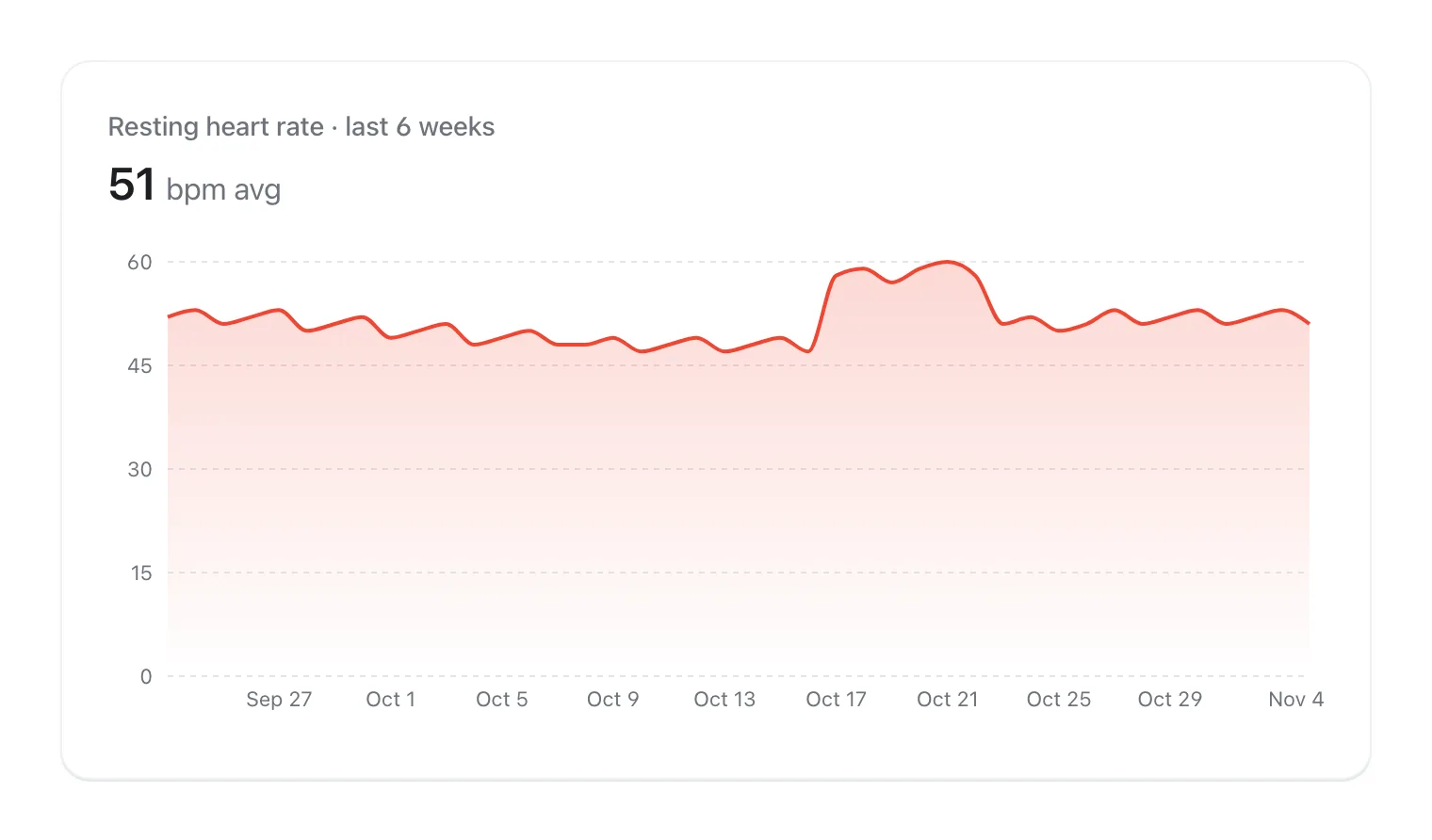
How much of a rise in resting heart rate matters?
Resting heart rate wobbles even when nothing is going on, so a small rise is not news. The best real-world numbers come from a 2020 study by Quer and colleagues, who looked at more than 32 million days of resting heart rate from 92,457 adults wearing Fitbit devices. On average, a person's daily resting heart rate varied with a standard deviation of about 3 bpm, and the median week-to-week swing was about 3 bpm.
Bigger moves do happen in healthy people. About 20% of participants had at least one week in which their resting heart rate moved by 10 bpm or more, and people had a median of 3 episodes of unusual rises over two years. The researchers also found a seasonal drift of about 2 bpm across the whole group, highest in early January and lowest in late July.
Put together, a practical rule of thumb looks like this. They're prompts, not medical cut-offs:
- Up 1 to 3 bpm for a day or two: normal day-to-day noise. Nothing to do.
- Up about 3 to 5 bpm for a few days: something is usually going on. Check sleep, alcohol, training, stress and how you feel.
- Up 5 to 10 bpm or more, or up for more than a week: look harder for a cause, take it easy, and watch for symptoms of illness.
- Elevated for several weeks with no explanation, or above 100 bpm at rest: book a doctor's appointment.
- Any rise with chest pain, shortness of breath, fainting or a pounding heart that won't settle: get urgent medical help.
Short-term causes: why your resting heart rate went up this week
When your resting heart rate jumps over a few days, it's almost always one of the causes below, and often two or three at once. For each, the clue tells you how to recognise it. Work down the list before worrying.
- Alcohol. Clue: the rise shows up the morning after drinking, often with a worse night's sleep. Alcohol is a well-known trigger for a faster heart rate; the effect usually fades after a night or two without it.
- Poor or short sleep. Clue: a late night, broken sleep, a new baby or a noisy room. In the Fitbit study, resting heart rate was lowest in people averaging about 7 to 7.5 hours of sleep. One or two good nights usually bring it back.
- An illness starting. Clue: the rise comes with a scratchy throat, aches, a higher breathing rate or a warmer wrist temperature, sometimes before you feel ill. Fever alone pushes heart rate up: in one classic study it rose by about 8.5 bpm for every 1 degree C of temperature.
- Dehydration. Clue: a hot day, a long workout, a stomach bug, or simply not drinking much. Dehydration is a recognised cause of a fast heart rate, and it usually settles once you've had enough fluid.
- Heat. Clue: a heatwave, a warm bedroom, a sauna or a hot bath late in the evening. Your heart works harder to move blood to the skin to cool you, so a hot night can lift the next day's number.
- Hard or unusually long training. Clue: a race, a big interval session or a much bigger week than usual. A rise of a few beats for a day or two after a hard effort is normal recovery.
- Stress and anxiety. Clue: a deadline, conflict, worry or a big life event. Stress is a common trigger for a faster heart rate, and it can last as long as the stress does.
- Caffeine, nicotine or a new medicine. Clue: more coffee than usual, energy drinks, or a new prescription or dose. Some medicines raise heart rate; check the leaflet and ask your pharmacist if you're unsure.
- Travel. Clue: a long flight, a new time zone or a different bedroom. Travel often stacks several causes at once: poor sleep, alcohol, dehydration and stress.
Can a higher resting heart rate mean you're getting sick?
Yes, it's one of the more useful early clues a watch gives you. In a 2020 study, Radin and colleagues used resting heart rate and sleep data from about 200,000 Fitbit users across the US and found that adding that data improved predictions of influenza-like illness in all five states they studied. Infections raise resting heart rate across whole populations, and often in individuals too.
What separates illness from a late night is that illness rarely moves one number alone. Look for a rise of several beats alongside lower HRV, a higher breathing rate, a warmer wrist temperature, or how you actually feel. If several of those move together, take it easy, sleep more and drink plenty. A watch can't tell a cold from a hard week, though, so it's a nudge, not a diagnosis. Our guide on HRV when sick covers what the other signals tend to do.
Resting heart rate went up after training more: is it overtraining?
A rise after a big session or a hard week is expected. Training is a stress, and your heart rate stays up a little while your body repairs. That's very different from overtraining, which develops over weeks of too much load and too little recovery.
It's tempting to treat resting heart rate as an overtraining test, but it isn't a reliable one on its own. A joint consensus statement from the European College of Sport Science and the American College of Sports Medicine reviewed the possible markers of overtraining and concluded that none of them meets all the criteria to be generally accepted. The pattern matters more than any single number: a resting heart rate that stays up for more than a week or two, alongside heavy legs, poor sleep, low mood or falling performance, is a reason to cut back.
If your resting heart rate went up when you started training more, give it a recovery week with lighter sessions and see whether it settles. If it does, your load was simply ahead of your recovery. If it doesn't, look at the other causes on this page and talk to a doctor if it persists. Our guide on signs of overtraining goes into the warning signs in more detail.
Long-term causes: why your resting heart rate has crept up over months
A rise over months is a different question from a rise this week. It usually reflects a change in how you live, sometimes a change in your health, and occasionally just getting older or the time of year.
Fitness is the biggest everyday factor. Regular aerobic exercise tends to lower resting heart rate, so a long break from training often lets it drift back up. Sleep matters too, and so does body weight: in the Fitbit study the link with BMI was U-shaped, with the lowest resting heart rates around a BMI of 21 for women and 23 for men. Age plays a part as well; average resting heart rate rose until about age 50 and then fell. Seasons add a small shift on top.
Some medical causes also raise resting heart rate over time. Cleveland Clinic lists anaemia, an untreated thyroid problem, and some medicines among the causes and risk factors for a fast heart rate, and notes that an overactive thyroid, pregnancy and certain medicines can raise resting heart rate. These need a doctor and simple tests to rule in or out, which is why an unexplained long-term rise is worth mentioning at your next appointment.
Is a persistently higher resting heart rate a problem in itself? In the Copenhagen Male Study, which followed 2,798 men for 16 years, the risk of death rose by 16% for every 10 bpm higher resting heart rate. That's an association across a population, not a prediction for you, but it's one more reason to take a lasting upward trend seriously rather than just a single high day. If your goal is to bring it back down, see our guide on how to lower resting heart rate.
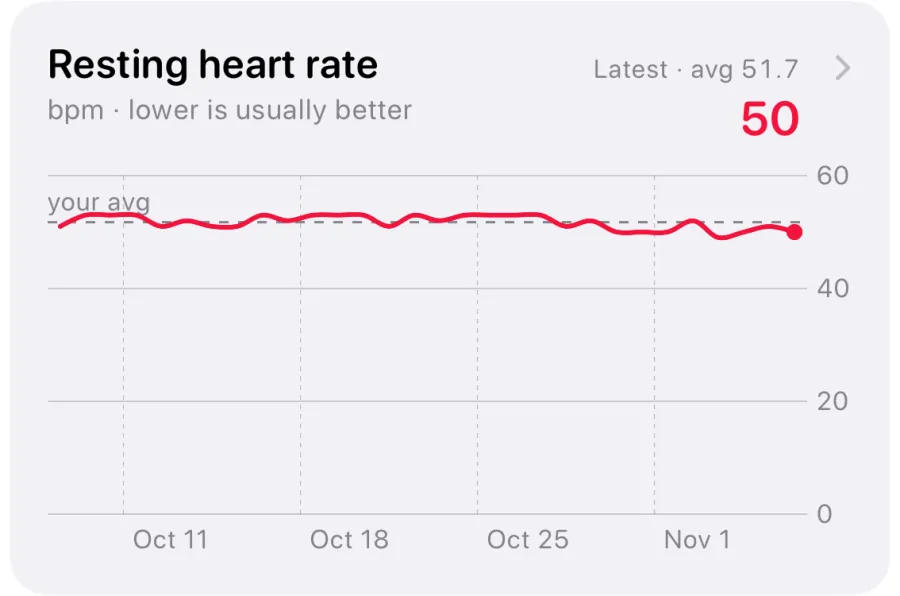
One high day or a real trend? A worked example
Picture someone whose resting heart rate usually sits between 50 and 54 bpm. On Saturday morning it reads 59 after a friend's wedding with wine and a 2 am bedtime. Sunday it's 56, Monday 53. That's a textbook short-term rise: a clear cause, a quick return, nothing to do but sleep and drink water.
Now picture a different week for the same person: 55, 57, 58, 58 and 60 bpm over five mornings, with no drinking, normal sleep and an easy training week, plus a scratchy throat on day four. No single number is dramatic, but the direction is steady and there's no everyday explanation. That's worth acting on: rest, watch for fever, and see a doctor if it keeps climbing or symptoms appear.
Here's a simple routine for any high morning:
- Compare with your own normal over the last few weeks, not with a chart of population averages.
- Ask what happened in the last 48 hours: alcohol, sleep, training, heat, stress, travel, illness.
- Check how you feel and whether HRV, breathing rate or wrist temperature moved too.
- If there's an obvious cause, take an easier day and check again in two or three days.
- If there's no obvious cause, keep an eye on it for a week and note any symptoms.
- If it stays up for several weeks, keeps rising, or comes with symptoms, talk to a doctor.
When should you see a doctor about a high resting heart rate?
A watch reading is a wellness signal, not a medical test, and a higher number on its own isn't a diagnosis. But some situations do need a professional.
Get help urgently if a fast heartbeat comes with chest pain, shortness of breath, or feeling faint or fainting, or if a pounding heart doesn't go away. The NHS advises calling 999 or going to A&E in those cases; outside the UK, use your local emergency number. Cleveland Clinic gives similar advice for a fast heart rate with trouble breathing, chest pain, dizziness or faintness.
Book a routine appointment if your resting heart rate is consistently above 100 bpm, which is the usual definition of tachycardia; if it has stayed well above your normal for several weeks without a clear cause; if it rose after starting or changing a medicine; or if it comes with ongoing tiredness, breathlessness on mild effort, weight loss, feeling hot and shaky, or palpitations that keep coming back or last more than a few minutes. Mention it too if you have a heart condition or a family history of heart problems.
Bring your data. A screenshot of your resting heart rate over the last few months, plus notes on sleep, alcohol, illness and training, gives a doctor far more to work with than a single reading in the clinic.
How VedaWatch helps you spot the cause
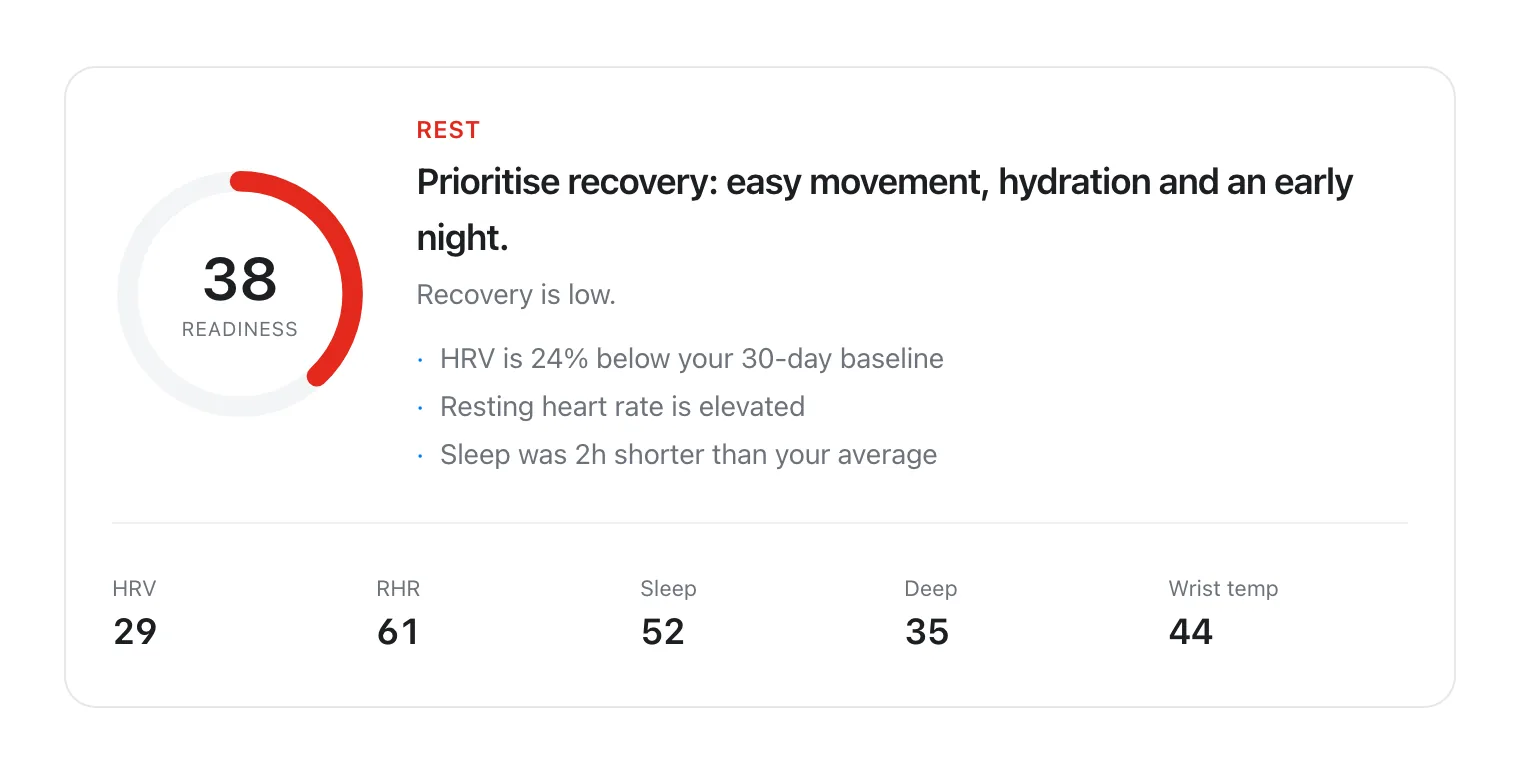
VedaWatch reads the resting heart rate your Apple Watch saves to Apple Health and compares each day with your own normal rather than population charts. Your readiness score counts resting heart rate as one of its parts alongside HRV and sleep, and its reasons say plainly when resting heart rate is a few beats above your recent baseline. When it's more than 3 bpm above, a Push day is held back to Hold, so a rising number automatically means a gentler suggestion.
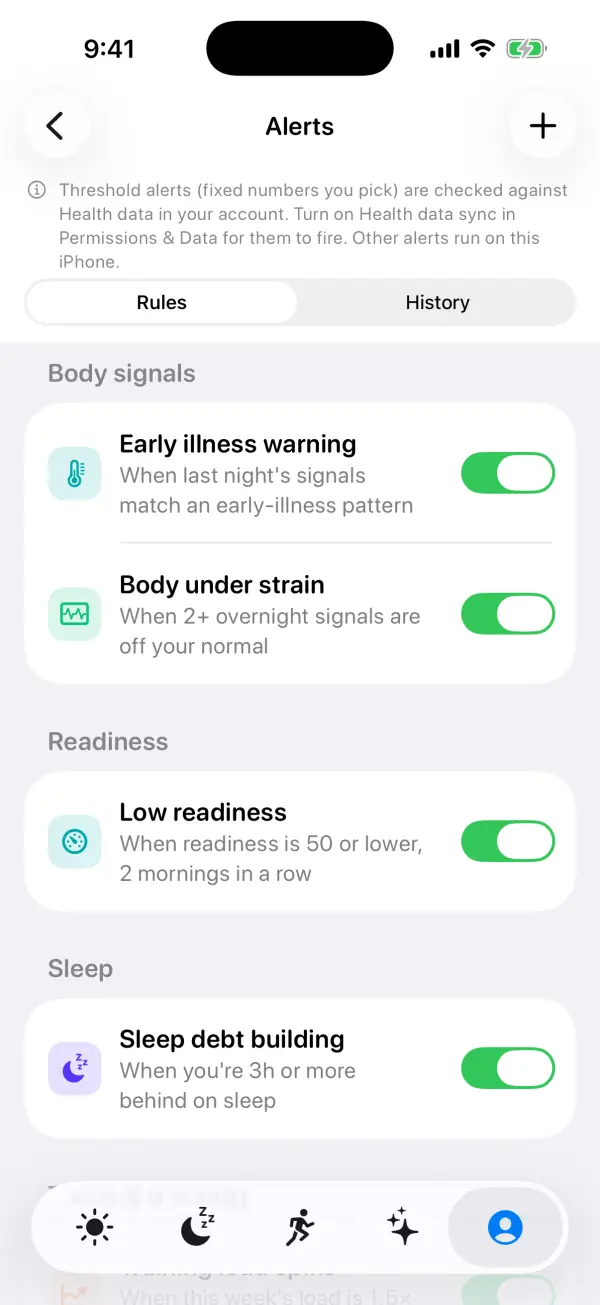
When resting heart rate is up together with another overnight signal, such as lower HRV, a higher breathing rate or a warmer wrist, the Recover tab shows a Body signals card that lists each one against your normal range. If the pattern looks fever-like, it becomes an early warning instead. You can turn either into a notification with the Body under strain and Early illness warning alerts. When things settle, Recover tells you your resting heart rate is back to normal, which is a useful check before you build training back up.
To find your own triggers, log Alcohol, Stressful day, Travel, Feeling ill and other tags in the Daily tags journal; logging alcohol, sauna or travel also stops those nights from triggering an early illness warning. Tapping resting heart rate opens a detail view with 7, 30 and 90 day charts, which is handy to show a doctor. None of this is a diagnosis, and it can only use what your watch recorded.
Frequently asked questions
Can anxiety raise my resting heart rate?
Yes. Stress and anxiety are common triggers for a faster heart rate, and ongoing stress can keep your resting number up for as long as it lasts. If anxiety is frequent or the racing heart worries you, talk to a doctor.
Why is my resting heart rate higher during my period?
In the Fitbit study, women of childbearing age showed more variation in resting heart rate than men of the same age, a gap that disappeared by about age 50. If your number rises at the same point in each cycle, compare like with like rather than reacting to a predictable rise.
Is a resting heart rate of 90 bad?
It's within the usual 60 to 100 bpm adult range, so not abnormal on its own. But if your normal is much lower, or 90 is a slow upward drift, it's worth looking for a cause and mentioning to your doctor.
How long does it take for resting heart rate to go back down after drinking?
For most people it settles within a night or two of normal sleep without alcohol. If it's still up after several days, something else is probably going on, such as an illness, poor sleep or stress.
Why is my Apple Watch resting heart rate higher than my chest strap?
Devices sample and calculate resting heart rate differently, so small gaps between them are normal. Compare your trend within one device rather than numbers across devices.
Related guides
- Resting heart rate on Apple Watch: what's high, low, and why it changes
- How to lower your resting heart rate: what works and how long it takes
- HRV when sick: what your Apple Watch shows before symptoms
- Signs of overtraining: what your Apple Watch can and can't show
- Apple Watch high heart rate notification: causes and what to do
- Apple Watch health alerts: early illness warning, body strain and other smart alerts in VedaWatch
Sources & further reading
- Quer G et al. (2020). Inter- and intraindividual variability in daily resting heart rate and its associations with age, sex, sleep, BMI, and time of year: retrospective, longitudinal cohort study of 92,457 adults. PLOS ONE 15(2):e0227709. doi:10.1371/journal.pone.0227709
- Radin JM et al. (2020). Harnessing wearable device data to improve state-level real-time surveillance of influenza-like illness in the USA: a population-based study. The Lancet Digital Health 2(2):e85-e93. doi:10.1016/S2589-7500(19)30222-5
- Karjalainen J, Viitasalo M (1986). Fever and cardiac rhythm. Archives of Internal Medicine 146(6):1169-1171. doi:10.1001/archinte.1986.00360180179026
- Meeusen R et al. (2013). Prevention, diagnosis, and treatment of the overtraining syndrome: joint consensus statement of the ECSS and ACSM. Medicine and Science in Sports and Exercise 45(1):186-205. doi:10.1249/MSS.0b013e318279a10a
- Jensen MT et al. (2013). Elevated resting heart rate, physical fitness and all-cause mortality: a 16-year follow-up in the Copenhagen Male Study. Heart 99(12):882-887. doi:10.1136/heartjnl-2012-303375
- Cleveland Clinic: Heart Rate: Normal Rates & What To Know
- Cleveland Clinic: Tachycardia
- NHS: Heart palpitations
This guide is educational, not medical advice, and has not been clinically reviewed. VedaWatch is not a medical device. If you have symptoms or concerns about your heart or health, contact a qualified healthcare professional.
Put your trends in perspective.
Explore HRV, sleep, and recovery with VedaWatch on your iPhone.
Download VedaWatch on the App Store →