 VedaWatch
Recovery & Apple Watch
HRV when sick: what your Apple Watch shows before symptoms
HRV when sick: how HRV, resting heart rate, wrist temperature and breathing rate shift before symptoms, how often wearables are wrong, and when to train again.
By VedaWatch editorial team · · 10 min read
The short answer
When you're coming down with something, overnight HRV often drops while resting heart rate, wrist temperature and breathing rate rise, sometimes a day or more before you feel ill. Apple Watch can flag that pattern against your own normal, but it can't diagnose illness, and stress, alcohol or a hard workout can look the same.
Can Apple Watch tell if you're getting sick?
Not in the sense of a diagnosis. Apple Watch can't tell you that you have a cold, flu or COVID-19. What it can do is notice that your body is behaving differently from usual. While you sleep it records heart rate, heart rate variability (HRV), breathing rate and, on supported models, wrist temperature, and compares them with your own typical range.
Apple's Vitals app does exactly this. After about seven nights of wearing your watch to sleep it learns your typical range, and it can send a notification the next morning when multiple metrics fall outside it. Apple lists illness among the things that can move these numbers, alongside medication, alcohol and altitude, and says the measurements are not intended for medical use.
So the honest answer is: your watch can show an early, non-specific "something is off" pattern, and research suggests that pattern often appears around or before the first symptoms of a respiratory infection. It's a reason to take the day easier and pay attention, not a test result.
What happens to HRV when you're sick
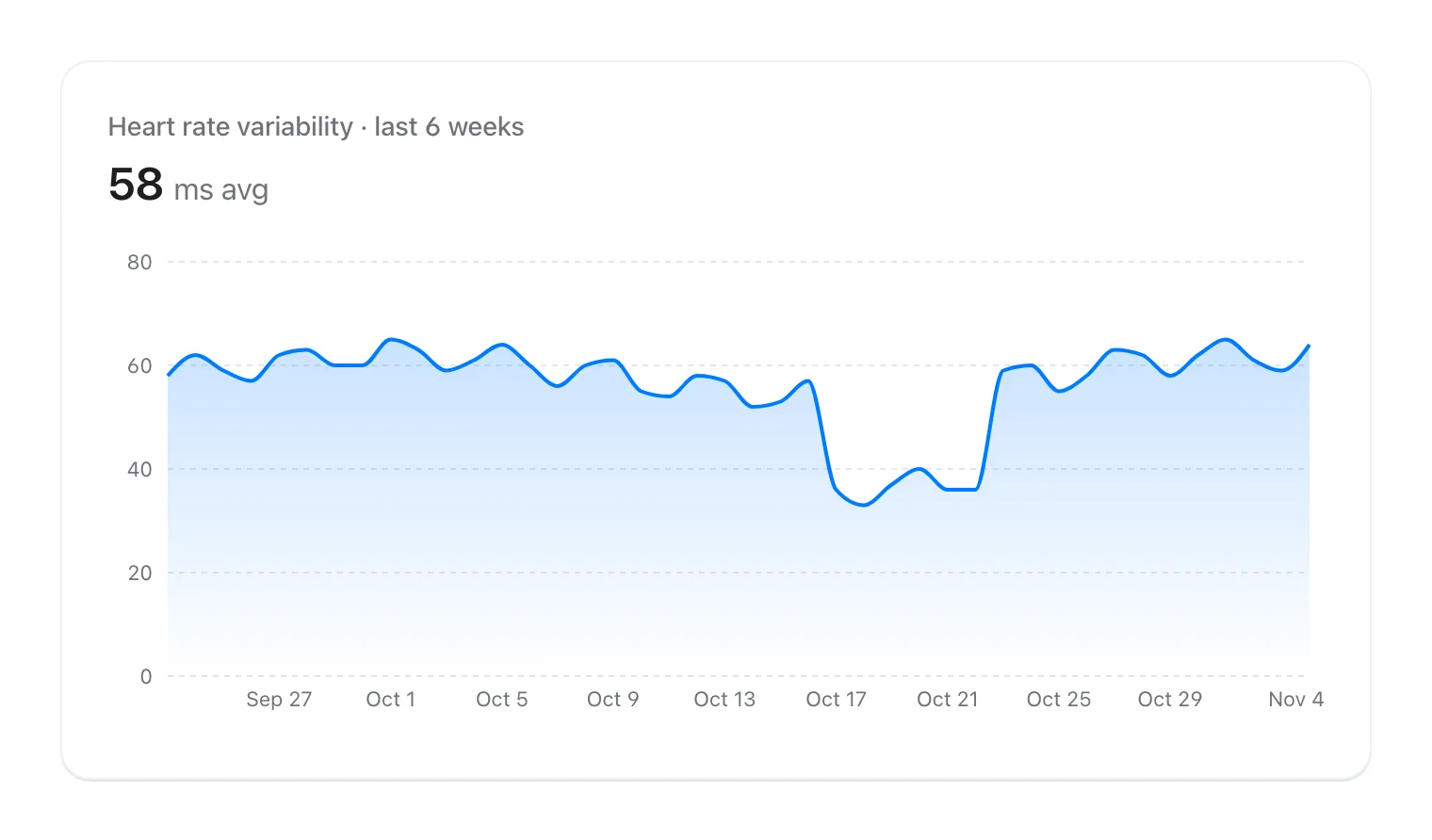
HRV is the small variation in time between heartbeats. It's shaped largely by the autonomic nervous system: when the rest-and-digest side is in charge, as it usually is during deep, quiet sleep, the gaps between beats vary more and HRV is higher. When your body is under load, whether from a hard session, a stressful week or an immune response, the stress side gains ground, the heart beats faster and more evenly, and HRV tends to fall.
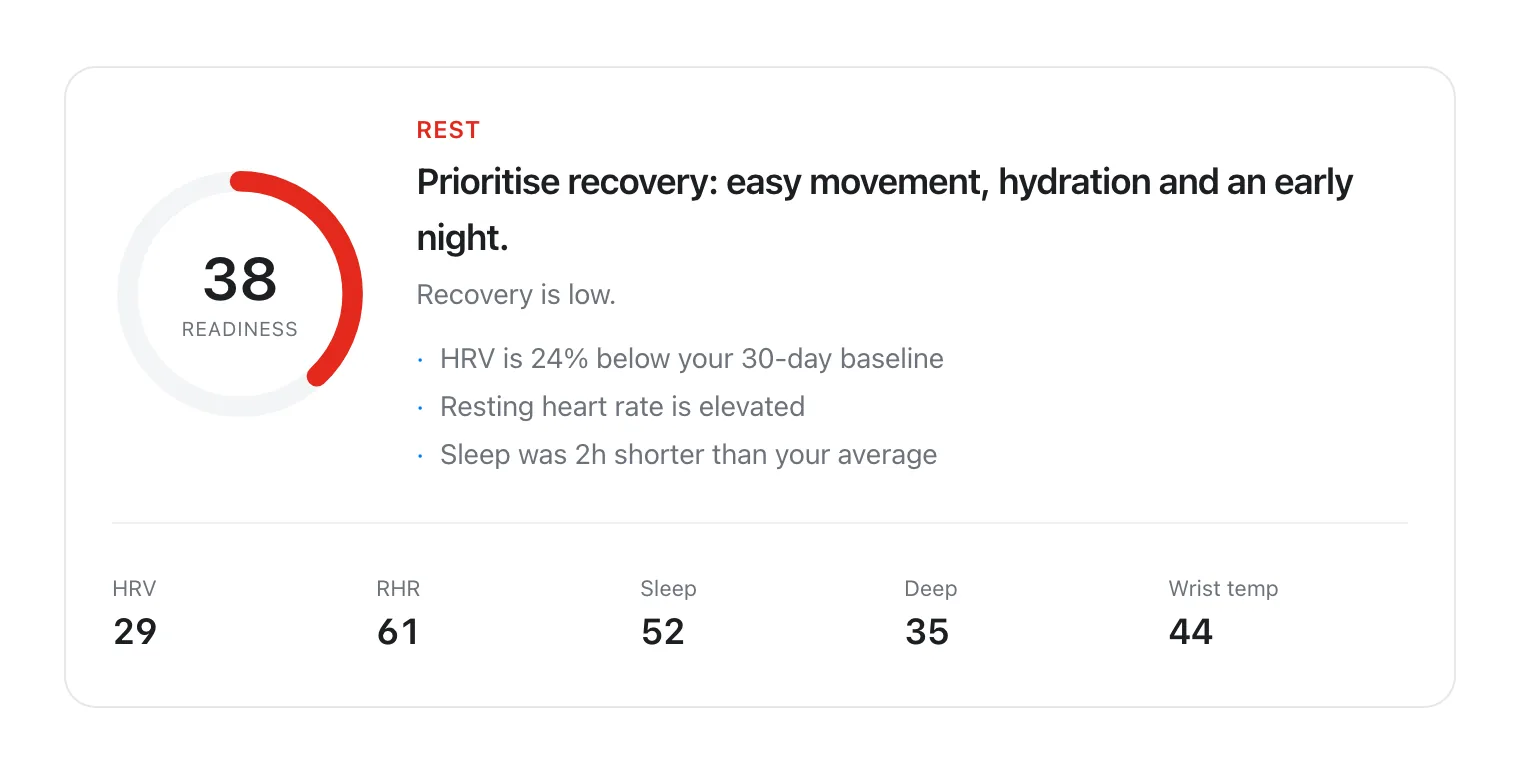
An infection is a whole-body event. Fever, inflammation and a body working harder to fight something off usually push resting heart rate up and HRV down for a few nights. That's why a low HRV morning paired with a higher resting heart rate is one of the most common patterns people notice in the Health app when they're coming down with something.
There's research on Apple Watch specifically. In the Warrior Watch Study, health care workers at Mount Sinai wore an Apple Watch that recorded HRV (Apple's SDNN measure). The daily pattern of SDNN differed between people who did and didn't get COVID-19, and it changed in the week before and after a positive swab test, as well as on the first day of symptoms. That's a group-level finding, not a per-person alarm, but it fits what many people see in their own charts.
The four overnight signals that change when you're getting sick
HRV on its own is noisy. It moves with sleep, alcohol, training and stress, so the useful question is whether several signals moved together, in the direction that suggests your body is fighting something. Here's what each one usually does and why it matters.
- HRV: tends to drop below your normal range. It reacts to almost everything, so it's the least specific of the four on its own.
- Resting heart rate: tends to rise above your normal. In the Stanford smartwatch studies, a sharp rise in resting heart rate against a person's own baseline was the main trigger for early infection alerts.
- Wrist temperature: Apple Watch shows each night as a change from your baseline, not a body temperature. A rise over consecutive nights can go with fever, but a warm room or heavy duvet can do the same.
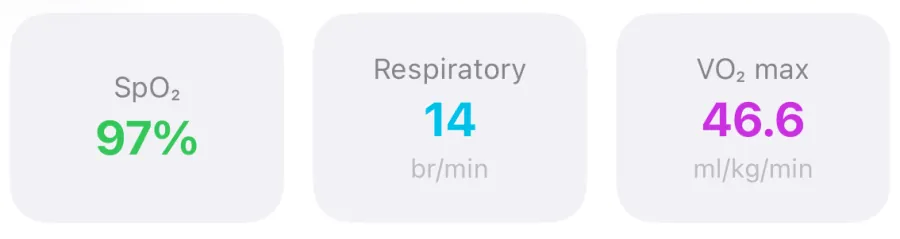
- Breathing (respiratory) rate: normally very stable night to night. In a Whoop study, the typical night-to-night variation in healthy people was about 0.5 breaths per minute, so a sustained rise beyond that stands out more than a dip in HRV does.
- Put together: one signal off for one night is everyday noise. Two or more off together, especially temperature or breathing rate alongside heart rate or HRV, and for two nights running, is the pattern worth noticing.
What wearable studies show about detecting illness before symptoms
Most of the evidence comes from COVID-19 studies run in 2020 and 2021, when researchers had large groups of wearable users and confirmed test results. The findings are encouraging, but they describe groups of people, and the numbers vary a lot between studies.
Heart rate and steps. In a study by Mishra and colleagues at Stanford, 26 of 32 people with COVID-19 (81%) had changes in heart rate, daily steps or sleep. Of 25 with symptom data, 22 showed those changes before or at symptom onset, and 4 at least nine days earlier. Looking back at the data, an alert based on resting heart rate rising far above each person's baseline could have caught 63% of cases before symptoms in real time.
A live alert system. The same group then ran a real-time alerting system with 3,318 participants, 84 of whom caught SARS-CoV-2. It raised alerts for 67 of them (80%), with signals appearing a median of 3 days before symptoms started.
Temperature. The TemPredict study used the Oura Ring with 63,153 participants. Its algorithm flagged COVID-19 an average of 2.75 days before people sought testing, with 82% sensitivity and 63% specificity in the training group. Adding continuous temperature improved accuracy by 4.9% compared with leaving it out.
Breathing rate. A study using the Whoop strap followed 271 people, 81 of whom tested positive. A model based on overnight respiratory rate identified 20% of positive cases two days before symptoms, and 80% by the third day of symptoms.
The pattern across studies: wearables often notice a change around the day symptoms begin, sometimes a few days earlier, and catch a large share but not all infections. Most of this research is about COVID-19, so how well it applies to colds and flu is less certain.
Limits and false alarms: why a low HRV morning isn't a diagnosis
The same studies are clear that these signals aren't specific to infection. In the real-time alerting study, participants' survey answers showed that other respiratory infections, stress, alcohol and travel could all trigger alerts. Those other causes triggered fewer alert days on average (1.15 per person, against 3.42 for people with COVID-19), but they still triggered them.
Specificity tells the same story. The TemPredict algorithm's 63% specificity in its training group means a meaningful share of healthy days were flagged too. Accuracy also varied with age and biological sex, so what works on average may work less well for you.
Some everyday causes of an "illness-like" night: alcohol in the evening, a late or very long workout, a hot bedroom, a short or broken night, jet lag, a stressful day, and some medications. For people who menstruate, wrist temperature normally runs higher in the second half of the cycle, which can look like a small fever signal.
It also works the other way. A normal-looking night doesn't rule out illness. Many infections cause no clear change in wearable data, especially mild ones, and wrist temperature isn't a thermometer. If you feel unwell, trust how you feel over a score.
What to do when your HRV drops and you feel run down
If your overnight signals are off and you also feel off, the sensible move is the same whether it turns out to be a bug, poor sleep or accumulated stress: lower the load and protect sleep. Here's a simple way to handle the next 24 to 48 hours.
- Check more than HRV. Look at resting heart rate, wrist temperature and breathing rate for last night against your recent normal. Several moving together means more than one number.
- Rule out the obvious. Did you drink, train late or long, travel, or sleep badly? If so, the pattern has a likely explanation and usually settles within a night or two.
- Swap hard training for easy movement. A walk or gentle mobility is fine if you feel up to it. Postpone intervals, heavy lifting and long efforts.
- Prioritise sleep and fluids. Go to bed earlier than usual and drink regularly through the day.
- Watch the trend, not one morning. If the signals return to your normal range the next night and you feel fine, carry on. If they stay off and symptoms appear, treat it as an illness and rest.
- Know when to get help. Chest pain, shortness of breath, a racing or irregular heartbeat, fainting, or a high or lasting fever are reasons to stop exercising and contact a doctor, whatever your watch says.
When to start training again after being sick
Most respiratory illnesses in active people are short. A systematic review for the International Olympic Committee pooled 54 studies of 31,065 athletes and found symptoms lasted 7.1 days on average, and in about 80% of cases athletes didn't lose more than a day of training. The few studies that measured it reported return to sport anywhere from 0 to 8.5 days.
How you return matters more than the exact day. The old "neck check" rule of thumb (training lightly if symptoms are only above the neck, such as a runny nose, but resting if they're below it, such as fever, aches or a chesty cough) is a reasonable starting point but has little research behind it. A study of athletes with respiratory infections, including COVID-19, found that excessive fatigue, fever, chills, headache, chest pain or pressure and difficulty breathing went with a longer road back to sport.
A cautious, graded return, based on symptoms first and your watch second, looks like this:
- Wait until any fever has gone and you feel close to normal at rest. Don't train through a fever or whole-body aches.
- Start with 2 or 3 days of easy, short sessions, such as walking or easy cycling at a pace where you can talk comfortably.
- Check your overnight data each morning. HRV and resting heart rate drifting back toward your normal range is a good sign. A higher resting heart rate than usual for the same easy effort suggests you're not there yet.
- Build back over the next few days to your usual volume, then add intensity last: intervals, races and heavy lifting come after normal easy training feels normal again.
- Step back a stage if symptoms return, you feel unusually tired the next day, or your signals drop again.
- If you had chest pain, breathing trouble or palpitations, were very unwell, or had COVID-19 with lasting symptoms, talk to a doctor before returning to hard exercise.
How VedaWatch helps you spot and recover from an illness-like pattern
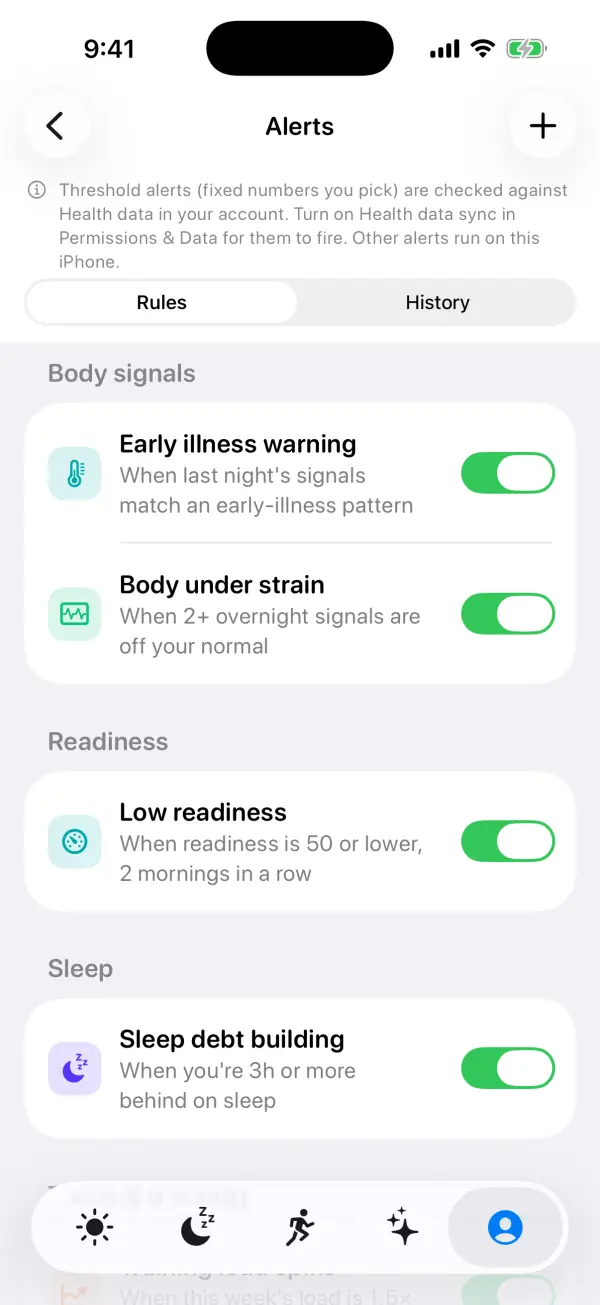
VedaWatch reads the overnight resting heart rate, HRV, breathing rate and wrist temperature your Apple Watch writes to Apple Health and compares each night with your own normal. Its Early illness warning alert looks for a fever-like signal (wrist temperature or breathing rate up) together with resting heart rate or HRV off your normal. It fires when 3 or more signals are off at once, or when the pattern shows up 2 nights running. The normal it compares against skips the last 3 nights, so an illness building over a few days doesn't quietly become your new baseline.
It tries to avoid the false alarms described above. Nights after you've tagged alcohol, sauna or travel in your daily journal are left out, a long workout the evening before rules it out unless both temperature and breathing rate are up, and in the likely second half of a menstrual cycle wrist temperature needs a bigger rise to count. The message describes a pattern and says plainly that a late night, a hot room or a hard day can look the same.
On the Recover screen the same pattern shows as an Early warning card listing each signal against your normal, with an "I feel unwell" button that logs the Feeling ill tag to your journal. Your readiness score gives a Push, Hold or Rest call for the day. When things settle, a Bounced back card tells you when HRV or resting heart rate has returned to your normal range, which is a useful check before you build training back up. None of this replaces how you feel or a doctor's advice.
Frequently asked questions
How many days before symptoms does HRV drop?
It varies. Studies of smartwatch data found changes a median of about 3 days before COVID-19 symptoms in one group, and mostly around the day symptoms began in others. Many people see no clear change in advance.
Can HRV go up when you're sick?
Sometimes. HRV usually falls during an infection, but an odd high reading can appear on a disturbed night, and on its own it says little. That's why it's better to judge several signals against your normal than HRV alone.
Does a low HRV mean I have COVID-19?
No. Low HRV is a general strain signal that alcohol, stress, poor sleep and hard training also cause. If you think you might have COVID-19 or another infection, use a test and follow local health advice.
Should I wear my Apple Watch to bed while I'm sick?
If it's comfortable, yes. Overnight readings are what build your baseline and show when HRV, resting heart rate and temperature return to normal, which helps you judge when to train again.
Why is my resting heart rate still high after I feel better?
Resting heart rate and HRV can take a few days longer than symptoms to settle after an illness. Keep training easy until they're back in your usual range, and see a doctor if it stays high or you notice palpitations.
Related guides
- Apple Watch health alerts: early illness warning, body strain and other smart alerts in VedaWatch
- Apple Watch wrist temperature: how it works and what changes mean
- Why is my HRV so low? Causes of a sudden drop and what to check
- Resting heart rate on Apple Watch: what's high, low, and why it changes
- Should you train or rest when HRV is low?
- Rest day vs active recovery: which one do you need today?
Sources & further reading
- Nature Biomedical Engineering (2020): Pre-symptomatic detection of COVID-19 from smartwatch data (Mishra et al.)
- Nature Medicine (2022): Real-time alerting system for COVID-19 and other stress events using wearable data (Alavi et al.)
- Journal of Medical Internet Research (2021): Use of physiological data from a wearable device to identify SARS-CoV-2 infection and symptoms and predict COVID-19 diagnosis (Hirten et al.)
- Scientific Reports (2022): Detection of COVID-19 using multimodal data from a wearable device: results from the first TemPredict Study (Mason et al.)
- PLOS ONE (2020): Analyzing changes in respiratory rate to predict the risk of COVID-19 infection (Miller et al.)
- British Journal of Sports Medicine (2022): Acute respiratory illness and return to sport: a systematic review and meta-analysis by a subgroup of the IOC consensus (Snyders et al.)
- British Journal of Sports Medicine (2021): Symptom cluster is associated with prolonged return-to-play in symptomatic athletes with acute respiratory illness (including COVID-19): AWARE study I (Schwellnus et al.)
- Apple Support: Track your overnight and daytime vitals
This guide is educational, not medical advice, and has not been clinically reviewed. VedaWatch is not a medical device. If you have symptoms or concerns about your heart or health, contact a qualified healthcare professional.
Put your trends in perspective.
Explore HRV, sleep, and recovery with VedaWatch on your iPhone.
Download VedaWatch on the App Store →