 VedaWatch
Recovery & Apple Watch
Is Apple Watch HRV accurate? What the validation studies actually show
A 2024 peer-reviewed study measured Apple Watch HRV against a chest-strap ECG reference across 316 paired readings. Here's what it found, why the watch still underestimates HRV, and what that means for using your trend instead of the raw number.
By VedaWatch editorial team · · 6 min read
The short answer
In a 2024 study against a Polar H10 chest strap, Apple Watch underestimated HRV by about 8ms on average and failed a formal equivalence test—so treat the absolute millisecond figure with caution. Resting heart rate from the same watches matched the chest strap closely, and your own week-to-week HRV trend is more dependable than any single reading.
Two different ways of measuring the same heartbeat
Apple Watch estimates HRV using photoplethysmography (PPG): an optical sensor shines light into your wrist and infers blood-volume changes as your heart beats. A chest strap or clinical ECG instead reads the heart's electrical signal directly.
Both approaches can derive HRV, but they start from different raw signals. PPG has to infer the exact timing of each heartbeat from a blood-flow waveform, which is inherently noisier than reading the electrical spike of each beat directly—so some gap between a wrist sensor and an ECG-based reference is expected, not necessarily a sign of a defective watch.
What the 2024 validation study actually measured
Researchers had 39 healthy adults wear an Apple Watch (Series 9 or Ultra 2) alongside a Polar H10 chest strap for a 5-minute measurement each morning, lying still, over 14 days—316 paired readings in total, analyzed with Kubios HRV software as the reference standard.
The result: Apple Watch underestimated HRV (SDNN) by an average of 8.31ms compared with the chest strap, with a mean absolute percentage error of 28.88%. That gap was large enough that the watch failed a formal equivalence test against a ±10ms margin—meaning statistically, the two devices could not be treated as interchangeable for HRV.
Resting heart rate was a different story: the same watches matched the chest strap closely, with a mean difference of just -0.08 bpm and no significant link between RHR error and HRV error. The sensor is good at counting beats; it's the beat-to-beat timing precision HRV needs that's harder for PPG to nail down.
Why your HRV trend is still useful despite the gap
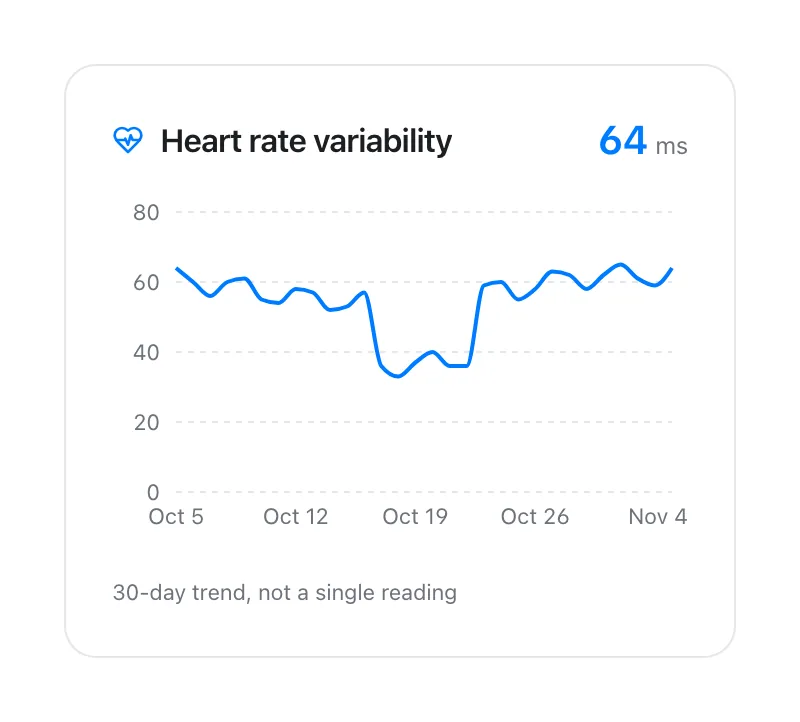
An average underestimate is different from random noise. If your watch consistently reads a bit low versus a chest strap, day after day, that consistent offset mostly cancels out when you compare this week's readings to your own last month—rather than to a chest-strap number or someone else's watch.
That's also why cross-device comparisons cause so much confusion: your Apple Watch, a friend's Oura Ring, and a lab ECG can each land on a different absolute number for the same body on the same morning, without any of them being "wrong" in isolation. The 2017 Thieme study on exercise heart-rate accuracy found a related pattern—PPG sensors stay closer to ECG at rest and during light activity, then drift further apart as intensity rises.
None of this means HRV is meaningless on a wrist sensor—it means the number is a relative signal, not a lab measurement, and should be read that way.
When the gap matters more—and when it doesn't
For everyday wellness tracking—noticing that this week looks lower than your usual range—the consistent-offset pattern found in the study is manageable: keep comparing your own history on the same device.
For clinical decisions, research protocols, or anything where an exact millisecond value matters, the study's authors are explicit that the equivalence test failed and caution is warranted. A smartwatch HRV reading is not a substitute for a clinical-grade ECG when precision is required.
Common questions about Apple Watch HRV accuracy
Is Apple Watch HRV completely unreliable? No—it tends to consistently underestimate versus a chest strap, which is different from being random or untrustworthy for tracking your own trend over time.
Should I buy a chest strap instead? Only if you need lab-grade precision for a specific purpose. For everyday recovery awareness, consistent daily measurement with your watch is more practical than a strap you'll only wear occasionally.
Why does my HRV differ from a friend's device of the same model? Even identical hardware can show some reading-to-reading variation from fit, skin contact, movement, and the exact moment a measurement is taken—another reason to track your own trend, not cross-device numbers.
VedaWatch reads HRV the way the research suggests you should
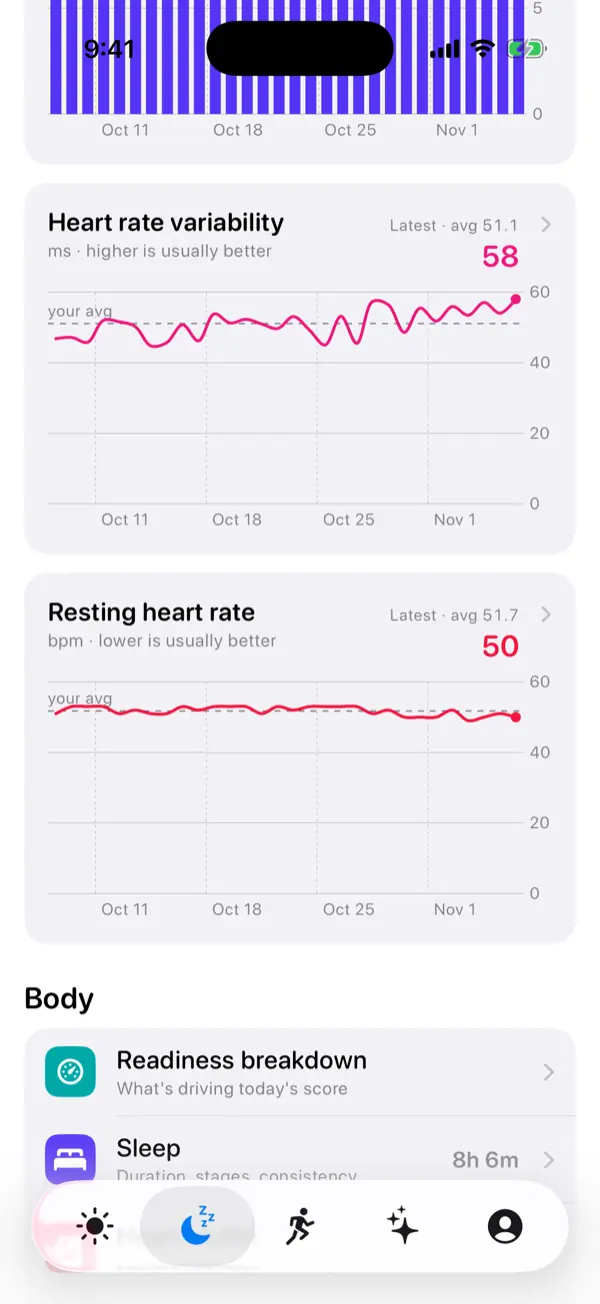
VedaWatch's Recovery view shows your HRV as a rolling trend against your own recent baseline, rather than presenting a single overnight reading as a verdict. That lines up with what the validation research actually supports: relative change over your own history, not an absolute number compared against another device.
With permission, VedaWatch reads whatever HRV data your Apple Watch already captured in Apple Health—it doesn't improve the sensor's underlying accuracy, only how the trend is presented alongside your sleep and resting heart rate.
Sources & further reading
- Sensors (2024): The Validity of Apple Watch Series 9 and Ultra 2 for Serial Measurements of Heart Rate Variability and Resting Heart Rate
- Sports Medicine International Open (2017): Validity of the Apple Watch for Heart Rate during exercise
- Apple Support: Monitor your heart rate with Apple Watch
This guide is educational, not medical advice, and has not been clinically reviewed. VedaWatch is not a medical device. If you have symptoms or concerns about your heart or health, contact a qualified healthcare professional.
Put your trends in perspective.
Explore HRV, sleep, and recovery with VedaWatch on your iPhone.
Download VedaWatch on the App Store →