 VedaWatch
Comparisons
Whoop vs Oura: recovery, sleep, strain and cost compared
Whoop vs Oura as of November 2026: band vs ring, Recovery vs Readiness, sleep, strain, battery and membership costs, plus where an Apple Watch fits in.
By VedaWatch editorial team · · 11 min read
The short answer
Pick Whoop if training load matters most: it's a screenless wrist band with a 0-21 Strain score, 14+ day battery and a membership from $199 a year. Pick Oura if sleep and everyday wear matter most: it's a ring from $399 plus $5.99 a month. Both rate recovery from HRV, resting heart rate and sleep against your own baseline.
Whoop vs Oura: which one is better?
Neither is better across the board. They measure many of the same signals from different places on the body and are built around different questions. Whoop asks how much strain you can take on today. Oura asks how well you slept and how balanced your recovery is. Both are designed to be worn day and night, and neither has a screen you interact with.
Whoop is a band, usually worn on the wrist, sold only as a membership that includes the hardware. Its daily loop is Recovery in the morning, Strain through the day and a sleep target at night. As of November 2026 the current hardware is WHOOP 5.0, or WHOOP MG on the top tier.
Oura is a titanium ring that you buy outright, with an optional membership that unlocks the full insights. Its daily loop is three 0-100 scores: Sleep, Readiness and Activity. As of November 2026 the current model is Oura Ring 5.
This guide compares them side by side using what each company publishes on its own site, works through the two-year cost, and explains where an Apple Watch fits if you already wear one. If you're weighing a single brand against Apple Watch, the Apple Watch vs Whoop and Apple Watch vs Oura guides cover those in more depth.
Whoop vs Oura at a glance (as of November 2026)
Here is how the two compare on the points people ask about most. Prices are US list prices from each company's own site before tax, and they can change.
- Form factor. Whoop: a screenless sensor on a fabric band. Oura: a titanium ring, 6.09 mm wide and 2.28 mm thick, from about 2 grams depending on size.
- Recovery score. Whoop Recovery: a percentage, green 67-99%, yellow 34-66%, red 1-33%, calculated once when you wake up. Oura Readiness: 0-100, with 85-100 Optimal, 70-84 Good, 60-69 Fair and 0-59 Pay Attention.
- Sleep. Whoop: sleep stages, a nightly sleep need based on your sleep debt and the previous day's activity, and a haptic alarm. Oura: a 0-100 Sleep Score built from contributors such as total sleep time, efficiency and how long you take to fall asleep.
- Strain and activity. Whoop: Strain on a 0 to 21 scale, scored through the day and for each workout, with a recommended target based on your Recovery. Oura: a 0-100 Activity Score and an Activity Balance contributor that compares your last 14 days of load with the past two months.
- Battery. Whoop 5.0 and MG: 14+ days per charge, with a Wireless PowerPack that charges the sensor while you wear it on Peak and Life. Oura Ring 5: 6 to 9 days per charge depending on ring size and usage, about 80 minutes to charge.
- Price. Whoop: One $199 a year, Peak $239 a year, Life $359 a year, hardware included. Oura: Ring 5 from $399 (Silver or Black) or $499 for other finishes, plus a membership of $5.99 a month or $69.99 a year, with a free first month for new members.
- Without a subscription. Whoop is sold only as a membership. Oura says the ring and app still work without a membership, but insights and personal health data are much more limited.
- Apple Health. Whoop says it syncs activities with Apple Health. Oura writes sleep, heart rate, respiratory rate, steps and workouts to Apple Health, and its support page doesn't list HRV among the exported data.
Wrist band vs ring: comfort, wear and battery life
The biggest everyday difference is where the sensor sits. A ring disappears under a duvet and next to a wedding band, which is why many people find Oura easier to wear at night. Oura offers a free sizing kit because the fit matters: a ring that spins or slides gives the sensors a worse signal.
Whoop sits on the wrist like a watch strap without a face. You can't check the time on it, which some people see as a plus. Whoop's tiers differ in band and charger: One comes with a Jet Black CoreKnit band, Peak with an Obsidian SuperKnit band and the Wireless PowerPack, and Life with the medical-grade WHOOP MG sensor and a choice of band.
Battery life favours Whoop. Whoop says the 5.0 and MG are designed for 14+ days on a charge, and because the Wireless PowerPack slides onto the sensor and charges it on your body, Peak and Life members don't have to take it off to charge. One comes with a wired Basic Charger instead. Oura Ring 5 is rated for 6 to 9 days and charges in about 80 minutes, so you take it off for an hour or so roughly once a week. Pick a daytime slot so you don't lose a night of data.
Lifters sometimes find a ring gets in the way of a barbell, while a band can feel bulky under a cuff. Try both shapes if you can; Whoop offers a one-month free trial of its Peak membership, and Oura offers a free sizing kit before you buy.
Whoop Recovery vs Oura Readiness: how the scores work
Both scores compare your body's overnight signals with your own normal rather than with a population average, which is the right approach because healthy HRV and resting heart rate vary widely from person to person.
Whoop Recovery is calculated when you wake up and uses heart rate variability, resting heart rate, sleep performance (the sleep you got compared with the sleep you needed) and respiratory rate, with blood oxygen and skin temperature also included. Whoop says the average member's Recovery is about 58%. The number then sets your Strain target for the day: a green day suggests you can take on more, a red day suggests less.
Oura Readiness weighs nine contributors in three groups. Sleep: Sleep, Sleep Balance and Sleep Regularity. Activity: Previous Day Activity and Activity Balance. Body stress: Resting Heart Rate, HRV Balance, Body Temperature and Recovery Index. The Balance contributors compare a weighted 14-day average with your two-month average, so Readiness reacts to trends, not just last night. Body temperature only counts when it's outside your normal range, so it can lower Readiness but never raise it.
In practice, Whoop's Recovery is a sharper single-night verdict tied to a training target, while Oura's Readiness is a broader daily balance check. Neither company publishes its weighting, so you can't convert one into the other. A Whoop 70% and an Oura 70 are not the same thing, even on the same morning.
Neither score is a diagnosis. A run of low scores together with a raised resting heart rate or temperature can be an early hint that you're run down or getting ill, but feeling unwell, chest pain, fainting or unusual breathlessness are reasons to see a doctor, whatever the score says.
Is Whoop or Oura better for sleep tracking?
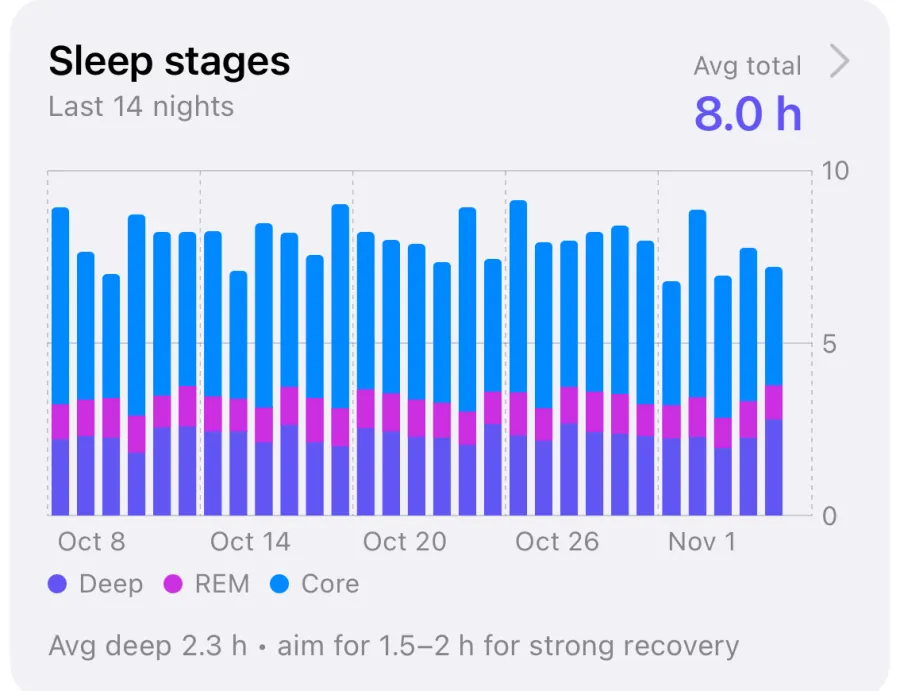
For telling sleep from wake, independent testing puts them close together. In a 2022 sleep-lab study by Miller and colleagues, 53 healthy adults wore six devices for one night alongside polysomnography, the clinical gold standard. Epoch-by-epoch agreement for sleep versus wake was 89% for Oura Gen 2, 86% for WHOOP 3.0 and 88% for Apple Watch Series 6. For the four sleep stages, agreement was 61% for Oura, 60% for WHOOP and 53% for Apple Watch.
That study used older generations of all three devices and only one night per person, so treat it as evidence that both are reasonable for sleep timing and duration, not as a ranking of today's models. The authors' own conclusion was that every device tested was valid for sleep timing and duration and needed to improve on sleep stages.
The bigger difference is coaching style. Whoop works out how much sleep you need tonight from your sleep debt and the previous day's activity, and its haptic alarm can wake you with a vibration rather than a sound. Oura grades the night you just had on its 0-100 Sleep Score, and feeds that night, your sleep over the past two weeks and how regular your bedtimes are into Readiness.
If you want a nightly target and a wake-up buzz, Whoop's approach is more hands-on. If you want a detailed report card on each night and a ring you forget you're wearing, Oura suits that better.
Strain and training: where Whoop and Oura differ most
This is the clearest split between the two. Whoop is built around Strain, a 0 to 21 score based on the Borg scale of perceived exertion. It's non-linear, so Whoop notes that it takes more stress to move from 16 to 17 than from 4 to 5. Whoop's developer documentation groups it as Light 0-9, Moderate 10-13, High 14-17 and All Out 18-21. Each workout gets its own Strain plus time in heart rate zones.
Oura doesn't use a Whoop-style strain scale. Its activity side is the 0-100 Activity Score, step and movement tracking, and the Activity Balance contributor inside Readiness, which flags when your recent 14-day load is well above or below what you're used to over two months. That's a useful guard against ramping up too fast, but it's a background check rather than a live target.
So if you train most days and want a number that tells you how hard to go, Whoop's Recovery-to-Strain loop is the more direct tool. If you exercise a few times a week and care more about sleep, stress and general health, Oura's lighter touch may be all you need.
Whoop vs Oura cost: a two-year worked example
The two pricing models make the first year and later years look different, so it helps to add them up. These are US list prices from each company's own site as of November 2026, before tax, ignoring sales and trial months.
Oura's monthly plan works out to $71.88 a year, so the annual plan at $69.99 is slightly cheaper. Whoop's prices are annual and include the hardware, with no upfront device cost. If you upgrade your Oura ring later you pay for new hardware; Whoop says new features and releases arrive on the hardware you already have and you can switch tiers any time.
- Whoop One for two years: 2 x $199 = $398.
- Whoop Peak for two years: 2 x $239 = $478.
- Oura Ring 5 in Silver or Black with the annual membership for two years: $399 + 2 x $69.99 = $538.98.
- Oura Ring 5 in another finish with the annual membership for two years: $499 + 2 x $69.99 = $638.98.
- Whoop Life for two years: 2 x $359 = $718.
- Oura Ring 5 without a membership: $399 or $499 once, with much more limited insights.
Whoop or Oura: which should you choose?
Start from the question you want answered each morning, and from what you're happy to wear 24 hours a day.
- You train hard most days and want a daily target: Whoop. Strain and the Recovery-based target are the core of the product.
- Sleep is your main focus and you dislike wearing anything on your wrist at night: Oura.
- You hate charging: Whoop, with 14+ days per charge, ahead of Oura's 6 to 9 days.
- You want the lowest ongoing cost: Whoop One costs less over two years than Oura with a membership, but Oura is the only one of the two that keeps working, in a limited way, if you stop paying.
- You want ECG or blood pressure insights: those are on Whoop Life with the MG sensor, not on One or Peak.
- You already wear an Apple Watch every day: consider whether you need a second device at all, as the next section explains.
Where does Apple Watch fit in a Whoop vs Oura decision?
If you already own an Apple Watch, it records most of the same raw signals: heart rate, HRV, resting heart rate, respiratory rate and sleep stages, and on newer models wrist temperature. As of November 2026, Apple's own Readiness score, a 0-10 rating built from activity, vitals and sleep, runs only on Apple Watch Series 12 and Ultra 4. Older models still record the data but don't add it up into one daily score.
What Apple Watch lacks compared with both is battery life. It needs charging far more often, so overnight tracking depends on a charging routine, such as topping up while you shower and get ready in the morning.
Many people wear an Apple Watch by day and an Oura ring at night. That works, but expect two sets of numbers that won't match. If you mainly want a morning recovery score, a strain view and sleep coaching, a third-party app can build them from the Apple Watch data you already have, which can save buying a second device.
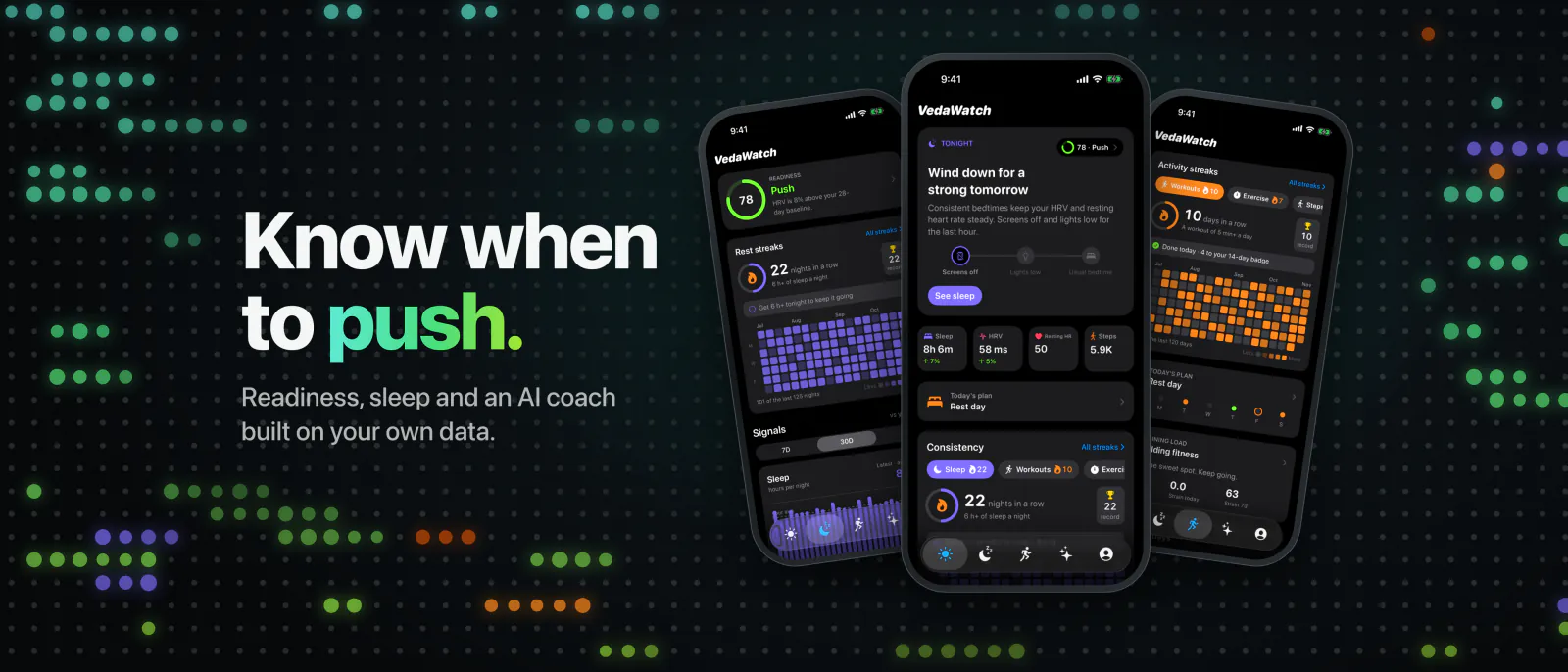
How VedaWatch covers the Whoop and Oura basics on Apple Watch
VedaWatch is an iPhone and Apple Watch app that reads the data your watch already saves to Apple Health. It works with Apple Watch Series 4 or later, so you don't need the newest model to get a daily score.
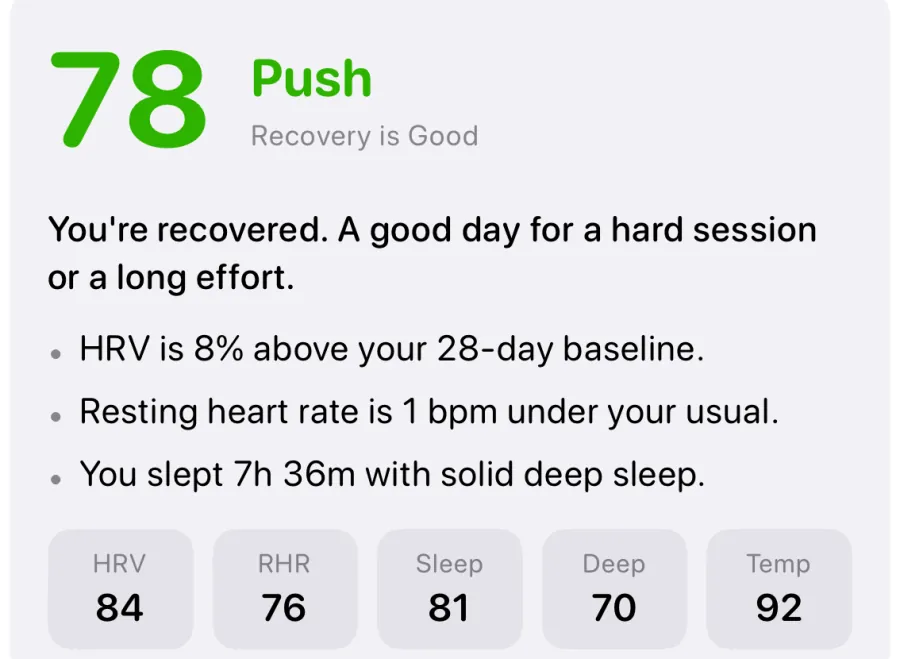
Recovery: a 0-100 readiness score built from HRV, resting heart rate, sleep and deep sleep compared with your own recent baseline, with a verdict of Push (70 and up), Hold (50 to 69) or Rest (under 50) and the plain reasons behind it.
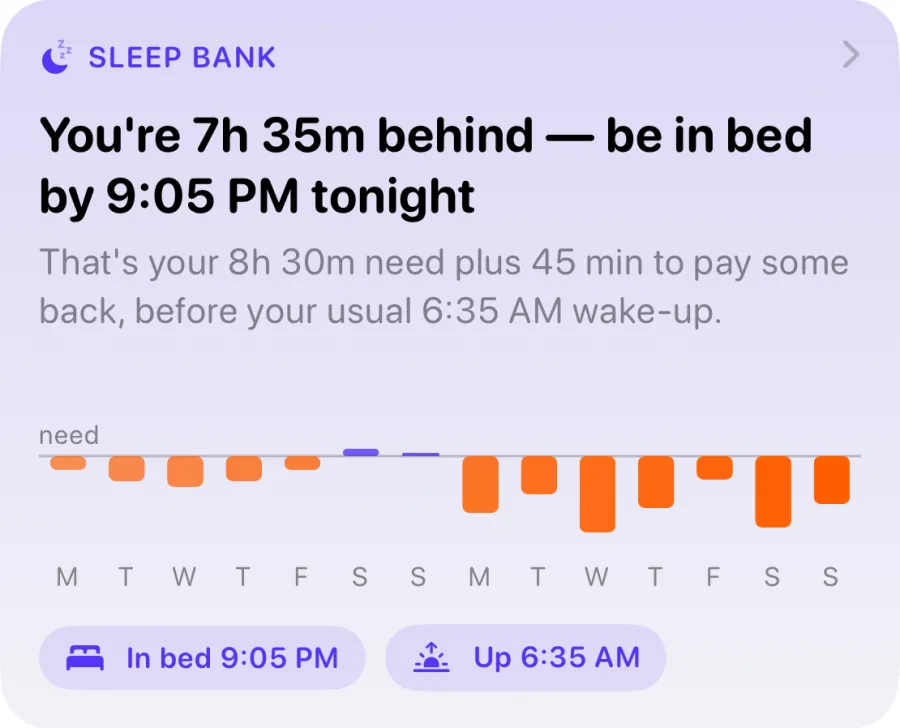
Strain: a daily strain on Whoop's familiar 0-21 scale on the Training Load screen, next to a 7-day versus 28-day training load ratio. Sleep: Sleep Bank tracks your sleep balance over the last 14 nights against your sleep need and suggests a bedtime for tonight, an idea similar to Whoop's sleep planning. The core app is free; Pro, which adds the AI coach and plans, is $6.99 a month or $59.99 a year.
VedaWatch's formulas are its own, so its numbers won't match Whoop's or Oura's. Like theirs, its scores are wellness guidance, not medical advice.
Frequently asked questions
Can you wear Whoop and Oura at the same time?
Yes, they don't interfere with each other, and some people do it to compare. Expect different numbers, because each uses its own sensors, baseline and weighting.
Does Oura work without a membership?
Yes, partly. Oura says the ring and app still work without a membership, but insights and personal health data are much more limited, and you can still export your data as CSV.
Is Whoop or Oura more accurate for HRV?
There's no clear published winner between the current models. Both measure HRV overnight while you're still, which is the most stable time to measure it, so consistency of wear matters more than the brand.
Which is better for women's health tracking?
Both offer cycle insights: Whoop lists Women's Hormonal Insights on every tier, and Oura says Readiness accounts for normal changes across the menstrual cycle and pregnancy. Neither is a contraceptive or a diagnostic tool.
Will my Whoop or Oura data show up in Apple Health?
Some of it. Oura writes sleep, heart rate, respiratory rate, steps and workouts to Apple Health, and Whoop syncs activities. Their Recovery, Readiness and Strain scores stay in their own apps.
Related guides
- Apple Watch vs Whoop: do you need a separate recovery band?
- Apple Watch vs Oura Ring: comparing HRV and recovery tracking
- Whoop alternative: 5 ways to get it from your Apple Watch
- Best recovery app for Apple Watch: an honest 2026 roundup
- Apple Watch sleep tracking: how accurate is it, and what to do when it's wrong
- Apple Watch Readiness score: what Recover, Pace Yourself, Ready, and Go For It mean
Sources & further reading
- WHOOP: Membership options (One, Peak, Life)
- WHOOP: How Does WHOOP Recovery Work?
- WHOOP Developer Platform: WHOOP 101 (Recovery, Strain and Sleep)
- Apple Support: Understand your readiness score on Apple Watch
- Oura: Oura Ring 5 (store page and technical specifications)
- Oura: Membership
- Oura Member Care: Readiness Score
- Miller DJ, Sargent C, Roach GD. A Validation of Six Wearable Devices for Estimating Sleep, Heart Rate and Heart Rate Variability in Healthy Adults. Sensors, 2022
This guide is educational, not medical advice, and has not been clinically reviewed. VedaWatch is not a medical device. If you have symptoms or concerns about your heart or health, contact a qualified healthcare professional.
Put your trends in perspective.
Explore HRV, sleep, and recovery with VedaWatch on your iPhone.
Download VedaWatch on the App Store →