 VedaWatch
Comparisons
Apple Watch vs Whoop: do you need a separate recovery band?
Apple Watch now has its own Readiness score, and Whoop has built its business on Recovery. Compare how each one works, what each costs, and whether wearing two devices actually gets you anything.
By VedaWatch editorial team · · 7 min read
The short answer
Whoop's Recovery score (0-100%, green/yellow/red) and Apple's Readiness score (0-10, four bands) measure similar things—HRV, resting heart rate, and sleep against your personal baseline—but Whoop is a membership-only band that stops working if you cancel, while Apple Watch is hardware you already own that can also run a third-party recovery score like VedaWatch's, on far more models than Apple's own Readiness app supports.
Two different bets on the same idea
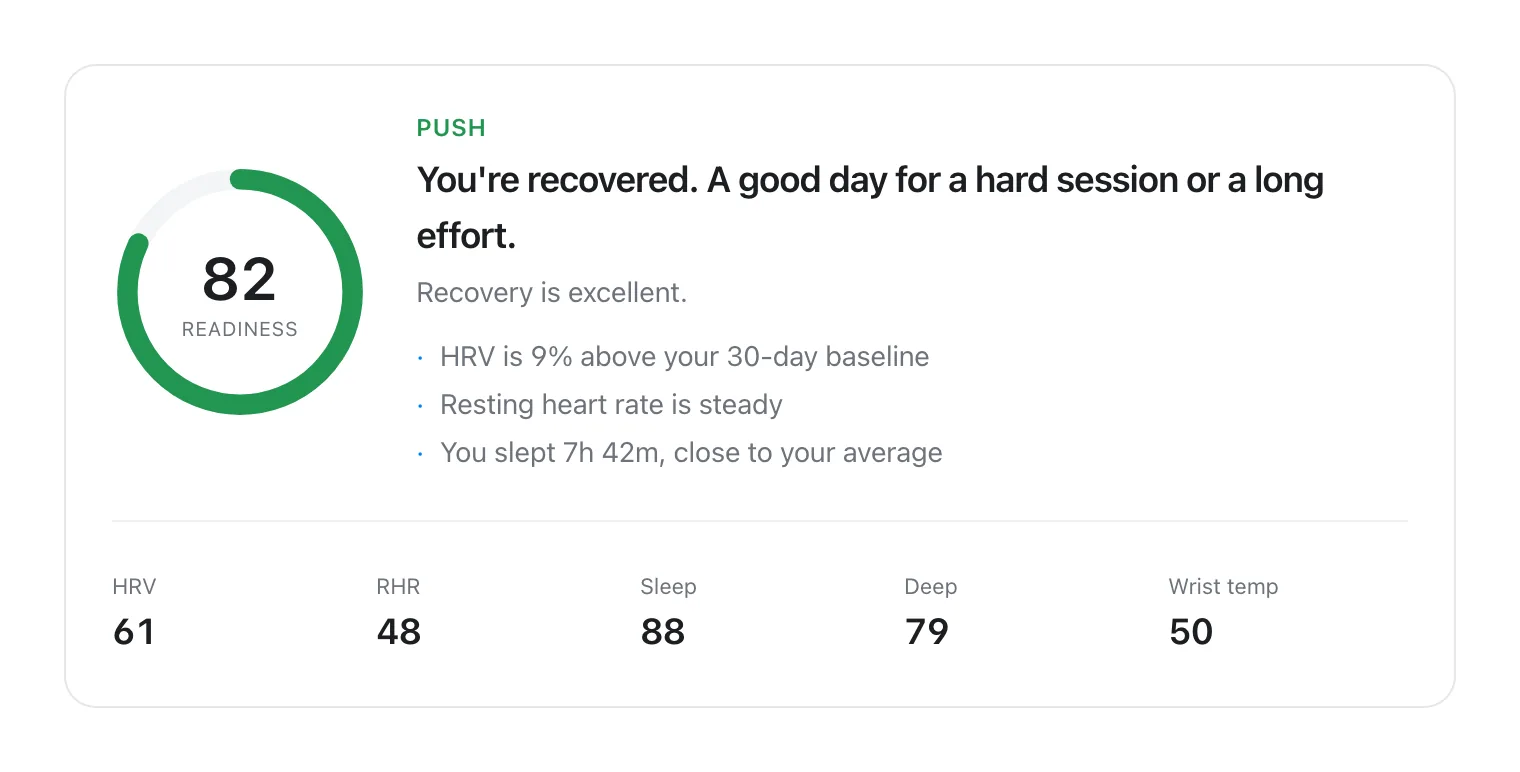
Whoop built an entire company around a single number: Recovery, a daily percentage meant to tell you how prepared your body is for strain. Apple shipped a close cousin of that idea into watchOS in 2026 with its own Readiness score. Both lean on the same physiological signals—HRV, resting heart rate, and sleep—compared against your own recent history, not a one-size-fits-all target.
The real difference isn't the math. It's the business model: Whoop is a subscription band with no native smartwatch features, while Apple Watch is a smartwatch you likely already own, where a recovery score is one feature among many.
How each score actually works
Whoop's Recovery is a percentage, color-coded green (67-99%), yellow (34-66%), or red (1-33%), calculated from HRV, resting heart rate, sleep performance (sleep obtained vs. sleep needed), and respiratory rate—Whoop says the average member recovery is around 58%.
Apple's Readiness is a 0-10 score sorted into four bands—Recover (0-1), Pace Yourself (2-4), Ready (5-7), and Go For It (8-10)—built from activity (active calories, workout effort, training load), overnight and daytime vitals (HRV, heart rate, respiratory rate, wrist temperature, blood oxygen), and recent sleep, each compared against your personal baseline.
In practice they're answering the same question with different scales and different weighting. Don't expect a Whoop green day and an Apple Watch "Go For It" day to line up perfectly, even worn on the same wrist.
Cost and hardware: own vs. rent
Whoop has no upfront device price—you pay a membership, and the band comes with it. Current tiers run from WHOOP One (around $199/yr) up through WHOOP Peak and WHOOP Life (around $359/yr) with more health features at each level. Cancel the membership and the device stops functioning; you're renting the hardware for as long as you pay.
Apple's own Readiness app is free, but it's gated to Apple Watch Series 12 and Ultra 4 specifically—older Apple Watches, including last year's models, don't get it. If you already own any Apple Watch that logs HRV, resting heart rate, and sleep to Apple Health, a third-party app can compute a comparable recovery score without requiring the newest hardware or an ongoing subscription to a second device.
Don't expect identical numbers
Sampling conditions, algorithms, and baseline windows differ between systems, so comparing a Whoop percentage directly against an Apple Readiness score (or a third-party score) is apples to oranges, even though the underlying biology is the same. The useful comparison is each system against its own history, not against the other brand's number.
Neither is a medical device. Whoop's own materials frame Recovery as a training-readiness signal, and Apple is explicit that Readiness "should not be solely relied on to determine whether it is safe to exercise." Treat either score as one input alongside sleep, soreness, and how you actually feel.
Which one actually makes sense for you
If you want continuous strain tracking, a dedicated coaching layer, and don't mind wearing a second device and paying for it indefinitely, Whoop is built specifically for that. It works independent of what phone or watch you use.
If you already wear an Apple Watch and mainly want to understand your recovery trend without adding a subscription-only band, you have two paths: Apple's own Readiness app if you have a Series 12 or Ultra 4, or a third-party app like VedaWatch if you don't—both read data your watch is already collecting.
Common questions
Can I use both at once? Yes, some people do, mainly for Whoop's strain/training-load tracking alongside Apple's ecosystem. Just don't expect the two recovery numbers to match.
Does Whoop work without an Apple Watch? Yes—Whoop is a standalone band with its own app and doesn't require any other wearable.
Will my old Apple Watch ever get Apple's Readiness app? Apple hasn't said. As of this writing it's exclusive to Series 12 and Ultra 4, regardless of watchOS version.
Get a recovery score from the Apple Watch you already have
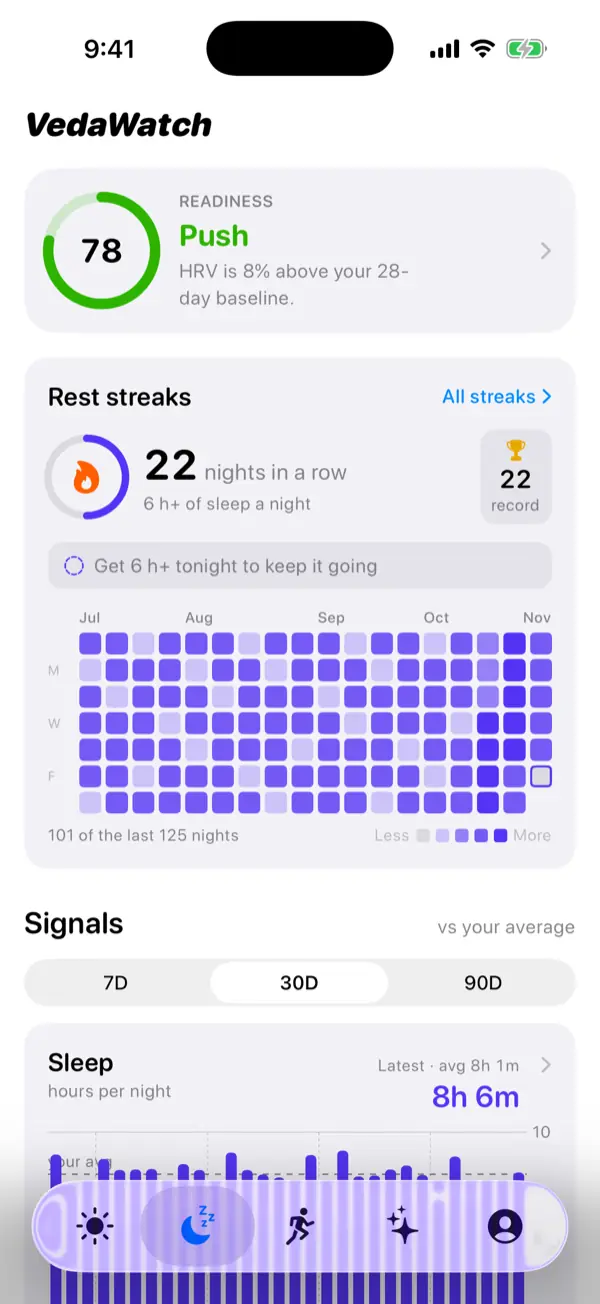
VedaWatch reads the HRV, resting heart rate, sleep, and wrist temperature data your Apple Watch already writes to Apple Health and turns it into a recovery score with the reasoning behind it—no second device, no separate subscription just to keep hardware working.
With permission, it works off data you already have. AI coaching is optional, requires your permission to share relevant data for processing, and is subject to your plan's limits.
Sources & further reading
- WHOOP: How Does WHOOP Recovery Work?
- WHOOP: Membership options and pricing
- Apple Support: Understand your readiness score on Apple Watch
This guide is educational, not medical advice, and has not been clinically reviewed. VedaWatch is not a medical device. If you have symptoms or concerns about your heart or health, contact a qualified healthcare professional.
Put your trends in perspective.
Explore HRV, sleep, and recovery with VedaWatch on your iPhone.
Download VedaWatch on the App Store →