 VedaWatch
Comparisons
Apple Watch vs Oura Ring: comparing HRV and recovery tracking
Oura tracks HRV continuously overnight from a ring and rolls it into a 0-100 Readiness Score with nine contributors. Apple Watch samples HRV periodically and now has its own Readiness feature on newer models. Here's how the two actually differ.
By VedaWatch editorial team · · 7 min read
The short answer
Oura's Readiness Score (0-100, built from nine contributors) comes from continuous overnight HRV sampling on a finger-worn ring, while Apple Watch samples HRV periodically from the wrist. Oura costs $399-499 upfront plus $5.99/month (the ring still works on a limited basis without a membership); Apple Watch is hardware most people already own, and its native Readiness score only runs on Series 12 and Ultra 4—though any Apple Watch can feed a third-party score like VedaWatch's.
A ring built around HRV vs. a watch that does everything else too
Oura built its product around one proposition: a ring that does nothing but sense your body and turn that into scores. Apple Watch is the opposite bet—a general-purpose smartwatch that happens to also track HRV, sleep, and (on newer models) Readiness, alongside notifications, apps, and everything else a smartwatch does.
That difference in focus shows up directly in how each device samples HRV, which is the detail most comparisons skip past.
How HRV sampling actually differs
Oura's ring sits on a finger with a stronger, more consistent blood-flow signal than the wrist, and it samples continuously overnight—Oura's own materials describe giving you your "entire night of HRV data" to review, not just a nightly average.
Apple Watch, by contrast, takes periodic HRV readings rather than tracking continuously; sampling happens while you're still, so the number of measurements you get varies with how much you move. Both approaches are legitimate ways to estimate HRV, but they're not measuring on the same schedule, which is one reason the two numbers won't match even side by side.
Oura's Readiness Score vs Apple's Readiness score
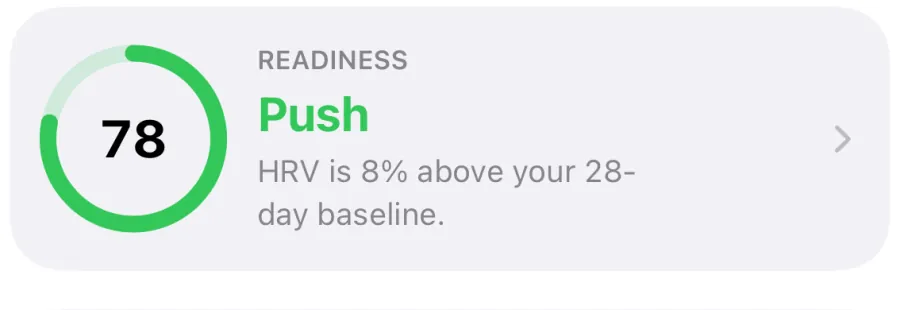
Oura's Readiness Score runs 0-100: 85+ is "Optimal," 70-84 is "Good," and under 70 means "Pay attention." It's the sum of nine Readiness Contributors across three pillars—sleep (Sleep, Sleep Balance, Sleep Regularity), activity (Previous Day Activity, Activity Balance), and body stress (Resting Heart Rate, HRV Balance, Body Temperature, Recovery Index)—with HRV Balance specifically comparing your recent HRV against your longer-term average rather than just yesterday.
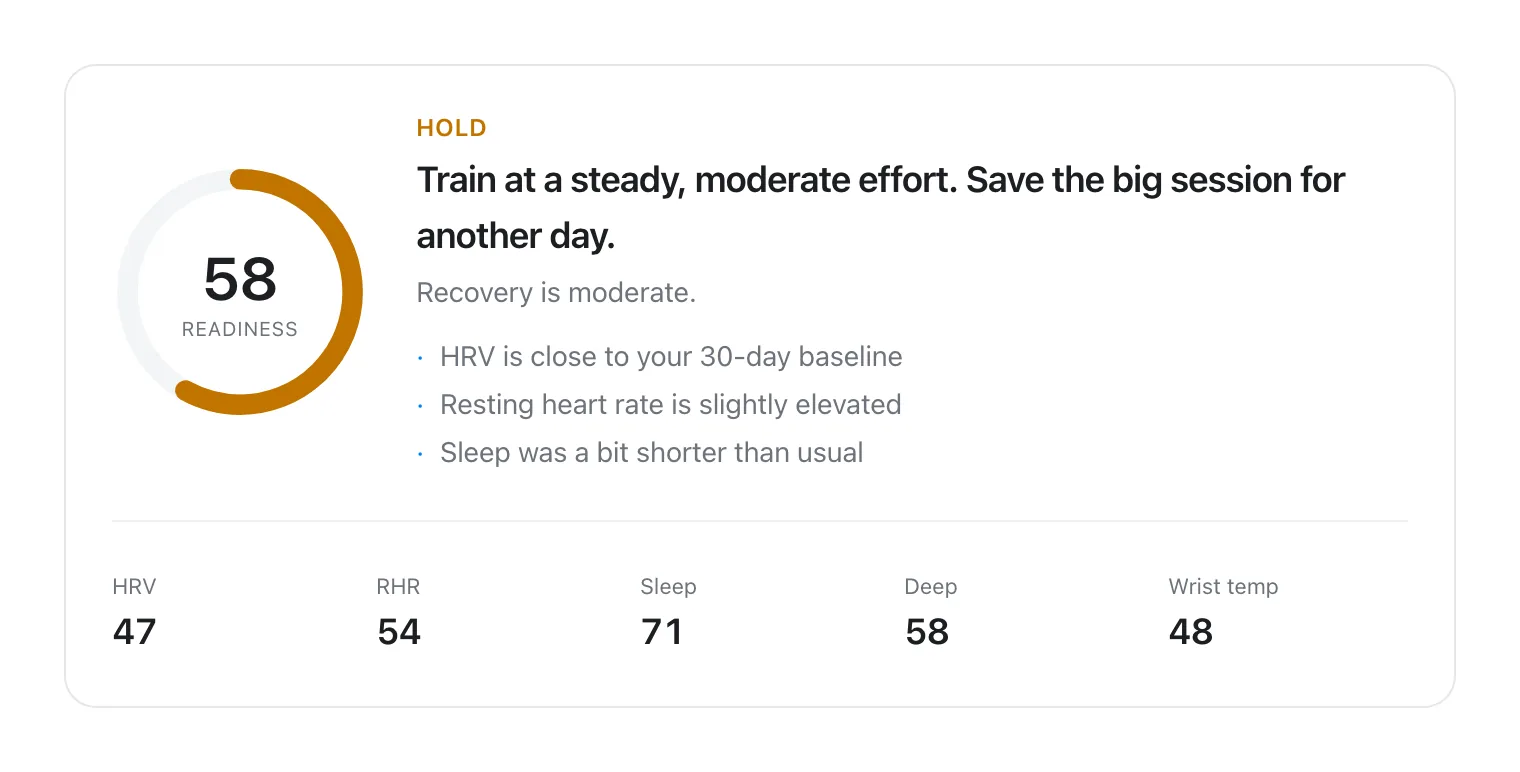
Apple's Readiness is simpler on paper: a 0-10 score in four bands (Recover, Pace Yourself, Ready, Go For It) built from activity, overnight/daytime vitals, and sleep. Oura's version leans harder into long-term trend contributors like Sleep Balance and HRV Balance; Apple's leans more on the most recent night and day.
What each one actually costs
Oura Ring 5 starts around $399 and runs up to $499 depending on finish, and that's before the $5.99/month membership required for full Scores and insights (new members get a free trial month). Oura says the ring and app still function without an active membership, but the insights, personal health data, and benefits you get are "much more limited"—so the hardware purchase alone doesn't get you the full Readiness picture indefinitely.
Apple Watch has no separate membership for its native Readiness feature, but that feature itself is gated to Series 12 and Ultra 4. If you own an older Apple Watch, Apple's own Readiness app isn't an option at any price—though the watch is still collecting the HRV, resting heart rate, and sleep data a third-party app can use.
Don't expect matching numbers
Different sensor placement (finger vs. wrist), different sampling schedules (continuous vs. periodic), and different scoring math mean an Oura Readiness Score and an Apple Watch-based recovery score are answering a similar question with different inputs. Track each system against its own history rather than trying to reconcile the two numbers directly.
Which one fits you
If continuous overnight HRV detail and long-term trend scoring (Sleep Balance, HRV Balance) matter more to you than having one fewer device to charge, Oura's purpose-built approach has a real edge—that's the tradeoff you're paying $399+ and a monthly fee for.
If you already wear an Apple Watch and would rather not add a ring, a subscription, or both, you have two paths to a recovery score: Apple's own Readiness app on Series 12/Ultra 4, or a third-party app like VedaWatch on any Apple Watch that's already logging HRV, resting heart rate, and sleep to Apple Health.
Common questions
Can I wear an Oura Ring and an Apple Watch together? Yes, plenty of people do, usually for Oura's sleep/HRV detail alongside Apple Watch's workout and notification features. The two Readiness-style scores won't necessarily agree.
Does the Oura Ring need to be charged often? No—Oura doesn't publish daily charging as a requirement; it's designed for multi-day battery life, though exact runtime varies with features used.
Is Oura's HRV more accurate than Apple Watch's? They're measuring from different locations with different sampling frequency, which makes "more accurate" hard to claim either way—each is more useful compared against its own history than against the other.
A recovery score from the Apple Watch you already wear
VedaWatch reads the HRV, resting heart rate, sleep, and wrist temperature data your Apple Watch already writes to Apple Health and turns it into a recovery score with the reasoning behind it—no ring, no second subscription just to unlock full insights.
With permission, it works off data you already have. AI coaching is optional, requires your permission to share relevant data for processing, and is subject to your plan's limits.
Sources & further reading
- Oura: Your Oura Readiness Score & How To Measure It
- Oura: Membership
- Apple Support: Understand your readiness score on Apple Watch
- Apple Support: Track your overnight and daytime vitals
This guide is educational, not medical advice, and has not been clinically reviewed. VedaWatch is not a medical device. If you have symptoms or concerns about your heart or health, contact a qualified healthcare professional.
Put your trends in perspective.
Explore HRV, sleep, and recovery with VedaWatch on your iPhone.
Download VedaWatch on the App Store →