 VedaWatch
Comparisons
Which Apple Watch is best for health tracking? (2026 guide)
Which Apple Watch is best for health tracking in November 2026: Series 12, Ultra 4 and SE 3 sensors compared, what older models lack, which watchOS you need.
By VedaWatch editorial team · · 9 min read
The short answer
As of November 2026, Apple Watch Series 12 is the best Apple Watch for most people who want health tracking: it has every health sensor plus Apple's new Readiness score and Recovery HRV. Ultra 4 has the same health features with much longer battery life. SE 3 covers sleep, temperature and sleep apnea but has no ECG, blood oxygen or hypertension notifications.
Which Apple Watch is best for health tracking?
As of November 2026, Apple's compare page lists three current models: Apple Watch Series 12, Apple Watch Ultra 4 and Apple Watch SE 3. For health tracking, Series 12 and Ultra 4 sit at the top and are effectively tied. Both have Apple's new Health Sensing System, the S11 chip, the Readiness app, Recovery HRV, the ECG app, the Blood Oxygen app, wrist temperature sensing, sleep apnea notifications, hypertension notifications and Sleep Score.
The difference between those two is mostly battery and build, not health data. Apple rates Series 12 at up to 24 hours of normal use and Ultra 4 at up to 50 hours. If you want to wear your watch to bed every night without thinking about the charger, that extra battery is the real health argument for Ultra 4.
SE 3 is the budget pick. It records heart rate, HRV, sleep stages, Sleep Score and wrist temperature, and it gets sleep apnea notifications. What it doesn't list is the ECG app, the Blood Oxygen app, hypertension notifications, Recovery HRV or Readiness. Apple's Series 12 announcement gives a starting US price of $399, and Apple launched SE 3 in September 2025 at $249.
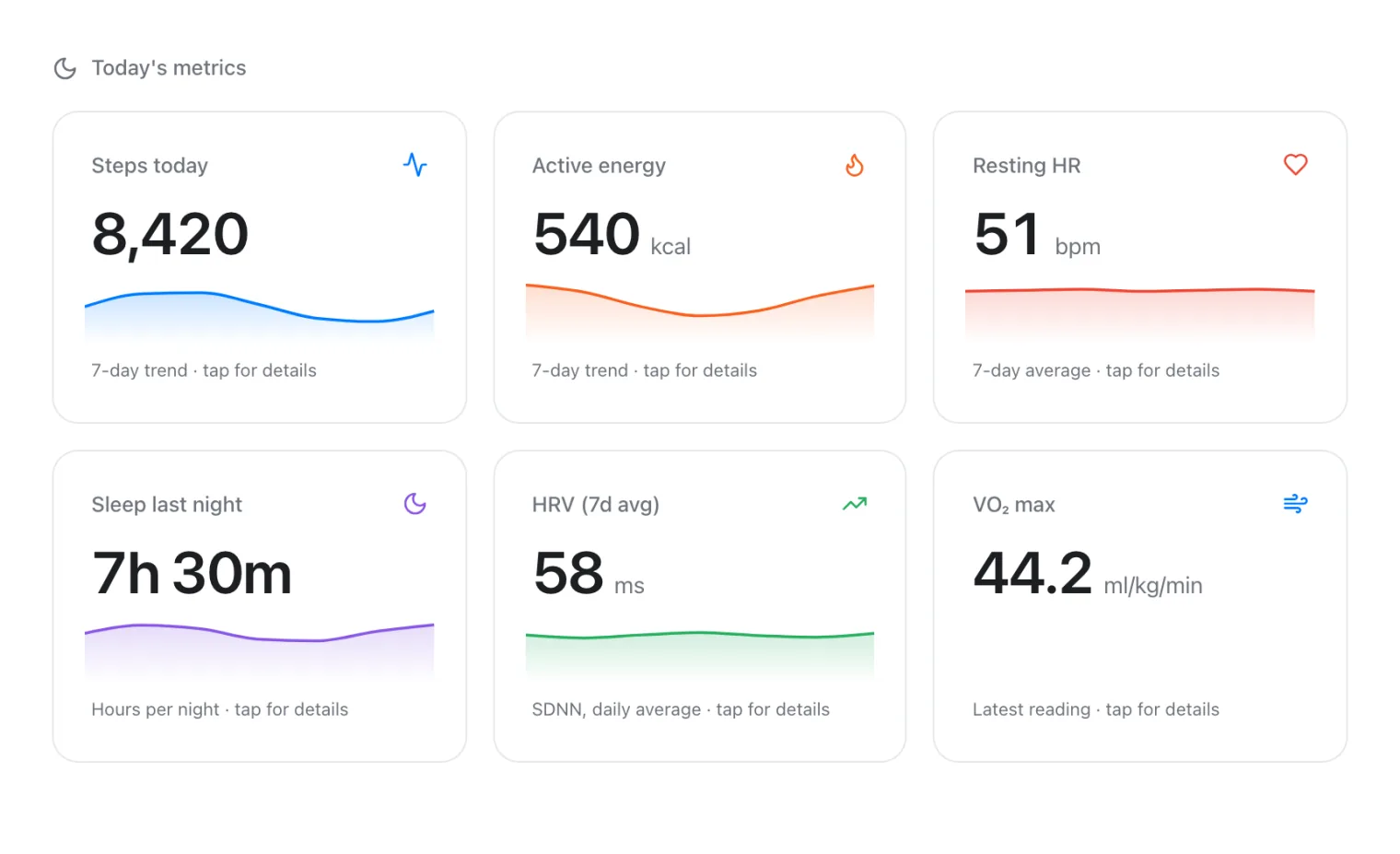
Series 12 vs Ultra 4 vs SE 3: health features compared
Here is what each current model offers for health, taken from Apple's compare page and tech specs as of November 2026. Read each line as a checklist rather than a ranking.
- Readiness app (daily 0-10 score): Series 12 yes, Ultra 4 yes, SE 3 no.
- Recovery HRV and high-frequency background heart rate: Series 12 yes, Ultra 4 yes, SE 3 no. SE 3 still records standard HRV.
- Vitals app: all three. Series 12 and Ultra 4 add HRV to the overnight view and a daytime view; SE 3 shows heart rate, respiratory rate, wrist temperature and sleep duration.
- ECG app: Series 12 yes, Ultra 4 yes, SE 3 no.
- Blood Oxygen app: Series 12 yes, Ultra 4 yes, SE 3 no.
- Hypertension notifications: Series 12 and Ultra 4 yes (regional clearance still pending in some countries), SE 3 no.
- Sleep apnea notifications: all three.
- Wrist temperature sensing: all three.
- Sleep Score and sleep stages: all three.
- Battery, normal use: Series 12 up to 24 hours, Ultra 4 up to 50 hours, SE 3 up to 18 hours.
- Water: Series 12 and SE 3 rated to 50 m, Ultra 4 to 100 m.
What's new for health in Series 12 and Ultra 4
The headline change in 2026 is hardware. Apple says the new optical heart sensor measures heart rate every 5 seconds through the day and measures HRV up to 24 times more often than before. That denser data feeds three features older watches don't get.
Recovery HRV is a second HRV measure that Apple says is best for daily signals of stress and recovery, while overall HRV is better for broader health trends. Overnight Vitals now compares Recovery HRV with your personal baseline, and a new daytime view lets you switch between overnight and daytime readings.
Readiness is a daily score from 0 to 10, grouped as Go for it (8-10), Ready (5-7), Pace Yourself (2-4) and Recover (0-1). Apple's support page says it uses your activity, daytime and overnight vitals, and sleep. To get a score you need your height, weight and age in Health Details, Activity set up, overnight vitals set up with at least 7 nights of sleeping in the watch, and Sleep turned on.
Apple is clear about the limits. It calls Readiness a general wellness feature that shouldn't replace professional medical judgment, and notes that it doesn't account for things like existing conditions or medications. The Vitals and Blood Oxygen apps are likewise for wellness, not medical use.
What older Apple Watch models are missing
If you already own an Apple Watch, the question is usually whether an upgrade adds anything you'd use. Here's what each older group has and lacks, based on Apple's model notes for each feature. Every group below still records heart rate, resting heart rate, HRV and sleep.
- Series 11, Series 10, Series 9, Ultra 3 and Ultra 2: ECG, wrist temperature, sleep apnea notifications, hypertension notifications, Vitals and Sleep Score. Missing: Readiness, Recovery HRV, 5-second heart rate and daytime vitals. For most people this group is close to complete.
- Series 8 and the original Ultra: ECG, wrist temperature, Vitals and Sleep Score. Missing: sleep apnea notifications (Series 9 or later, Ultra 2 or later, or SE 3), hypertension notifications (Series 9 or later, Ultra 2 or later), and everything new in Series 12.
- Series 7 and Series 6: ECG and Sleep Score. Missing: wrist temperature (Series 8 or later, SE 3 and all Ultra models), sleep apnea and hypertension notifications.
- SE (2nd generation): Sleep Score. Missing: ECG (no SE model has it), blood oxygen (not supported on any SE), wrist temperature, sleep apnea and hypertension notifications.
- Series 5, Series 4 and the first SE: heart rate, HRV and sleep data still reach Apple Health, and Series 4 and 5 have the ECG app. Missing: Sleep Score, which Apple lists only for Series 6 or later, SE (2nd generation) or later and Ultra, plus all the newer sensor features.
Which features need which watchOS version
Hardware isn't the only gate. Some features arrive with a software update, and an older watch stops getting new features once it can't run the latest watchOS.
watchOS 27, released in September 2026, runs on Apple Watch Series 9 or later, SE 3 and Ultra 2 or later. That means Series 6, 7, 8, SE (2nd generation) and the original Ultra stay on watchOS 26. Being left behind doesn't switch off what you already have, but new health features in watchOS 27 and later won't reach those watches.
Sleep Score came with watchOS 26 for Series 6 or later, SE (2nd generation) or later and all Ultra models, paired with an iPhone 11 or later on iOS 26. Hypertension notifications ask for Series 9 or later or Ultra 2 or later on the latest watchOS, an iPhone 11 or later, and Wrist Detection turned on. The Vitals app asks for the latest watchOS and iOS. Readiness needs Series 12 or Ultra 4, which ship with watchOS 27 and need an iPhone 11 or later on iOS 27.
A quick rule: if your watch can't install watchOS 27, assume any health feature Apple announced from September 2026 onward won't come to it. If it can, check the feature's own support page, because some features also need a particular sensor.
Blood oxygen in the US: the part-number catch
Blood oxygen is the one feature where where you bought the watch matters. Apple stopped offering on-watch blood oxygen on watches it sold in the US from January 18, 2024. In August 2025 Apple brought back a redesigned version for affected US watches, starting with Series 9, Series 10 and Ultra 2 on iOS 18.6.1 and watchOS 11.6.1.
In the redesigned version, the watch still takes the measurement, but your iPhone calculates the result and it appears in the Respiratory section of the Health app. Apple's Vitals support page says US models with part numbers ending in LW/A or LS/A analyze blood oxygen on iPhone, and those results don't appear in Vitals. You can find your part number on the watch in Settings, General, About.
None of this applies to SE models, which don't support the Blood Oxygen app at all. If blood oxygen during sleep matters to you, check the model and part number before you buy, and remember Apple describes the feature as for wellness, not medical use.
How to choose: four common situations
Most people don't need every sensor. Work out which signals you'd actually look at, then pick the cheapest watch that records them reliably.
- You mainly care about sleep, recovery and training: Series 12 if you want Apple's own Readiness score and Recovery HRV, Ultra 4 if you often forget to charge or do long outdoor days. A Series 9, 10 or 11 you already own gives you the same raw HRV, resting heart rate and sleep data; what you'd miss is Apple's score, not the measurements.
- You want heart-rhythm and blood pressure screening features: you need a non-SE model. ECG works on Series 4 or later and every Ultra; hypertension notifications need Series 9 or later or Ultra 2 or later, and you must be 22 or older, not pregnant and not already diagnosed with hypertension.
- You're on a budget or buying for a teenager or older parent: SE 3 is the cheapest current watch with wrist temperature, sleep apnea notifications and Sleep Score, and it runs watchOS 27. It skips ECG, blood oxygen and hypertension notifications.
- You have a Series 6, 7, 8, SE (2nd generation) or original Ultra: your watch still records the core data, but it stopped at watchOS 26. If you'd use sleep apnea or hypertension notifications, or want future features, an upgrade adds something real. If you only read sleep and HRV trends, it may not.
What these health notifications can and can't tell you
Several features on the list are screening notifications, not diagnoses. Hypertension notifications look at your heart data over 30-day periods; Apple says not everyone with high blood pressure will get a notification and the feature can't detect a heart attack. Sleep apnea notifications watch for signs of moderate to severe sleep apnea over 30 days in adults 18 or older.
No notification means the watch didn't see a pattern, not that you're in the clear. If you get one, or you have symptoms such as chest pain, fainting, shortness of breath or loud snoring with daytime sleepiness, talk to a doctor, who can arrange a proper test such as a blood pressure check or a sleep study. For chest pain, pressure or tightness, Apple's own advice is to call emergency services.
Getting more from the Apple Watch you already have
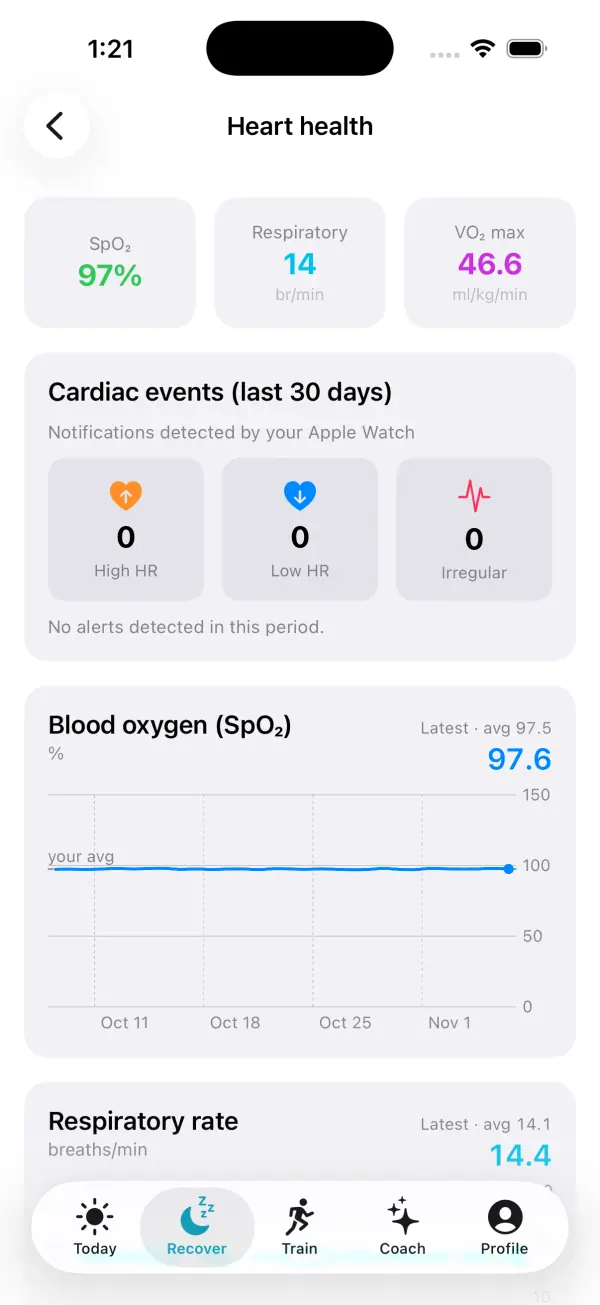
If your watch doesn't have Apple's Readiness app, a third-party app can work with the HRV, resting heart rate and sleep it already writes to Apple Health. VedaWatch is one option. It works with Apple Watch Series 4 and later and turns those readings into a 0-100 readiness score that compares last night with your recent baseline, with a verdict of Push (70 and above), Hold (50-69) or Rest (below 50).
Because VedaWatch only reads what your watch records, what you see depends on your model. On watches with wrist temperature, its alerts can use temperature as well as breathing rate, resting heart rate and HRV when looking for an overnight pattern that's off your normal; on watches without it, they use the other signals. Blood oxygen shows up only if your watch saves it to Apple Health. The core app is free; VedaWatch Pro, which adds the AI Coach and the adaptive training plan, costs $6.99 a month or $59.99 a year on the US App Store as of November 2026. Like Apple's features, it's a wellness tool and not medical advice.
Frequently asked questions
Is Apple Watch Ultra 4 better than Series 12 for health tracking?
Not for sensors: Apple lists the same health features for both, including Readiness and Recovery HRV. Ultra 4's advantage is battery life, up to 50 hours versus 24, which makes nightly sleep tracking easier.
Will my Series 11 get the Readiness score?
As of November 2026, Apple's support page lists Readiness only for Series 12 and Ultra 4, and Apple hasn't announced it for older models. A third-party app can build a similar score from your Apple Health data.
Does Apple Watch SE 3 track HRV and sleep stages?
Yes. SE 3 records HRV and sleep stages and gives a Sleep Score, and its Vitals app shows overnight heart rate, respiratory rate, wrist temperature and sleep duration. It doesn't get Apple's Recovery HRV, which is limited to Series 12 and Ultra 4.
Can an Apple Watch measure blood pressure?
No. Hypertension notifications don't give a blood pressure number; they look for patterns over 30 days that suggest high blood pressure. If you get one, confirm it with a blood pressure cuff and talk to a doctor.
Is a refurbished Series 9 or 10 a good health tracker?
For most health tracking, yes: both run watchOS 27 and have ECG, wrist temperature, sleep apnea and hypertension notifications. They lack only the Series 12 additions, Readiness, Recovery HRV and 5-second heart rate.
Related guides
- Apple Watch Readiness score: what Recover, Pace Yourself, Ready, and Go For It mean
- Best recovery app for Apple Watch: an honest 2026 roundup
- Apple Watch hypertension notification: how it works, what to do
- Apple Watch sleep apnea notifications: what they mean
- Apple Watch blood oxygen: normal SpO2, sleep and accuracy
- Is Apple Watch worth it for fitness? What the research says
Sources & further reading
- Apple: Compare Apple Watch models
- Apple Newsroom: Introducing Apple Watch Series 12 with the all-new Health Sensing System (September 2026)
- Apple: Apple Watch SE 3 technical specifications
- Apple Support: Understand your readiness score on Apple Watch
- Apple Support: Hypertension notifications on your Apple Watch
- Apple Support: Track your overnight vitals with Apple Watch
- Apple Newsroom: An update on Blood Oxygen for Apple Watch in the US (August 2025)
- Apple Newsroom: Apple introduces Apple Watch SE 3 (September 2025)
This guide is educational, not medical advice, and has not been clinically reviewed. VedaWatch is not a medical device. If you have symptoms or concerns about your heart or health, contact a qualified healthcare professional.
Put your trends in perspective.
Explore HRV, sleep, and recovery with VedaWatch on your iPhone.
Download VedaWatch on the App Store →