 VedaWatch
Recovery & Apple Watch
Apple Watch blood oxygen: normal SpO2, sleep and accuracy
Apple Watch blood oxygen explained: normal SpO2 awake and while sleeping, how the watch measures it, what accuracy studies found, and US availability in 2026.
By VedaWatch editorial team · · 10 min read
The short answer
Most healthy people read 95-100% blood oxygen (SpO2) on Apple Watch while awake. During sleep it normally dips a little: in one study of 350 healthy people the median overnight value was 96.5% and brief lows averaged about 90%. Apple Watch is a wellness tool, not a medical device, so judge trends, not single readings.
What is a normal blood oxygen level on Apple Watch?
Blood oxygen, or SpO2, is the percentage of the hemoglobin in your blood that is carrying oxygen. Apple says the majority of people have a blood oxygen level of 95-100%, and the FDA gives the same range for most healthy people measured with a pulse oximeter.
That range is a guide, not a hard line. Apple notes that some people have normal levels below 95%, and that slightly lower values during sleep are expected. The FDA adds that readings are generally a little lower at high altitude and can be lower in people with some lung or heart conditions.
So a single 94% on your wrist is rarely news. What matters more is where your readings usually sit, whether they stay low across days, and whether you feel unwell. The sections below give the numbers that put a reading in context.
What is normal SpO2 while sleeping?
Breathing becomes slower and shallower in sleep, so overnight oxygen saturation runs a little below your daytime level and has brief dips. The best-known reference is a 1996 study in the journal Chest by Gries and Brooks, which reviewed all-night pulse oximetry from 350 people (aged 1 month to 85 years) whose overnight sleep studies were normal. Motion artifacts were removed before analysis.
Here is what the healthy group looked like, which is a useful yardstick when you look at your own overnight data:
- Median saturation across the night: 96.5% on average (standard deviation 1.5 points). Half of the night was spent above this value.
- The level they spent 90% of the night above: 94.7% on average (standard deviation 1.6).
- The single lowest value of the night: 90.4% on average (standard deviation 3.1). In other words, a brief dip to around 90% was ordinary in healthy sleepers.
- Age mattered: people over 60 had lower values, with an average median of 95.1% and a 10th-percentile level of 92.8%.
- Sex, race and body mass index were not linked to any of the measures in this group. People with obstructive sleep apnea had significantly lower values on all three measures.
How does Apple Watch measure blood oxygen?
Apple Watch uses the same basic idea as a fingertip pulse oximeter. A sensor on the back shines light, including a bright red light, into your wrist and measures how much comes back. Oxygen-rich and oxygen-poor blood absorb light differently, so the reflected signal can be turned into an estimated saturation. A finger clip shines light through the fingertip; the watch has to work with light reflected from the wrist, which is one reason fit and stillness matter so much.
An on-demand measurement in the Blood Oxygen app takes 15 seconds. With background measurements turned on, the watch also takes readings now and then when you're not moving, and during sleep if Track Sleep with Apple Watch is on. How often that happens depends on your activity, so the number of readings varies from day to day. You can turn off readings during Sleep Focus and Theater mode in the Blood Oxygen settings.
Results are saved in the Health app on iPhone under Respiratory, then Blood Oxygen. Apple lists Apple Watch Series 6 or later and all Ultra models as supported; Apple Watch SE and Apple Watch For Your Kids don't support it, and the app isn't available to people under 18. Availability also varies by country or region.
How to get a good on-demand reading
Apple says that even under ideal conditions, the watch may not be able to get a reliable measurement every time. These steps, based on Apple's own guidance, give it the best chance:
- Sit down and rest your arm on a table or in your lap, wrist flat with the palm facing down. Don't make a fist or let the arm hang.
- Wear the band snug, with the back of the watch flush against the top of your wrist. If your wrist bone gets in the way, move the watch 1 to 2 inches up your arm.
- Open the Blood Oxygen app, tap Start and stay completely still for the 15 seconds.
- If it fails, warm up first. Low blood flow to the skin, for example in the cold, is a common reason for no result, as are motion and some tattoos.
- Calm down before you measure. Apple says a reading won't succeed if your resting heart rate is above 150 bpm.
- Take two or three readings a few minutes apart rather than trusting one number, and compare them with your usual range in the Health app.
Is blood oxygen available on Apple Watch in the US?
Yes, but on some US watches it works differently. Because of a patent dispute, Apple Watch models bought in the United States on or after January 18, 2024, with part numbers ending in LW/A or LS/A, do the blood oxygen analysis on the paired iPhone rather than on the watch. The watch still takes the measurement, and the result appears in the Health app on iPhone. This is how Apple's support pages describe it as of November 2026.
For those LW/A and LS/A models, Apple also says blood oxygen data is not available in the Vitals app, which otherwise compares overnight heart rate, respiratory rate, blood oxygen, wrist temperature and sleep duration (or HRV on Series 12 and Ultra 4) against your typical range after 7 nights of wear.
Watches bought before that date, or bought outside the US, keep the original version that calculates on the watch. To check yours, look up the model number in the Watch app on iPhone under General, then About. Whichever version you have, keep iOS and watchOS up to date, because Apple says this experience needs the latest versions of both.
Is Apple Watch blood oxygen accurate? What the studies found
Independent studies broadly agree that Apple Watch tracks a reference pulse oximeter well at normal levels in people sitting still, gets less precise as oxygen drops, and occasionally produces low outliers. The details:
- Everyday agreement: Spaccarotella and colleagues (Journal of Clinical Medicine, 2022) compared Apple Watch Series 6 with a hospital pulse oximeter in 257 adults: 56 healthy, 60 with lung disease and 141 with heart disease. The average difference was about 0.2 percentage points, with 95% limits of agreement of about -3.5 to +3.0 points and a correlation of 0.89. Five people got no watch reading despite several attempts.
- Controlled low oxygen: Walzel and colleagues (Sensors, 2023) had 18 healthy volunteers breathe low-oxygen air to push saturation down as low as 70%. Apple Watch 8 had a mean bias of -0.1 points and a root-mean-square error of 2.2 points against a Masimo finger oximeter, and correctly flagged readings below 90% with 91% sensitivity and 95% specificity. It was the most reliable of the three watches tested.
- Against arterial blood: Jiang and colleagues (JMIR Formative Research, 2026) compared Apple Watch Series 7 and a Masimo finger oximeter with blood gas measurements during induced low oxygen. Both devices tended to read too high. Below 88% saturation, the watch's error was 5.82 points versus 3.52 for the finger device, and the authors warned the watch could miss some low-oxygen episodes. The study was small, with limited diversity in skin tone and age.
- Outliers in healthy people: Schroder and colleagues (npj Digital Medicine, 2023) tested 38 healthy people at rest. 14% of watch readings came out below 95%, none below 92%, and the authors concluded such outliers shouldn't worry otherwise healthy users.
Why is my Apple Watch blood oxygen low, and when should I worry?
A single low reading on an otherwise healthy day is most often about measurement, not your lungs. Movement, a loose band, cold hands, a bent wrist or a tattoo under the sensor can all pull a reading down or stop it. The FDA also lists skin pigmentation, skin thickness, skin temperature, poor circulation and current smoking as factors that can affect pulse oximeter accuracy, and notes evidence of accuracy differences between lighter and darker skin.
Real dips have common causes too: altitude, a chest infection, and breathing pauses during sleep. Low overnight readings are what people usually notice, and the Gries and Brooks data show that brief dips toward 90% happen in healthy sleepers. What deserves attention is a pattern: readings that stay below your usual level for several days, a median that keeps falling, or low overnight values combined with loud snoring, gasping at night or heavy daytime sleepiness.
Don't use the watch to rule anything out. The FDA lists warning signs of low oxygen that need a clinician whatever a device says: bluish lips, face or nails, worsening shortness of breath or cough, restlessness, chest pain or tightness, and a fast pulse. Some people with low oxygen have few or none of these signs. If you have them, or if your readings stay low and worry you, contact a doctor; for severe breathing trouble or chest pain, get emergency care.
What Apple Watch blood oxygen can't tell you
Apple is clear that Blood Oxygen measurements are not intended for medical use and are designed for general fitness and wellness purposes only. That has practical consequences. The watch doesn't diagnose sleep apnea from SpO2, it isn't a substitute for a prescribed oximeter if you have a lung or heart condition, and it doesn't measure continuously, so it can miss short events between readings.
Apple's sleep apnea notifications are a separate feature with their own requirements, and a blood oxygen trend from the watch is not the same as an overnight sleep study. If you're worried about your breathing at night, take your history to a doctor; they can arrange proper testing.
Where the watch does help is context. Weeks of background readings show what is normal for you, so a change stands out. Treat it like any other wellness signal: a reason to look closer or ask a professional, not a verdict.
How VedaWatch helps you read your blood oxygen
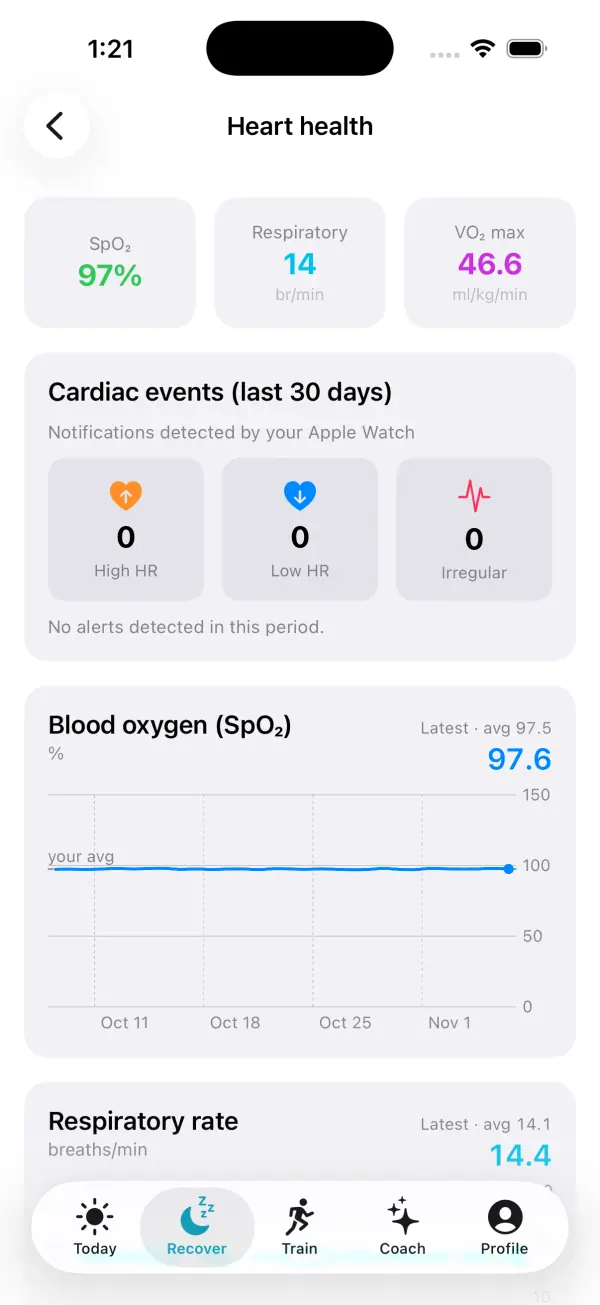
The Health app lists your readings, but it doesn't tell you whether today's number is usual for you. VedaWatch reads the blood oxygen samples already stored in Apple Health, whichever version of the feature your watch uses, and puts them in context on the Heart health screen (Recover, then Heart health).
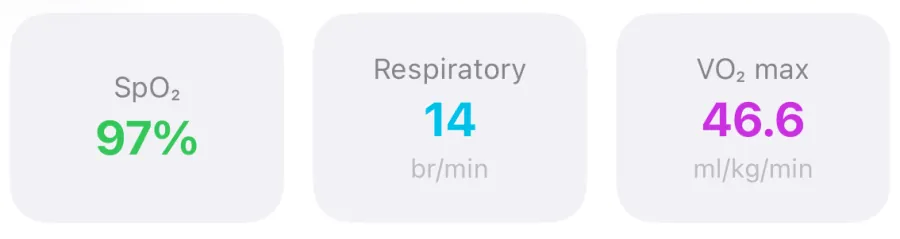
At the top, a tile shows your latest SpO2 next to respiratory rate and VO2 max, colour-coded so a low reading stands out. Below it, a 30-day chart plots your daily average against your own average line. Tap it to open the blood oxygen detail: a 7, 30 or 90 day history, how your last week compares with your usual (the average of your earlier readings from the last 90 days, with your normal spread), and where the latest value falls on a simple scale of Typical (95% and above), Below typical (90-95%) and Low (under 90%). It also lists every reading and what tends to move SpO2, such as watch fit, altitude and breathing during sleep.
Heart health also counts high, low and irregular rhythm notifications from the last 30 days, and if you turn on the AI Coach, blood oxygen is part of the daily summaries it can use. None of this turns the watch into a medical device: VedaWatch's own guidance says one low reading is usually a fit issue and to talk to a doctor about readings that stay low.
Putting it together
A practical way to use Apple Watch blood oxygen: leave background measurements on, wear the watch snug to bed, and after a few weeks note your usual daytime and overnight range. Expect overnight numbers a point or two below daytime and the odd brief dip. Repeat any surprising on-demand reading after warming up and sitting still.
Pay attention to sustained changes rather than single values, especially alongside how you feel, your resting heart rate and your breathing rate during sleep. If readings stay low, or you have symptoms, the next step is a clinician, not another app.
Frequently asked questions
Is 93% blood oxygen on Apple Watch bad?
Not necessarily. In a study of healthy people, 14% of Apple Watch readings at rest came out below 95%, so repeat it sitting still with a snug band. If readings keep coming in low or you feel short of breath, talk to a doctor.
Why does my Apple Watch show fewer blood oxygen readings some days?
Background readings are only taken when you're still, and how often depends on your activity. A loose band, cold skin or readings turned off during Sleep Focus also reduce the count.
Does Apple Watch blood oxygen work on Apple Watch SE?
No. Apple lists Series 6 or later and all Ultra models as supported, and says the Blood Oxygen app isn't supported on Apple Watch SE or Apple Watch For Your Kids.
Why doesn't blood oxygen appear in my Vitals app?
If your watch was bought in the US on or after January 18, 2024 and its part number ends in LW/A or LS/A, Apple says blood oxygen isn't shown in Vitals. Your results are calculated on iPhone and appear in the Health app instead.
Can Apple Watch detect sleep apnea from blood oxygen?
Apple doesn't offer that. Its sleep apnea notifications are a separate feature, and only a sleep study can diagnose sleep apnea, so mention low overnight readings and symptoms like loud snoring to a doctor.
Related guides
- Apple Watch sleep apnea notifications: what they mean
- Normal respiratory rate during sleep, and what Apple Watch shows
- Apple Watch Vitals app explained: typical range and outliers
- Apple Watch health alerts: early illness warning, body strain and other smart alerts in VedaWatch
- Apple Watch sleep tracking: how accurate is it, and what to do when it's wrong
- Apple Watch VO2 max (Cardio Fitness): what it measures and how accurate it is
Sources & further reading
- Apple Support: Use the Blood Oxygen app on Apple Watch
- Apple Support: Track your overnight and daytime vitals with Apple Watch
- FDA: Pulse Oximeter Basics
- Gries RE, Brooks LJ. Normal oxyhemoglobin saturation during sleep: how low does it go? Chest (1996)
- Spaccarotella C et al. Assessment of non-invasive measurements of oxygen saturation and heart rate with an Apple smartwatch. Journal of Clinical Medicine (2022)
- Walzel S et al. Evaluation of leading smartwatches for the detection of hypoxemia: comparison to reference oximeter. Sensors (2023)
- Jiang Y et al. Performance of wearable pulse oximetry during controlled hypoxia induction. JMIR Formative Research (2026)
- Schroder C et al. The Apple Watch SpO2 sensor and outliers in healthy users. npj Digital Medicine (2023)
This guide is educational, not medical advice, and has not been clinically reviewed. VedaWatch is not a medical device. If you have symptoms or concerns about your heart or health, contact a qualified healthcare professional.
Put your trends in perspective.
Explore HRV, sleep, and recovery with VedaWatch on your iPhone.
Download VedaWatch on the App Store →