 VedaWatch
Nutrition
What to eat after a workout: protein, carbs and timing
What to eat after a workout, by session type: how much protein and carbs, whether the anabolic window is real, worked examples by body weight, and how to rehydrate.
By VedaWatch editorial team · · 11 min read
The short answer
After most workouts, eat a normal meal with protein and carbs within a few hours, and drink to replace what you sweated. Aim for about 0.3 g of protein per kg of body weight, roughly 20 g at 70 kg. Fast refuelling only matters if you train again within about 8 hours.
What should you eat after a workout?
A meal or snack that contains protein and carbohydrate, plus enough fluid to make up for what you sweated. That covers the three jobs of recovery nutrition: giving your muscles amino acids to repair and adapt, refilling the carbohydrate (glycogen) stored in muscle and liver, and restoring fluid balance.
The amounts are smaller than supplement marketing suggests. The 2016 joint position statement on nutrition and athletic performance from the American College of Sports Medicine, the Academy of Nutrition and Dietetics and Dietitians of Canada recommends about 0.25 to 0.3 g of high-quality protein per kg of body weight after exercise, which works out to 15 to 25 g for most people. For carbohydrate, what matters most is your total for the day, scaled to how much you train.
Timing matters less than most people think. Unless you trained fasted or are training again later the same day, eating your next normal meal within a couple of hours is enough. The sections below explain why, then give examples for easy cardio, strength sessions, long or hard endurance sessions, double days and evening workouts.
Is the 30-minute anabolic window real?
Not in the narrow sense gym lore suggests. In a 2013 review, Aragon and Schoenfeld concluded that the evidence for an urgent post-exercise "anabolic window of opportunity" is far from definitive, and that how much timing matters depends on things like training status, age and what you ate before training.
The same year, a meta-analysis by Schoenfeld, Aragon and Krieger pooled 23 studies on protein timing. Once total daily protein intake was accounted for, timing made no significant difference to muscle strength or size. Total protein was the strongest predictor of results. A later 10-week trial in 21 trained men (Schoenfeld and colleagues, 2017) gave the same protein dose either right before or right after training and found similar gains in strength and muscle either way. The authors argued the window is several hours wide, depending on when you last ate.
That doesn't mean timing is irrelevant. The ISSN position stand on nutrient timing notes that protein eaten anywhere from immediately to 2 hours after exercise strongly stimulates muscle protein synthesis, and that muscle stays more sensitive to protein for about 24 hours after training. The practical reading: eat protein after training because it's convenient and useful, but don't panic if lunch is 90 minutes away.
- Timing matters more: you trained fasted (for example first thing in the morning), your last meal was 4 to 6 hours before training, you train again within about 8 hours, or you're an older adult.
- Timing matters less: you ate a mixed meal 1 to 3 hours before, you won't train the same muscles or energy systems again until tomorrow, and your daily protein and carbohydrate totals are on target.
How much protein should you eat after a workout?
The ACSM statement gives about 0.3 g per kg of body weight after key sessions and then every 3 to 5 hours across the day's meals. The ISSN suggests a similar pattern of 20 to 40 g (0.25 to 0.40 g/kg) every 3 to 4 hours. Aragon and Schoenfeld suggest 0.4 to 0.5 g per kg of lean body mass both before and after training, with the two meals no more than about 3 to 4 hours apart for a 45 to 90 minute session, or up to 5 to 6 hours apart if the meal before training was large.
Worked out per meal, 0.3 g/kg is about 17 g at 55 kg, 21 g at 70 kg and 26 g at 85 kg. The ACSM statement adds that doses above 40 g have not yet been shown to boost muscle protein synthesis further, and may only make sense for very large athletes or during weight loss.
Quality matters a little. The same statement says dairy proteins seem to be better than other tested proteins, largely because of their leucine content and how quickly they're digested, and that milk-based protein after resistance training has been shown to increase strength and improve body composition. Meat, eggs, soy and other proteins work too. Check labels or a nutrition database for grams of protein per portion, because it varies widely between products.
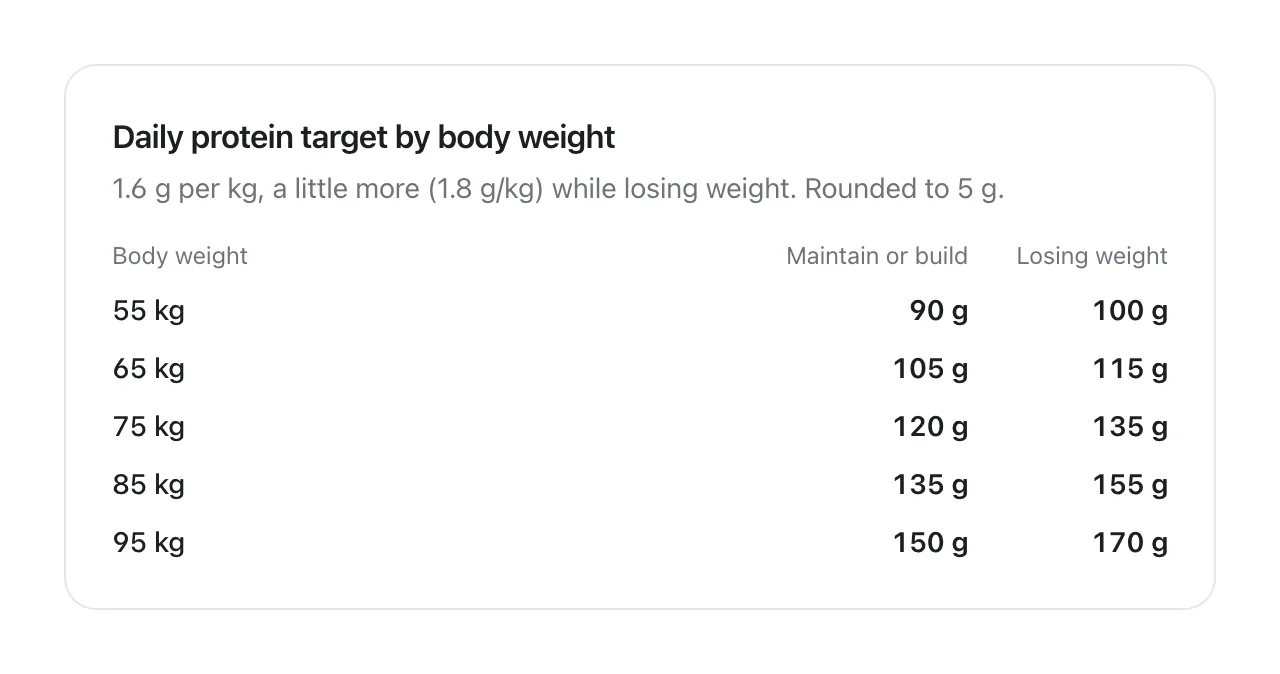
Above all, the post-workout meal is one of several. Daily protein recommendations for people who train run from about 1.2 to 2.0 g per kg (ACSM) or 1.4 to 2.0 g per kg (ISSN), and the total you reach across the day matters more than any single meal. For your full-day number, see our guide to how much protein per day to build muscle.
Do you need carbs after a workout?
Carbohydrate refills your glycogen, which matters most after long or hard endurance work. Muscle rebuilds glycogen at only about 5% per hour, according to the ACSM statement, so when there's little time before the next session, an early start counts. Aragon and Schoenfeld note that delaying carbohydrate by 2 hours can cut the rate of glycogen resynthesis by as much as 50%.
That urgency mostly applies to endurance athletes with less than about 8 hours between glycogen-draining sessions. For typical strength training, the review reports that a moderate-volume session lowers muscle glycogen by about 36 to 39%, and stores recover within 24 hours even when carbohydrate is delayed. The ACSM statement agrees: as long as your total carbohydrate and energy intake is adequate, you can choose the foods and timing that suit you.
So the better question is how many carbs per day. The ACSM statement scales daily carbohydrate with training load:
- Light (low intensity or skill-based activity): 3 to 5 g per kg per day. At 70 kg, 210 to 350 g.
- Moderate (a moderate exercise program, about 1 hour a day): 5 to 7 g per kg per day. At 70 kg, 350 to 490 g.
- High (an endurance program of about 1 to 3 hours a day at moderate to high intensity): 6 to 10 g per kg per day. At 70 kg, 420 to 700 g.
- Very high (extreme commitment, about 4 to 5 hours or more a day): 8 to 12 g per kg per day.
What to eat after different types of workouts
Here's how the evidence translates into real meals for a 70 kg person. Scale the grams to your own weight. Carbohydrate values for the example foods come from USDA FoodData Central and are approximate: a medium banana has about 27 g, a 100 g plain bagel about 52 g, a slice of white bread about 14 g and 20 g of honey about 16 g. For protein foods, use the label, since protein per portion varies a lot by product.
- Easy cardio of 30 to 45 minutes (walk, easy run, easy ride, yoga): no special recovery food. Eat your next normal meal and drink to thirst. If that meal is hours away and you're hungry, a piece of fruit with yogurt or milk is plenty.
- Strength session after a meal 1 to 3 hours earlier: your next meal with about 20 to 30 g of protein (0.3 to 0.4 g/kg) within 2 or 3 hours, with whatever carbs the meal naturally includes, such as rice, potatoes, bread or fruit.
- Strength session done fasted, for example before breakfast: eat soon after. Aragon and Schoenfeld say timing matters most when training follows a long fast. Breakfast with 20 to 30 g of protein and some carbs is the target.
- Long run or ride (over about 90 minutes) or hard intervals, with no more training today: a carb-rich meal with protein within a couple of hours, for example a bagel with 20 g of honey (about 68 g of carbs, roughly 1 g/kg) plus a protein source, then carb-rich meals for the rest of the day to reach your daily total.
- Two sessions within about 8 hours (a double day, a tournament, a brick workout): this is where fast refuelling pays off. The ACSM statement suggests about 1.0 to 1.2 g of carbs per kg per hour, starting early and continuing for 4 to 6 hours. At 70 kg that's 70 to 84 g an hour, easiest as frequent snacks and drinks, plus 0.25 to 0.3 g/kg of protein early on.
- Evening workout close to bed: have dinner with protein as usual. The ISSN stand adds that 30 to 40 g of casein (a slow-digesting milk protein) in the 30 minutes before sleep may increase muscle protein synthesis and can help you reach your daily protein target.
How to rehydrate after a workout
Most people finish exercise with a fluid deficit. The easiest way to measure it is to weigh yourself before and after a typical session: each kilogram lost is roughly a litre of fluid. Because you keep sweating and passing urine afterwards, the ACSM statement recommends drinking about 125 to 150% of the remaining deficit, which is 1.25 to 1.5 L for every kg lost. Spread it over the next few hours rather than drinking it all at once.
Sodium helps you keep the fluid. The same statement says salt from food or drink helps retain what you drink, and that people who lost a lot of sodium in sweat shouldn't restrict it after exercise. In practice, a normal meal with some salt alongside water works well for most people. If you have high blood pressure, or heart or kidney disease, follow your doctor's advice on sodium and fluids.
Two drinks are worth thinking about. Alcohol in the recovery period is discouraged: the ACSM statement says it can impair glycogen storage, slow rehydration and blunt the muscle protein synthesis you trained for, so if recovery is a priority, keep it small or skip it. Coffee, on the other hand, is less of a problem than its reputation: the statement says the diuretic warnings appear overstated for people who habitually drink moderate amounts, under about 180 mg of caffeine. For a full plan before, during and after training, see our guide to how much water to drink when training.
What to eat after a workout if you're trying to lose weight
The same principles apply, with protein getting more important. The ACSM statement notes that when energy intake is reduced, higher protein intakes help preserve muscle, and intakes as high as 2.0 g per kg a day or more, spread over the day, may help limit the loss of lean mass.
A post-workout meal doesn't need to be extra food on top of your day. Make your next planned meal the one that follows training, build it around 20 to 30 g of protein, and keep carbs in line with what the session demanded: more after a long or hard session, fewer after an easy walk. Skipping food after training to save calories can leave you hungry later and make it harder to recover for the next session.
If you have a history of disordered eating, are pregnant, have diabetes or another medical condition, or take medication that affects blood sugar, talk to your doctor or a registered dietitian before changing how you eat around exercise.
How VedaWatch helps you refuel after training
When you finish a workout, the Today screen in the VedaWatch iPhone app can show a Workout done card for the next two hours, with the session length and three recovery steps: Refuel, Hydrate, and Sleep well (Early night if your body asked for rest that day). Refuel is highlighted for the first hour, then Hydrate. The card says to refuel within the hour, which is a handy habit rather than a hard deadline: as above, the research window is a few hours wide for most people.
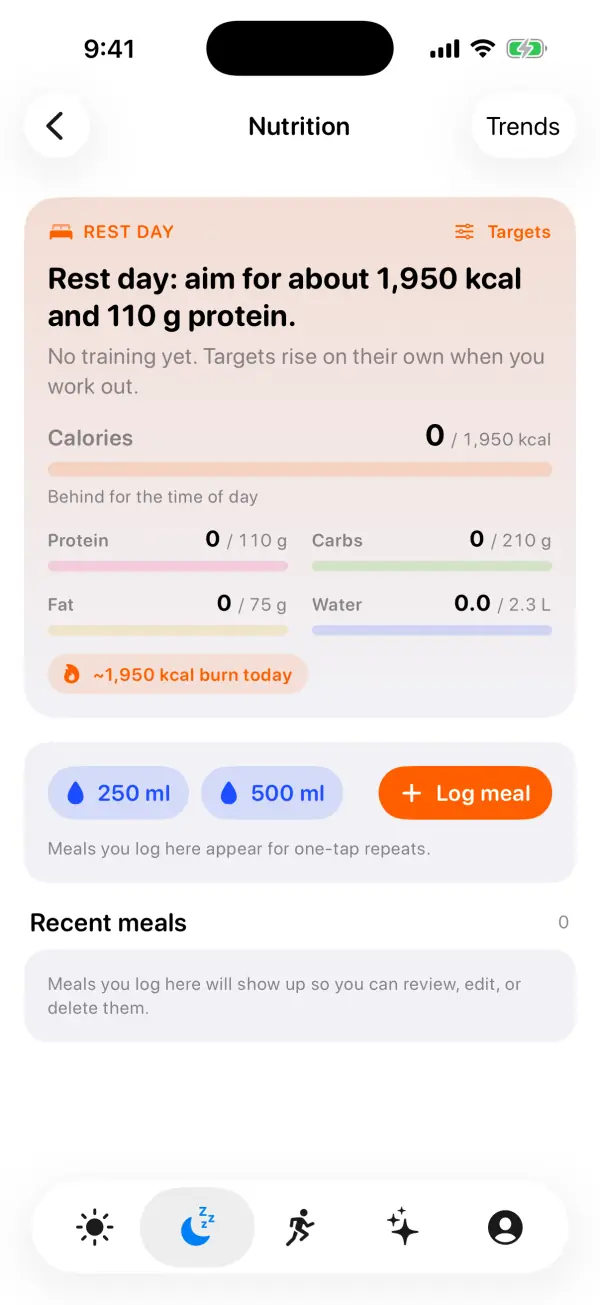
The Fuel card on the Nutrition screen (Recover tab) moves with your training. After your Apple Watch records a workout, or when your VedaWatch training plan has a session today, the day becomes a light, training or hard training day, and the calorie, carb and water targets go up. Protein stays the same every day at 1.6 g per kg by default, because it follows your weight rather than each session. On a training or hard day, if you're well behind on calories from 1 pm, the card suggests eating some carbs soon so you recover; if protein is lagging later in the day, it suggests a protein-heavy dinner.
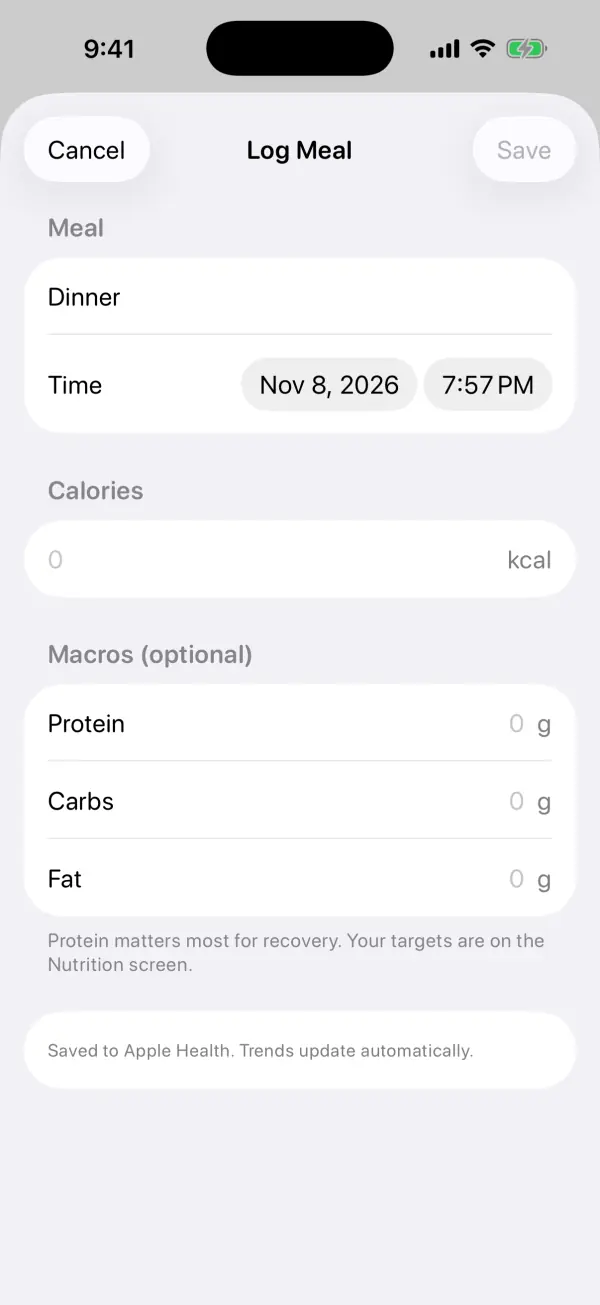
Logging is quick: tap Log meal and add protein and carbs if you know them, or pick a usual meal under LOG AGAIN, and tap 250 ml or 500 ml for water. Everything is saved to Apple Health, and food logged in other apps that write to Apple Health counts too. You can also ask Siri, "How's my fuel in VedaWatch". The targets are general guidance for healthy adults who train, not medical or dietetic advice.
Checking whether your recovery meals add up over the week
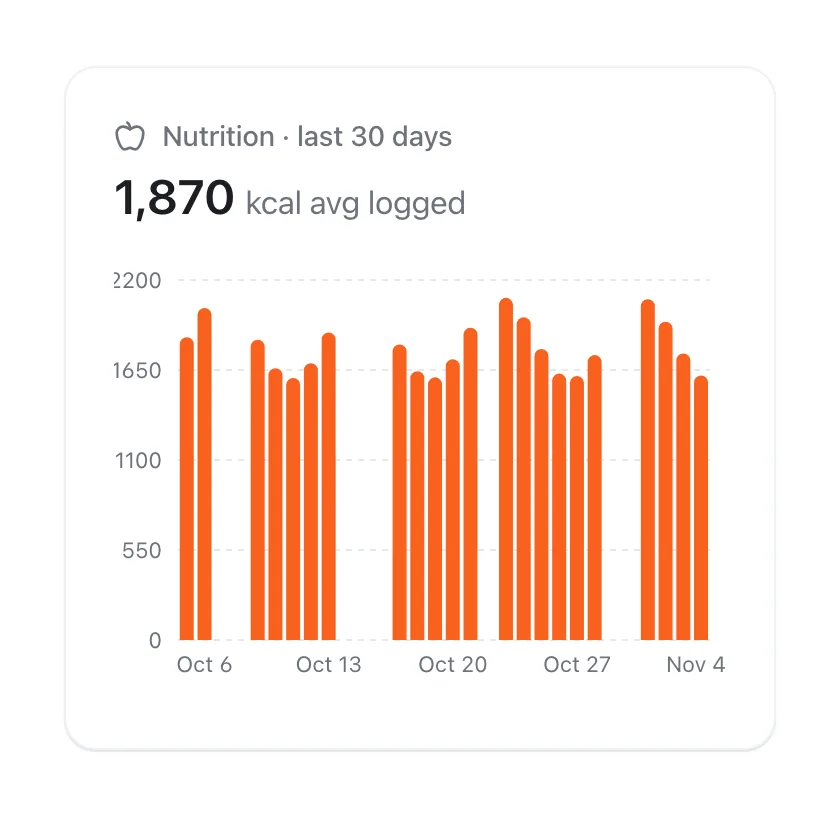
One post-workout meal rarely makes or breaks your progress; the week's pattern does. On the VedaWatch Nutrition screen, Eaten vs burned shows the last seven days of calories eaten against calories burned, with a line on how many days you hit your protein target. Tap Trends to see longer-term calories, protein and water, with protein and water drawn against your Fuel targets.
If you often train in the evening, the Meal timing & recovery card compares nights when your last meal was within 3 hours of bedtime with nights you ate earlier, and reports any clear difference in next-morning resting heart rate, HRV or sleep once it has enough nights of each. It's a pattern in your own data, not proof of cause, but it can tell you whether a late recovery dinner seems to cost you sleep.
Frequently asked questions
Is it bad to skip eating after a workout?
One skipped snack won't undo a session, especially if you ate a meal in the few hours before. It matters more if you trained fasted, train again the same day, or regularly fall short on daily protein or energy.
Do I need a protein shake after the gym?
No. A shake is just a convenient way to get 20 to 30 g of protein; milk, yogurt, eggs, meat, fish, tofu or legumes do the same job. Use whatever helps you reach your daily total.
What if I'm not hungry after training?
That's common after hard sessions. A drink that contains protein and carbs, such as milk or a smoothie, is often easier than solid food, or simply eat at your next meal if it's within a couple of hours.
Should I eat after a morning workout if I already had breakfast?
If breakfast came 1 to 3 hours before training, your next regular meal covers recovery. Aragon and Schoenfeld suggest keeping the meals around a 45 to 90 minute session within about 3 to 4 hours of each other.
Is fat bad in a post-workout meal?
Not for recovery. Fat slows digestion, which matters before exercise, but after it you can eat a normal mixed meal. Just make sure the protein and carbs are there.
Related guides
- How much protein per day to build muscle: g/kg by body weight
- How much water should I drink when working out?
- How much to eat on training vs rest days: calorie and protein targets from your Apple Watch
- What to eat before a morning run: by run length and timing
- HRV after a workout: the normal dip and how long recovery takes
- Logging nutrition to Apple Health: what actually syncs, and why your numbers might be off
Sources & further reading
- Medicine & Science in Sports & Exercise (2016): American College of Sports Medicine Joint Position Statement. Nutrition and Athletic Performance (Thomas, Erdman, Burke)
- Journal of the International Society of Sports Nutrition (2017): ISSN position stand: nutrient timing (Kerksick et al.)
- Journal of the International Society of Sports Nutrition (2013): Nutrient timing revisited: is there a post-exercise anabolic window? (Aragon, Schoenfeld)
- Journal of the International Society of Sports Nutrition (2013): The effect of protein timing on muscle strength and hypertrophy: a meta-analysis (Schoenfeld, Aragon, Krieger)
- PeerJ (2017): Pre- versus post-exercise protein intake has similar effects on muscular adaptations (Schoenfeld et al.)
- USDA FoodData Central: nutrient values for bananas, bagels, white bread and honey
This guide is educational, not medical advice, and has not been clinically reviewed. VedaWatch is not a medical device. If you have symptoms or concerns about your heart or health, contact a qualified healthcare professional.
Put your trends in perspective.
Explore HRV, sleep, and recovery with VedaWatch on your iPhone.
Download VedaWatch on the App Store →