 VedaWatch
Nutrition
How much water should I drink when working out?
How much water to drink before, during and after a workout: ACSM guidance, a worked sweat-rate test, when electrolytes matter, and how to avoid overdrinking.
By VedaWatch editorial team · · 11 min read
The short answer
Drink about 5 to 7 ml per kg of body weight around 4 hours before training. During it, aim to lose no more than 2% of your body weight without ever gaining weight; for most sessions under an hour, drinking to thirst is enough. Afterwards, replace each kilogram lost with 1 to 1.5 litres, plus some salt.
How much water should you drink when working out?
There is no single number, because people sweat at very different rates. A review of athlete sweat testing found whole-body sweat rates typically run from about 0.5 to 2.0 litres an hour, and the National Athletic Trainers' Association (NATA) puts the adult range during exercise at 0.5 to 4.0 litres an hour. A fixed rule like "a cup every 15 minutes" will be too much for some people and too little for others.
What the American College of Sports Medicine (ACSM) and NATA agree on is the goal: start training well hydrated, don't let fluid losses during the session go past about 2% of your body weight, don't drink so much that you gain weight, and replace what's left afterwards. In practice that looks like this:
- Before: about 5 to 7 ml per kg of body weight, slowly, at least 4 hours before you start. If you haven't peed since, or your urine is dark, add another 3 to 5 ml per kg about 2 hours before.
- During, under an hour in mild weather: drink when you're thirsty. Most people start well hydrated and won't lose 2% of their body weight in that time.
- During, longer or hot sessions: drink to a plan based on your own sweat rate, so you finish with less than a 2% body-weight loss and no gain.
- After: 100% to 150% of the weight you lost, so 1 to 1.5 litres for each kilogram, with food or a drink that contains sodium. The higher end matters when you have less than 4 hours before you train again.
- Every day: let thirst and meals cover the rest, and drink more on hot or very active days.
How much water should you drink a day if you exercise?
The US National Academies set adequate intakes for total water of about 3.7 litres a day for men and 2.7 litres for women. That counts water from food as well as drinks: roughly 20% comes from food and the other 80% from beverages, coffee and tea included. The same report says most healthy people meet their needs by letting thirst be their guide and drinking with meals, and that people who are very physically active or live in hot climates may need more.
So exercise adds to a baseline rather than replacing it. The extra is roughly what you sweat, and you can measure that with a bathroom scale: over a single session, 1 kg of body weight lost is about 1 litre of fluid. That is why the sweat-rate test further down is worth ten minutes of your time.
Thirst still matters, but it lags during exercise. NATA notes that people drinking freely during activity replace roughly two-thirds of their sweat losses, and that thirst is blunted in the cold and in many older exercisers. Three simple checks give a better daily picture: your first-morning urine colour, how thirsty you feel on waking, and your morning body weight compared with your usual. If your morning urine is dark and you wake up thirsty, you're probably behind.
How much water to drink before a workout
The ACSM's fluid replacement position stand recommends drinking slowly at least 4 hours before exercise, about 5 to 7 ml per kg of body weight. Starting early gives your kidneys time to pass any excess, so you aren't stopping for the toilet ten minutes in. If you produce no urine, or it's dark, drink another 3 to 5 ml per kg about 2 hours before. A drink with some sodium, or a salty snack, helps you hold on to it.
Here is what those ranges mean at common body weights:
- 60 kg: 300 to 420 ml about 4 hours before, plus 180 to 300 ml about 2 hours before if needed.
- 70 kg: 350 to 490 ml about 4 hours before, plus 210 to 350 ml about 2 hours before if needed.
- 80 kg: 400 to 560 ml about 4 hours before, plus 240 to 400 ml about 2 hours before if needed.
- 90 kg: 450 to 630 ml about 4 hours before, plus 270 to 450 ml about 2 hours before if needed.
How much water to drink during a workout
The ACSM's goal for drinking during exercise is to prevent a water deficit of more than 2% of body weight. NATA reports that endurance performance in temperate and hot conditions is consistently reduced at or beyond that level, and that strength and power suffer too. It also points out that drinking more than you sweat brings no performance benefit and raises the risk of low blood sodium, so the safe zone has a floor and a ceiling: lose less than 2%, but don't gain.
For a 70 kg person, 2% is 1.4 kg. In a 45-minute gym session or an easy run on a cool day, many people never get close, which is why drinking to thirst works well for most sessions under an hour. NATA also calls drinking to thirst a safe default during activity if you don't know your sweat rate.
It gets harder in long or hot sessions. At 1.5 litres an hour, a 2-hour run produces about 3 litres of sweat, and only a planned drinking strategy will keep you under 2%. Cold weather and altitude are traps of their own: you can still sweat heavily under layers while thirst is blunted. If you can't drink during the activity itself, as in some team sports, use the breaks.
The ACSM notes that drinks containing electrolytes and carbohydrate can have benefits over water alone in some circumstances. Long sessions are the usual case, where they help keep you fuelled and replace some of the sodium you sweat.
How to calculate your sweat rate (with a worked example)
Weighing yourself before and after exercise is the simplest and most accurate way to measure whole-body sweat rate, according to a methods review in Sports Medicine. NATA gives the formula: sweat loss in litres equals weight before minus weight after (in kg), plus any fluid you drank, minus any urine you passed. Divide by the hours you exercised for your sweat rate.
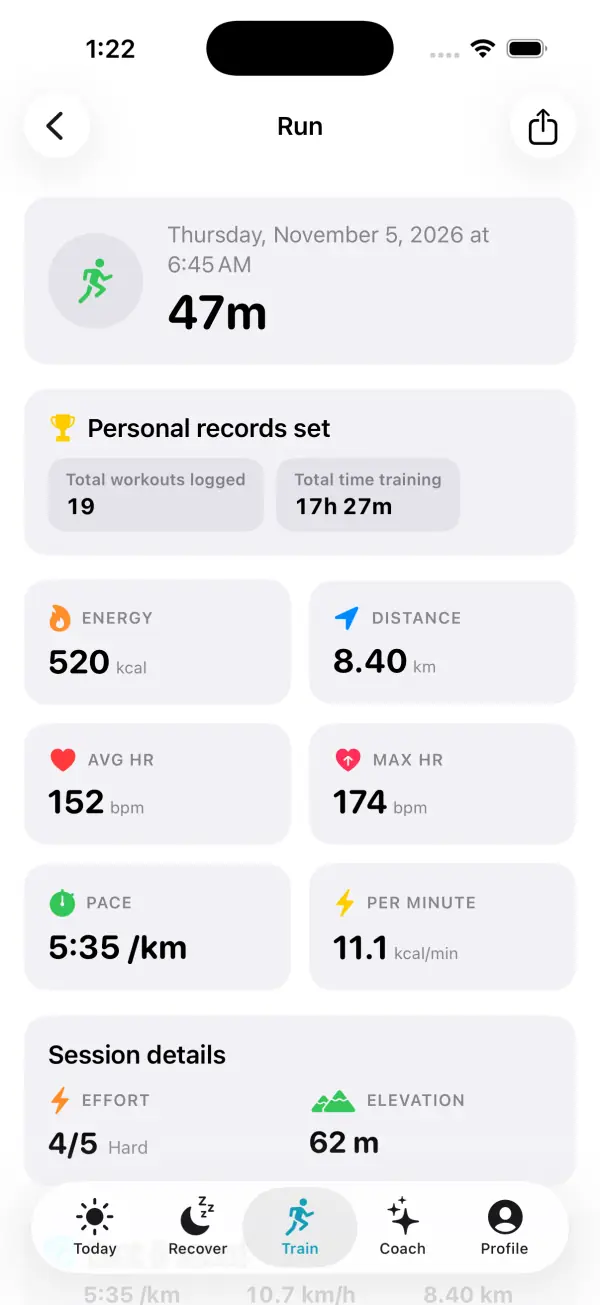
Worked example. Sam weighs 75.0 kg before a 75-minute run and 74.1 kg after. Sam drank a 600 ml bottle during the run and didn't need the toilet. Sweat loss is 0.9 kg plus 0.6 litres, so 1.5 litres. Divided by 1.25 hours, that's a sweat rate of 1.2 litres an hour. Sam finished 0.9 kg down, which is 1.2% of body weight, so this run was within the 2% guide.
Now Sam plans a 2-hour run in similar weather. At 1.2 litres an hour, that's about 2.4 litres of sweat. Two percent of 75 kg is 1.5 kg, so Sam needs to drink at least 0.9 litres to stay under 2%, and no more than 2.4 litres to avoid gaining weight. Somewhere around 0.5 to 0.8 litres an hour sits comfortably in between. Afterwards, whatever weight Sam is down is the amount to replace.
To get a number you can trust:
- Pee first, then weigh yourself nude or in minimal dry clothing on the same scale before and after.
- Towel off before the second weigh-in. Sweat trapped in clothing makes the loss look smaller than it is.
- Write down what you drank (weigh or measure your bottle) and add it back. Subtract any urine; if you can't measure it, avoid a toilet stop during the test.
- Test in conditions like the ones you're planning for: same intensity, similar weather, same kit. Summer and winter sweat rates can be very different.
- Repeat it a few times and use a range rather than one exact figure. Sweat rate varies from day to day even in the same person.
- For sessions longer than 2 to 3 hours, remember that about 5% to 15% of weight loss is fuel burned and water breathed out rather than sweat, so the raw number slightly overstates what you need to drink.
How much water to drink after a workout
Start from your weigh-in. NATA recommends replacing 100% to 150% of the weight you lost, because a big volume drunk quickly is partly passed straight out as urine. The upper end matters most when you have less than 4 hours before the next session, such as a double day or a tournament. If Sam finishes a run 0.9 kg down, that's 0.9 to 1.35 litres over the next few hours, not all in one go.
Sodium helps you keep it. Pairing fluids with a meal or salty snack, or using a drink that contains sodium, improves retention. NATA also advises eating and drinking within 2 hours of activity to replace fluid, electrolytes, carbohydrate and protein. Drinks with more than 2% alcohol reduce how much fluid you hold on to, so a post-race beer is not a recovery drink.
If you're not training again the same day, normal meals and drinking to thirst will usually restore your balance by the next morning. A morning weight close to your usual is a good sign you've caught up.
Do you need electrolytes, or is plain water enough?
Sweat contains sodium, and the amount varies widely. The Sports Medicine review estimates whole-body sweat sodium at about 10 to 70 mmol per litre. Since 1 mmol of sodium is 23 mg, that's roughly 230 to 1,600 mg of sodium in every litre of sweat. NATA reports measured sodium losses during exercise of 0.2 to 7.3 g an hour across studies.
For a typical workout of an hour or less, water plus your normal meals is enough. Electrolytes start to matter in longer sessions, in heat, when you sweat heavily, and in the hours after hard training when you want to rehydrate quickly.
NATA suggests that people with unusually salty sweat (above 60 mEq per litre) and very high sweat rates (above 2.5 litres an hour) may benefit from extra sodium in their drinks during activity, but that there's no evidence of benefit beyond replacing individual losses. It also found little evidence that sodium tablets help you hold on to fluid. If you have high blood pressure, heart or kidney disease, or follow a low-sodium diet, check with your doctor before adding salt or electrolyte products.
Can you drink too much water when exercising? Hyponatremia
Yes. Exercise-associated hyponatremia (EAH) is a blood sodium level below 135 mmol per litre during or within 24 hours of activity. NATA describes it as being caused by drinking water or other low-sodium drinks, sports drinks included, beyond what you sweat, so that body weight stays the same or rises during exercise lasting an hour or more. Severe cases can cause brain swelling and are a medical emergency.
It's most common in long, slow endurance events. In a study of 488 Boston Marathon finishers published in the New England Journal of Medicine, 13% had hyponatremia and 0.6% had critical levels (120 mmol per litre or less). The strongest risk factors were gaining weight during the race, finishing times over 4 hours, and being very light or very heavy for one's height. Runners who drank more than 3 litres during the race, or drank at every mile, were also more likely to be affected.
Prevention is simple: don't drink more than you sweat. Your sweat-rate test gives you the ceiling, and finishing heavier than you started is the warning sign. Early symptoms include headache, nausea, dizziness, puffy hands or face, and confusion, and they can look like dehydration. If someone becomes confused, vomits repeatedly or collapses after a long event, especially if they've been drinking a lot, get medical help rather than giving more water, because the treatment is different.
How VedaWatch helps you track water on training days
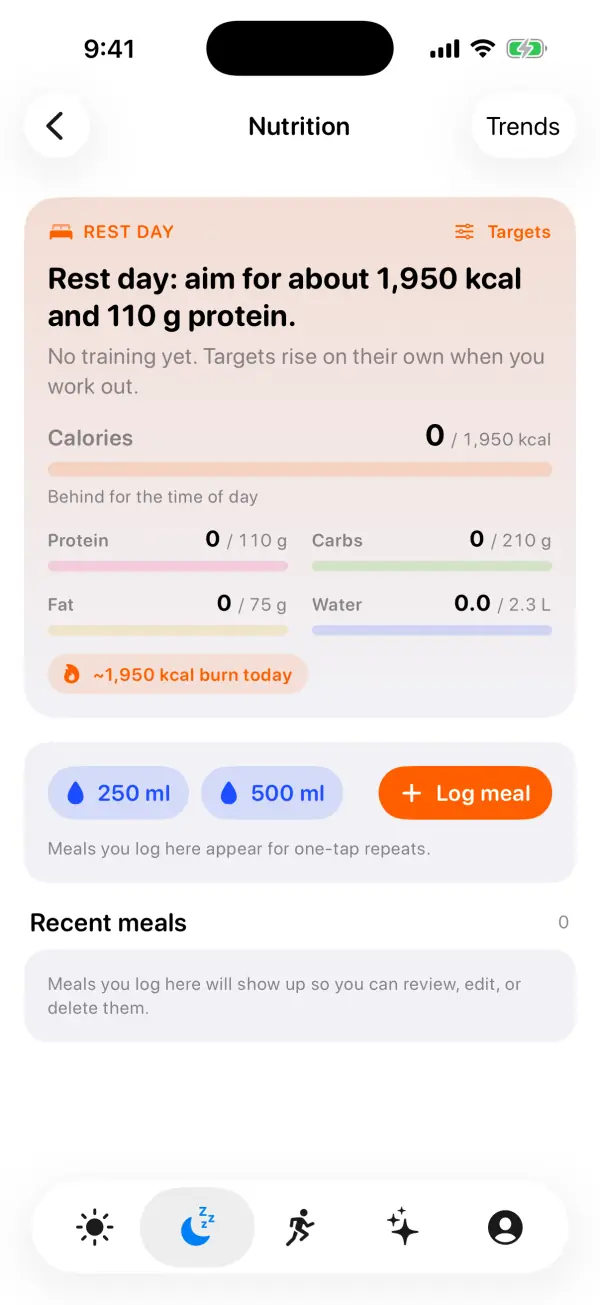
VedaWatch's Nutrition screen, under the Recover tab, includes a daily water target that moves with your training. It's a rule of thumb: about 33 ml per kg of body weight, plus 0.6 litres for every hour of training, planned or done (whichever is longer), rounded to the nearest 0.1 litre and capped at 5 litres. Your weight comes from Apple Health; if there isn't one, it assumes 70 kg and tells you so.
At 70 kg that's about 2.3 litres on a rest day and 2.8 litres with a 45-minute session on your plan. For Sam at 75 kg, it's about 2.5 litres on a rest day and 3.2 litres on the day of the 75-minute run. Treat the training allowance as a starting point: if your sweat test shows 1.2 litres an hour or more in the heat, you'll need more than the target suggests, and on a cool easy day you may need less.
Logging is quick. Tap 250 ml or 500 ml on the Nutrition screen, or say "Log water in VedaWatch" to Siri, which logs a 250 ml glass unless you give an amount. Water is saved to Apple Health, and water logged by other apps that write to Apple Health counts too. Tap Trends to see your daily water as bars against your rest-day target. The target is general guidance, not medical advice; if you have a heart or kidney condition or have been told to limit fluids, follow your doctor's advice instead.
Frequently asked questions
Does coffee count toward my water intake?
Yes. The National Academies say caffeinated drinks can contribute to daily hydration as much as non-caffeinated ones, because caffeine's effect on urine output appears short-lived. During exercise itself, water or a sports drink is the more practical choice.
Should I drink water during a 30-minute workout?
Only if you're thirsty. In a short session in mild conditions, most people who start hydrated lose well under 2% of their body weight, so sipping to thirst is enough.
Is it bad to drink a lot of water right before exercising?
A large volume just before you start mostly sloshes in your stomach and sends you to the toilet. Drinking earlier, about 4 hours before with a top-up 2 hours before if your urine is dark, gives your body time to absorb what it needs and pass the rest.
How do I know if I'm dehydrated after a workout?
Compare your weight before and after: a loss of more than 2% means you fell behind. Dark urine, strong thirst, headache and dizziness are other signs. If you feel confused, faint or very unwell, get medical help.
Do I need to drink more water when strength training?
Usually less than for long cardio, because sessions are often shorter with rest between sets. The same rules apply: weigh yourself before and after a typical session, and if you lose well under 2% of your body weight, drinking to thirst is fine.
Related guides
- How much to eat on training vs rest days: calorie and protein targets from your Apple Watch
- What to eat before a morning run: by run length and timing
- Logging nutrition to Apple Health: what actually syncs, and why your numbers might be off
- Training for a 5K, 10K or half marathon with Apple Watch: a plan that adapts to your recovery
- Half marathon taper: the final 7 days, day by day
- What to eat after a workout: protein, carbs and timing
Sources & further reading
- Sawka MN et al. American College of Sports Medicine position stand: Exercise and fluid replacement. Med Sci Sports Exerc. 2007;39(2):377-390
- McDermott BP et al. National Athletic Trainers' Association position statement: Fluid replacement for the physically active. J Athl Train. 2017;52(9):877-895
- Baker LB. Sweating rate and sweat sodium concentration in athletes: a review of methodology and intra/interindividual variability. Sports Med. 2017;47(Suppl 1):111-128
- Almond CSD et al. Hyponatremia among runners in the Boston Marathon. N Engl J Med. 2005;352:1550-1556
- National Academies: Report sets dietary intake levels for water, salt, and potassium (2004)
This guide is educational, not medical advice, and has not been clinically reviewed. VedaWatch is not a medical device. If you have symptoms or concerns about your heart or health, contact a qualified healthcare professional.
Put your trends in perspective.
Explore HRV, sleep, and recovery with VedaWatch on your iPhone.
Download VedaWatch on the App Store →