 VedaWatch
Recovery & Apple Watch
HRV after a workout: the normal dip and how long recovery takes
Why HRV drops after a hard workout, how long it takes to recover by session type according to research, and how to use next-morning HRV to plan your next session.
By VedaWatch editorial team · · 9 min read
The short answer
A lower HRV after a hard workout is normal: it's your body recovering, not a sign something is wrong. Research suggests full recovery takes up to 24 hours after easy sessions, 24 to 48 hours after threshold work and at least 48 hours after high-intensity sessions. Judge it against your own baseline the next morning, not right after training.
What happens to HRV after a workout?
During exercise your nervous system shifts toward the fight-or-flight side: heart rate rises and the beat-to-beat variation that heart rate variability (HRV) measures shrinks. When you stop, the parasympathetic (rest-and-digest) side gradually takes back control, and HRV climbs back toward your normal. Researchers call this cardiac parasympathetic reactivation.
How fast that happens depends mostly on how hard the session was and how fit you are. After an easy jog it can be over within minutes. After intervals, a race or a very long effort, HRV can stay below your normal through the following night and sometimes the night after. So a low HRV the morning after a hard workout is usually the expected footprint of the training, not a warning sign by itself.
The useful question isn't whether HRV dropped, but how far it dropped compared with your own baseline and whether it bounced back on the timeline you'd expect for that kind of session.
How long does HRV take to recover? Typical times by session type
The most-cited summary comes from a 2013 review in Sports Medicine by Stanley, Peake and Buchheit, which pooled studies of HRV recovery after single aerobic training sessions in athletes and healthy adults. Their headline numbers, plus what other studies add, give a rough guide:
- Easy, low-intensity session (conversational pace, below the first ventilatory threshold): complete recovery within about 24 hours. In a 2007 study of highly trained runners, HRV was back to pre-run values within 5 to 10 minutes after 60 or even 120 minutes of easy running.
- Threshold or tempo session (comfortably hard, between the two ventilatory thresholds): about 24 to 48 hours for complete recovery, according to the 2013 review.
- High-intensity intervals or races: at least 48 hours, according to the same review. In the 2007 study, HRV in less-trained men took 90 minutes or more just to return to baseline after an interval session, compared with about 30 minutes in the highly trained runners.
- Very long efforts such as a marathon: expect a clear dip that night. In a 2010 study of ten active men, overnight SDNN (the HRV measure Apple Watch reports) fell to about 90% of the rest-day level after a moderate endurance session and to about 64% after a marathon.
- Strength training: the data are thinner. A 2016 review found acute resistance exercise lowers parasympathetic activity more than aerobic exercise in young healthy adults, so heavy lifting can dip HRV as much as a hard cardio day, but there are no well-established recovery windows yet.
Why does HRV drop after hard exercise?
In the first hour or so, the main driver is the chemical aftermath of effort: acid build-up in muscles and blood keeps sympathetic drive high. Over the following one to 48 hours, the 2013 review points to shifts in blood plasma volume and blood pressure control as the more likely reason HRV stays suppressed. That's why intensity matters more than duration in most studies: hard efforts create a bigger internal disturbance to clear.
Duration still plays a part when it gets long enough. A 2012 study had 14 healthy men run at 6 pm on separate evenings. Raising intensity from easy to vigorous in a 30-minute run raised their overnight heart rate but did not change overnight HRV. A 90-minute run, however, did lower overnight HRV compared with a rest day. Shorter hard sessions mostly show up in your heart rate; long or very hard ones show up in your overnight HRV too.
Other things travel with hard training and push HRV the same way: a late finish, a short night, a big meal or drinks after a race, travel to an event, or heat. When your HRV is lower than a session alone would explain, one of these is often part of the story.
Why your recovery time differs from someone else's
The 2013 review found that cardiac autonomic recovery happens faster in people with greater aerobic fitness, and the 2007 runner study showed the same thing directly: the same interval session that highly trained runners recovered from in about 30 minutes took less-trained men 90 minutes or more. The review's authors describe recovery as highly individual and recommend that training be planned around each person's own recovery pattern.
That means the times above are starting points, not rules. A newer runner may need two easy days after intervals, while a well-trained one may be back to baseline the next morning. Age, sleep, stress, illness and how used you are to a given session all shift the timeline. The only way to know your own pattern is to watch how your HRV responds to your own training over several weeks.
How to read your next-morning HRV after a hard workout
Skip the readings taken during or straight after the workout. They mostly show that you just exercised. The number that tells you about recovery is the one taken at rest, ideally overnight or first thing in the morning, compared with your own recent baseline.
Here's a worked example. Say your overnight HRV usually sits around 50 ms. After a 30-minute moderate run you wake up to 46 ms, about 8% below normal. That's well inside ordinary day-to-day noise and fits an easy-to-moderate session. After intervals you wake up to 40 ms, 20% below normal. That's a meaningful dip, but it's what a hard session can do. If it's back to 47 or 48 ms within one to two mornings, your body handled the session as expected. If you ran a marathon and wake up at 32 ms, about 64% of normal, that matches what the 2010 study saw after a marathon and calls for several easy days.
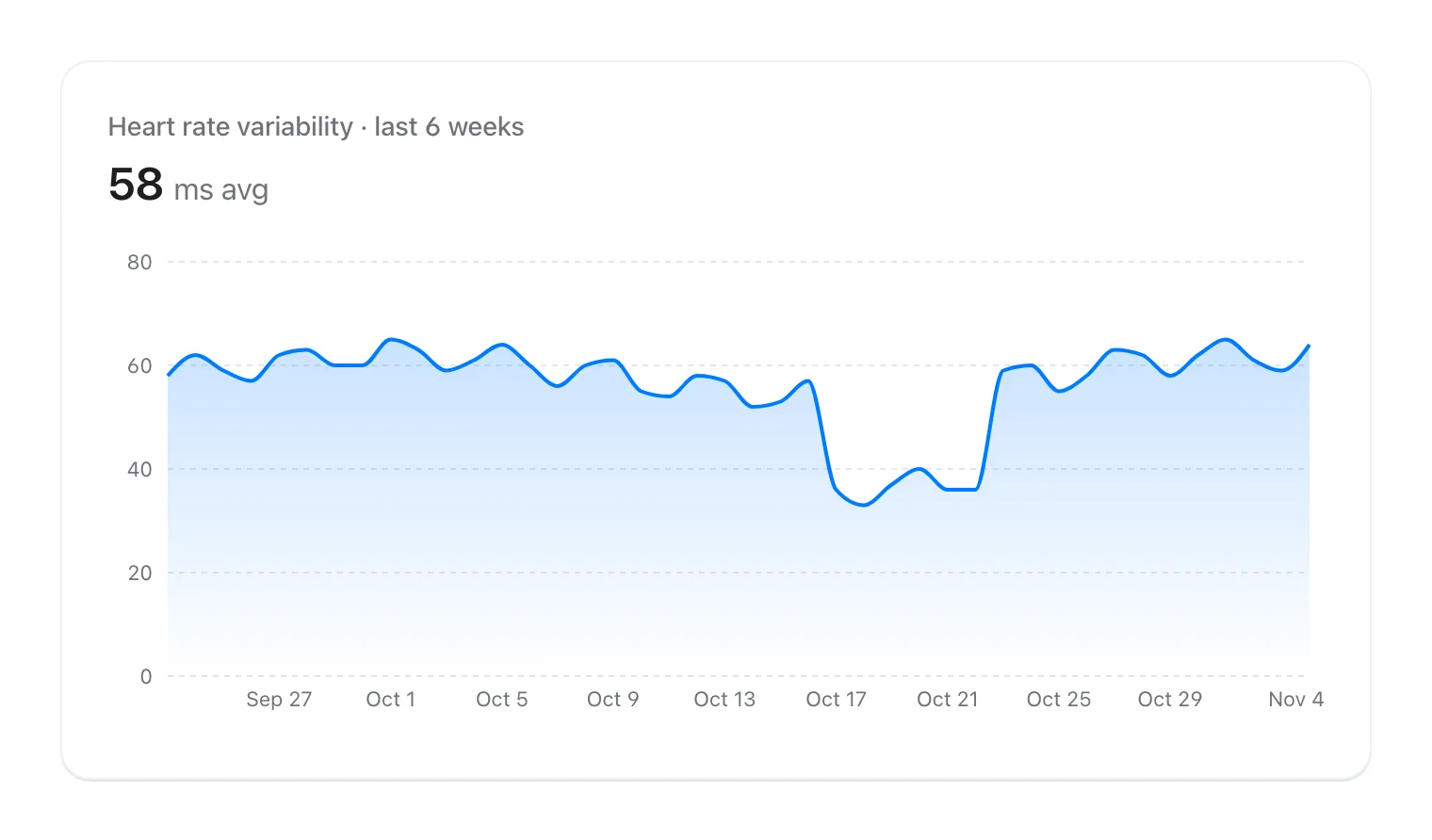
Don't overreact to a single morning. Plews and colleagues, writing about elite endurance athletes in 2013, recommend using appropriate averaging, such as looking at several days together, rather than reacting to one day's value, because daily HRV is noisy. Wrist readings add their own noise, so the trend across several mornings is far more trustworthy than any one number.
Using next-morning HRV to plan your next session
HRV-guided training has been tested in trials. In a 2007 study by Kiviniemi and colleagues, 26 moderately fit men trained for four weeks. One group followed a fixed plan; another measured HRV every morning and did a high-intensity run when HRV was unchanged or up, and a low-intensity run or rest when it had dropped below their own reference value (the 10-day mean minus one standard deviation) or had fallen two days in a row. The HRV-guided group improved peak oxygen uptake from 56 to 60 ml/kg/min, while the fixed-plan group did not change significantly.
You don't need a lab protocol to borrow the idea. A simple version for the morning after a hard session:
- HRV at or above your baseline, normal sleep, resting heart rate steady, legs feel fine: you've recovered. Go ahead with the next hard session if your plan calls for one.
- HRV a little below baseline (within your normal day-to-day range) and you feel fine: train as planned, but treat any hard session as optional and stop early if it feels unusually hard.
- HRV clearly below baseline the morning after a hard session: expected. Make today easy, such as Zone 2, mobility, an easy walk or a light technique session, and save the next hard effort until HRV is back near baseline.
- HRV clearly below baseline and resting heart rate up, sleep short or you feel run down: rest or keep it very light, and recheck tomorrow.
- HRV still low two or three mornings later with no new hard training: something besides the workout is probably involved. Look at sleep, alcohol, stress and possible illness before adding intensity.
- After a race or a very long effort: plan several easy days by default, and let HRV returning toward baseline confirm you're ready rather than deciding by the calendar alone.
What a hold day looks like in practice
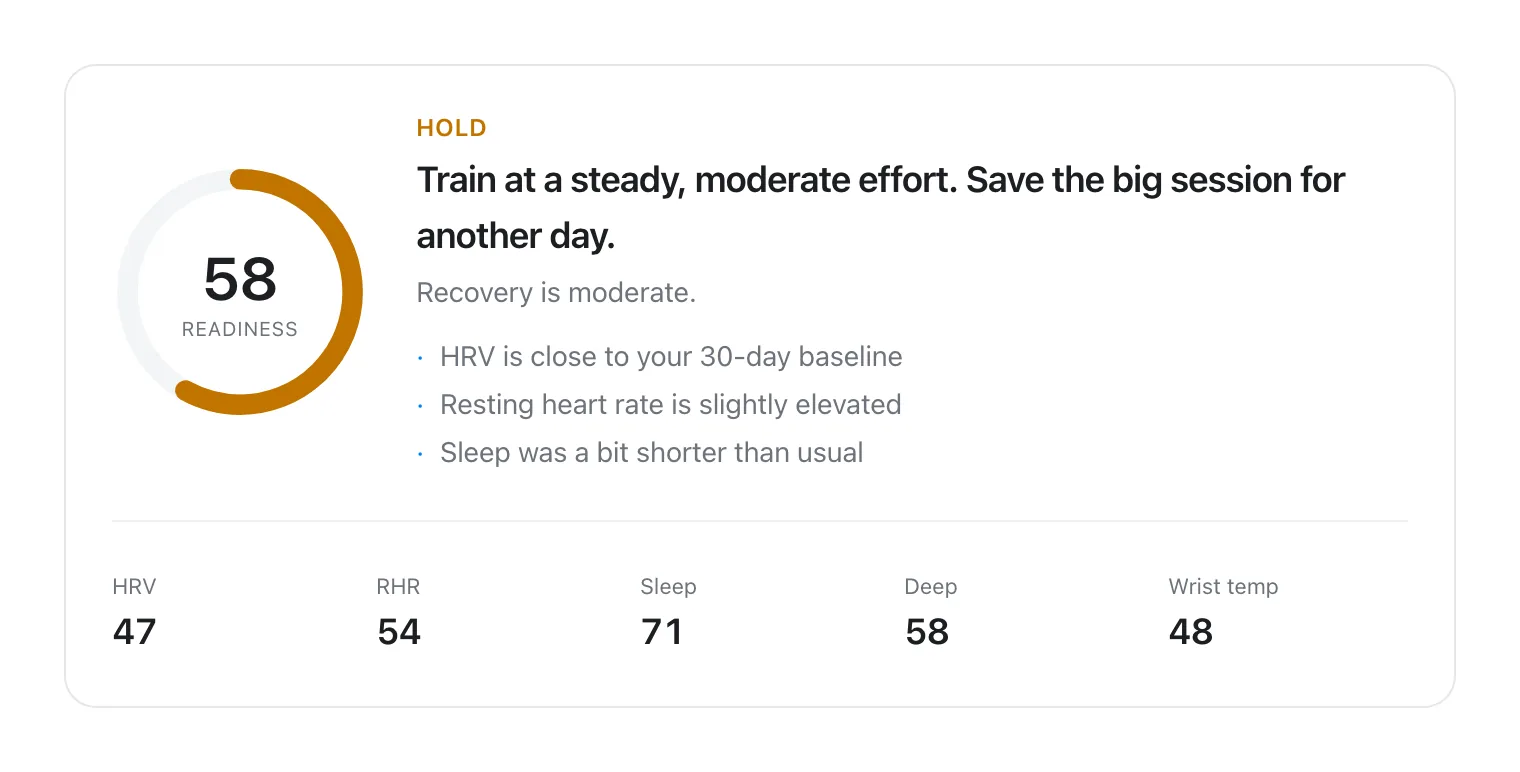
Most mornings after a hard session land in the middle: HRV a bit low, resting heart rate a touch high, sleep a little short. That's not a reason to do nothing. It's a day for steady, moderate work that keeps you moving without adding another big stress before you've absorbed the last one.
Good choices are an easy aerobic session you could hold a conversation through, a strength session that works the muscles you didn't load yesterday, or mobility work. Keep intensity, not just duration, in check, since the research above suggests intensity drives most of the HRV cost.
When low HRV after training lasts too long
A dip that recovers within the timeline for that session type is normal training. What deserves attention is HRV that stays clearly below your baseline for several days in a row, especially when resting heart rate stays up, sleep worsens, performance drops and you feel more tired rather than less. That combination can mean your training load has outpaced your recovery, or that something else is going on, such as illness or high stress.
Not every pattern is simple, either. Plews and colleagues note that in elite athletes both rises and falls in HRV have been linked to poor adaptation, so a number on its own can mislead. When several signals point the same way, cut back on intensity for a few days and see whether HRV and how you feel come back.
HRV is a wellness signal, not a diagnosis. If low readings come with chest pain, unusual shortness of breath, dizziness, fainting, palpitations or a fever, stop training and talk to a doctor. Apple's own guidance on its readiness feature says it should not be relied on alone to decide whether it's safe to exercise.
How VedaWatch helps you read the post-workout dip
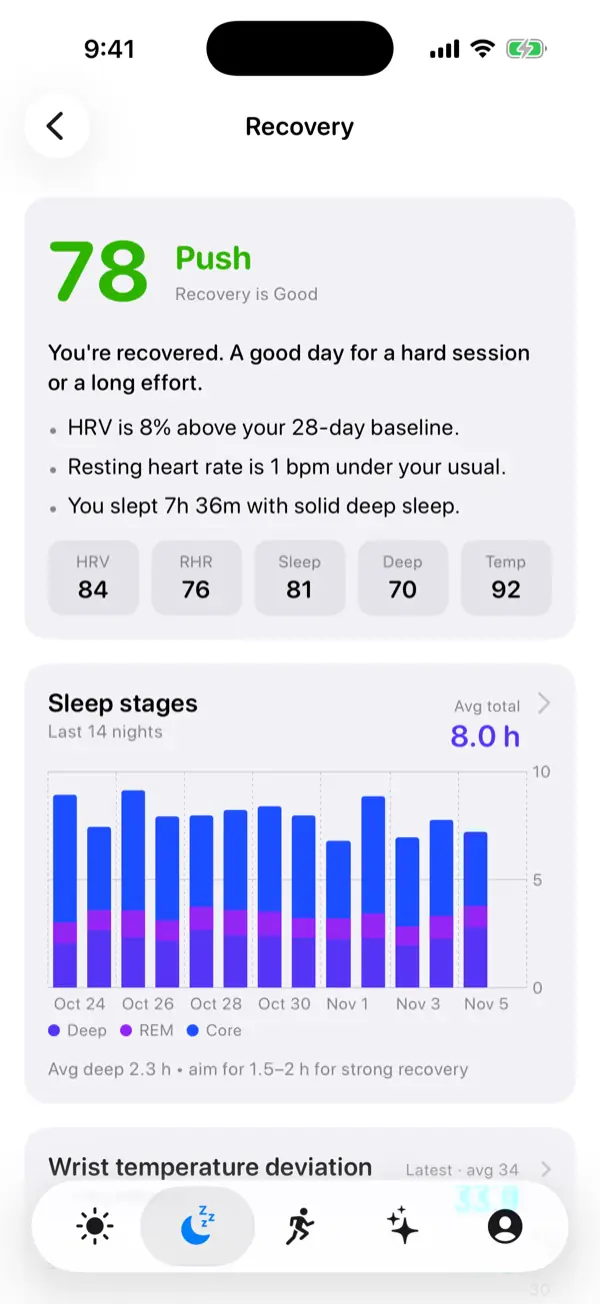
VedaWatch reads the HRV, resting heart rate and sleep your Apple Watch already saves to Apple Health and turns them into a daily readiness score. It compares today's HRV with your own recent baseline, and when HRV is more than 10% below it, the score's reasons say so in plain words, for example "HRV is 12% below your 14-day baseline". A score of 70 or more is a Push day, 50 to 69 a Hold day and below 50 a Rest day. If your resting heart rate is more than 3 bpm above baseline, a Push day is turned down to Hold.
Over time it also learns which of your own workouts cost you the most recovery. For workouts of at least 20 minutes, it compares your HRV the next morning with your normal (the median of the 28 days before), using the last 60 days of workouts. Once a workout type has at least three such mornings and stands out (at least 8% below your normal and clearly worse than rest days or your other workouts), it can show up on the Recover tab under What moves your recovery, and the morning after you do that workout again the app can tell you to expect a dip and keep the day easy. It's a pattern in your own data, not proof of cause.
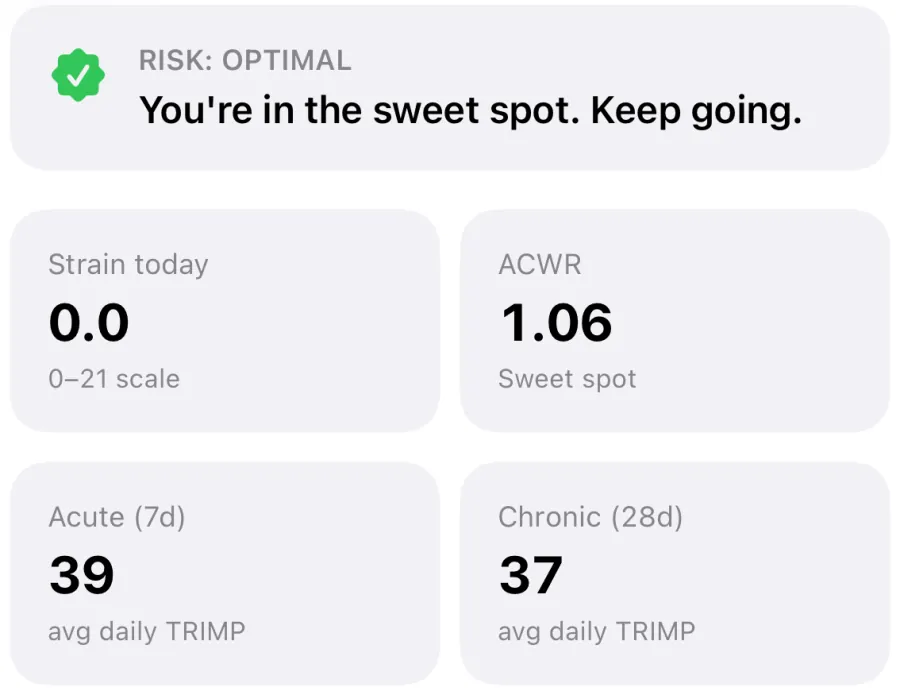
The daily coach on the Train tab uses the same readiness score to pick a hard, moderate or easy session, and your training load card shows whether your recent weeks are building faster than usual. None of this replaces how you feel or advice from a professional.
Frequently asked questions
Is it normal for HRV to drop the day after a hard workout?
Yes. A lower HRV the morning after intervals, a race or a long session is the expected result of training stress. It becomes worth a closer look only when it stays well below your baseline for several days.
Should HRV go up after a workout?
Not in the hours afterward. Over weeks and months of sensible training, though, resting HRV often trends upward as fitness improves, and the occasional higher reading after a rest day is common.
Why is my HRV higher after a hard workout than before?
Single readings are noisy, and a good night's sleep after a tiring day can lift overnight HRV. One higher reading isn't a sign the session was too easy; look at the pattern over several mornings.
Does an evening workout lower HRV more than a morning one?
It can for some people, because a late hard session leaves less time to settle before sleep. In the 2012 study above, even a vigorous 30-minute run at 6 pm didn't change overnight HRV, so it varies by person and session; compare your own late and early workout days.
Should I skip my workout if HRV is low after yesterday's session?
Not necessarily. Swapping a hard session for an easy one is usually enough, and research on HRV-guided training mostly changes intensity rather than cancelling training. Rest if you also feel unwell or other signals are off.
Related guides
- Should you train or rest when HRV is low?
- Why is my HRV so low? Causes of a sudden drop and what to check
- Signs of overtraining: what your Apple Watch can and can't show
- Rest day vs active recovery: which one do you need today?
- Apple Watch Training Load and ACWR, explained (and why sports scientists argue about it)
- Apple Watch Readiness score: what Recover, Pace Yourself, Ready, and Go For It mean
Sources & further reading
- Sports Medicine (2013): Cardiac parasympathetic reactivation following exercise: implications for training prescription (Stanley, Peake, Buchheit)
- Medicine & Science in Sports & Exercise (2007): Autonomic recovery after exercise in trained athletes: intensity and duration effects (Seiler, Haugen, Kuffel)
- International Journal of Sports Medicine (2010): Effects of moderate and heavy endurance exercise on nocturnal HRV (Hynynen et al.)
- European Journal of Applied Physiology (2012): Effects of exercise intensity and duration on nocturnal heart rate variability and sleep quality (Myllymäki et al.)
- Clinical Physiology and Functional Imaging (2016): Acute and training effects of resistance exercise on heart rate variability (Kingsley, Figueroa)
- European Journal of Applied Physiology (2007): Endurance training guided individually by daily heart rate variability measurements (Kiviniemi et al.)
- Sports Medicine (2013): Training adaptation and heart rate variability in elite endurance athletes: opening the door to effective monitoring (Plews et al.)
- Apple Support: Understand your readiness score on Apple Watch
This guide is educational, not medical advice, and has not been clinically reviewed. VedaWatch is not a medical device. If you have symptoms or concerns about your heart or health, contact a qualified healthcare professional.
Put your trends in perspective.
Explore HRV, sleep, and recovery with VedaWatch on your iPhone.
Download VedaWatch on the App Store →