 VedaWatch
Nutrition
How much protein per day to build muscle: g/kg by body weight
How much protein per day to build muscle, by body weight: what meta-analyses show (1.6 to 2.2 g/kg), grams per meal, older adults and when to check with a doctor.
By VedaWatch editorial team · · 9 min read
The short answer
For most people who lift, about 1.6 g of protein per kg of body weight a day (0.7 g per lb) captures most of the muscle-building benefit; aiming for up to 2.2 g/kg covers people who respond more. Spread it over three or four meals of roughly 0.4 g/kg each, and pair it with progressive resistance training.
How much protein per day do you need to build muscle?
The best single number comes from a 2018 meta-analysis in the British Journal of Sports Medicine by Morton and colleagues. It pooled 49 randomised controlled trials with 1,863 participants who did at least six weeks of resistance training, some with extra protein and some without. Gains in fat-free mass stopped improving at a total intake of about 1.62 g of protein per kg of body weight per day.
That number is an average with a wide margin. The 95% confidence interval ran from 1.03 to 2.20 g/kg/day, which means some people may get everything they need from less, and others may keep benefiting up to about 2.2 g/kg. The authors themselves suggested that about 2.2 g/kg/day may be a prudent target for people who want to be sure they are maximising gains.
The International Society of Sports Nutrition (ISSN) lands in the same place. Its 2017 position stand says an overall daily intake of 1.4 to 2.0 g/kg is sufficient for most exercising people to build and maintain muscle. Put together, a practical rule is: 1.6 g/kg as a solid target, 2.2 g/kg as a generous upper end, and anything in between is reasonable.
For comparison, the Recommended Dietary Allowance for the general adult population is 0.8 g/kg a day. That figure is set to prevent deficiency in most people, not to support muscle growth with hard training, which is why lifting guidelines sit about twice as high.
Protein per day by body weight: worked examples
Multiply your body weight in kilograms by your chosen g/kg figure. If you think in pounds, 1.6 g/kg is about 0.73 g per lb, and 2.2 g/kg is almost exactly 1 g per lb, which is where the popular "one gram per pound" rule comes from. That rule sits at the generous end of the evidence, not the minimum.
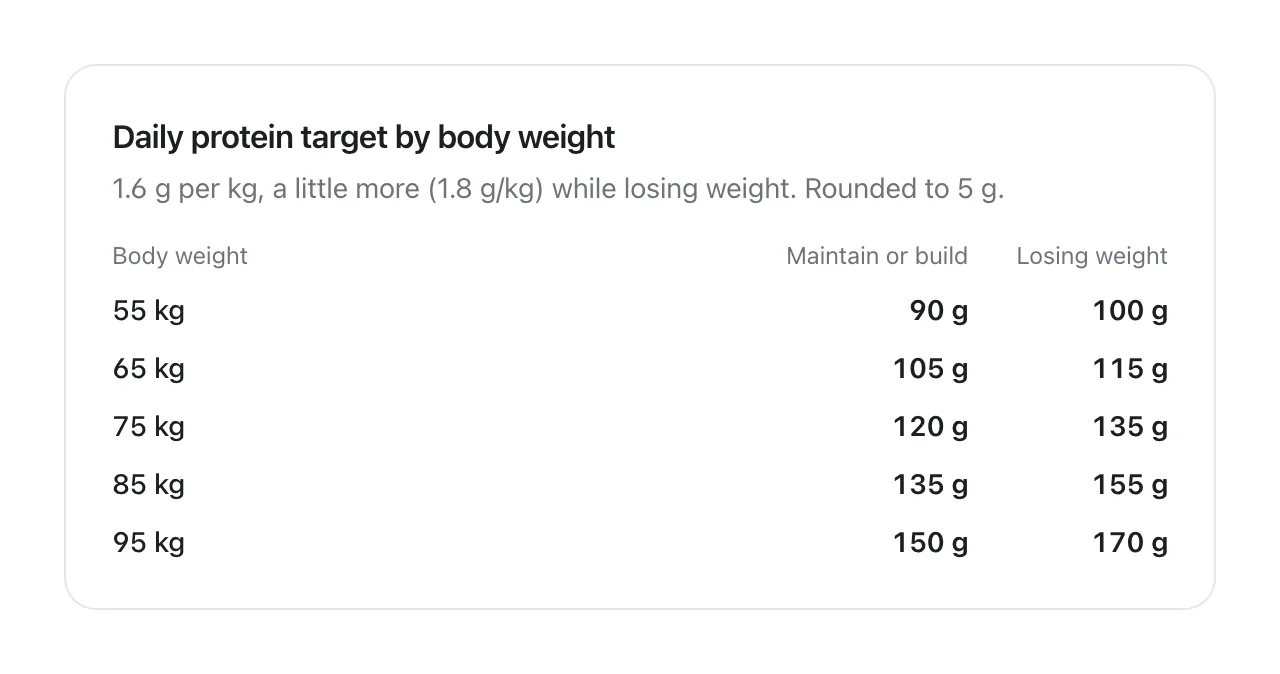
Here is what the range looks like at common body weights. The first figure is 1.6 g/kg, the second 2.2 g/kg, both rounded to the nearest gram.
- 55 kg (121 lb): 88 g to 121 g a day.
- 65 kg (143 lb): 104 g to 143 g a day.
- 75 kg (165 lb): 120 g to 165 g a day.
- 85 kg (187 lb): 136 g to 187 g a day.
- 95 kg (209 lb): 152 g to 209 g a day.
Should you aim for 1.6 or 2.2 g/kg?
Both ends are defensible, so choose by situation rather than by fear of missing out. The Morton meta-analysis found that extra protein helped more in people who were already resistance-trained, and that its effect on gains in fat-free mass became smaller with age. Its estimate of where gains plateau also came with a confidence interval wide enough that nobody can name your personal number.
Lean towards 1.6 g/kg if you are newer to lifting, at or above maintenance calories, or simply find large amounts of protein hard to eat. Lean towards 2.0 to 2.2 g/kg if you are experienced and gains have slowed, if your appetite and budget make it easy, or if you are eating in a calorie deficit.
Dieting is the clearest case for going higher. The ISSN position stand notes that intakes of 2.3 to 3.1 g/kg/day may be needed to maximise retention of lean mass in resistance-trained people during hypocaloric (calorie-deficit) periods. That is a specific situation for trained lifters cutting body fat, not a general target.
Two practical notes. First, protein is not a substitute for the training itself: the trials behind these numbers all paired protein with progressive resistance training. Second, if you carry a lot of body fat, multiplying total body weight by 2.2 can give a very large number. Many coaches and dietitians base the target on a goal or lean body weight instead; a registered dietitian can help you pick a sensible reference weight.
How much protein per meal, and how many meals?
Once you know your daily total, split it across the day. The ISSN recommends about 0.25 g of high-quality protein per kg of body weight per serving, or an absolute 20 to 40 g, spread evenly every 3 to 4 hours. A 2018 review by Schoenfeld and Aragon went a step further and suggested about 0.4 g/kg per meal across at least four meals to reach at least 1.6 g/kg/day, and up to about 0.55 g/kg per meal if you are aiming for 2.2 g/kg/day.
For a 75 kg person, that works out as follows. At 0.4 g/kg, each meal is 30 g, and four meals give 120 g, which is 1.6 g/kg. At 0.55 g/kg, each meal is about 41 g, and four meals give about 165 g, which is 2.2 g/kg. Three larger meals plus one protein-rich snack works just as well as four equal meals if that fits your day better.
What about the old idea that the body can only use 20 to 25 g at a time? Schoenfeld and Aragon concluded that larger doses do lead to more amino acids being burned, but not all the extra is wasted. A 2023 study in Cell Reports Medicine by Trommelen and colleagues found that 100 g of protein after exercise produced a greater and longer-lasting (more than 12 hours) anabolic response than 25 g. So if you eat most of your protein in two big meals, you are not throwing it away. Even spacing is a sensible default, not a strict rule.
Each serving should also be high quality. The ISSN suggests each dose contain about 700 to 3,000 mg of leucine alongside a full set of essential amino acids, which is easiest to hit with animal proteins or with larger or combined servings of plant proteins.
Do older adults need more protein to build muscle?
Yes, relative to body weight they seem to need more per meal. Muscle becomes less responsive to protein with age, sometimes called anabolic resistance. In a 2015 analysis in the Journals of Gerontology, Moore and colleagues found that muscle protein synthesis plateaued after about 0.24 g/kg of protein in a single meal in young men (about 22 years old), but only after about 0.40 g/kg in older men (about 71 years old).
For a 70 kg person, that is the difference between about 17 g and about 28 g of protein in one meal. In practice, an older lifter who eats small amounts of protein at breakfast and lunch and most of it at dinner may be under-dosing two meals out of three.
For daily totals, the PROT-AGE Study Group recommends that people over 65 eat at least 1.0 to 1.2 g/kg a day to maintain and regain muscle and function, at least 1.2 g/kg for those who exercise or are otherwise active, and 1.2 to 1.5 g/kg for most older adults with acute or chronic illness. These are floors for health and function; healthy older adults who lift seriously can reasonably use the same 1.6 g/kg target as younger lifters, with bigger servings at each meal.
Older adults are also more likely to have reduced kidney function without knowing it, so a check-up before a big jump in protein is worth it. That is the next section.
Is a high-protein diet safe for your kidneys?
For healthy adults, the intakes in this guide fall within what professional bodies recommend for people who train; the ISSN notes its 1.4 to 2.0 g/kg range sits within the Institute of Medicine's acceptable range for protein. The picture is different if your kidneys are already not working well.
The 2024 KDIGO clinical guideline for chronic kidney disease (CKD) suggests keeping protein at about 0.8 g/kg a day for adults with CKD stages G3 to G5, and to avoid high intakes above 1.3 g/kg a day in adults with CKD who are at risk of progression. The PROT-AGE group likewise says older people with severe kidney disease (eGFR below 30) who are not on dialysis may need to limit protein. Both 1.6 and 2.2 g/kg are well above those limits.
Talk to your doctor or a registered dietitian before raising your protein if you have chronic kidney disease or reduced eGFR on a blood test, diabetes or high blood pressure (both common causes of kidney disease), a single kidney, or any condition where you've been told to watch your protein. The same applies if you are pregnant, have a history of disordered eating, or take medicines that affect the kidneys. Many people with kidney problems don't know it, so if you haven't had a routine blood test in a while, it's reasonable to ask for one.
How to actually hit your protein target
Most people who fall short do so because of one or two low-protein meals, usually breakfast or lunch, rather than a low total at dinner. A simple plan is to build every meal around a protein source first and fill the rest of the plate after.
- Work out your daily number: body weight in kg times 1.6 (or up to 2.2). Write it down.
- Divide by the number of meals you actually eat. Three meals and one snack is fine.
- Check your two lowest meals for a week. Raise those first rather than adding a shake to an already high-protein dinner.
- Use whole foods first. Supplements such as whey are a convenience, not a requirement; the ISSN notes protein needs can be met from food.
- Keep your training progressive. Protein supports muscle growth from training; it doesn't create it on its own.
- Judge progress over months, using strength, measurements and how clothes fit, not day-to-day scale changes.
Tracking your protein target with VedaWatch
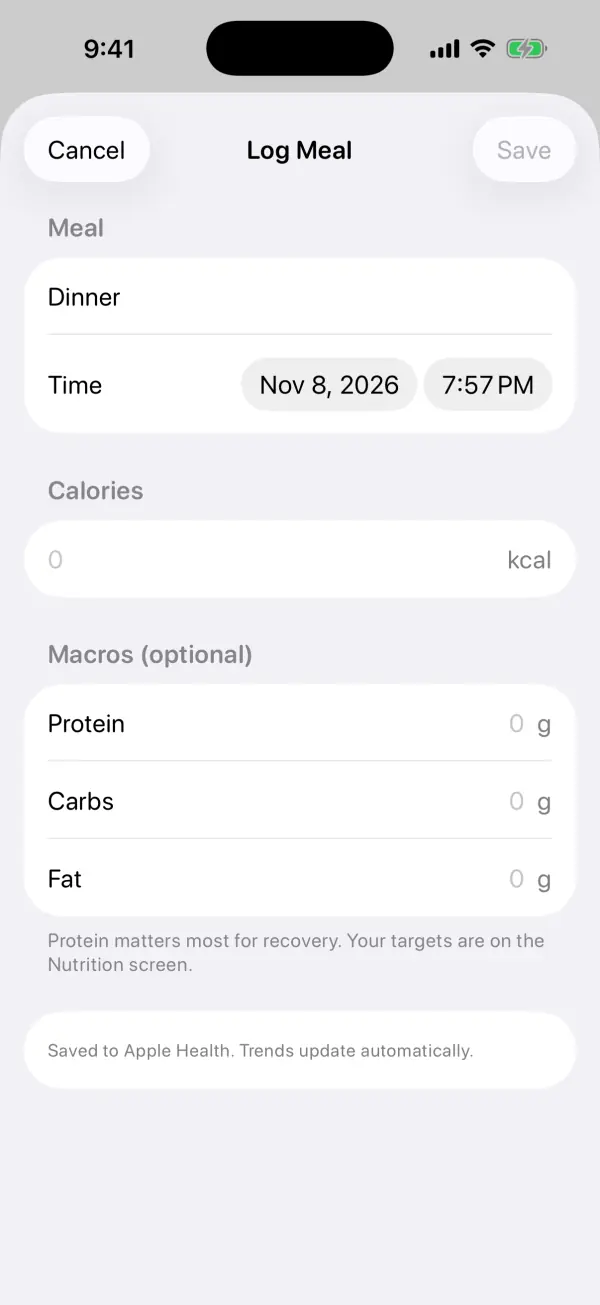
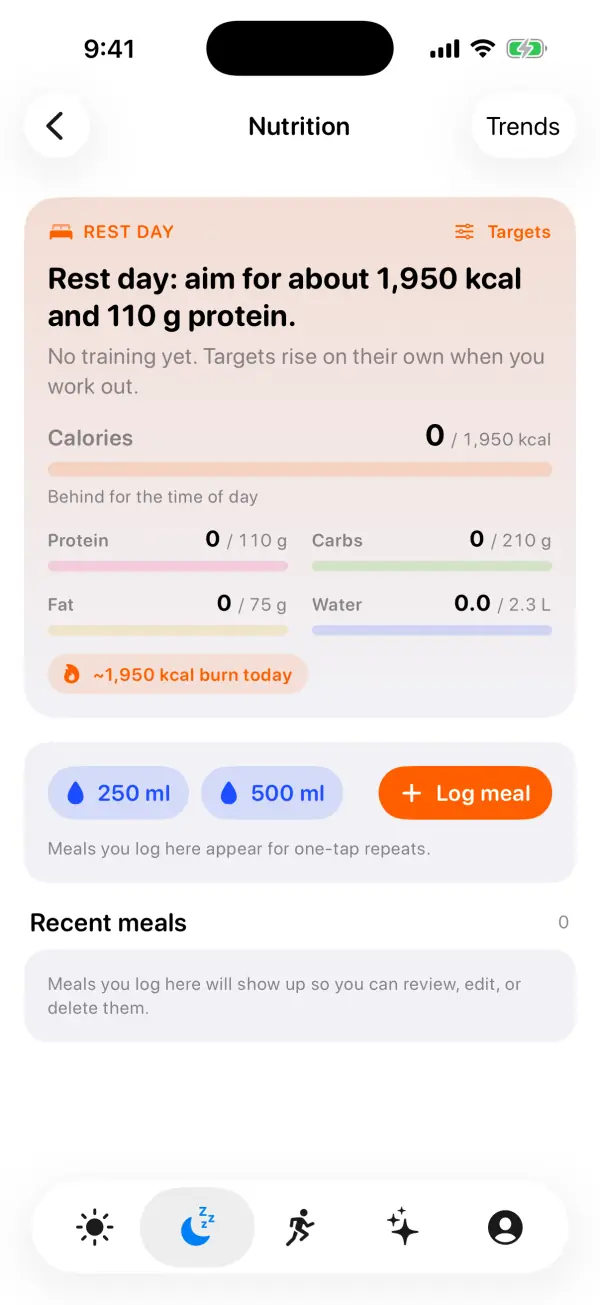
If you'd rather not do the maths, the Nutrition screen in VedaWatch (under the Recover tab) works out a daily protein target from your latest weight in Apple Health. It uses 1.6 g/kg by default, rounded to the nearest 5 g, and you can change it anywhere from 1.2 to 2.4 g/kg under Targets. If you choose the Lose gradually goal, it adds 0.2 g/kg to help hold on to muscle. If Apple Health has no weight for you, it assumes 70 kg and says so.
Protein stays the same on rest days and training days, in line with the research above; it's carbs, calories and water that rise with training. The Fuel card shows a protein bar against your target, and if you're falling behind it says how many grams are left, suggesting you add some to each meal, or after 4 pm, make dinner protein-heavy. You can also ask Siri "How much protein is left in VedaWatch".
Meals you log in VedaWatch are saved to Apple Health, and protein logged in other apps that write to Apple Health counts too. Trends shows your daily protein against your target over time. It's general guidance for healthy adults, not dietary advice, so if any of the kidney or health cautions above apply to you, set the target with your clinician.
Frequently asked questions
Is 1 gram of protein per pound too much?
No, for healthy adults it is at the top of the evidence-based range rather than above it: 1 g per lb is about 2.2 g/kg. It just isn't necessary for most people, since the average benefit plateaus around 1.6 g/kg (about 0.7 g per lb).
Can you build muscle on 100 g of protein a day?
It depends on your weight. 100 g is about 1.6 g/kg for a 62 kg person but only about 1.2 g/kg for someone weighing 85 kg. Lifters still gain muscle at lower intakes, just probably not as much as they could.
Do I need protein right after a workout?
There's no need to rush. The ISSN notes that the anabolic effect of exercise lasts at least 24 hours, so your total for the day and an even spread across meals matter more than a narrow post-workout window. A protein-rich meal within a few hours of training is a simple habit.
Does protein from plants count the same?
It counts toward your total, but many plant proteins contain less leucine and fewer essential amino acids per gram. Mixing sources and using slightly bigger servings helps you reach the same per-meal dose.
Should I eat more protein on training days?
Not necessarily. Muscle building responds to your intake over days and weeks, and the anabolic effect of training lasts more than a day, so a steady daily target is simpler. Carbohydrate and total calories are what usually need to rise with training volume.
Related guides
- How much to eat on training vs rest days: calorie and protein targets from your Apple Watch
- Logging nutrition to Apple Health: what actually syncs, and why your numbers might be off
- Progressive overload explained: how to progress every lift
- How many sets per muscle per week? What the research says
- What to eat after a workout: protein, carbs and timing
- How much creatine should I take? A beginner's dosing guide
Sources & further reading
- British Journal of Sports Medicine (2018): A systematic review, meta-analysis and meta-regression of the effect of protein supplementation on resistance training-induced gains in muscle mass and strength in healthy adults (Morton et al.)
- Journal of the International Society of Sports Nutrition (2017): International Society of Sports Nutrition Position Stand: protein and exercise (Jäger et al.)
- Journal of the International Society of Sports Nutrition (2018): How much protein can the body use in a single meal for muscle-building? Implications for daily protein distribution (Schoenfeld and Aragon)
- Cell Reports Medicine (2023): The anabolic response to protein ingestion during recovery from exercise has no upper limit in magnitude and duration in vivo in humans (Trommelen et al.)
- Journals of Gerontology Series A (2015): Protein ingestion to stimulate myofibrillar protein synthesis requires greater relative protein intakes in healthy older versus younger men (Moore et al.)
- Journal of the American Medical Directors Association (2013): Evidence-based recommendations for optimal dietary protein intake in older people: a position paper from the PROT-AGE Study Group (Bauer et al.)
- Kidney International (2024): KDIGO 2024 Clinical Practice Guideline for the Evaluation and Management of Chronic Kidney Disease
This guide is educational, not medical advice, and has not been clinically reviewed. VedaWatch is not a medical device. If you have symptoms or concerns about your heart or health, contact a qualified healthcare professional.
Put your trends in perspective.
Explore HRV, sleep, and recovery with VedaWatch on your iPhone.
Download VedaWatch on the App Store →