 VedaWatch
Habits & Goals
Weekly vs daily fitness goals: which keeps you consistent?
Weekly vs daily fitness goals compared: what the WHO 150-300 minute guideline and goal research say, why weekly targets survive missed days, and how to set yours.
By VedaWatch editorial team · · 11 min read
The short answer
For workouts, a weekly goal usually works better than a daily one. Health guidelines are written per week (150-300 minutes of moderate activity), research links weekly totals to health whether they're spread out or bunched up, and a weekly target absorbs a missed day instead of breaking. Keep daily goals for small habits like steps.
Weekly vs daily fitness goals: which works better?
For structured exercise such as runs, gym sessions and classes, a weekly goal is usually the better fit. "Train 3 days this week" or "150 minutes this week" leaves room for a late meeting, a sick child or a bad night's sleep. "Work out every day" turns each of those into a failure, and failures are where most routines quietly end.
Daily goals still have a job. They suit small, low-effort behaviours you can do almost every day, such as a step count, a short walk after lunch or a few minutes of mobility. Repeating the same small action in the same situation is how habits become automatic, and a daily target supports that.
So the practical answer is not one or the other. Use a weekly target for the training that needs recovery and planning, and a daily floor for the small movement habits that don't. The rest of this guide explains why that split holds up, using exercise guidelines and goal research, and shows how to set both.
This is general information about building an exercise routine, not medical advice. If you're new to exercise, pregnant, or have a heart, lung, joint or other health condition, ask a doctor or qualified professional what's safe for you before you raise your activity.
How much exercise do adults need per week?
The World Health Organization's 2020 guidelines are written in weekly amounts, not daily ones. Adults aged 18 to 64 are advised to do 150 to 300 minutes of moderate-intensity aerobic activity a week, or 75 to 150 minutes of vigorous activity, or an equivalent mix. On top of that, they recommend muscle-strengthening activity that works all major muscle groups on 2 or more days a week. Going beyond these amounts may bring extra benefit.
Two details in the 2020 update matter for goal setting. First, the old rule that activity only counted in bouts of at least 10 minutes was dropped: bouts of any length now count toward the weekly total. Second, the guidelines say that doing some physical activity is better than doing none, and that people who aren't meeting the targets should start small and build up frequency, intensity and duration over time.
Moderate intensity means you breathe faster but can still talk, such as brisk walking or easy cycling. Vigorous means you can only say a few words before pausing for breath, such as running or hard intervals. As a rough rule, one vigorous minute counts about the same as two moderate ones.
- 150 minutes of moderate activity as 5 sessions: 5 x 30 minutes, for example brisk walks on weekdays.
- 150 minutes as 3 sessions: 3 x 50 minutes, for example three longer gym or cycling sessions.
- 150 minutes as 2 sessions: 2 x 75 minutes, for example a long Saturday hike and a Sunday ride.
- 75 minutes of vigorous activity: 3 x 25 minutes of running, or a mix such as 2 x 20-minute runs plus 70 minutes of brisk walking.
- Strength: 2 sessions a week that work all the major muscle groups. These can be separate days or added to aerobic days.
Does it matter how you spread your weekly exercise?
This is the strongest argument for weekly goals: the research that links activity to health mostly measures weekly totals, and the pattern within the week seems to matter less than many people assume.
A 2017 study in JAMA Internal Medicine pooled survey data from 63,591 adults aged 40 and over in England and Scotland. People who reached the guideline amount in just 1 or 2 sessions a week, the so-called weekend warriors, had a lower risk of death from any cause than inactive people (hazard ratio 0.70). Regularly active people, who spread the same amount over more sessions, had a similar result (0.65). Even people below the guideline, the insufficiently active group, had a lower risk than the inactive group (0.69).
A 2023 study in JAMA used wrist accelerometers worn for a week by 89,573 UK Biobank participants, which avoids relying on what people remember. Those who reached at least 150 minutes of moderate-to-vigorous activity with half or more of it on 1 or 2 days had lower rates of atrial fibrillation, heart attack, heart failure and stroke than inactive participants, and their risks were similar to those of people who spread the same activity more evenly.
These are observational studies, so they show associations rather than proof, and they don't mean cramming is ideal. Long, hard sessions after a sedentary week carry more risk of soreness and injury, especially if you're returning from a break. But they do support the idea that the weekly total is what counts most, which is exactly what a weekly goal measures.
Why weekly goals survive missed days
A daily goal has no slack. Miss Tuesday and the goal is broken, with nothing you can do about it. Once the perfect run is gone, it is easy to slide into all-or-nothing thinking, where the goal starts to feel pointless. A weekly goal gives the missed session somewhere to go, because Wednesday or Saturday can still make it up.
Research on goals with built-in slack points the same way. Marissa Sharif and Suzanne Shu studied what they call emergency reserves: a hard goal with a few allowed skips, such as hitting a step target 7 days a week with 2 skips allowed per week. In a month-long step challenge with more than 270 students and staff, the reserve groups reached their goals more often than people given an easy goal (5 days a week) or a hard goal (7 days, no skips). After missing a day, people in the weekly-reserve group got back on target the next day 55% of the time, compared with 44% for the easy goal and 37% for the hard one.
The authors' explanation is that a reserve turns a miss into something that still feels like progress, so people stay committed instead of giving up. A weekly target works much the same way: missing a planned day uses up slack rather than ending the goal.
A very large field experiment backs up the value of getting back on track. A 2021 megastudy in Nature tested 53 four-week programs with more than 60,000 gym members. The best performer gave a tiny bonus, worth about 9 US cents, to people who returned for their next planned workout after missing one, and it increased weekly gym visits by about 27%. The money was trivial; the message that one missed session shouldn't become two did the work.
Habit research agrees that a single miss is not the problem. In a 2010 study of 96 people building a new daily habit, the time for it to feel automatic ranged from 18 to 254 days, with about 66 days typical, and missing one opportunity did not meaningfully slow progress. What mattered was repeating the behaviour over weeks, not an unbroken record.
When a daily goal is the better choice
Daily goals make sense when the behaviour is small, safe to repeat every day, and benefits from a fixed cue. Walking is the classic case. A step count, a 10-minute walk after dinner or taking the stairs at work don't need recovery days, and doing them at the same point every day is what helps them become automatic.
Daily targets also help when the problem is sitting rather than training. Someone who already runs three times a week but spends most of the day at a desk gets something different from a daily step or movement floor than from a fourth run. The WHO guidelines also advise limiting sedentary time, which is a day-by-day behaviour.
Where daily goals go wrong is with hard training. "Work out hard every day" leaves no room for recovery, and muscles, tendons and the nervous system adapt between sessions, not during them. If you like the rhythm of moving every day, make most days easy and only some hard, and let the weekly number decide how many hard days you get.
A daily goal can also be set so low that missing it is rare: a floor rather than a target. "At least 4,000 steps" or "at least 5 minutes of movement" keeps the daily habit alive on terrible days without turning them into failures.
How to set a weekly fitness goal you'll actually keep
A weekly goal only helps if the number fits your real life. Start from what you did over the last few weeks, not from what you wish you did, and build in slack on purpose.
- Count your baseline. Look back at the last 4 weeks and note how many days you trained or how many active minutes you logged in a typical week. Say it was 2 sessions.
- Set the target one step above your baseline, not five. If 2 is normal, aim for 3 sessions a week. If you're starting from zero, 2 sessions of 20 to 30 minutes is a sensible beginning, since any activity is better than none.
- Plan more days than you need. Pick 4 possible training days for a target of 3. The spare day is your reserve: if Tuesday falls through, Thursday takes its place and the week is still on track.
- Decide what counts before the week starts. For example: any workout of 20 minutes or more, or any strength session, counts as a day. Clear rules stop you arguing with yourself on Sunday night.
- Attach each planned day to a time and place: "Monday, Wednesday and Saturday at 7 am, at the gym near work." Deciding in advance removes a daily decision about whether and when to train.
- Add a small daily floor if you want one, such as a walk or a step minimum, kept low enough that a busy day can still meet it.
- Review the week, not the day. On Sunday or Monday, check whether you hit the target. If you hit it 3 to 4 weeks in a row and it felt easy, raise it by one session. If you missed it most weeks, lower it; a goal you keep is worth more than a bigger one you abandon.
Combining daily and weekly goals: a sample setup
Most people end up with both kinds of goal, each doing what it's good at. Here's one setup that lines up with the WHO guidelines for a person who currently trains about twice a week:
Weekly: 3 training sessions, with 4 days planned, including 2 strength sessions. Weekly: about 150 minutes of moderate activity in total, counting walks and other workouts. Daily: a step floor set near what you already reach on most days, so it maintains the habit rather than demanding a leap.
If you use Apple Watch Activity rings, they are daily by design, but you aren't stuck with the same goal every day. Apple lets you schedule a different ring goal for each day of the week, so a rest day can have a lower Move or Exercise goal than a training day. You can also pause your rings for up to 90 days without breaking your award streak, for illness, injury or travel. Each Monday, the Watch recaps the previous week and lets you adjust goals for the week ahead, which is a good moment for the weekly review above.
Whatever tools you use, judge yourself on weeks and months. One missed day out of 30 is a 97% month. A run of good weeks is the thing that actually changes fitness.
How VedaWatch tracks weekly and daily goals
VedaWatch, an iPhone and Apple Watch app that reads your Apple Health data, uses both kinds of goal, built around the ideas above.
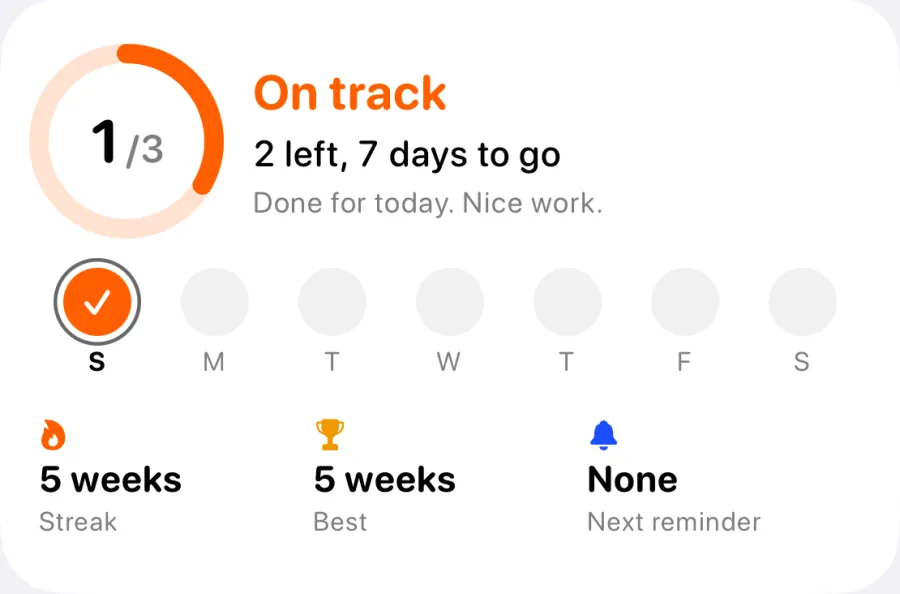
The weekly training target on the Train tab asks how many days a week you want to train, from 1 to 7, with 3 as the default. Each day counts once, and both guided sessions and other workouts from Apple Health count (a day needs 20 minutes or more of workouts, and you can switch other workouts off). Missing a planned day is forgiven: the week only reads Behind when you're more than one session short of the expected pace, or when every day left is needed. When the target can no longer be reached, the card says Fresh start soon rather than marking the week as failed. Your streak counts weeks in a row that hit the target, and the week in progress never breaks it.
Reminders are optional. Once on, you get at most one a day on your training days, they stop once your week is done, and they hold off when your readiness says rest. If you fall behind but can still catch up, one extra catch-up nudge a week may suggest that a short session counts.
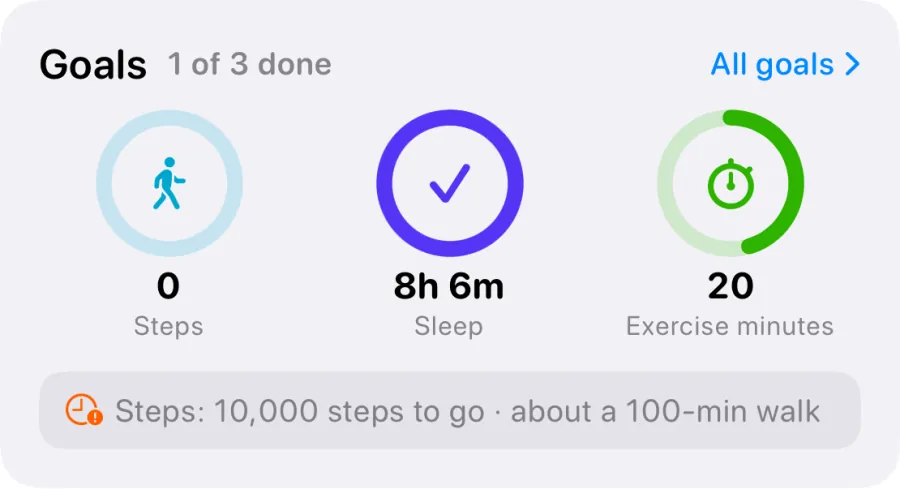
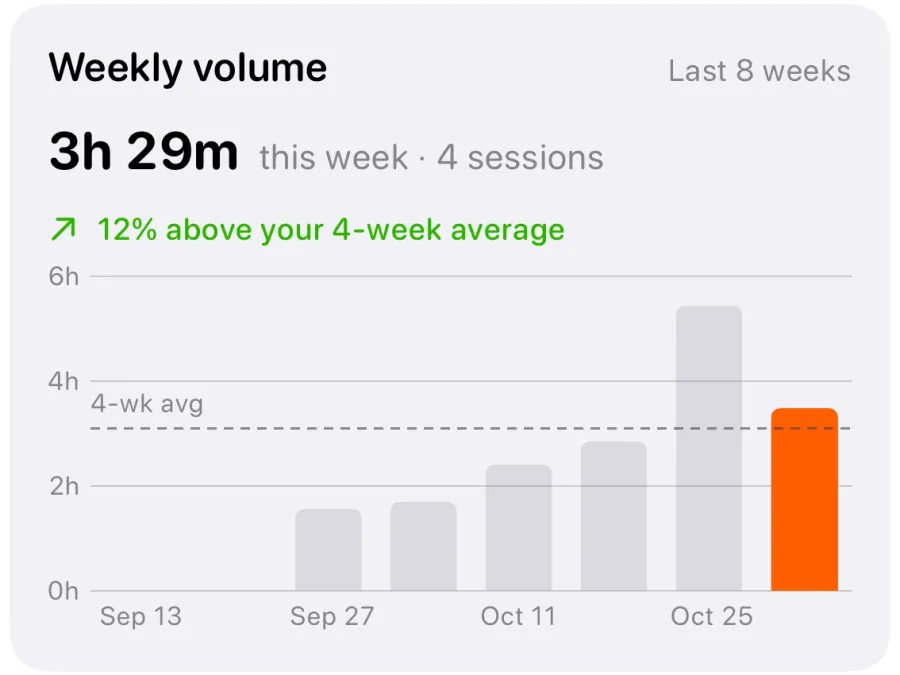
Metric goals cover steps, sleep, exercise minutes, active energy and distance, each daily or weekly. When you switch a step, exercise, energy or distance goal from daily to weekly, the target is multiplied by 7 so the effort stays the same, and a weekly goal shows what each remaining day needs to finish. The editor also shows how often you'd have hit a target over recent weeks, which makes it easier to pick a number near your real baseline. The Weekly volume card shows your training time for the last 8 weeks against your 4-week average.
Frequently asked questions
Is it better to work out every day or a few times a week?
For most people, a few well-spaced sessions plus light daily movement works better than hard training every day, because the body adapts during recovery. If you enjoy daily exercise, keep most days easy.
Can I get all 150 minutes on the weekend?
Large observational studies found that people who did the guideline amount in 1 or 2 sessions had health associations similar to people who spread it out. Build up gradually if you're not used to long sessions, since a sudden jump raises the risk of soreness and injury.
Should my step goal be daily or weekly?
Steps suit a daily goal because walking needs no recovery and benefits from a daily cue. A weekly step total can be kinder if your days vary a lot, such as shift work or travel.
What should I do after missing a planned workout?
Make the next planned session the priority and keep it short if you need to. Research on gym habits suggests the key is not letting one missed session turn into two.
How many training days a week should a beginner aim for?
Two or three days a week is a common, realistic start, with at least two days that include strength work over time. Pick a number you could keep in a busy week and raise it once it feels easy.
Related guides
- How to stay consistent with workouts: set a weekly training target
- How to set step, sleep and exercise goals with Apple Watch and track your progress
- Apple Watch streaks beyond Move: track sleep, steps and exercise consistency
- How many steps a day do you need? What the studies show by age
- Rest day vs active recovery: which one do you need today?
- How to close your rings every day (and when to pause them)
Sources & further reading
- British Journal of Sports Medicine (2020): World Health Organization 2020 guidelines on physical activity and sedentary behaviour (Bull et al.)
- JAMA Internal Medicine (2017): Association of "Weekend Warrior" and other leisure time physical activity patterns with risks for all-cause, cardiovascular disease, and cancer mortality (O'Donovan et al.)
- JAMA (2023): Accelerometer-derived "weekend warrior" physical activity and incident cardiovascular disease (Khurshid et al.)
- Organizational Behavior and Human Decision Processes (2021): Nudging persistence after failure through emergency reserves (Sharif and Shu)
- UCLA Anderson Review: The case for building wiggle room into goals
- Nature (2021): Megastudies improve the impact of applied behavioural science (Milkman et al.)
- European Journal of Social Psychology (2010): How are habits formed: Modelling habit formation in the real world (Lally et al.)
- Apple Support: Adjust your Activity ring goals on Apple Watch
This guide is educational, not medical advice, and has not been clinically reviewed. VedaWatch is not a medical device. If you have symptoms or concerns about your heart or health, contact a qualified healthcare professional.
Put your trends in perspective.
Explore HRV, sleep, and recovery with VedaWatch on your iPhone.
Download VedaWatch on the App Store →