 VedaWatch
Habits & Goals
How many steps a day do you need? What the studies show by age
How many steps a day you need, by age, from large cohort studies: where 10,000 came from, whether walking pace matters, and how to set a step goal you'll keep.
By VedaWatch editorial team · · 10 min read
The short answer
For most adults, about 7,000 to 8,000 steps a day captures most of the health benefit seen in large studies. In a 2022 meta-analysis, risk stopped falling at around 6,000 to 8,000 steps for people 60 and over and 8,000 to 10,000 for younger adults. 10,000 is a fine goal, not a requirement; any increase helps.
How many steps a day do you really need?
The best current evidence points to a range, not a single magic number. A 2025 review in The Lancet Public Health pooled 57 studies from 35 cohorts that measured steps with a device and then followed people for years. Compared with 2,000 steps a day, 7,000 steps a day was linked with a 47% lower risk of death from any cause over the follow-up, along with lower rates of heart disease, dementia, depressive symptoms and falls. For several of those outcomes the curve bent at around 5,000 to 7,000 steps: risk kept falling after that, but more slowly.
An earlier pooled analysis of 15 cohorts and 47,471 adults, published in the same journal in 2022, found the same shape. Risk fell steeply from the lowest step counts and then levelled off at a point that depended on age. The authors put that point at roughly 6,000 to 8,000 steps a day for adults aged 60 and over, and 8,000 to 10,000 for adults under 60.
So a practical answer is: if you walk less than about 5,000 steps a day, adding steps is one of the simplest health changes you can make. If you are already at 7,000 to 10,000, you are in the range where these studies saw most of the benefit, and other things such as strength training, sleep or harder cardio may matter more than a bigger step count.
Two cautions apply to every number on this page. These are observational studies, so they show that people who walk more tend to live longer and healthier, not that a specific step count causes it; healthier people may simply walk more. And they describe groups, not you. Treat them as a guide for setting goals, not a prescription.
How many steps a day by age
Most of the research is in adults, and the clearest age split comes from the 2022 meta-analysis of 15 cohorts led by Amanda Paluch. Here is what the main studies found, from the youngest groups to the oldest. The figures are where the benefit levelled off in each study, not targets you must reach.
- Adults under 60: in the 2022 meta-analysis, risk of death kept falling up to about 8,000 to 10,000 steps a day before flattening.
- Adults 60 and over: the same analysis found the curve flattened earlier, at about 6,000 to 8,000 steps a day.
- Older women (average age 72): in a 2019 study of 16,741 women in the Women's Health Study, about 4,400 steps a day was linked with lower mortality than about 2,700, and the benefit levelled off at around 7,500 steps.
- All adult ages pooled: the 2025 review found meaningful benefit at 7,000 steps compared with 2,000, with only small extra gains beyond that for most outcomes. Its authors note that it couldn't analyse results by age.
- Any age, starting low: a 2023 meta-analysis of 17 cohorts and 226,889 people found each extra 1,000 steps a day was linked with a 15% lower risk of death from any cause, with lower risk seen from about 3,900 steps a day upward.
Where did 10,000 steps a day come from?
Not from a clinical trial. As Harvard Health Publishing tells it, the number goes back to 1965, when a Japanese company sold a pedometer called Manpo-kei, which translates as "10,000 steps meter". It was a marketing name, and a round, memorable one, which is why it spread to step counters and fitness apps around the world.
Researchers have tested the number since, and it holds up as a reasonable goal for healthy, active adults. A 2011 expert review in the International Journal of Behavioral Nutrition and Physical Activity found that healthy adults typically take between 4,000 and 18,000 steps a day and called 10,000 reasonable for that group. But the authors of the 2022 meta-analysis opened their paper by noting that, although 10,000 steps is widely promoted, there was little evidence behind it as a threshold.
That's the honest summary. 10,000 is not wrong, and in the 2022 data people under 60 kept seeing lower risk up to about that level. It's just not a line you have to cross for walking to count.
Is 10,000 steps necessary, or is 7,000 enough?
For most people, 7,000 is a sensible target and 10,000 is a stretch goal. The 2025 Lancet Public Health review put it this way: 10,000 steps a day can still be a viable target for people who are more active, but 7,000 is linked with clinically meaningful health benefits and might be more realistic for some.
Here is how the 7,000-step comparison looked against 2,000 steps a day in that review: 47% lower risk of death from any cause, 25% lower risk of developing cardiovascular disease, 38% lower risk of dementia, 22% lower risk of depressive symptoms, 28% lower risk of falls and 14% lower risk of type 2 diabetes. The authors rated the certainty of evidence as moderate for most outcomes, and low or very low for a few, including falls.
Above 7,000, the extra benefit for most outcomes was small, though some outcomes such as cancer mortality and depressive symptoms followed a straighter line, with no clear plateau. So more is not useless. It's that the biggest health return comes from getting off the bottom of the curve, not from pushing from 9,000 to 12,000.
If 10,000 motivates you and you hit it comfortably, keep it. If it makes you feel like you've failed every day at 6,500, a lower goal you actually reach is likely the better choice.
Does walking pace matter, or just the step count?
Pace is measured as cadence, the number of steps per minute. In a lab study of adults aged 21 to 40, about 100 steps a minute marked the start of moderate-intensity walking, and about 130 steps a minute marked vigorous intensity. That gives you a simple self-check: count your steps for 15 seconds and multiply by four. If you're at 25 or more in 15 seconds, you're walking at a moderate pace.
For mortality, total steps seem to matter more than speed. In the Women's Health Study, faster stepping was linked with lower risk at first, but once total daily steps were taken into account, most of the cadence measures were no longer significant. The 2022 meta-analysis found something similar for time spent walking at 100 steps a minute or faster, though people whose best 30 minutes of the day were brisker still had lower risk after adjusting for total steps.
The practical takeaway is to get the steps first, then make some of them brisk. Brisk walking also counts toward the moderate activity that physical activity guidelines are built on: 30 minutes at 100 steps a minute is about 3,000 steps, which the 2011 review suggested should come on top of your normal daily movement.
Cadence also gives you a handy conversion for planning: at about 100 steps a minute, 1,000 steps takes around 10 minutes of brisk walking. A slow stroll or shopping trip gives fewer steps per minute, and longer legs mean fewer steps for the same distance, so treat this as a rough guide.
How to set a realistic step goal
Start from your own average, not from a famous number. Studies of walking programmes typically raise daily steps by about 2,000 to 2,500, according to the 2011 review, so that's a realistic size for a first step up. Here's a simple way to set and grow a goal.
- Find your baseline: look at your average daily steps over the last two to four weeks in the Health app, with your iPhone or Apple Watch worn as usual.
- Add about 2,000 steps to that average. If you average 4,500, your first goal is around 6,500. That's roughly 20 extra minutes of walking a day at a brisk pace.
- Pick where the steps come from: a 10-minute walk after two meals, walking part of the commute, or a walking call each day. Specific habits stick better than a bare number.
- Hold the goal for two to four weeks, until you hit it on most days without thinking about it.
- Step up again by 1,000 to 2,000 if you want to. Once you're at 7,000 to 8,000, or 6,000 to 8,000 if you're 60 or over, decide whether to keep adding steps or spend that effort on brisk walking or strength training instead.
- Use a weekly total if your days vary a lot. 49,000 steps a week is 7,000 a day on average, and lets a long weekend walk make up for a desk-bound Tuesday.
Are your step counts accurate on iPhone and Apple Watch?
Your iPhone and Apple Watch count steps with motion sensors. When more than one source records the same type of data, Apple Health uses a priority order you can change, so a walk recorded by both shouldn't simply be added twice.
What trips people up is what isn't counted. If your iPhone sits on a desk and you don't wear a watch, those steps are missed. Cycling, swimming and much of a strength session produce few or no steps, even though they're real exercise. That's one reason step count works best as one measure of daily movement alongside exercise minutes, not as the only one.
Day-to-day consistency matters more than precision. As long as you carry or wear the same devices in the same way, your average is a fair comparison with your own past, which is what a goal needs.
How VedaWatch helps you set and keep a step goal
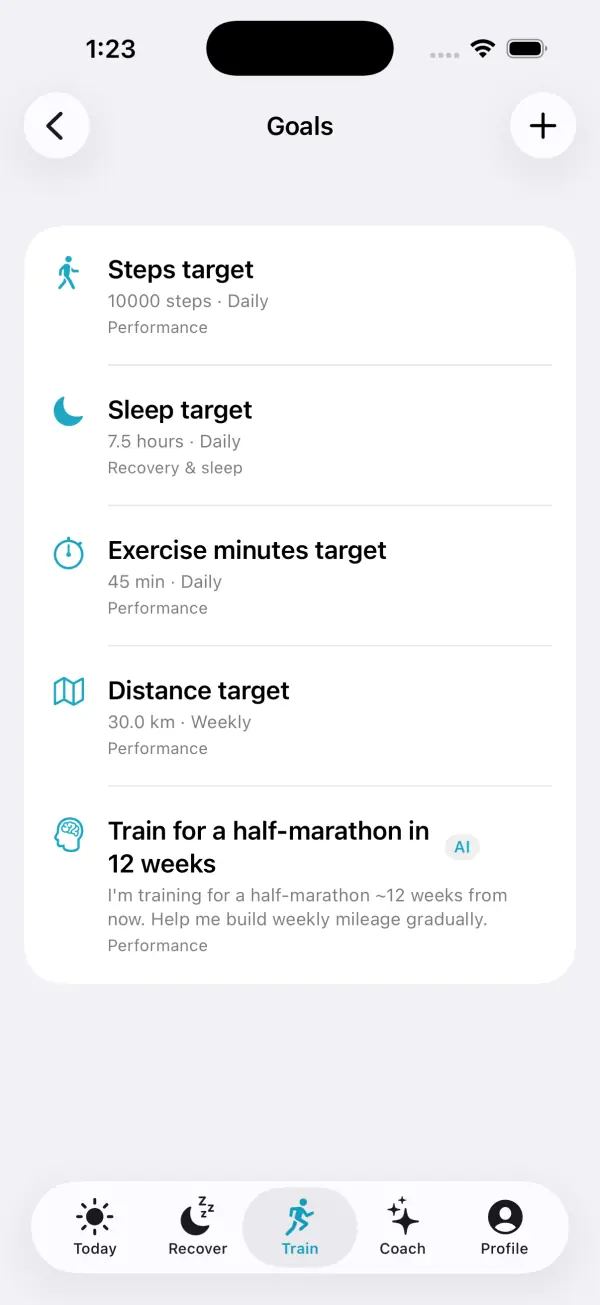
VedaWatch reads your steps from Apple Health and turns them into a goal you can track without logging anything. On the Train tab, open Goals, tap +, choose Metric target, then pick Steps and Daily or Weekly. The default is 10,000 steps a day, but the editor helps you pick your own number: once it has at least five days of your data, it shows a line like "Your average over the last 30 days: 7,850 steps. You'd have hit this target 40% of the time." That's the baseline-plus-a-little approach above, done for you. Switching a steps goal from Daily to Weekly multiplies the target by 7.
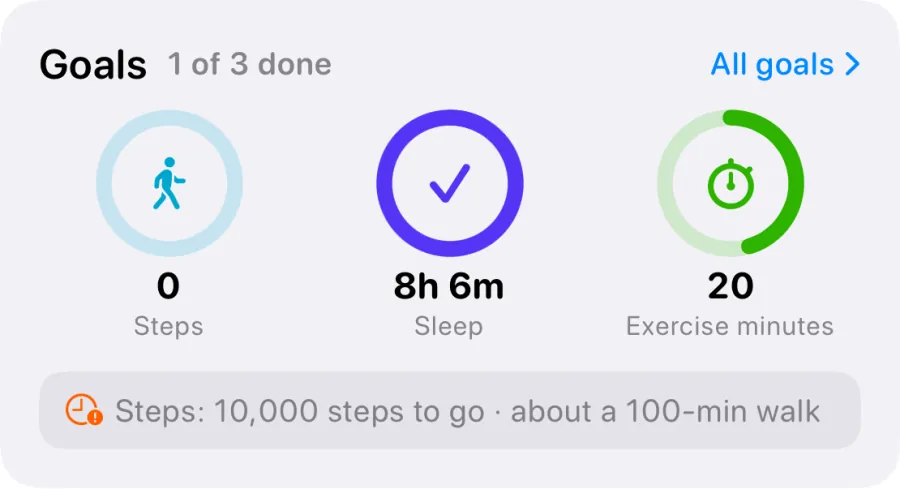
During the day, the goal shows whether you're on pace, treating 7:00 to 21:00 as the active day. When you're behind, it turns the gap into a walk, estimating about 100 steps a minute, as in "3,800 steps to go · about a 40-min walk". The goal's detail page shows your streak, best run, hit rate over the last 30 days and a bar chart against your target line.
Tap Steps on the Today tab for a detail page with a 7, 30 or 90-day trend and a Where you stand bar using common adult activity bands: Low below 5,000, Light 5,000 to 7,500, Active 7,500 to 10,000 and Very active above 10,000. Step goals don't need Pro; asking the AI coach about a goal does.
Steps alongside your other daily goals
Steps work best as part of a small set of goals rather than on their own. A typical combination is a daily step goal, a daily or weekly exercise-minutes goal for the brisk part, and a sleep goal. In VedaWatch the Today tab shows up to three active goals as rings, with one line pointing at whichever is furthest behind.
If you walk less on some days for good reasons, such as a rest day after a hard workout, a weekly steps goal is more forgiving and still keeps you honest across the week. And if you're unwell, injured or very tired, missing a step goal for a day or two is fine. A goal is there to help you, not to grade you.
If you've been inactive for a long time, have a heart or lung condition, joint pain that walking makes worse, or you feel chest pain, unusual breathlessness or dizziness when you walk, talk to a doctor before increasing your steps. This guide is general information, not medical advice.
Frequently asked questions
Do steps from running count the same as walking steps?
Your step count includes both, and the studies above counted all steps measured by the device. Running packs more steps into fewer minutes at a higher intensity, so a run is an efficient way to add to your daily total.
Is 5,000 steps a day enough?
It's far better than 2,000, and the 2025 review saw several health risks start to level off from around 5,000 to 7,000. If 5,000 is where you are, it's a good base; adding another 2,000 over a few weeks brings you into the range linked with most of the benefit.
Can I lose weight just by walking 10,000 steps?
Extra walking burns extra energy, but weight change also depends on what you eat, and the studies on this page measured health outcomes like mortality and heart disease, not weight loss. Treat steps as good for health in their own right, whether or not the scale moves.
Do I need to do all my steps in one walk?
No. The studies counted total steps across the day. Short walks after meals, taking stairs and walking during calls all add up, though a longer brisk walk also counts toward moderate activity.
How many steps a day should a 70-year-old aim for?
In the 2022 meta-analysis, benefit for adults 60 and over levelled off at around 6,000 to 8,000 steps a day, and in a study of women averaging 72, about 7,500. Starting from your current average and adding gradually is safer than jumping to a fixed number, especially with balance or joint problems.
Related guides
- How to set step, sleep and exercise goals with Apple Watch and track your progress
- Apple Watch Activity Rings explained: why they won't close, and the research behind them
- Weekly vs daily fitness goals: which keeps you consistent?
- Walking workout plan: a 6-week brisk walking plan for Apple Watch
- Zone 2 training with Apple Watch: find your heart rate range and stick to it
- Apple Watch streaks beyond Move: track sleep, steps and exercise consistency
Sources & further reading
- The Lancet Public Health (2025): Daily steps and health outcomes in adults: a systematic review and dose-response meta-analysis (Ding et al.)
- The Lancet Public Health (2022): Daily steps and all-cause mortality: a meta-analysis of 15 international cohorts (Paluch et al.)
- JAMA Internal Medicine (2019): Association of step volume and intensity with all-cause mortality in older women (Lee et al.)
- European Journal of Preventive Cardiology (2023): The association between daily step count and all-cause and cardiovascular mortality: a meta-analysis (Banach et al.)
- International Journal of Behavioral Nutrition and Physical Activity (2011): How many steps/day are enough? For adults (Tudor-Locke et al.)
- International Journal of Behavioral Nutrition and Physical Activity (2019): Walking cadence (steps/min) and intensity in 21-40 year olds: CADENCE-adults (Tudor-Locke et al.)
- Harvard Health Publishing (2019): 10,000 steps a day, or fewer?
- Apple Support: Manage Health data on your iPhone, iPad, or Apple Watch
This guide is educational, not medical advice, and has not been clinically reviewed. VedaWatch is not a medical device. If you have symptoms or concerns about your heart or health, contact a qualified healthcare professional.
Put your trends in perspective.
Explore HRV, sleep, and recovery with VedaWatch on your iPhone.
Download VedaWatch on the App Store →