 VedaWatch
Workouts & Training
Walking workout plan: a 6-week brisk walking plan for Apple Watch
A 6-week walking workout plan with brisk pace and cadence targets, weekly step and Exercise ring goals, and what research says walking for fitness does.
By VedaWatch editorial team · · 10 min read
The short answer
A good walking workout plan builds from about 10 to 30 minutes of brisk walking, five days a week, over six weeks, then adds one interval walk and one longer walk. Brisk means you can talk but not sing, or roughly 100 steps a minute. By week 5 that reaches the WHO's 150 minutes a week.
What is a good walking workout plan?
A walking workout plan is just a schedule that makes your walks a little longer, a little faster or a little harder each week, instead of walking the same loop at the same pace forever. The goal for most adults is the World Health Organization's guideline: 150 to 300 minutes of moderate-intensity activity a week, and brisk walking counts as moderate intensity.
The plan below gets you there in six weeks. You walk five days a week. Every walk starts and ends with five easy minutes, and the part in the middle is brisk. The brisk block grows from 10 minutes in week 1 to 30 minutes in week 5, which is where you reach 150 brisk minutes a week. Week 6 keeps that volume and swaps two of the walks for an interval walk and a longer walk, so you keep improving rather than plateauing.
If 10 brisk minutes feels hard, repeat week 1 until it doesn't. If it feels easy, start at week 2 or 3. A plan is only useful if you can do it next week too, so pick the week that feels like a 5 or 6 out of 10, not a 9.
How fast is a brisk walk? Pace, cadence and the talk test
Brisk is the word that matters most in any walking plan, and it is also the one people get wrong most often. A stroll to the shops does count towards your step total, but it usually isn't moderate intensity. There are three simple ways to check.
The talk test. The CDC's rule of thumb is that during moderate activity you can talk but not sing. During vigorous activity you can't say more than a few words without pausing for breath. For the brisk blocks in this plan, aim for the first: talking in full sentences is possible but takes a little effort.
Speed. The CDC lists walking briskly as 2.5 miles per hour or faster (about 4 km/h). Fitter or taller people may need to go well above that to feel any effort, which is why the talk test and cadence are more personal guides than a single speed.
Cadence. In the CADENCE-adults study, 76 healthy adults aged 21 to 40 walked on a treadmill while researchers measured their energy use. About 100 steps a minute was a good threshold for moderate intensity and about 130 steps a minute for vigorous intensity. To find your cadence, count your steps for 15 seconds at your brisk pace and multiply by four. If you get 90, quicken your steps; if you get 110 or more, you are comfortably in the brisk range. These are group averages from younger adults, so treat 100 as a starting point and let the talk test have the final say.
The 6-week walking plan, week by week
Each walk below is 5 minutes easy, then the brisk block, then 5 minutes easy. Spread the five walks across the week and leave at least one day in between your two hardest walks once they appear. Two days a week are rest days or gentle walking only.
- Week 1: five walks of 20 minutes, each with 10 minutes brisk. That's 50 brisk minutes for the week. Focus on finding your brisk pace with the talk test.
- Week 2: five walks of 25 minutes, each with 15 minutes brisk, for 75 brisk minutes. Check your cadence once during each walk.
- Week 3: five walks of 30 minutes, each with 20 minutes brisk, for 100 brisk minutes. Make one of them a hill walk: pick a route with a climb or two and keep the effort, not the speed, the same.
- Week 4: five walks of 35 minutes, each with 25 minutes brisk, for 125 brisk minutes. Replace one with your first interval walk: after the warm-up, do 5 rounds of 2 minutes fast and 2 minutes at your normal brisk pace.
- Week 5: five walks of 40 minutes, each with 30 minutes brisk, for 150 brisk minutes. This meets the WHO's weekly minimum on walking alone. Keep one interval walk and one hill walk in the week.
- Week 6: three walks of 40 minutes with 30 minutes brisk, one interval walk of 6 rounds of 3 minutes fast and 2 minutes brisk, and one longer walk of 50 to 60 minutes at an easy-to-brisk pace. That adds up to roughly 170 to 180 minutes of moderate activity.
How to do interval and hill walks
Intervals and hills are the two ways to make walking harder without needing to run. They push your heart rate and breathing up for short spells, which is where most of the extra fitness comes from once steady brisk walking starts to feel easy.
For an interval walk, the fast parts should feel like a 7 out of 10: you can say a short sentence but wouldn't want to hold a conversation. That's near the vigorous end of the talk test, and for many people it means a cadence in the region of 120 to 130 steps a minute. Shorten your stride and quicken your steps rather than reaching out with longer strides, and drive your arms with your elbows bent. The recovery parts are your normal brisk pace, not a stop.
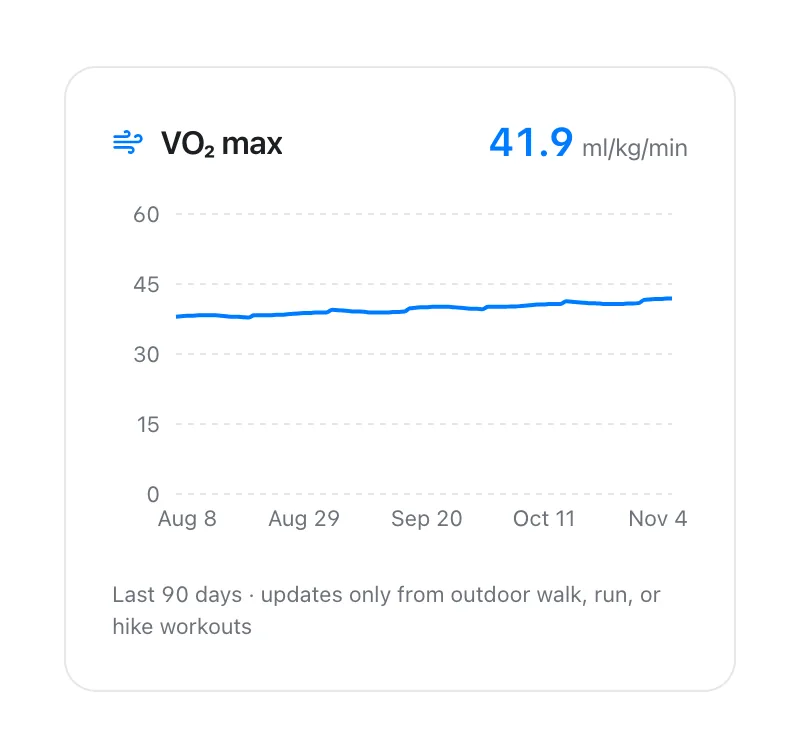
For a hill walk, slow your speed going up so the effort stays the same as on the flat, and lean slightly forward from the ankles. On the way down, take shorter steps to go easy on your knees. A treadmill with an incline works too, but Apple Watch only updates its Cardio Fitness estimate from outdoor walks, runs and hikes, so walk outside at least once a week if you want that number to keep updating.
If an interval or hill walk leaves you sore or wiped out the next day, do the next walk easy and repeat that week before moving on. Progress in walking is slow by design, and that's part of why it's so easy to stick with.
Step and Exercise ring goals for each week
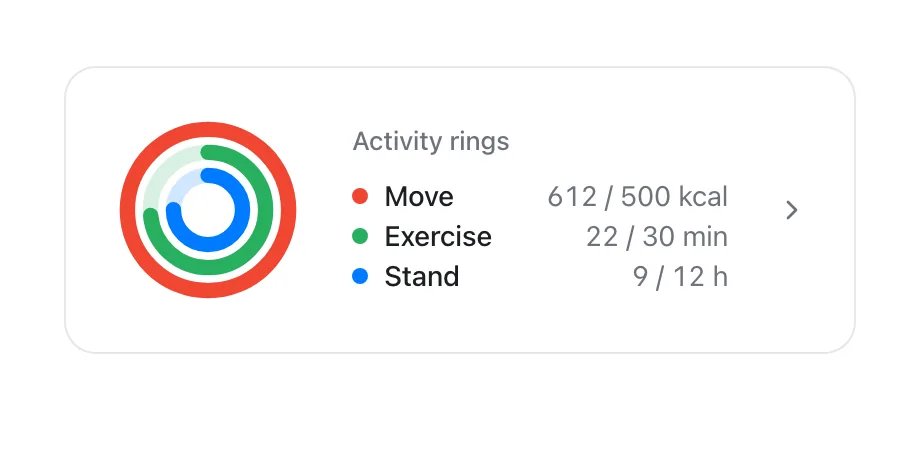
Apple's Exercise ring is built for exactly this kind of plan. Apple says you close it with at least 30 minutes of activity at or above a brisk walk, so a walk that is genuinely brisk adds minutes, while a slow stroll mostly adds to the Move ring and your steps. If your brisk walks are not filling the Exercise ring, that's a useful sign to pick up the pace.
A simple way to set goals for the six weeks is to match them to the plan rather than to a fixed number from day one.
Exercise minutes: start your daily Exercise goal at around your brisk block plus a little everyday movement, such as 15 minutes in week 1, and raise it as the brisk block grows until it reaches 30 minutes in week 5. If your Apple Watch currently asks for more than you can manage, lowering the goal for a few weeks is better than missing it every day.
Steps: look at your average daily steps over the last couple of weeks and set your first step goal about 1,000 to 2,000 above it. Each week, if you hit it on most days, add another 1,000 or so. A 30-minute brisk walk at 100 steps a minute is about 3,000 steps on its own, so the walks in this plan move your step count a long way by themselves.
On rest days, it's fine to miss a step goal. A weekly step total is more forgiving than a daily one and better reflects a plan that has hard days and easy days.
Is walking good exercise? What the research shows
Walking for fitness has more good evidence behind it than most people expect. A 2015 meta-analysis in the British Journal of Sports Medicine pooled 42 studies of outdoor walking groups with 1,843 participants. By the end of the programmes, systolic blood pressure was on average 3.72 mmHg lower, resting heart rate 2.88 beats per minute lower and body fat 1.31 percentage points lower, while VO2 max rose by 2.66 ml/kg/min. Depression scores also improved, and no notable side effects were reported.
Pace seems to matter as well as amount. A pooled analysis of 11 British cohorts with 50,225 walkers found that people who reported walking at an average pace had a 20% lower risk of death from any cause than slow walkers, and brisk or fast walkers 24% lower. Links with cardiovascular deaths were similar, but there was no link with cancer deaths.
Step data tells a similar story. In a UK Biobank study of 78,500 adults who wore a wrist accelerometer, more daily steps were linked with lower risk of death, heart disease and cancer, up to about 10,000 steps a day. Faster stepping in a person's most active 30 minutes was linked with lower risk on top of their total steps.
Two caveats. The pace and step studies are observational, so they show that brisk walkers tend to be healthier, not that walking faster is guaranteed to change your own risk. And group averages hide a lot of variation between people. For the bigger picture on step counts, see our guide to how many steps a day you need.
How to track a walking workout on Apple Watch
Your Apple Watch counts steps all day, but starting a workout for your planned walks gives you better data and makes each walk easy to find later.
- Open the Workout app and choose Outdoor Walk (or Indoor Walk on a treadmill). Outdoor walks also feed Apple's Cardio Fitness estimate.
- Walk your 5-minute warm-up, then start your brisk block. Glance at heart rate and pace, and use the talk test to check you're in the right range.
- For interval walks, build a custom workout with work and recovery intervals if your Watch offers one for walking, or simply watch the elapsed time and switch every few minutes.
- After the walk, check the summary on your iPhone in the Fitness app: duration, distance, average pace and heart rate. Week to week, a faster pace at the same heart rate is a sign your fitness is improving.
- Look at your Exercise ring at the end of the day. If a 30-minute brisk walk only added 15 minutes, you were probably below brisk for half of it.
How VedaWatch helps you follow a walking plan
VedaWatch reads your steps, Exercise minutes and workouts from Apple Health, so a walking plan can run on what your Watch already records without extra logging.
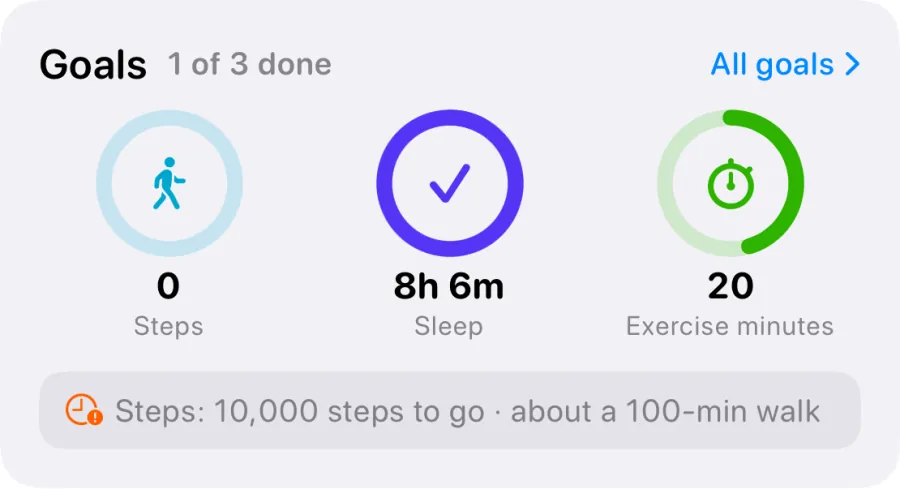
Goals. On the Train tab, open Goals, tap +, choose Metric target, and pick Steps or Exercise minutes, daily or weekly. When a step goal is behind, the Goals card turns the gap into walking time, estimating about 100 steps a minute, such as "3,800 steps to go, about a 40-min walk". An Exercise minutes goal that's behind suggests a brisk session of the minutes left. Raise either goal as you move through the weeks of the plan.
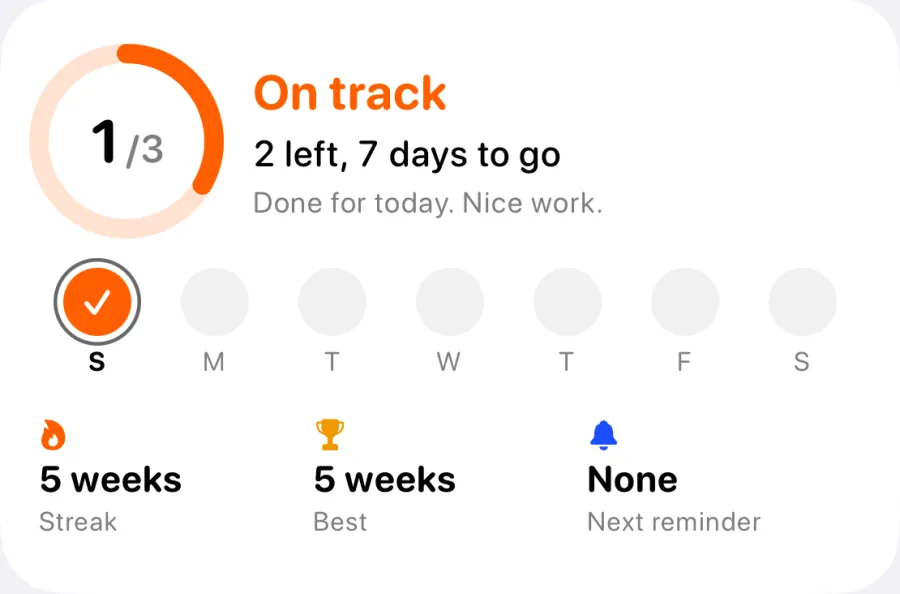
Planned walks. On the Weekly target screen you can plan your week day by day. Tap a day, choose Activity, then Walk, and set the length, such as About 30 min. Any walking workout from Apple Health on that day counts as planned, or you can start it as a guided walk from VedaWatch that coaches the session by time. With Count other workouts on, walks of 20 minutes or more also count towards your weekly target and its streak.
Recovery. If your readiness looks low, VedaWatch suggests going easier that day, and a recovery day in your plan becomes a very easy walk. That fits the plan above: when you're run down, an easy walk is better than forcing an interval session.
Goals and the weekly target are free. The AI Coach, which can answer questions about your walks and suggest changes to your week plan for you to apply or dismiss, is part of VedaWatch Pro at $6.99 a month or $59.99 a year.
Safety, and what to do after week 6
Walking is one of the safest ways to get fitter, but check with a doctor before starting if you have a heart or lung condition, high blood pressure that isn't controlled, diabetes, joint problems, or you're pregnant, or if you've been inactive for a long time and have health concerns. Stop and get medical advice if you have chest pain or pressure, unusual breathlessness, dizziness or pain that changes the way you walk. This guide is general information, not medical advice.
Good shoes and a gradual build-up prevent most of the common niggles, such as sore shins or blisters. If something hurts, repeat a week rather than pushing on.
After week 6 you have three good options. Keep the week 6 pattern as a long-term routine, since 150 minutes or more of brisk walking already meets the WHO guideline. Build towards 300 minutes a week, the top of the WHO range, by lengthening the longer walk and adding a sixth walk. Or, if you'd like to start running, a walk-run plan such as Couch to 5K is a natural next step. Whatever you choose, add two days a week of muscle-strengthening work, which the WHO recommends for all adults alongside aerobic activity.
Frequently asked questions
Is walking 30 minutes a day enough exercise?
Thirty minutes of brisk walking on five days a week adds up to 150 minutes, the WHO's minimum for adults. More brings more benefit, up to 300 minutes a week, and the WHO also recommends muscle-strengthening activity on two days a week.
How long until I see results from a walking plan?
Walking feels easier within a few weeks for most people, and in walking-group studies blood pressure, resting heart rate and fitness had improved by the end of the programmes. Changes in Apple's Cardio Fitness estimate usually show over months.
Is it better to walk faster or walk longer?
Both help. Large studies link both more daily steps and a brisker pace with better health, so a plan that first builds time and then adds faster intervals covers both.
Does a treadmill walk count?
Yes. A brisk treadmill walk counts towards your Exercise ring and the WHO's weekly minutes. It just won't update Apple Watch's Cardio Fitness estimate, which only uses outdoor walks, runs and hikes.
Can I split a walk into shorter ones?
Yes. The WHO guidelines count all moderate activity towards the weekly total, so two 15-minute brisk walks give you the same minutes as one 30-minute walk.
Related guides
- How many steps a day do you need? What the studies show by age
- How to close your rings every day (and when to pause them)
- Apple Watch VO2 max (Cardio Fitness): what it measures and how accurate it is
- Zone 2 training with Apple Watch: find your heart rate range and stick to it
- Couch to 5K on Apple Watch: the 9-week plan, week by week
- How to set step, sleep and exercise goals with Apple Watch and track your progress
Sources & further reading
- International Journal of Behavioral Nutrition and Physical Activity (2019): Walking cadence (steps/min) and intensity in 21-40 year olds: CADENCE-adults (Tudor-Locke et al.)
- British Journal of Sports Medicine (2015): Is there evidence that walking groups have health benefits? A systematic review and meta-analysis (Hanson & Jones)
- British Journal of Sports Medicine (2018): Self-rated walking pace and all-cause, cardiovascular disease and cancer mortality (Stamatakis et al.)
- JAMA Internal Medicine (2022): Prospective associations of daily step counts and intensity with cancer and cardiovascular disease incidence and mortality and all-cause mortality (del Pozo Cruz et al.)
- British Journal of Sports Medicine (2020): World Health Organization 2020 guidelines on physical activity and sedentary behaviour (Bull et al.)
- CDC: How to Measure Physical Activity Intensity
- Apple: Close Your Rings
- Apple Support: Track your cardio fitness levels
This guide is educational, not medical advice, and has not been clinically reviewed. VedaWatch is not a medical device. If you have symptoms or concerns about your heart or health, contact a qualified healthcare professional.
Put your trends in perspective.
Explore HRV, sleep, and recovery with VedaWatch on your iPhone.
Download VedaWatch on the App Store →