 VedaWatch
Workouts & Training
Couch to 5K on Apple Watch: the 9-week plan, week by week
A complete couch to 5K plan for Apple Watch: all 9 weeks of run/walk intervals, how to set them up in the Workout app, and what to change on low-recovery days.
By VedaWatch editorial team · · 11 min read
The short answer
Couch to 5K is about 9 weeks of three run/walk sessions a week, starting with 1-minute runs and ending with 30 minutes of continuous running. On Apple Watch, build each week as a Custom Workout in the Workout app so it taps you at every switch, and repeat a week or walk more on low-recovery days.
How couch to 5K works with an Apple Watch
Couch to 5K is a beginner running plan that takes you from no running at all to about 30 minutes of continuous running, which for many new runners is roughly 5 km. The best-known version, from England's NHS, runs for 9 weeks with three sessions a week and rest days in between. Week 1 alternates 1 minute of running with 90 seconds of walking; by week 9 you run for 30 minutes without stopping.
Every session starts with a 5-minute brisk walk and ends with a 5-minute walk, so each one takes about half an hour. That's a realistic slot for most people, and three of them a week sits comfortably alongside the CDC's suggestion of 150 minutes of moderate activity a week for adults.
The Apple Watch is a good fit because the hard part of run/walk training is the clock. Instead of staring at a timer, you can save each week's intervals as a Custom Workout in the built-in Workout app. The watch then tells you when to switch between running and walking, shows what's left in the current interval, and records heart rate, distance and pace to Apple Health. Your phone can stay at home if you have a cellular model or don't need music from it.
One honest caveat: 30 minutes of running is the goal, not exactly 5 km. Depending on your pace, 30 minutes might be 3.5 km or 5.5 km. Both count as finishing the plan. If you want the full distance, add a few extra minutes in the weeks after week 9.
The 9-week couch to 5K plan, week by week
This is the NHS Couch to 5K schedule. Do each week's session three times, on non-consecutive days, for example Monday, Wednesday and Saturday. Every session begins with a 5-minute brisk walk and ends with a 5-minute walk; the steps below show only the part in between.
From week 5 the three runs in a week are different, and the third one is a big jump. Week 5's third run is 20 minutes without a walk break, compared with 8-minute runs two days earlier. That's the moment most people doubt themselves. Slow right down for it; finishing slowly is the whole point.
- Week 1 (all three runs): 1 min run, 90 s walk, repeated until you've done 8 runs. About 8 minutes of running in total.
- Week 2 (all three runs): 90 s run, 2 min walk, repeated until you've done 6 runs. About 9 minutes of running.
- Week 3 (all three runs): 90 s run, 90 s walk, 3 min run, 3 min walk, then the same again (the last 3-minute run has no walk after it). About 9 minutes of running in longer pieces.
- Week 4 (all three runs): 3 min run, 90 s walk, 5 min run, 2 min 30 s walk, 3 min run, 90 s walk, 5 min run. About 16 minutes of running.
- Week 5: run 1 is 5 min run, 3 min walk, three times through (ending on a run). Run 2 is 8 min run, 5 min walk, 8 min run. Run 3 is 20 minutes of running with no walk break.
- Week 6: run 1 is 5 min run, 3 min walk, 8 min run, 3 min walk, 5 min run. Run 2 is 10 min run, 3 min walk, 10 min run. Run 3 is 25 minutes of running.
- Week 7 (all three runs): 25 minutes of continuous running.
- Week 8 (all three runs): 28 minutes of continuous running.
- Week 9 (all three runs): 30 minutes of continuous running. That's the finish line of the plan.
How to set run/walk intervals in the Apple Watch Workout app
Apple Watch's Workout app can save a Custom Workout with a warmup, any number of work and recovery intervals, and a cooldown. For couch to 5K, Work is your run and Recovery is your walk. Apple says custom workouts work with every workout type except Multisport and Open Water Swim, so use Outdoor Run (or Indoor Run on a treadmill) for all of them, even the walking parts. Here's week 1 as an example:
- Open the Workout app on your Apple Watch and turn the Digital Crown to Outdoor Run.
- Tap the button with three dots on the Outdoor Run tile (Apple calls it the More or Goals button, depending on your watchOS version), tap Custom, then tap Add.
- Tap Warmup, choose Time and set 5:00. This is your brisk walk.
- Tap Add, choose Work, choose Time and set 1:00. Then tap Add, choose Recovery, choose Time and set 1:30.
- If your watch offers Repeats under Add, select the Work and Recovery intervals you just made and set 7 repetitions. If it doesn't, add Work and Recovery pairs one after another until you have 7 of each.
- Add one more Work interval of 1:00, so the session ends on your 8th run.
- Tap Cooldown, choose Time and set 5:00. Tap the default name under Custom Title, call it something like C25K Week 1, then tap Create Workout.
- To start, scroll to Outdoor Run, open the same menu and tap C25K Week 1. During the run, the Up Next view shows what's left in the current interval and what comes next.
Building the rest of the weeks as Custom Workouts
Weeks 1 and 2 are simple repeats. Weeks 3 to 6 change interval lengths inside one session, so add the intervals one by one in order rather than using Repeats. Week 4, for example, is Warmup 5:00, Work 3:00, Recovery 1:30, Work 5:00, Recovery 2:30, Work 3:00, Recovery 1:30, Work 5:00, Cooldown 5:00.
Weeks 5 and 6 need three different custom workouts each, one per run. Name them clearly (C25K 5.1, 5.2, 5.3) so you pick the right one at the door. From week 7 you don't need intervals at all: a Warmup of 5:00, one Work interval of 25:00, 28:00 or 30:00, and a Cooldown of 5:00 is enough.
You don't have to create all of them on day one. Build next week's workout on your rest day, and delete old ones by swiping left on them in the custom workout list.
A small tip: set your intervals by time, not distance. Couch to 5K is written in minutes, and running by time means a slow day and a fast day are the same workout, which is exactly what a beginner needs.
How fast should you run in couch to 5K?
Slower than you think. The most common reason people stall in weeks 5 and 6 is running the early intervals too fast. A good check is the talk test the CDC uses for intensity: at a moderate effort you can talk but not sing, while at a vigorous effort you can't say more than a few words without pausing for breath. Your running intervals should feel closer to the first than the second, especially in the longer runs from week 5.
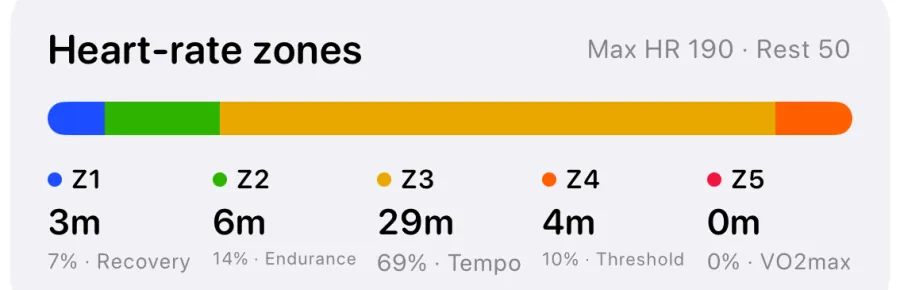
Your Apple Watch heart rate zones can confirm it after the run. Don't be surprised if a beginner's run lands mostly in zones 3 and 4 even at a gentle jog; running is simply harder than walking when you're new to it. That's fine in the first weeks. What you're aiming for over time is the same interval feeling easier at the same pace, or getting faster at the same heart rate.
If you can't keep up the running interval without gasping, slow to a shuffle rather than stopping. If even that's too much, repeat the week. Nobody is checking your pace, and the plan only works if you finish the sessions.
What to do on low-recovery days
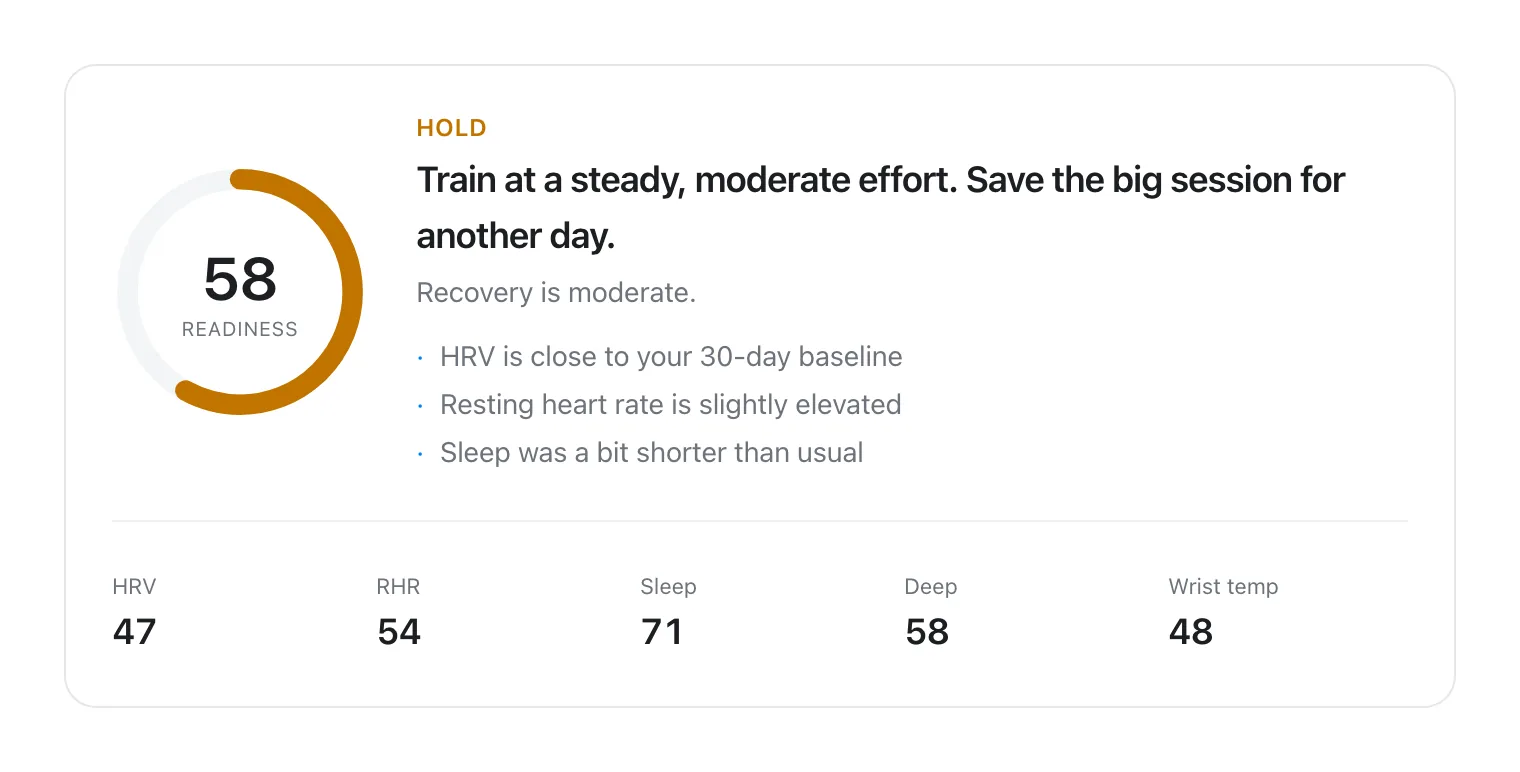
Couch to 5K is gentle, but your body doesn't know that the plan says Wednesday. Bad sleep, a stressful week, a cold coming on or sore legs from the last run can all make a session feel much harder than it should. Apple Watch can't tell you to rest by itself, but its overnight heart rate variability (HRV), resting heart rate and sleep data are useful clues when they look clearly worse than your normal.
Research on endurance training that is adjusted to HRV, such as a 2020 systematic review by Düking and colleagues, found the approach promising but with limited and inconsistent evidence so far. So treat these numbers as a nudge, not a rule, and always weigh how you actually feel. Here's a sensible way to adjust a couch to 5K session:
- Slightly off (short night, a bit tired, numbers a little below normal): do the session as planned, but run the intervals slower and take an extra walk break if you need one.
- Clearly off (several signals worse than usual, heavy legs, or the warmup walk feels hard): replace the session with the previous week's version, or swap it for a 20 to 30 minute brisk walk and do the run tomorrow.
- Unwell (fever, chest symptoms, or feeling ill): don't run. Rest until you feel normal again, then restart with the last week you completed comfortably.
- Never make up a missed run by running two days in a row. Keep at least one rest day between sessions and simply shift the week.
- If you miss a week or more, go back one week before carrying on. If you miss several weeks, go back further.
Is it OK to repeat a week of couch to 5K?
Yes, and the NHS plan says so directly: it's fine to repeat any run or week, and to take longer than 9 weeks. Finishing in 12 or 14 weeks is still finishing. The three biggest jumps, where repeating is most often worth it, are week 3 to 4 (running time almost doubles), week 5's third run (the first 20 minutes without a break) and week 6 to 7 (no more walk breaks).
A useful rule is to move on only when you finished all three runs of the current week and the last one felt manageable. If you finished but had to walk during running intervals, repeat. Repeating with your Apple Watch is easy, because the custom workout is already saved.
Some aches are normal when you start running, like mild muscle soreness that fades within a day or two. Pain that is sharp, gets worse as you run, makes you limp, or is still there days later is a reason to stop and get it checked, not to push through.
How VedaWatch helps with your first 5K
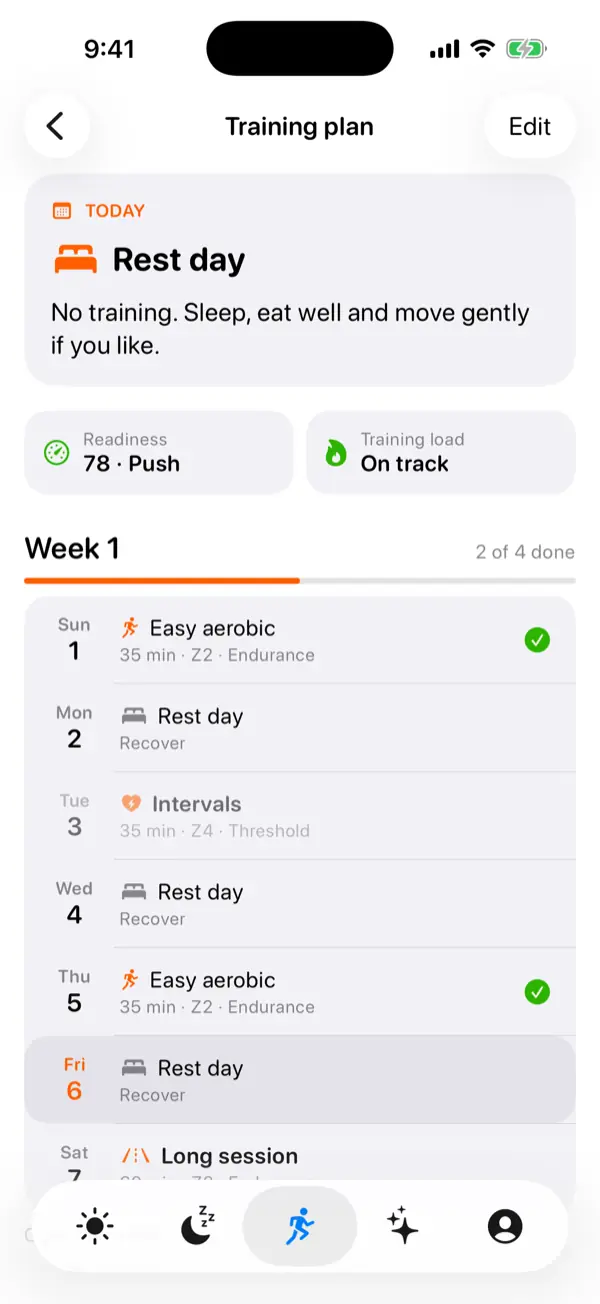
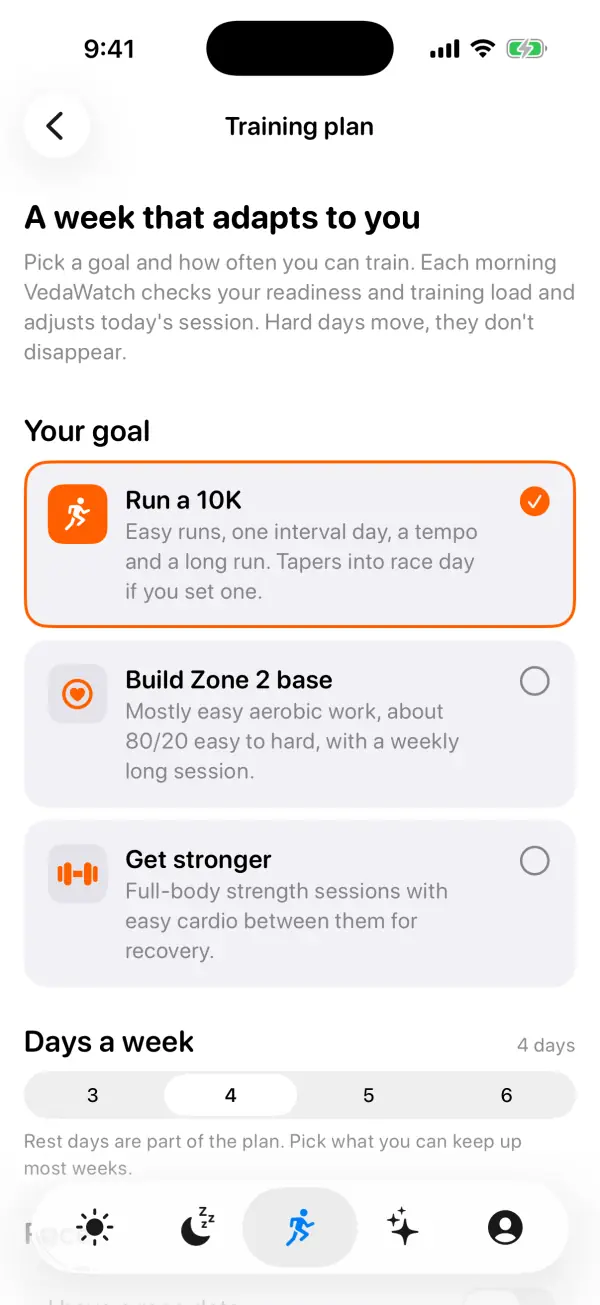
If you'd like a plan that adjusts itself instead of a fixed calendar, VedaWatch's Training plan has a Run my first 5K goal. It isn't the NHS schedule. It's VedaWatch's own plan, described in the app as going from easy run-walks to running 5 km without stopping, gentle and built around rest. It recommends 8 weeks to your chosen run day (4 at the minimum), defaults to 3 days a week, and you can choose up to 6.
Early on, your regular runs are run-walks of 2 minutes easy running and 1 minute walking, and once a week there's a longer session where you walk for a minute whenever you need. From the build phase, one session a week adds gentle pickups: 6 times 1 minute a little quicker, with 2 minutes walking between. Sessions grow slowly for three weeks, then ease off in a lighter week, and the final weeks get lighter so you arrive fresh. A target time is optional; a first 5K is guided by effort.
Each morning, the plan checks your readiness score, built from your HRV, resting heart rate and sleep compared with your recent baseline, plus your training load. On a Rest morning, any session becomes a very easy 20-minute walk or similar. On a Hold morning, the longer session is cut by a quarter and a pickups session becomes an easy run, and the pickups move to a later day in the week if there's room. While your baseline is still forming, it simply tells you to follow the plan and go by feel.
Today's session appears at the top of the VedaWatch workout picker on your Apple Watch as a one-tap start with a duration target, and the watch taps your wrist when you reach it. It doesn't beep at each run/walk switch, so if you want interval alerts, you can do that day's session as a Custom Workout in Apple's Workout app instead. VedaWatch counts a session as done when Apple Health has workouts that day adding up to at least half its planned minutes. The Training plan is part of VedaWatch Pro, $6.99 a month or $59.99 a year on the US App Store.
After week 9, and when to check with a doctor
Once you can run 30 minutes, keep three runs a week for a while so the habit and your joints settle. Then either add a few minutes to one run each week until you cover the full 5 km, or move on to a structured 5K or 10K plan with a race date. Our race training guide explains how base, build and taper phases work.
Talk to a doctor before starting if you have a heart or lung condition, diabetes, high blood pressure, are pregnant, are returning from an injury, or haven't exercised in a long time and are worried about your health. Stop running and get medical help if you have chest pain, unusual shortness of breath, dizziness or fainting. This guide is general information, not medical advice, and Apple Watch readings are wellness signals, not a diagnosis.
Frequently asked questions
Can I do couch to 5K on Apple Watch without my iPhone?
Yes. Custom workouts live in the Workout app on the watch, and Apple Watch records heart rate and time on its own. Outdoor distance and route use the watch's GPS, and everything syncs to Apple Health when your iPhone is back in range.
Should I use Outdoor Run or Outdoor Walk for couch to 5K?
Outdoor Run. Custom workouts are built inside one workout type, and the walking intervals are part of a running session. In Apple Health it will show as one run that includes your walk breaks.
Can I do couch to 5K on a treadmill?
Yes. Build the same custom workout under Indoor Run. Indoor distance is estimated rather than measured by GPS, so go by time, which is how the plan is written anyway.
Is 9 weeks enough to run 5K?
For many people, 9 weeks is enough to run for 30 minutes, which may be a little short of or a little beyond 5 km depending on pace. Taking longer by repeating weeks is common and completely fine.
What if I can only run twice a week?
Then each week takes a week and a half. Keep the sessions in order and move to the next week after three completed runs, rather than skipping a session to stay on the calendar.
Related guides
- Training for a 5K, 10K or half marathon with Apple Watch: a plan that adapts to your recovery
- Easy run pace: how slow should easy runs be?
- Should you train or rest when HRV is low?
- Apple Watch heart rate zones explained: what each zone means and how to set them
- How to run a faster 5K: an 8-week plan with Apple Watch
- How to start running again after a break: a plan by break length
Sources & further reading
- NHS: Couch to 5K running plan (week-by-week)
- NHS: Get running with Couch to 5K
- Apple Support: Create a custom workout on Apple Watch
- CDC: Adult Activity: An Overview (physical activity guidelines)
- CDC: Measuring Physical Activity Intensity (the talk test)
- Düking et al. 2020, Scandinavian Journal of Medicine & Science in Sports: Predefined vs. data-guided training prescription based on autonomic nervous system variation: A systematic review
This guide is educational, not medical advice, and has not been clinically reviewed. VedaWatch is not a medical device. If you have symptoms or concerns about your heart or health, contact a qualified healthcare professional.
Put your trends in perspective.
Explore HRV, sleep, and recovery with VedaWatch on your iPhone.
Download VedaWatch on the App Store →