 VedaWatch
Workouts & Training
Apple Watch VO2 max (Cardio Fitness): what it measures and how accurate it is
Apple Watch estimates your VO2 max—a strong predictor of long-term health—from outdoor walk, run, and hike workouts. Here's exactly how it's calculated, what counts as a good score, and what a 2024 lab validation study found about its accuracy.
By VedaWatch editorial team · · 7 min read
The short answer
Apple Watch estimates VO2 max from your heart rate and motion during outdoor walks, runs, and hikes—indoor and gym workouts don't count. A 2024 validation study against lab-measured VO2max found the watch underestimated it by about 4.5 mL/kg/min on average, with accuracy getting worse at the fitness extremes: it tends to overestimate low fitness and underestimate high fitness. Treat your score as a useful trend, not a lab-precise number.
What Cardio Fitness actually measures
Apple describes cardio fitness as a measurement of VO2 max—the maximum amount of oxygen your body can consume during exercise—and calls it a strong indicator of overall physical health and a predictor of long-term health.
Apple Watch estimates it using the heart and motion sensors during outdoor workouts in the Workout app, then factors in your age, sex, weight, height, and any medications that could affect your heart rate. It supports a VO2 max range of 14–65 mL/kg/min on Apple Watch Series 3 or later.
How to actually get a Cardio Fitness reading
Cardio Fitness doesn't update from just any workout—the type matters.
- Wear your Apple Watch for at least 24 hours before your first estimate appears.
- Log Outdoor Walk, Outdoor Run, or Hiking workouts in the Workout app—these are the types that count toward an estimate.
- Skip indoor and gym-equipment workouts: Apple is explicit that indoor workouts, including ones that require gym equipment, don't count toward your cardio fitness estimate. Push workouts aren't supported either.
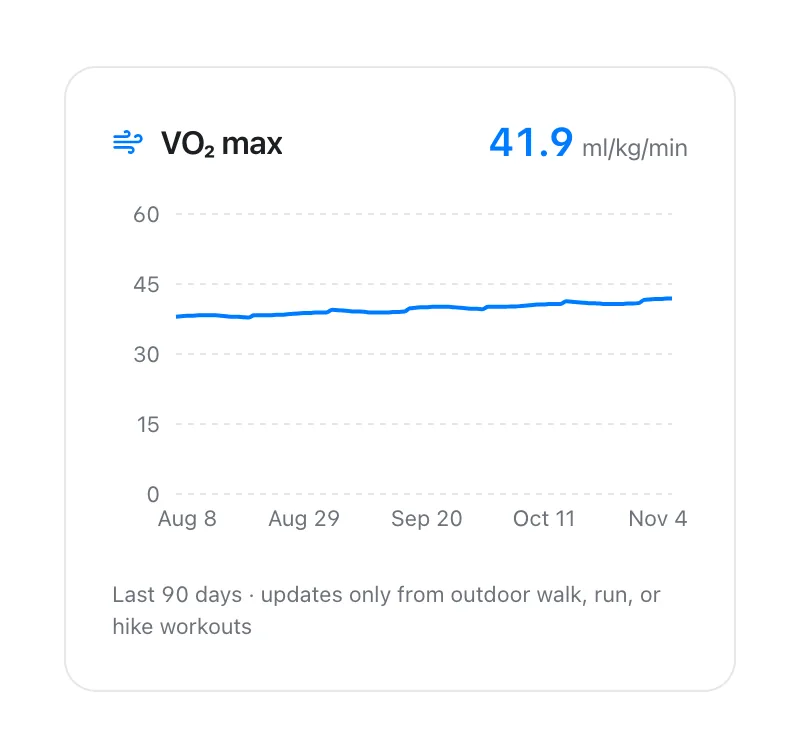
- Check your result in Health → Browse → Heart → Cardio Fitness, where you can view daily, weekly, monthly, six-month, and yearly averages.
What counts as a good score
Apple doesn't give you one universal target—classifications are available to users 20 or older, and you compare your result to others by tapping your score in the Health app, which shows how you rank against people of your age and sex. Apple's own cardio fitness screens label results as high, above average, below average, or low relative to that comparison group.
If your levels are low for your age and sex, Apple can also send a notification—and continued low readings trigger additional ones. Apple's general guidance: most people can improve their VO2 max by increasing the intensity and frequency of their cardiovascular exercise.
What a 2024 lab study found about accuracy
A 2024 validation study (JMIR Biomedical Engineering) tested the Apple Watch Series 7 against a gold-standard lab measurement: 19 participants completed a graded cycle-ergometer test to exhaustion with a portable metabolic gas analyzer, then a separate outdoor-run session wearing the watch.
Lab-measured VO2max averaged 45.88 mL/kg/min; the watch's estimate averaged 41.37—a bias of about 4.51 mL/kg/min lower, a statistically significant underestimate with a medium effect size. Reliability between the two methods was rated "poor to moderate" (ICC 0.47), and the mean absolute percentage error was 15.79%.
The more striking finding was how accuracy varied by fitness level. Participants with "poor" fitness (by standard criteria) were overestimated by about 3.8 mL/kg/min, while participants with "excellent" fitness were underestimated by about 12 mL/kg/min—the watch compresses results toward the middle of the range, flattering low fitness and understating high fitness. That pattern echoes Apple's own disclaimer that certain conditions or medications limiting your heart rate may cause VO2 max to be overestimated.
For context, Apple's own technical data (from a larger, longitudinal study design with repeated measurements per person) reported a smaller bias of around 1.2–1.4 mL/kg/min. The independent study's larger error likely reflects its single-session design rather than Apple's approach of refining an estimate over many workouts over time.
Common questions about Apple Watch VO2 max
Why hasn't my Cardio Fitness score updated in weeks? It only updates from outdoor Walk, Run, or Hike workouts—if you've been doing indoor cardio, strength training, or cycling, nothing will register.
Is a higher number always better? Generally yes for cardiovascular fitness, but the 2024 study found the watch tends to compress scores—so a very high score may be a bigger underestimate than it looks, and a low score may be a bit better than it looks.
Can medication affect my score? Yes—Apple states that medications limiting your heart rate response can cause VO2 max to be overestimated, since the estimate leans on your heart-rate response during exercise.
See your Cardio Fitness trend alongside the rest of your training
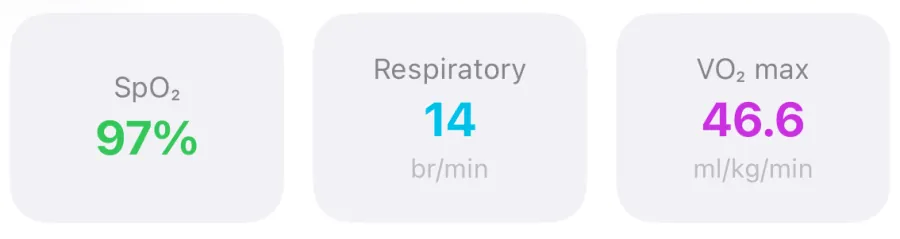
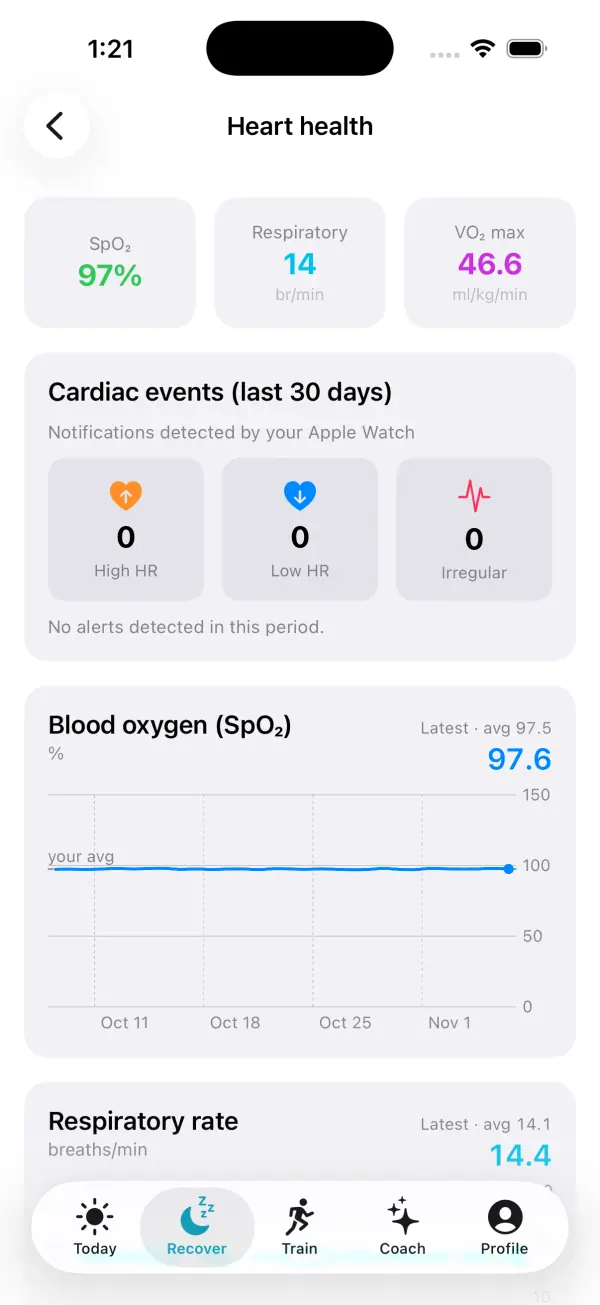
VedaWatch's Heart health view reads your VO2 max trend from Apple Health over the last 90 days, alongside resting heart rate, HRV, and blood oxygen—so a step-change in Cardio Fitness shows up next to the training and recovery signals that might explain it.
With permission, VedaWatch displays whatever estimate Apple Watch already produced; it doesn't recalculate or improve VO2 max accuracy itself. The lab study above is a reason to read your trend over months, not chase a single updated number.
Sources & further reading
- Apple Support: Track your cardio fitness levels
- JMIR Biomedical Engineering (2024): Assessing the Accuracy of Smartwatch-Based Estimation of Maximum Oxygen Uptake Using the Apple Watch Series 7: Validation Study (Caserman et al.)
This guide is educational, not medical advice, and has not been clinically reviewed. VedaWatch is not a medical device. If you have symptoms or concerns about your heart or health, contact a qualified healthcare professional.
Put your trends in perspective.
Explore HRV, sleep, and recovery with VedaWatch on your iPhone.
Download VedaWatch on the App Store →