 VedaWatch
Strength Training
Strength training for runners: a 2-day plan and when to lift
Strength training for runners: what research says about running economy and injury, a simple 2-day plan, and how to schedule lifting around hard runs.
By VedaWatch editorial team · · 11 min read
The short answer
Two strength sessions a week of heavy-ish lower-body lifts, single-leg work, calf raises and a little jumping can make running more economical, typically by about 2 to 8% in studies, without adding body weight. Lift on hard-run days or after easy runs, and keep heavy leg work away from the day before intervals or your long run.
Does strength training help runners?
Yes, for most runners it is one of the better uses of an extra hour a week. The clearest benefit is running economy: how much oxygen you need to hold a given pace. A 2018 systematic review of 24 studies in middle- and long-distance runners found that adding strength training generally improved running economy by 2 to 8% compared with running alone, and time trials from 1.5 to 10 km also tended to improve.
The same review found that body composition was not negatively affected, so the worry about getting heavier or bulky does not hold up in these studies. Its practical conclusion was that two to three strength sessions a week, mixing heavy lifting, explosive lifting and jumps, are likely to help distance runners.
Strength work is not magic, and not every study found a benefit. It works alongside sensible running, not instead of it. The rest of this guide covers what the research actually shows, a plan you can start this week, and the part most guides skip: where to put the sessions so they don't wreck your key runs.
What the research says about running economy and race times
Running economy works like fuel efficiency. Two runners with the same VO2 max can race very differently if one uses less oxygen at the same speed. Strength training seems to help mainly through the nervous system and stiffer, springier muscles and tendons, so each stride returns more energy and costs less, rather than by building muscle size.
A well-known Norwegian trial shows how little it can take. Seventeen well-trained runners were split into two groups. One group added half-squats, 4 sets of 4 repetitions at their maximum load, three times a week for 8 weeks, on top of normal running. Their one-rep max rose by 33.2%, running economy improved by 5.0% and time to exhaustion at maximal aerobic speed went up by 21.3%. VO2 max and body weight did not change. The running-only group did not change either.
A 2016 meta-analysis focused on high-level runners (VO2 max above 60 ml/kg/min) pooled 5 controlled trials with 93 runners and found a large benefit for running economy. Most programmes were modest: 2 to 4 lower-body exercises at 40 to 70% of one-rep max, plus up to 200 jumps and 5 to 10 short sprints, 2 to 3 times a week for 8 to 12 weeks.
Two things follow. First, you don't need long gym sessions; a short, focused routine was enough in these studies. Second, most of the data comes from trained runners over a few months, so treat the percentages as what is possible, not a promise for your next race.
Can strength training prevent running injuries?
Probably it helps, but the evidence is weaker than for running economy, and it is worth being honest about that. The strongest numbers come from sport in general. A 2014 meta-analysis of 25 randomised trials with 26,610 participants found that strength training programmes were linked to about a third of the injury risk (relative risk 0.315), while stretching showed no clear benefit. Most of those trials were in team sports, not distance running.
Runner-specific evidence is mostly observational. In a 2025 study of 867 runners preparing for the New York City Marathon, 36.1% picked up an overuse injury during training. The one self-test linked to risk was the single-leg glute bridge: runners who could hold it for 20 to 29 seconds on their weaker side had a 64% lower risk of overuse injury than those who managed 0 to 9 seconds. The authors concluded that strength work targeting the hips may help, but that more rigorous research is needed.
In practice, strength training is a reasonable bet against the classic overuse problems, but it can't cancel out doing too much running too soon. Increasing mileage gradually still matters most. If you already have pain that changes how you run, swells, or gets worse during a run, see a doctor or physiotherapist rather than trying to strengthen through it.
How many days a week should runners strength train?
Two sessions a week is the sweet spot for most runners. It matches the 2 to 3 sessions used in most running studies, and it meets the World Health Organization's advice for all adults to do muscle-strengthening activity on 2 or more days a week.
Each session can be 30 to 45 minutes including a warm-up. If you run 5 or 6 days a week, two short sessions are easier to fit and recover from than three long ones. Many coaches drop to one shorter maintenance session in the busiest or final weeks before a race; that is common practice rather than something trials have pinned down, but it keeps the habit without adding fatigue.
What matters more than the exact number is lifting heavy enough. Light, high-rep circuits feel productive but did little in the studies above. The aim is a few hard sets of a few moves, finishing each set with about 2 to 3 good reps still in the tank.
A 2-day strength plan for runners
This plan uses dumbbells or a barbell, but every move has a bodyweight or band version. Day A is heavier and slower; Day B is single-leg, calf and spring work. Warm up for 5 to 10 minutes first with easy cardio, leg swings and a few light sets of the first lift.
Day A, heavy strength: 3 to 4 exercises, done with good form and heavy-ish weight.
- Squat (goblet, back or front squat): 3 sets of 5 to 6 reps. Use a weight you could lift 2 to 3 more times. This is the move closest to the half-squats in the Norwegian study.
- Romanian deadlift: 3 sets of 6 to 8 reps. Hinge from the hips with a flat back; it loads the hamstrings and glutes that drive you forward.
- Rear-foot elevated split squat: 2 sets of 8 reps per leg. Running is a series of single-leg landings, so train one leg at a time.
- Straight-knee single-leg calf raise: 3 sets of 10 to 15 reps per leg, slow on the way down, holding a dumbbell once bodyweight gets easy.
- Side plank: 2 sets of 30 seconds per side, for the hips and trunk that keep your pelvis level.
- Day B, single-leg and spring work: start with jumps while you are fresh.
- Pogo hops: 3 sets of 15 to 20 quick, stiff-ankle hops. Begin with 2 sets if you have never done jumps, and skip them if you have shin or Achilles pain.
- Step-up to a knee-height box: 3 sets of 8 reps per leg, driving through the front foot.
- Single-leg glute bridge or hip thrust: 3 sets of 10 to 12 reps per leg, with a 2-second hold at the top.
- Bent-knee calf raise (seated or with knees bent): 3 sets of 12 to 15 reps, which shifts the work to the soleus, the deep calf muscle that takes much of the load in running.
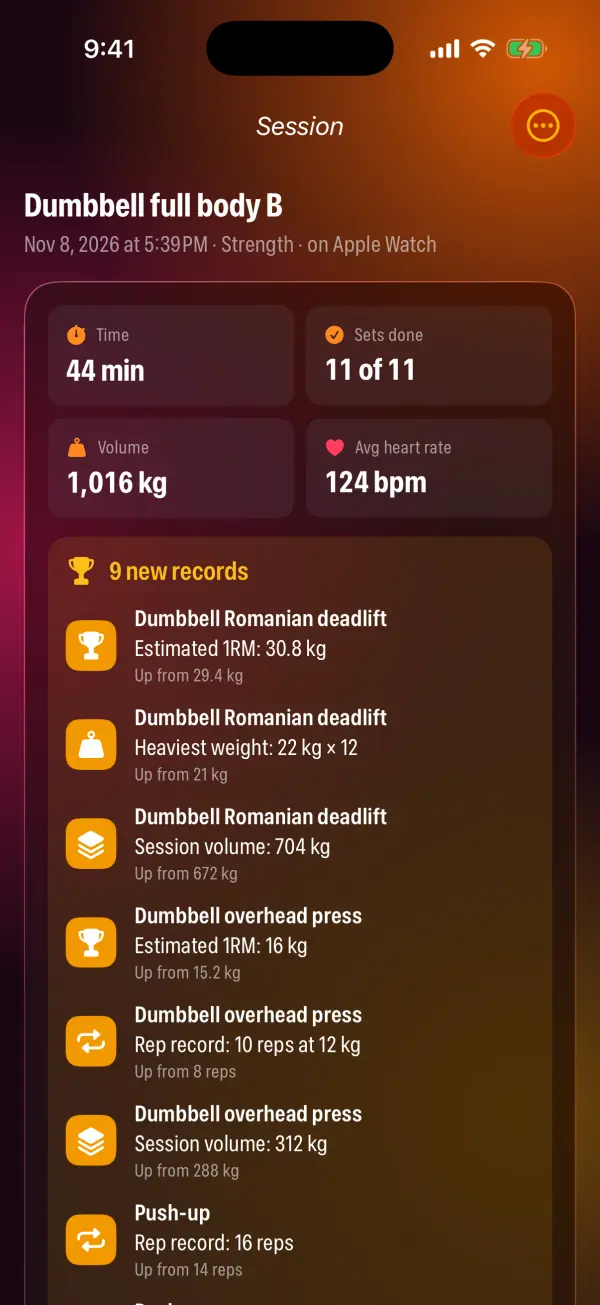
- Push-ups and one-arm dumbbell rows: 2 sets of 8 to 12 each, for posture and arm drive late in a race.
How to progress over 8 to 12 weeks
The studies above ran for 8 to 12 weeks, so plan in blocks of about that length. Progress the weight slowly and let your running lead; if your legs feel flat on key runs for more than a week, hold the lifting steady.
A simple way to move forward is double progression: stay at a weight until you hit the top of the rep range on every set, then add a little load and drop back to the bottom of the range.
- Weeks 1 to 2: learn the moves. Use light weights, 2 sets each, and expect some soreness. Avoid lifting legs the day before a hard run.
- Weeks 3 to 6: build. Go to the full sets, add weight when every set reaches the top of the rep range, and add pogo hops if your calves and Achilles feel fine.
- Weeks 7 to 10: get strong. Keep reps low on the main lifts (4 to 6) with longer rests of 2 to 3 minutes, so you lift heavy without much fatigue.
- Every 4th week or so: ease off. Do 1 to 2 fewer sets, especially when running volume peaks.
- Final 1 to 2 weeks before a race: keep one short session with lighter loads and no new exercises, or rest entirely if your legs feel heavy.
When to strength train around hard runs
Timing is where many runners go wrong. In one trial, 14 trained and moderately trained runners did a strength session and a run 6 hours apart, in both orders. The next day, running cost more oxygen after the strength-then-run day, and time to exhaustion at a hard pace fell from about 335 seconds at baseline to 238 seconds (strength first) and 275 seconds (run first).
A related study found that 6 hours after a strength session, easy-pace running economy was unaffected, but performance above the anaerobic threshold dropped after heavy sessions. In short: heavy leg sessions can blunt hard running into the next day, while easy running is affected much less.
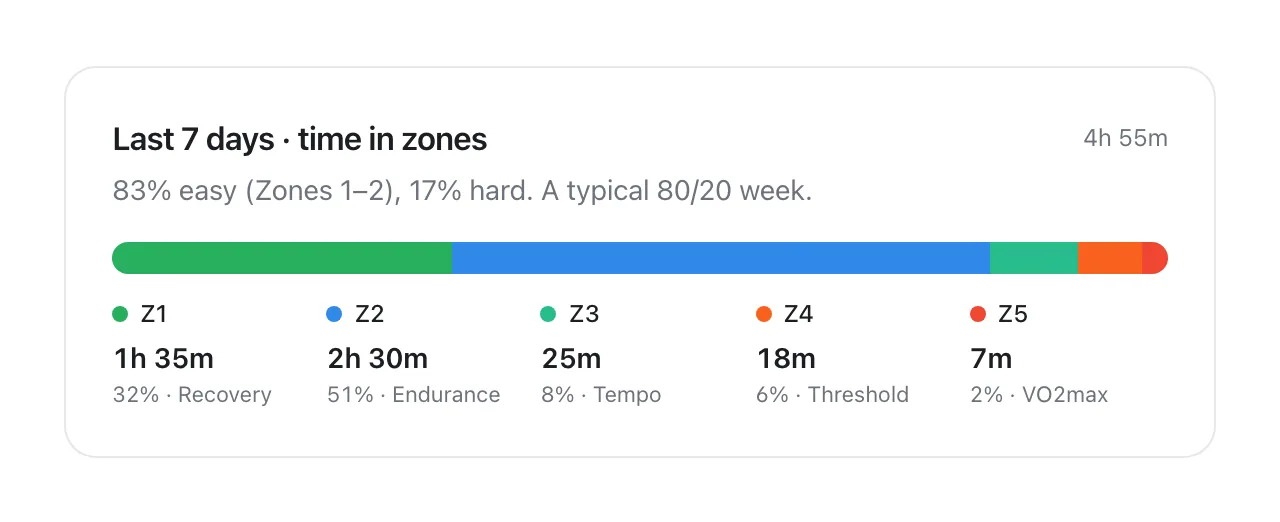
That points to a simple rule many coaches use: keep hard days hard and easy days easy. Stack your heavy lifting on the same day as a quality run, after the run, so the following day can be easy. Avoid heavy leg work the day before intervals, a tempo run or your long run.
- Best slot: same day as intervals or a tempo run, after the run, either straight after or later that day. You get one fully hard day followed by recovery.
- Good slot: after an easy run, when the next day is easy or a rest day.
- Avoid: heavy squats or deadlifts the day before a key session or long run, and jumps on the morning of a hard run.
- Example, running 4 days: Tuesday intervals then Day A, Wednesday rest, Thursday easy run then Day B, Friday rest, Saturday easy run, Sunday long run.
- Example, running 3 days: Monday Day A, Tuesday easy run, Wednesday rest, Thursday tempo run then Day B, Friday rest, Saturday long run, Sunday rest.
- Short on time: put both sessions after easy runs and keep them under 30 minutes. Doing it consistently matters more than perfect timing.
Strength training through a race build and taper
Early in a training block, when running volume is lower and races are far away, is the time to push strength: two full sessions a week with steady weight increases. As the plan moves into its hardest running weeks, keep the weights but cut the sets, so lifting maintains what you built without stealing recovery from your key runs.
During a taper, the goal is to arrive fresh. Lighter, shorter sessions keep the movement pattern without leaving your legs sore on race day. Avoid anything new, and avoid heavy leg work in the last few days before the race.
After the race, give yourself a few easy days before lifting heavy again, then restart at the lighter end of the plan. Runners who pause strength work during a busy season often find it takes a few weeks to get back to their previous weights, which is normal.
Common mistakes and when to get help
The most common mistake is treating strength as more cardio: long circuits with light weights and short rests. That mostly adds fatigue. Fewer, heavier sets with full rest are closer to what the research used.
Other common mistakes are lifting legs hard the day before a long run, adding jumps and heavy squats in the same week you raise your mileage, and skipping single-leg and calf work, which matter for a sport made of one-legged landings.
This is general fitness guidance, not medical advice. Stop and get checked by a doctor or physiotherapist if you have pain that makes you limp, swelling, pain at rest or at night, or pain in a bone that gets worse with each run. If you have a heart condition or other health concern, talk to your doctor before adding hard training.
Fitting strength around your runs with VedaWatch
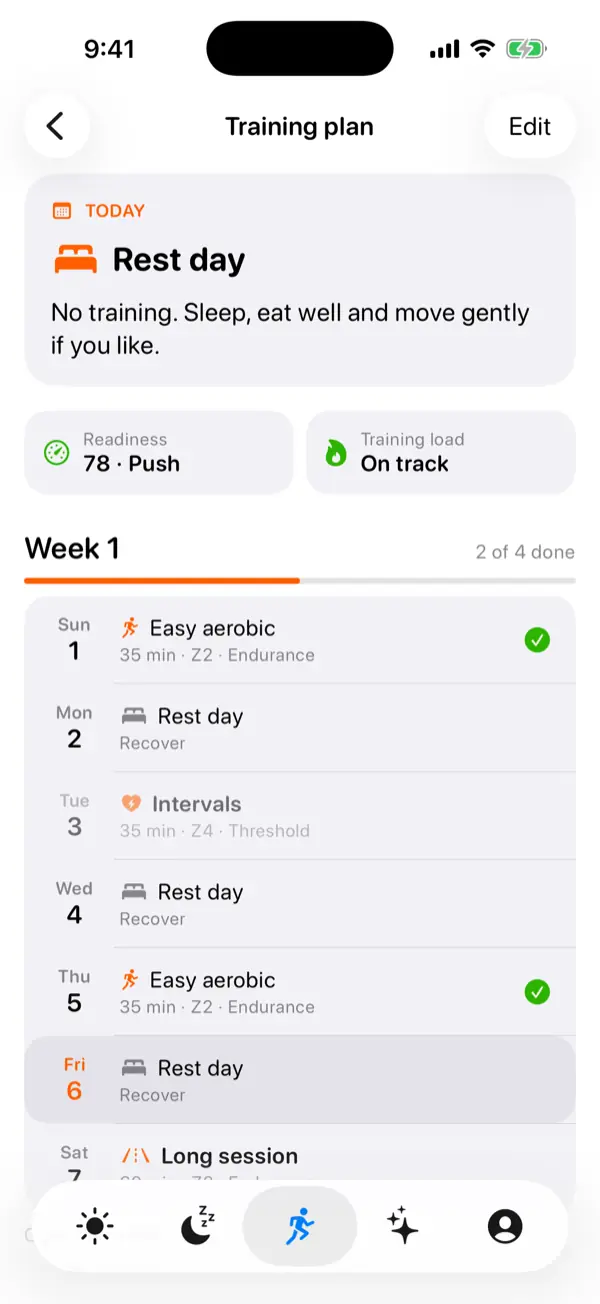
VedaWatch's race training plans (Pro: $6.99 a month or $59.99 a year) schedule your runs but don't add strength sessions, so the strength days are yours to place. In Your week on the Train tab, days taken by the training plan are marked and locked, and the plan's other days, its rest days included, are free for something else. That makes it easy to put Day A on your interval day and Day B on an easy day without the two getting in each other's way.
For each free day you can add a Strength focus, with or without a body area, a library session, or a session you built yourself. The Guided library includes sessions such as Dumbbell legs and glutes, Dumbbell full body and Leg day, full gym, plus a 15-minute Runner's mobility session for hips, hamstrings, calves and ankles.
When the coach builds a strength session for a day, it counts your recent Apple Health runs as leg work. If a run loaded your legs hard in the last 48 hours, it can steer you toward upper body or core instead. On Apple Watch, the guided player can count reps for squats, lunges and hinges from your wrist motion, and every session is saved to Apple Health so it counts toward your training load alongside your runs.
Frequently asked questions
Should runners lift before or after running?
On the same day, run first and lift after, so your key run happens on fresh legs. In one trial, running the next day suffered more when strength came first.
Can bodyweight exercises be enough for runners?
They are a good start, especially single-leg moves, calf raises and hops. Most runners outgrow them within a few weeks, though, and then need dumbbells, a kettlebell or a barbell to keep the sets challenging.
Will strength training make me slower at first?
You may feel heavy-legged for the first week or two while your body adapts to new exercises. That usually fades quickly. Starting light and keeping heavy legs away from hard runs helps.
Do I need plyometrics or jumping?
They are optional but useful: many of the programmes that improved running economy included short jumps or sprints. Start with low-level hops and skip them if you have shin, foot or Achilles pain.
Is strength training useful for beginner runners too?
Yes, though most studies looked at trained runners. Beginners can start with one or two short sessions a week using bodyweight and light weights, and build up as running becomes routine.
Related guides
- Guided strength workouts on Apple Watch: step-by-step sessions with spoken cues and rep counting
- Training for a 5K, 10K or half marathon with Apple Watch: a plan that adapts to your recovery
- Progressive overload explained: how to progress every lift
- How to increase running mileage safely (and the 10% rule)
- Easy run pace: how slow should easy runs be?
- Half marathon taper: the final 7 days, day by day
Sources & further reading
- Sports Medicine (2018): Effects of strength training on the physiological determinants of middle- and long-distance running performance: a systematic review (Blagrove, Howatson, Hayes)
- Medicine & Science in Sports & Exercise (2008): Maximal strength training improves running economy in distance runners (Støren et al.)
- Journal of Strength and Conditioning Research (2016): Effects of strength training on running economy in highly trained runners: a systematic review with meta-analysis (Balsalobre-Fernández et al.)
- British Journal of Sports Medicine (2014): The effectiveness of exercise interventions to prevent sports injuries: a systematic review and meta-analysis of randomised controlled trials (Lauersen et al.)
- Clinical Journal of Sport Medicine (2025): Strength and flexibility self-assessment and subsequent training injuries among runners of the New York City Marathon (Toresdahl et al.)
- Applied Physiology, Nutrition, and Metabolism (2013): The effects of strength training and endurance training order on running economy and performance (Doma, Deakin)
- European Journal of Sport Science (2014): The acute effects of intensity and volume of strength training on running performance (Doma, Deakin)
- British Journal of Sports Medicine (2020): World Health Organization 2020 guidelines on physical activity and sedentary behaviour (Bull et al.)
This guide is educational, not medical advice, and has not been clinically reviewed. VedaWatch is not a medical device. If you have symptoms or concerns about your heart or health, contact a qualified healthcare professional.
Put your trends in perspective.
Explore HRV, sleep, and recovery with VedaWatch on your iPhone.
Download VedaWatch on the App Store →