 VedaWatch
Strength Training
Progressive overload explained: how to progress every lift
Progressive overload explained simply: the ways to progress, a double-progression example, how much weight to add, when to deload and how to track it.
By VedaWatch editorial team · · 11 min read
The short answer
Progressive overload means making your training slightly harder over time so your body keeps adapting. Add reps first, then weight once you reach the top of your rep range, in small steps. Keep good form, stop a little short of failure, log every session, and ease off when you stall repeatedly.
What is progressive overload?
Progressive overload is the principle that, to keep getting stronger or building muscle, the demand you put on a muscle has to rise gradually over weeks and months. Your body adapts to the work you give it. Once a weight feels routine, doing exactly the same sets and reps forever mostly maintains what you have.
The American College of Sports Medicine (ACSM) has long named progressive overload, along with specificity and variation, as a core principle of resistance training. Its 2026 position stand, an overview of 137 systematic reviews, adds a useful nuance: you don't need progression to get the early benefits of lifting, but overload is likely needed if you want continued, longer-term gains. For beginners who start very light, adding load is often what makes the training meaningful at all.
In practice, overload doesn't mean adding weight every session. It means a small, deliberate step up in one variable at a time, taken only when you've earned it: you finished every rep of the last session with good form.
7 ways to apply progressive overload
Load is the obvious lever, but it's not the only one. The ACSM's 2009 position stand lists increasing the load, the repetitions at a given weight, the tempo, the rest periods and the overall volume as ways to progress. Here are the practical options, roughly in the order most people should reach for them:
- More reps at the same weight. The easiest step: 3 sets of 8 becomes 3 sets of 9. This is the first half of double progression.
- More weight. Once you can do the top of your rep range on every set, add the smallest jump your equipment allows and go back to the bottom of the range.
- More sets. Going from 2 to 3 working sets per exercise raises weekly volume. Useful when weight and reps have stalled, as long as you recover from it.
- A harder variation. For bodyweight moves this is the main lever: incline push-up to push-up to feet-elevated push-up, or split squat to rear-foot-elevated split squat.
- Slower lowering (tempo). A slow, controlled lowering of a few seconds makes the same weight harder. Handy when the next dumbbell is too big a jump.
- More range of motion. A deeper squat or a full stretch at the bottom of a row is more work at the same load.
- Shorter rests or more frequent sessions. These add density rather than strength. Use them sparingly: very short rests mostly just reduce how many reps you can do in the next set.
How much weight should you add, and when?
The best-known rule of thumb comes from the ACSM's 2009 position stand: when you can perform the current weight for one to two reps more than your target on two consecutive sessions, increase the load by 2 to 10%. Use the lower end for small-muscle exercises like curls, lateral raises and triceps work, and the higher end for large-muscle lifts like squats and deadlifts. Coaches often call this the two-for-two rule.
For a novice, the same document recommends loads around 60 to 70% of your one-rep max for 8 to 12 reps, training the whole body 2 to 3 days a week. You don't need to know your one-rep max to use this: a weight you can lift for about 10 to 12 reps with good form lands roughly in that zone.
Equipment usually decides the real step size. A 2 kg (5 lb) jump on a 10 kg dumbbell is 20%, far more than the guideline, which is exactly why rep progression matters: you build up reps until the next dumbbell becomes manageable. Barbells, with small plates, allow much finer steps.
Don't chase load at the expense of form. If the extra weight changes how the lift looks, shortens your range of motion or needs a lot of body swing, you're not ready for it yet. A rep that only counts when you cheat it isn't progress.
Double progression: a worked example
Double progression is the simplest system that works for most people, especially with dumbbells and kettlebells where jumps are large. You pick a rep range, say 8 to 12. You add reps until you hit the top of the range on every set, then add weight and drop back to the bottom. Reps, then load: two kinds of progress, hence the name.
Here's how it might look for a goblet squat, 3 sets, rep range 8 to 12, starting with a 16 kg dumbbell and stepping up in 2 kg jumps. One session a week is shown for simplicity; with two sessions a week it moves faster.
- Week 1: 16 kg, 3 × 8. All sets completed with about two reps left in the tank. Volume (weight × reps): 384 kg.
- Week 2: 16 kg, 3 × 9. All reps hit, so add a rep to every set next time.
- Week 3: 16 kg, 3 × 10. Still clean.
- Week 4: 16 kg, aiming for 3 × 11, you get 11, 11, 10. Not every rep landed, so repeat the same target next session rather than moving on.
- Week 5: 16 kg, 3 × 11. Done.
- Week 6: 16 kg, 3 × 12. You've reached the top of the range on every set. Volume: 576 kg.
- Week 7: 18 kg, 3 × 8. Weight goes up by one step, reps drop back to the bottom of the range. Volume: 432 kg, lower than week 6, and that's fine: the heavier sets are the point.
- Week 8 onwards: climb the reps again at 18 kg toward 3 × 12, then move to 20 kg.
Is it working? How to read your numbers
Two things in that example are easy to misread. First, week 4 isn't a failure. Missing a rep or two and repeating the target is how double progression is meant to work; progress comes in steps, not a straight line. Second, volume drops when the weight goes up. Comparing raw volume across a weight change can make a good week look like a bad one.
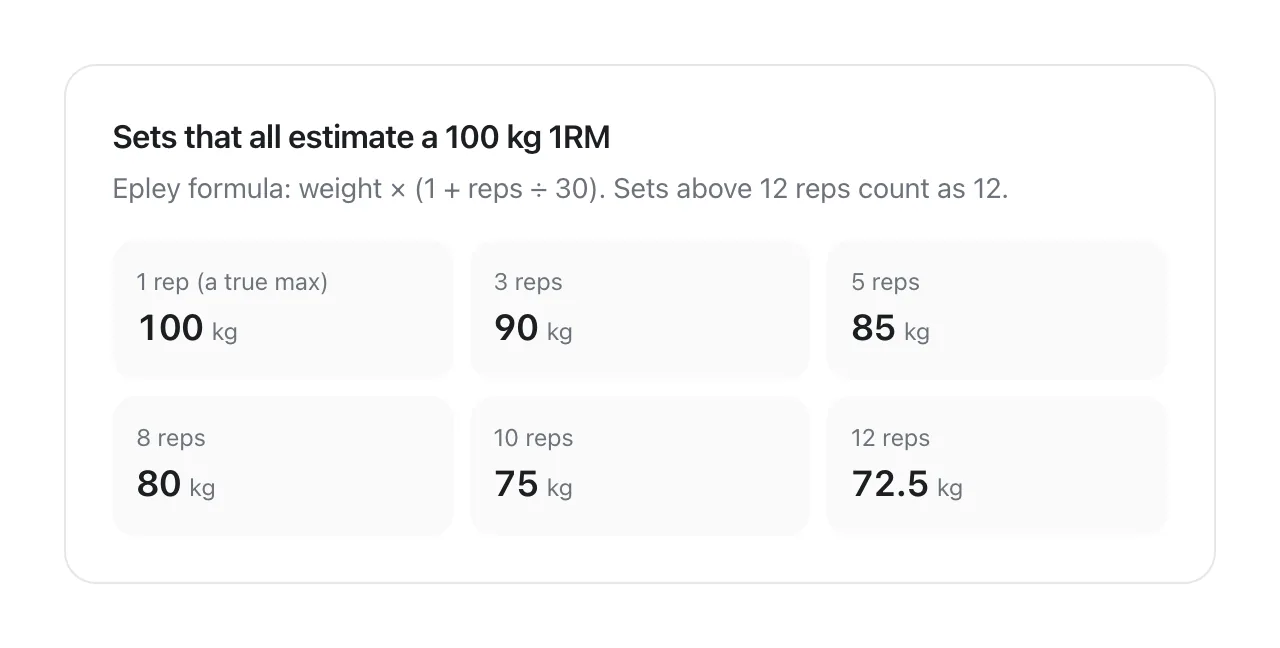
A steadier yardstick is estimated one-rep max (e1RM), which turns any set into a guess at your best single. The common Epley formula is weight × (1 + reps ÷ 30). In the example, 16 kg × 12 works out to about 22.4 kg, and 18 kg × 8 to about 22.8 kg. So week 7 is a small step up in strength even though the volume fell. Epley gets less precise at high reps, so compare like with like and treat the number as a trend, not a true max.
Over a few months, the pattern you want is a rising e1RM or rising reps at the same weight on your main lifts. Flat for a week or two is normal. Flat or falling for several weeks is your cue to look at sleep, food, stress, or whether you need a lighter week.
What to do when progressive overload stalls
Every lifter hits plateaus, and beginners usually progress faster than people with years of training. Before changing your program, check the basics. Are you sleeping enough, eating enough protein and total food, and training each muscle consistently? A run of short nights or a stressful week can wipe out reps you had last week.
If you miss your target at the same weight two sessions in a row, the simplest fix is a reset: drop the weight a step or so, rebuild the reps and work back up. Coming back to a weight you used to grind out and moving it easily often gets you past it on the second attempt.
Other options are to switch to a slightly different rep range, change the variation (for example a dumbbell press instead of a barbell press for a few weeks), or add a set for a muscle that seems under-trained. Change one thing at a time so you can tell what worked.
Do you need a deload week?
A deload is a planned period of easier training to let fatigue drop before you push again. A 2023 international Delphi consensus of strength and physique coaches described deloads as typically lasting about a week and often taking place every 4 to 6 weeks, but agreed the timing should depend on how you respond to training rather than a fixed calendar. The experts agreed you can deload by cutting sets, cutting reps or training on fewer days, while keeping the main multi-joint lifts in.
Evidence that deloads boost results is still thin. In a 2024 study, young adults who stopped lifting completely for one week in the middle of a 9-week program gained a similar amount of muscle to those who trained straight through, but slightly less lower-body strength. That was a full week off, not a lighter week, so it doesn't settle the question, but it suggests a deload isn't magic.
A practical approach for most people: don't schedule deloads by rule if you're progressing, sleeping well and feel fresh. Take an easier week when you've stalled across several lifts, joints feel achy, motivation has dropped, or life is unusually stressful. Keep the same exercises with fewer sets, or the same sets at a noticeably lighter weight, and then resume where you left off.
How to track progressive overload
You can't progress what you don't record. For every working set, log the exercise, weight, reps, and how hard it felt. That last part matters: a set of 10 that left two reps in the tank is very different from one taken to failure.
The repetitions in reserve (RIR) scale, validated by Zourdos and colleagues in 2016, makes effort easy to record. You rate a set on a 1 to 10 scale where 10 means you couldn't have done another rep, 9 means one rep left, 8 means two left, and so on. Many programs aim to leave a few reps in reserve on most sets: hard enough to drive progress, with enough left to keep your form and recover for the next session. The ACSM's 2026 position stand also notes that perceived-effort scales are a practical way to adjust the weight as you get stronger.
Review your log every few weeks, not every set. Look for three things: rising reps or weight on your main lifts, steady weekly sets per muscle, and sessions you actually finish. If one of those is slipping, that's where to adjust.
How VedaWatch applies progressive overload for you
If you'd rather not run the numbers yourself, VedaWatch's daily coach on the Train tab builds each guided strength session from your own history with each exercise, using the double progression described above. The first time you do a loaded exercise, it gives you a rep target and asks you to pick a weight you could lift 2 to 3 more times, rather than guessing a weight. After that, when you hit every rep, the next session adds one rep per set until the top of the range, then adds weight and drops back to the bottom. For loaded lifts, the rep range is 8 to 12 by default, or lower (6 to 10 or 5 to 8, depending on your level) with a strength goal.
Weight steps depend on the equipment: 2 kg for most dumbbell moves, 2.5 kg for barbell upper-body lifts, 4 kg for kettlebells and 5 kg for barbell lower-body lifts, or 5 to 10 lb if you train in pounds. Miss reps twice in a row at the same weight and it takes about 10% off to rebuild. Bodyweight exercises add reps and then move to a harder variation once you top out (or an easier one after two tough sessions), and timed holds like planks add 5 seconds at a time. When a bodyweight move tops out with no harder variation to move to, it suggests slowing the lowering to 3 seconds.
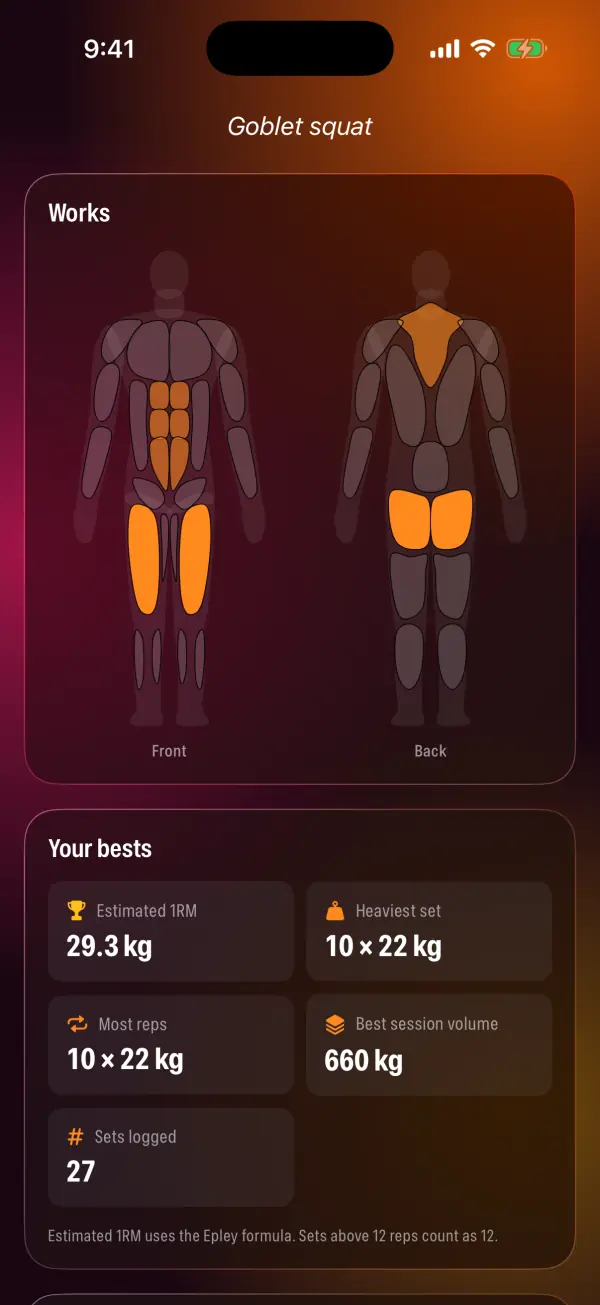
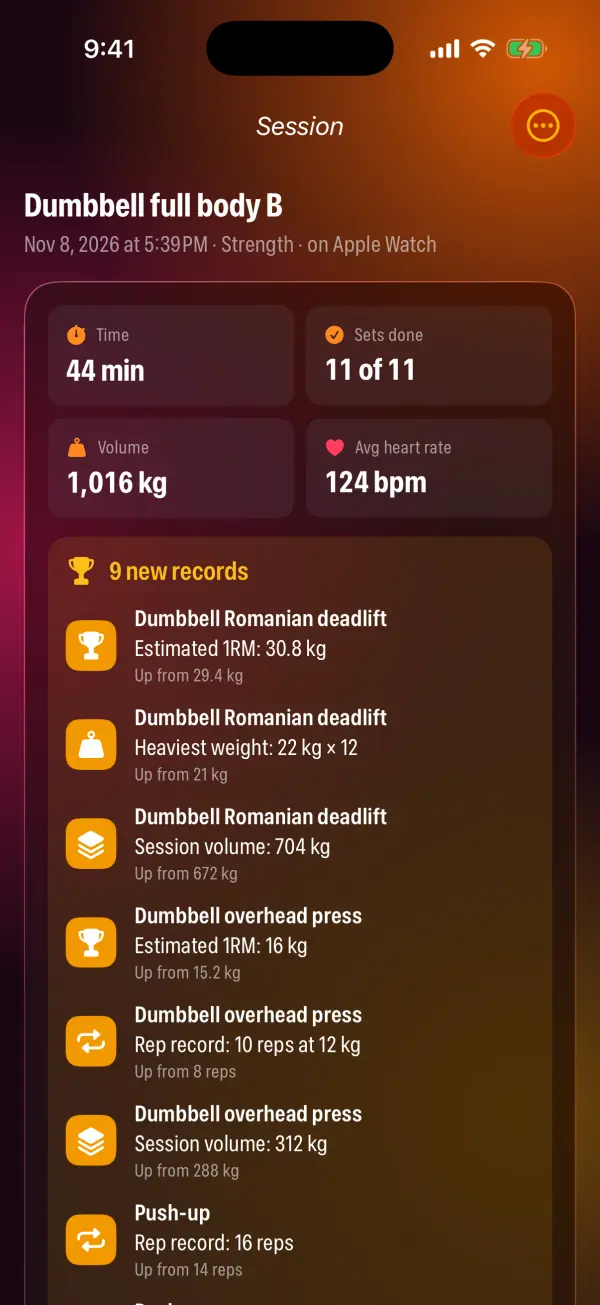
It also reads your recovery. On an easy day, such as when your readiness is low or you've asked for an easier session, it holds the weight and reps instead of adding more, and on a rest-day verdict any loaded lift is about 10% lighter than last time. Each change comes with a one-line reason in the session preview, so you can see why the numbers moved. Strength progress then shows your estimated 1RM, bests and records for every exercise. The player lets you record the reps and weight you actually did, and the next session builds on that. The coach is general fitness guidance, not a medical program.
When to ease off, and when to get advice
Progressive overload should feel challenging, not painful. Muscle soreness a day or two after a new or harder session is common. Sharp pain during a lift, pain in a joint that gets worse from session to session, or pain that changes how you move is a reason to stop that exercise and get it checked by a doctor or physiotherapist.
If you're new to exercise, pregnant, returning from injury, or have a heart condition, high blood pressure or another medical condition, talk to a health professional before starting a progressive strength program. This guide is general fitness information, not medical advice.
Frequently asked questions
How often should you increase weight with progressive overload?
Only when you've earned it, usually after hitting the top of your rep range on every set, or one to two extra reps on two sessions in a row. Beginners may move up every week or two on some lifts; experienced lifters may take weeks or months for the same jump.
Is adding reps as good as adding weight?
For muscle growth, it seems to be close. In an 8-week trial of trained adults, adding reps at the same weight built similar muscle to adding weight, while adding weight had a small, uncertain edge for maximal strength. Most people do best combining both, which is what double progression does.
Can you progressive overload with only light dumbbells?
Yes, for a while. Add reps, sets, slower lowering, pauses and harder single-leg or single-arm variations. Once sets become very long and the effort comes from endurance more than strength, heavier dumbbells or adjustable ones will make further progress much easier.
Do I have to train to failure for progressive overload to work?
No. Stopping a little short of failure on most sets lets you keep good form and recover for the next session, and you can still add reps and weight over time. What matters most is that the sets are genuinely hard and that they get a bit harder over the weeks.
Does progressive overload apply to cardio too?
The same idea applies: gradually increase duration, frequency or intensity. Change one at a time and build up gradually, especially with running, where joints and tendons can lag behind your fitness.
Related guides
- How to track strength training progress with Apple Watch: volume, 1RM and muscle balance
- How to calculate your one rep max: Epley, Brzycki and Lombardi
- How many sets per muscle per week? What the research says
- Deload week: what it is, when to take one and how to do it
- Train by readiness: how VedaWatch picks today's workout from your Apple Watch data
- Beginner full body workout plan: 3 days a week for 8 weeks
Sources & further reading
- Currier BS et al. American College of Sports Medicine Position Stand. Resistance training prescription for muscle function, hypertrophy, and physical performance in healthy adults: an overview of reviews. Med Sci Sports Exerc. 2026
- American College of Sports Medicine. Position stand: Progression models in resistance training for healthy adults. Med Sci Sports Exerc. 2009
- Plotkin D et al. Progressive overload without progressing load? The effects of load or repetition progression on muscular adaptations. PeerJ. 2022
- Bell L et al. Integrating deloading into strength and physique sports training programmes: an international Delphi consensus approach. Sports Med Open. 2023
- Coleman M et al. Gaining more from doing less? The effects of a one-week deload period during supervised resistance training on muscular adaptations. PeerJ. 2024
- Zourdos MC et al. Novel resistance training-specific rating of perceived exertion scale measuring repetitions in reserve. J Strength Cond Res. 2016
This guide is educational, not medical advice, and has not been clinically reviewed. VedaWatch is not a medical device. If you have symptoms or concerns about your heart or health, contact a qualified healthcare professional.
Put your trends in perspective.
Explore HRV, sleep, and recovery with VedaWatch on your iPhone.
Download VedaWatch on the App Store →