 VedaWatch
Sleep
Does sleep help muscle recovery? What the research shows
Does sleep help muscle recovery? What studies show about sleep loss, strength, muscle growth and injury, how much athletes need, and a plan around hard training.
By VedaWatch editorial team · · 9 min read
The short answer
Yes. Sleep is when much of the repair from training happens, and losing it works against you. In one lab study, a single night without sleep cut muscle protein synthesis by 18%, and short sleep is linked to weaker performance and more injuries. Aim for 7 hours or more, and protect sleep most around hard sessions.
Does sleep help muscle recovery?
Yes. Training is the stimulus, but the adaptation, meaning repaired and slightly bigger, stronger muscle, happens in the hours and days afterwards, and a large share of those hours are spent asleep. When sleep is cut short, the evidence points the same way across very different kinds of studies: muscle builds protein more slowly, the hormonal environment tilts towards breakdown, performance drops, and injuries become more common.
The clearest direct evidence comes from lab studies. In a randomised crossover study of 13 healthy young adults, one night of total sleep deprivation reduced muscle protein synthesis the next afternoon by 18% compared with a normal night. The same study found cortisol, a hormone associated with breakdown, 21% higher and testosterone 24% lower after the sleepless night.
Sleep isn't magic, though. It doesn't replace sensible training, enough protein and enough total food. Think of it as the condition that lets those other things work. The rest of this guide covers what the research actually shows, how much sleep people who train seem to need, and how to plan your sleep around your hardest days.
What happens to your muscles while you sleep
Muscle is constantly being built up and broken down. Muscle protein synthesis is the building side, and a hard session pushes it up for many hours afterwards, as long as there are amino acids from protein available. Sleep is a long stretch of that recovery window, and it is also a long stretch without food.
That's why sleep and nutrition interact. In a study of 16 young men who lifted weights in the evening, drinking 40 g of casein protein 30 minutes before bed meant the protein was digested and absorbed during the night, whole-body protein balance turned positive, and mixed muscle protein synthesis was about 22% higher than with a placebo drink, a result at the edge of statistical significance. Sleep, in other words, isn't a pause in recovery: what you give your body before it matters.
Hormones change too. After a night without sleep, the study above saw higher cortisol and lower testosterone the next day. These are short-term changes in small groups of people, so they don't prove that a bad night undoes a week of training. They do show a mechanism by which repeated short sleep could slowly work against muscle.
Does lack of sleep make you weaker?
On average, yes, though by less than many people fear and not for every kind of task. A 2022 meta-analysis pooled 227 performance measures from 69 studies that compared normal sleep with 6 hours or less. Overall, sleep loss lowered exercise performance by about 7.6%, and the effect was significant for every category tested, including strength, power, high-intensity intervals, endurance and skill.
The pattern of sleep loss mattered. A full night without sleep, or being woken much earlier than usual, consistently hurt performance. Going to bed late and waking at the normal time was less consistent. Performance also fell by roughly 0.4% for every extra hour awake before the session, so the later in the day you train after a short night, the bigger the hit.
Time of day showed up clearly. Tasks done in the afternoon or evening after sleep loss were reliably worse, while tasks done in the morning were largely unaffected. The authors' practical advice: if sleep loss can't be avoided, avoid a full sleepless night or a very early alarm where you can, and train earlier in the day.
Most of these studies were short and about 89% of the participants were men, so treat the numbers as averages rather than predictions for you.
Can poor sleep cost you muscle?
The strongest warning comes from dieting. In a crossover study of 10 overweight adults on two weeks of moderate calorie restriction, people given 5.5 hours of sleep opportunity a night lost 55% less fat and 60% more fat-free mass than when they had 8.5 hours. The weight on the scale went down either way; what it was made of changed.
That matters for anyone cutting or trying to lose fat while keeping muscle. If you are eating less to lose fat, short sleep appears to make it harder to hold on to muscle. It's a small study, but it lines up with the lab findings on protein synthesis and hormones.
There is a hopeful finding too. In a study of 24 young men limited to 4 hours in bed for five nights, sleep restriction lowered the rate at which muscle made sarcoplasmic protein, reduced mitochondrial function and worsened glucose tolerance. A group that did three high-intensity interval sessions during those same five nights didn't show those drops. Training during a short stretch of poor sleep may protect you from some of its effects, so a bad week doesn't have to mean no training at all.
Does lack of sleep increase injury risk?
Several studies link short sleep with more injuries, but most are observational, so they show an association rather than proof. In one often-cited study of 112 adolescent athletes, those who slept under 8 hours a night on average were 1.7 times more likely to have had an injury than those who slept 8 hours or more.
Plausible reasons include slower reactions, poorer coordination and decision-making when tired, and incomplete recovery between sessions. Sleep also matters for illness: the 2021 expert consensus on athlete sleep notes that, in the wider population, habitually sleeping under 7 hours a night increases susceptibility to respiratory infection, and an infection can cost more training than any single bad session.
The practical point is simple. Short sleep is one more reason to be careful with the riskiest work: maximal lifts, new skills, fast change-of-direction drills and big jumps in training load.
How much sleep do you need to build muscle?
There is no proven number of hours for muscle growth. The 2021 expert consensus on athlete sleep describes habitual sleep under 7 hours a night as short, so treat 7 hours as a floor rather than a goal. It also says a one-size-fits-all range such as 7 to 9 hours is unlikely to be ideal and recommends an individual approach that considers how much sleep each athlete feels they need.
People in hard training may need more than they think. In a Stanford study, 11 college basketball players aimed for at least 10 hours in bed for 5 to 7 weeks and slept about 111 minutes more a night on average. Their timed sprint improved from 16.2 to 15.5 seconds and their free-throw and three-point shooting each improved by about 9%, alongside better reaction time, mood and lower daytime sleepiness. It was a small study without a control group, but it suggests many athletes carry hidden sleep debt.
A useful personal test: if you regularly sleep much longer on free days than on workdays, or you need an alarm every single morning, your usual night is probably shorter than your body wants. Our guide to how much sleep you need covers ways to estimate your own number.
A practical sleep plan around hard training
The goal isn't perfect nights. It's making sure your hardest sessions, and the nights after them, get the most protection. Here's a plan that fits most training weeks, whether you lift, run or both.
- Set a fixed wake-up time first, then count back your sleep need (start with 8 hours if you don't know it) plus about 15 minutes to fall asleep. That's your target time in bed, for example 10:45 PM for a 7:00 AM alarm.
- Put your hardest sessions, such as heavy lifting, intervals or long runs, on days that follow your most reliable nights, not after late events or early travel.
- Treat the night after a hard session as part of the session. Keep it free of late alcohol and late screens where you can, and go to bed on time even if you feel wired.
- Finish hard evening training a few hours before bed if you can, eat a proper meal with protein afterwards, and consider a protein-rich snack before bed on heavy lifting days.
- After a short night, move the hard session earlier in the day if possible, or keep the session but cut the top end: drop a set, skip maximal attempts and leave a couple more reps in reserve.
- If you're more than a few hours behind on sleep over a week, go to bed 30 to 45 minutes earlier for several nights rather than trying to sleep 11 hours once.
- In heavy training blocks or before a race or competition, aim for the top of your own range, and add a short early-afternoon nap if it doesn't hurt your night sleep.
Should you train after a bad night's sleep?
Usually, yes, with adjustments. One short night lowers performance a little on average, but it doesn't make a moderate session harmful, and the sleep restriction study above even suggests training can blunt some effects of a short run of bad nights. What you want to avoid is chasing personal records or piling more load on top of a growing sleep debt.
A simple rule: after one short night, train but lower the ceiling. After several short nights in a row, or when other signals agree, such as lower HRV than usual, a higher resting heart rate, heavy legs or a lingering cold, make it an easy day or a rest day. If you're unsure whether to push on a low-readiness morning, our guide to working out with low HRV goes through it in more detail.
If you feel exhausted most days despite spending enough time in bed, snore loudly, stop breathing in your sleep as noticed by a partner, or struggle to fall or stay asleep for weeks, talk to a doctor. Those can be signs of a sleep disorder that no training plan will fix, and they are worth checking.
How VedaWatch helps you protect sleep around training
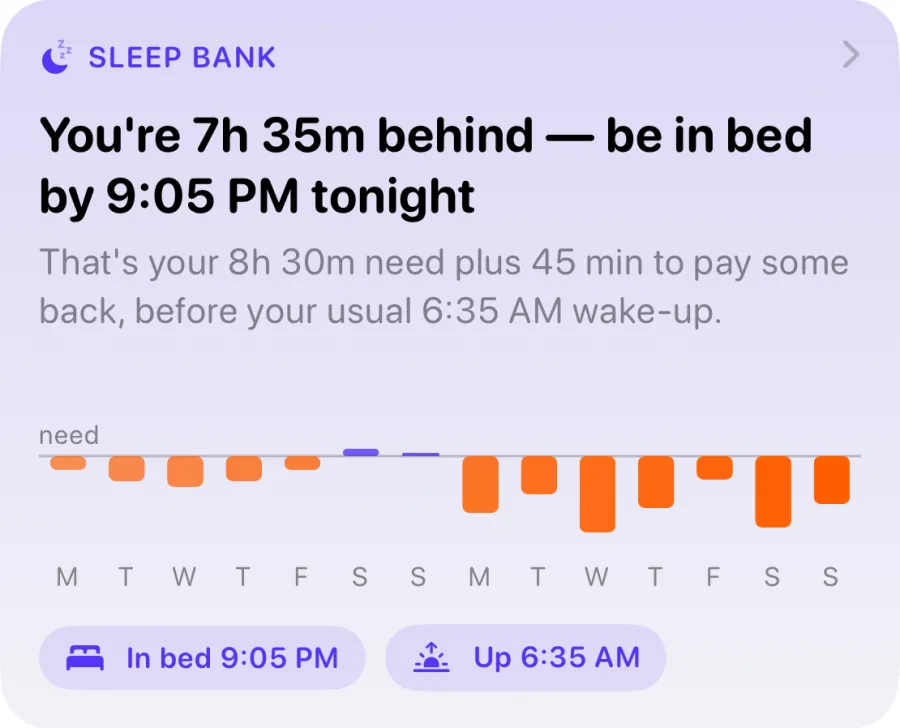
If you wear your Apple Watch to bed, VedaWatch reads the sleep it saves to Apple Health and puts it next to your training. Sleep Bank, on the Recover tab, compares each of your last 14 nights with your sleep need, counts recent nights most, and tells you in one line how far behind or ahead you are and when to be in bed tonight. It repays debt gradually, never asking for more than 45 extra minutes in one night, which matches the advice above.
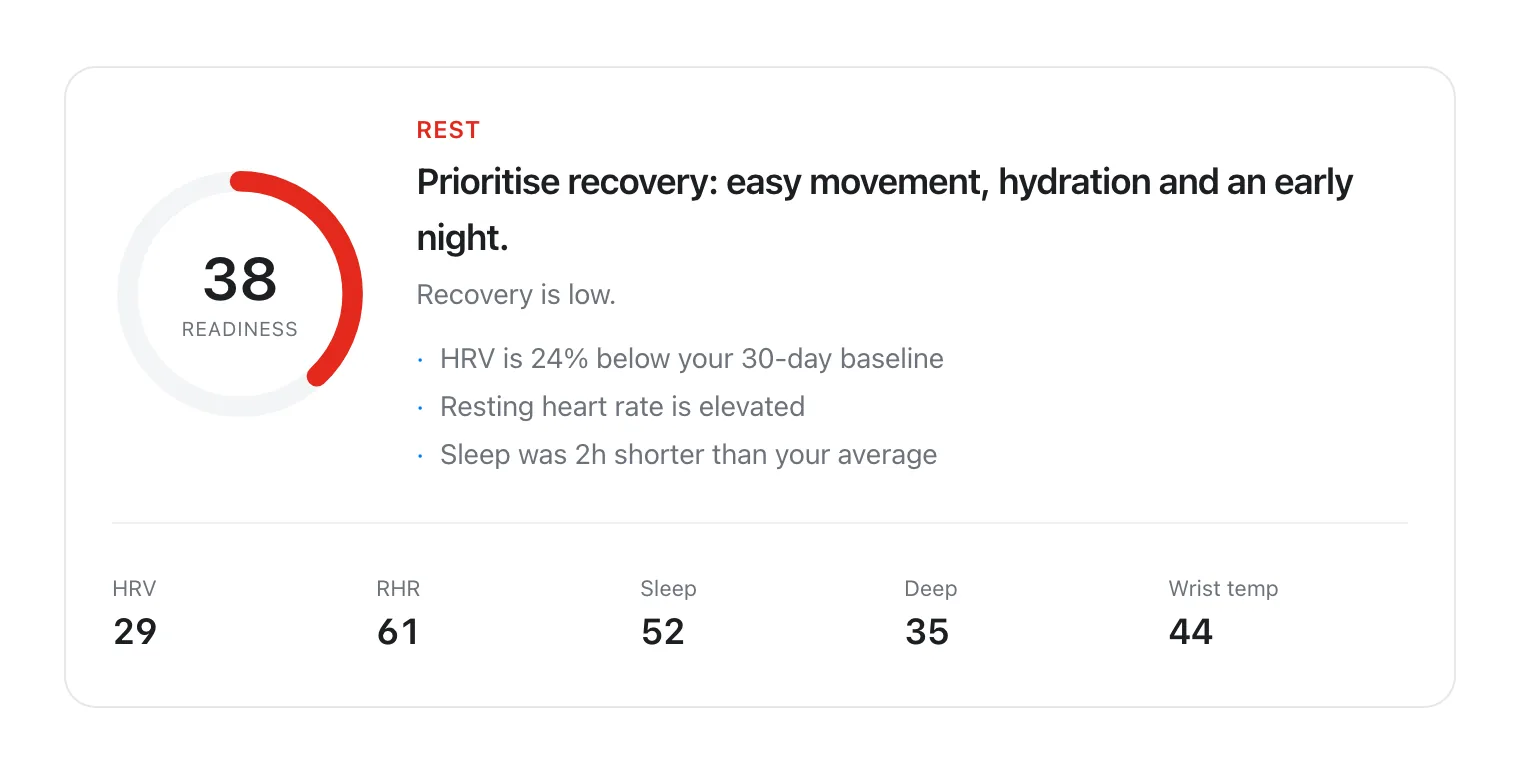
Last night's sleep and deep sleep are part of your daily readiness score from 0 to 100, alongside HRV and resting heart rate compared with your recent baseline. A score of 70 or more is a Push day, 50 to 69 is Hold, and under 50 is Rest, with the reasons listed, such as a short night. Unless a training plan sets the day, the Today's session card on the Train tab uses that verdict: a Rest day becomes a gentle mobility session of 20 minutes or less, and loaded lifts are set about 10% lighter than last time.
You can also turn on the "Sleep debt building" alert, which arrives in the early evening when Sleep Bank has you behind by an amount you choose, with the bedtime that starts paying it back. All of this is an estimate from your Watch's sleep tracking, which isn't perfect, and it isn't medical advice.
Frequently asked questions
Do muscles grow while you sleep?
Muscle repair and growth carry on around the clock after training, and sleep is a long, uninterrupted part of that window. Studies show that losing sleep slows muscle protein synthesis, which is why sleep matters even though growth isn't limited to the night.
Is 6 hours of sleep enough to build muscle?
You can still make progress on 6 hours, but it's below the 7 hours that the athlete sleep consensus treats as the line for short sleep, and research links short sleep with lower muscle protein synthesis, weaker performance and, during dieting, more muscle loss. If 6 hours is your normal, adding even 30 to 60 minutes is one of the easiest recovery gains available.
Do naps help muscle recovery?
A short early-afternoon nap can top up total sleep after a short night, and many athletes use them. The 2021 expert consensus on athlete sleep says more research is needed on the benefits of napping, so treat naps as a supplement to night sleep, not a replacement.
Does deep sleep matter more than total sleep for muscles?
Deep sleep is often linked with physical recovery, but most of the evidence on muscle comes from studies that changed total sleep, not single stages. Getting enough total sleep is the reliable lever, and consumer wearables estimate stages less precisely than they measure total sleep.
Should I take protein before bed?
It's optional but reasonable on heavy training days. In one study, 40 g of casein 30 minutes before sleep after evening lifting was digested overnight and raised muscle protein synthesis by about 22% compared with a placebo, at the edge of statistical significance. Your total daily protein matters more than timing.
Related guides
- How much sleep do I need? By age, for athletes, and for you
- Sleep debt calculator for Apple Watch: how VedaWatch's Sleep Bank works
- Should you train or rest when HRV is low?
- How much protein per day to build muscle: g/kg by body weight
- Signs of overtraining: what your Apple Watch can and can't show
- Rest day vs active recovery: which one do you need today?
Sources & further reading
- Lamon S et al. The effect of acute sleep deprivation on skeletal muscle protein synthesis and the hormonal environment. Physiological Reports, 2021
- Craven J et al. Effects of acute sleep loss on physical performance: a systematic and meta-analytical review. Sports Medicine, 2022
- Nedeltcheva AV et al. Insufficient sleep undermines dietary efforts to reduce adiposity. Annals of Internal Medicine, 2010
- Saner NJ et al. Exercise mitigates sleep-loss-induced changes in glucose tolerance, mitochondrial function, sarcoplasmic protein synthesis, and diurnal rhythms. Molecular Metabolism, 2021
- Milewski MD et al. Chronic lack of sleep is associated with increased sports injuries in adolescent athletes. Journal of Pediatric Orthopaedics, 2014
- Walsh NP et al. Sleep and the athlete: narrative review and 2021 expert consensus recommendations. British Journal of Sports Medicine, 2021
- Mah CD et al. The effects of sleep extension on the athletic performance of collegiate basketball players. Sleep, 2011
- Res PT et al. Protein ingestion before sleep improves postexercise overnight recovery. Medicine & Science in Sports & Exercise, 2012
This guide is educational, not medical advice, and has not been clinically reviewed. VedaWatch is not a medical device. If you have symptoms or concerns about your heart or health, contact a qualified healthcare professional.
Put your trends in perspective.
Explore HRV, sleep, and recovery with VedaWatch on your iPhone.
Download VedaWatch on the App Store →