 VedaWatch
Workouts & Training
Should I work out when sore? How to train through DOMS
Sore 1-3 days after a workout? Learn when it's fine to train, how to adjust the session, what actually eases soreness, and which signs mean you should stop.
By VedaWatch editorial team · · 7 min read
The short answer
Usually yes, if it's ordinary muscle soreness. Keep moving, but for 1-2 days make the session shorter and easier or train muscles that aren't sore. Light exercise eases DOMS for a while. Stop and get checked if the pain is sharp, one-sided, in a joint, or comes with dark urine or major swelling.
Can you work out when you're sore?
In most cases, yes. The stiff, tender feeling that shows up a day or two after a new or hard workout is called delayed-onset muscle soreness (DOMS). It's a mild form of muscle damage that heals on its own, and training through it doesn't stop that healing as long as you go easier.
The key review on DOMS treatment, by Cheung, Hume and Maxwell, puts it plainly: exercise is the most effective way to relieve the pain of DOMS, though the relief only lasts while you move. Their advice for people who train every day is to cut the intensity and duration of training for 1-2 days after a hard, soreness-causing session, or to train the parts of the body that are less affected so the sore muscles can recover.
So the real question isn't whether to train, but how. A sore body still benefits from movement. It just shouldn't get the same hard session again straight away.
What DOMS is, and why it shows up a day later
DOMS comes from small, ultrastructural damage inside muscle fibres, followed by a local inflammatory response. It's caused mostly by unfamiliar exercise and by eccentric work, where the muscle lengthens under load: lowering into a squat, the downward phase of a push-up, or running downhill.
The pain is delayed because the repair process takes time to build. A 2018 review by Hotfiel and colleagues describes soreness that typically peaks 48 to 72 hours after exercise. That's why the second morning after leg day often feels worse than the first.
DOMS is most common at the start of a season or a new program, when you return after a break, or when you try a type of training you haven't done before. It's not a sign of a good workout, and it's not required for progress. A well-trained muscle doing a familiar session often won't get sore at all.
Normal soreness or an injury? How to tell
Soreness and injury feel different. Use this as a rough guide, not a diagnosis, and see a doctor or physical therapist when you're unsure.
- Timing. DOMS starts several hours after training and builds over 1-3 days. An injury usually hurts at a specific moment during the activity.
- Feel. DOMS is a dull, spread-out ache and stiffness that's worse when you press on the muscle or stretch it. Sharp, stabbing or burning pain points to something else.
- Location. DOMS sits in the belly of the muscles you worked, usually on both sides. Pain in a joint, a tendon, or one specific spot on one side is more likely an injury.
- Warm-up test. DOMS usually eases as you warm up. Pain that gets worse as you keep moving is a reason to stop.
- Course. DOMS fades within about a week. Pain that's still there, or getting worse, after that deserves a proper look.
Warning signs: when soreness isn't just soreness
Rarely, very hard or unaccustomed exercise causes rhabdomyolysis, a serious breakdown of muscle tissue that can harm the kidneys. MedlinePlus lists severe exertion among its causes and dark, red or cola-colored urine, reduced urine output, and weakness of the affected muscles among its symptoms. If you notice any of those after training, contact a health professional promptly rather than waiting for it to pass.
Also get checked if a muscle is badly swollen, if you can't move a limb normally, if soreness comes with fever or feeling generally unwell, or if you have muscle pain you can't link to exercise. Some medicines, including statins, can cause muscle pain as a side effect, and so can infections such as the flu.
If you feel ill rather than just sore, rest. Training through a fever or a whole-body illness is a different decision from training through stiff legs.
How to adjust your workout when you're sore
Pick one of these options depending on how sore you are. Mild soreness usually means you can train normally after a good warm-up; the more it hurts, the further down the list you should go.
- A little sore: do your planned session, but warm up for 10 minutes first and stop adding weight if your movement feels off.
- Sore in one area: train something else. Sore legs after squats? Do upper body, or an easy swim or ride. Sore chest and shoulders? Train legs or go for a walk.
- Sore all over: do 20-40 minutes of easy cardio, such as walking, cycling or an easy jog, at a pace where you can talk in full sentences. That's the light exercise that eases soreness for a while.
- Very sore, moving stiffly: take a mobility and light-movement day. Gentle range-of-motion work, a walk, and an early night.
- Two days after a hard session and still very sore: skip intensity entirely and go back to it next time with a little less volume than before.
Why you should still go easier while sore
Soreness isn't only a feeling. Cheung and colleagues note that DOMS can reduce joint range of motion, shock absorption and peak torque, the maximum force a muscle can produce. Your body may also change how it recruits muscles to work around the sore ones.
Those changes are why a heavy or explosive session on very sore muscles is a poor idea. You're weaker than usual, so the session is less productive, and the compensation can put unaccustomed stress on tendons and ligaments. The same review warns that a premature return to hard sport may raise the risk of further injury.
Hard running on sore legs carries the same risk. Your stride changes when your quads and calves are stiff, so an easy run or a cross-training day is the safer choice until the worst has passed.
What actually helps soreness go away
A 2018 meta-analysis by Dupuy and colleagues pooled 99 studies of post-exercise recovery methods. Active recovery, massage, compression garments, cold-water immersion, contrast water therapy and cryotherapy all reduced DOMS to some degree, and massage came out as the most effective for both soreness and perceived fatigue. Other methods, including stretching, showed no change.
In practice: gentle movement, a massage or foam roller if you enjoy it, and compression gear if you own it. None of these speeds healing dramatically, but they can make the next few days more comfortable.
The basics matter more than any gadget. Sleep is when most repair happens, and protein spread through the day supports muscle repair. Neither removes soreness overnight, but both help you bounce back from training in general.
How to get less sore next time
The best prevention is the repeated bout effect. As McHugh's review describes it, a single bout of eccentric exercise protects the muscle against damage from later bouts of the same kind. Your first week of a new program is the sore one; by the third or fourth session of the same exercises, soreness is usually much milder.
Use that to your advantage. Cheung and colleagues recommend bringing in eccentric or new exercises gradually, over 1-2 weeks, at the start of a program or season. Start new lifts with one or two fewer sets than you think you can manage, and add downhill running or a new class slowly.
Train consistently, too. Long gaps reset some of that protection, which is why the first session back after a holiday hurts more than you expect.
How VedaWatch adjusts sessions to soreness
If you train with VedaWatch's guided strength workouts, the check-in after each session asks how hard it was and, optionally, whether anything is sore or tight. Tap a muscle once for a little, twice for sore, three times for very sore.
The coach uses those answers when it builds your next sessions. For about three days, muscles you marked sore or very sore are kept out of the main exercises, very sore muscles are also avoided as helpers, and running drops out of the cardio options when your legs are sore (unless you're following a running plan). Mobility days focus on the muscles you marked. A check-in older than two days counts one level lower, so suggestions loosen as you recover.
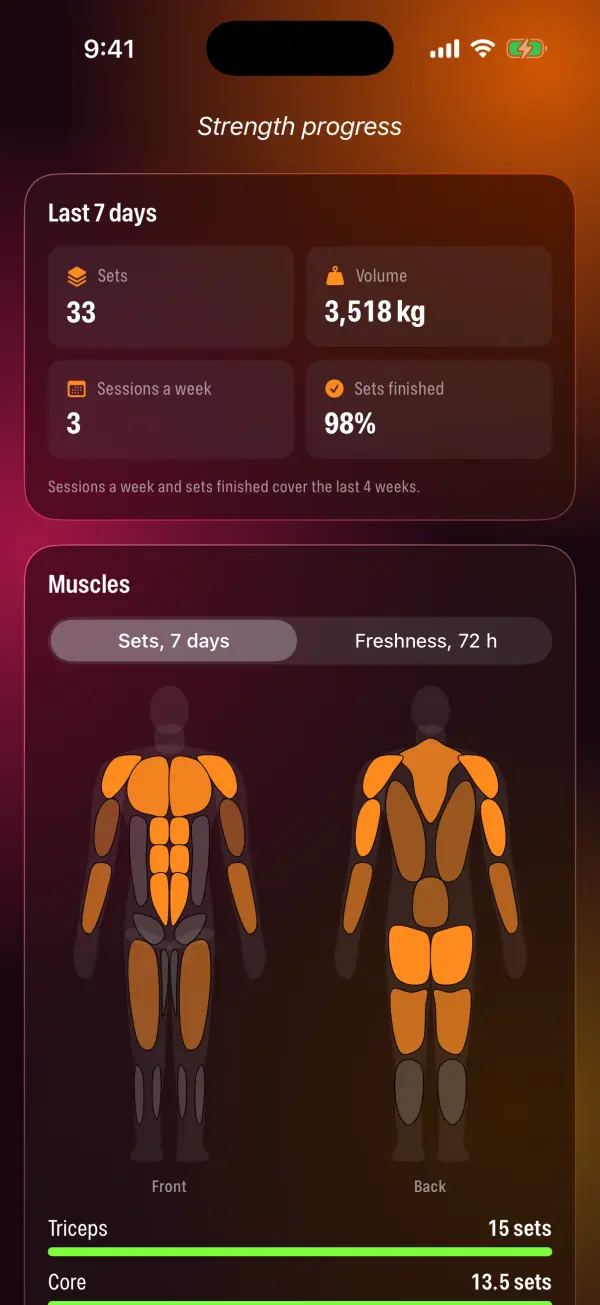
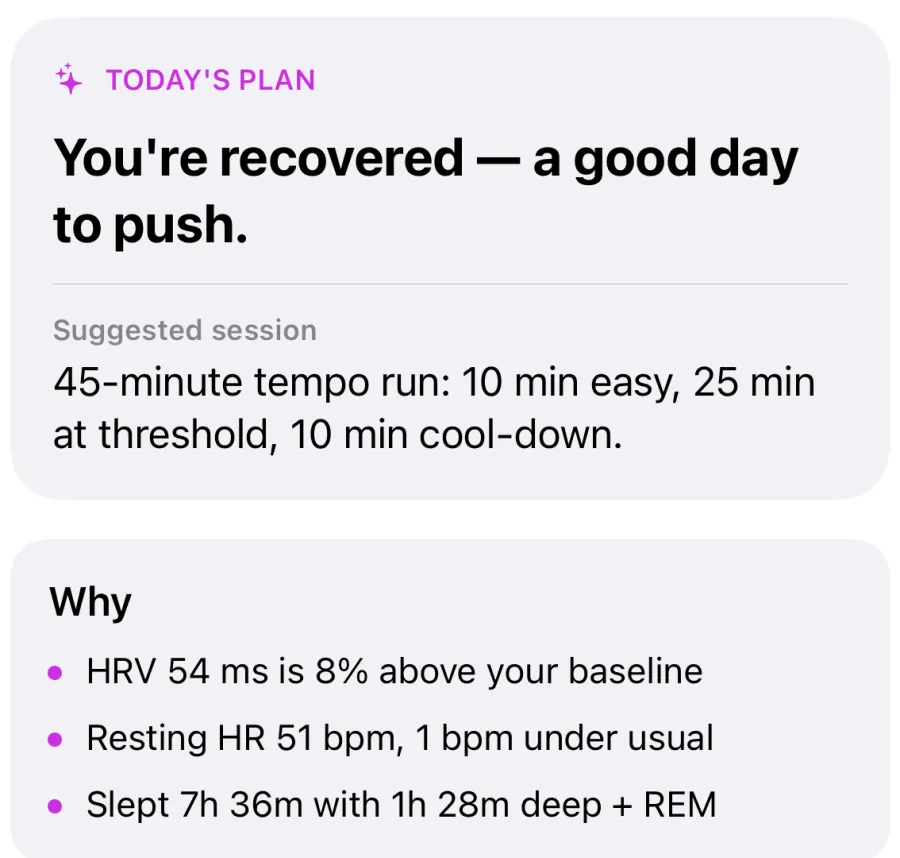
Soreness also feeds the Freshness view on the Strength progress screen, alongside the sets you did in the last 72 hours. Combined with your readiness score from overnight HRV, resting heart rate and sleep, it gives the coach a fuller picture than a calendar alone.
Frequently asked questions
Is it better to rest or work out with sore muscles?
For ordinary DOMS, light activity usually beats complete rest because movement eases the ache for a while. Rest the sore muscles from hard work for 1-2 days, but keep the rest of your body moving.
How long does muscle soreness last?
DOMS typically peaks 48 to 72 hours after the workout and fades over the following days. If it's still there or getting worse after about a week, get it checked.
Does being sore mean I had a good workout?
No. Soreness mostly reflects how new or eccentric the exercise was, not how effective it was. Many productive sessions cause little or no soreness once your body is used to them.
Should I stretch when I'm sore?
Gentle stretching can feel nice, but studies haven't found that it reduces DOMS. Light movement and massage have better evidence for easing soreness.
Can I run when my legs are sore?
An easy, short run is usually fine with mild soreness. If your stride feels different or you're very sore, choose cycling, swimming or walking instead until it settles.
Related guides
- Rest day vs active recovery: which one do you need today?
- Signs of overtraining: what your Apple Watch can and can't show
- Deload week: what it is, when to take one and how to do it
- Does sleep help muscle recovery? What the research shows
- Guided strength workouts on Apple Watch: step-by-step sessions with spoken cues and rep counting
- How many sets per muscle per week? What the research says
Sources & further reading
- Cheung K, Hume P, Maxwell L. Delayed onset muscle soreness: treatment strategies and performance factors. Sports Medicine, 2003
- Hotfiel T, et al. Advances in Delayed-Onset Muscle Soreness (DOMS): Part I: Pathogenesis and Diagnostics. Sportverletzung Sportschaden, 2018
- Dupuy O, et al. An evidence-based approach for choosing post-exercise recovery techniques. Frontiers in Physiology, 2018
- McHugh MP. Recent advances in the understanding of the repeated bout effect. Scandinavian Journal of Medicine & Science in Sports, 2003
- MedlinePlus: Rhabdomyolysis
- MedlinePlus: Muscle aches
This guide is educational, not medical advice, and has not been clinically reviewed. VedaWatch is not a medical device. If you have symptoms or concerns about your heart or health, contact a qualified healthcare professional.
Put your trends in perspective.
Explore HRV, sleep, and recovery with VedaWatch on your iPhone.
Download VedaWatch on the App Store →