 VedaWatch
Strength Training
How many sets per muscle per week? What the research says
How many sets per muscle per week build muscle and strength: what dose-response meta-analyses found, ranges for beginners and lifters, and how to count sets.
By VedaWatch editorial team · · 10 min read
The short answer
For most people, about 10 to 20 hard sets per muscle per week is a sensible range for building muscle. Beginners can grow well on less, roughly 5 to 10. Meta-analyses show more sets bring more growth with diminishing returns, and strength needs fewer sets than size. Count only sets taken close to failure.
How many sets per muscle per week should you do?
The research points to a range rather than a magic number. If your goal is muscle growth, around 10 hard sets per muscle per week is a good floor for most people who have trained for a while, and many lifters do well anywhere up to about 20. If you are new to lifting, fewer sets work: something like 5 to 10 per muscle is plenty to start, and you can add more as you adapt.
If your main goal is strength rather than size, you need less. Strength gains rise with volume too, but they level off much sooner, so a few hard sets of the lifts you care about, done often, take you a long way.
Those numbers assume hard sets: sets taken within a few reps of failure, not warm-ups or easy filler. The rest of this guide shows where the ranges come from, how to choose your own number, and how to count sets when one exercise trains several muscles.
What the dose-response meta-analyses found
Several meta-analyses have pooled many training studies to ask how muscle growth and strength change as weekly sets go up. Here is what each found and what it means for your training.
- Schoenfeld, Ogborn and Krieger (2017), 15 studies and 34 training groups: each additional weekly set was linked to about 0.37% more muscle growth, and the higher-volume groups within each study gained 3.9 percentage points more than the lower-volume groups. When sets were grouped as under 5, 5 to 9 and 10 or more per muscle, more sets trended toward more growth, though that comparison wasn't statistically clear on its own. This paper is where the popular "10 or more sets" guideline comes from.
- Pelland and colleagues (published 2026), 67 studies and 2,058 participants: the largest analysis so far. Both muscle size and strength kept increasing as weekly sets rose, but with diminishing returns, and the flattening was much more pronounced for strength than for size. The authors found the best way to count was a full set for the muscle an exercise targets and half a set for muscles that only assist.
- Ralston and colleagues (2017), 9 studies and 61 training groups: higher weekly set volumes produced greater strength gains than low volumes, with medium volumes also beating low ones. For well-trained people, the authors suggested medium or high volumes as an appropriate dose.
- Baz-Valle and colleagues (2022), trained young men only: comparing under 12, 12 to 20 and more than 20 weekly sets, more than 20 gave no extra growth for the quadriceps or biceps, though the triceps did grow more. The authors suggested 12 to 20 weekly sets per muscle as a reasonable standard for trained lifters.
- Schoenfeld and colleagues (2019), a single trial in 34 trained men: doing 1, 3 or 5 sets per exercise three times a week for 8 weeks gave similar strength gains in every group, but the higher-volume groups grew more muscle in several sites. Three short sessions a week, about 13 minutes each, were enough for marked strength gains.
Ranges for beginners, intermediate and experienced lifters
Most of the volume studies were done on young adults, many of them men, over a few weeks or months, so treat these ranges as starting points rather than prescriptions. The right number for you also depends on your sleep, age, stress, other sports and how much time you have.
A useful rule: start at the low end of your range, run it for several weeks, and only add sets if progress stalls and you are recovering well. More volume is a tool for when less has stopped working, not a default.
- New to lifting (your first several months): about 5 to 10 hard sets per muscle per week. Two or three full-body sessions with a few sets per major muscle each time gets you there. In the 2017 meta-analysis, even under 5 sets a week still produced growth, just less of it.
- Intermediate (consistent training for a good while, with easy beginner gains slowing): about 10 to 15 sets per muscle per week for the muscles you most want to grow, and less for the rest.
- Experienced (several years, progress has slowed): about 12 to 20 sets per muscle per week for priority muscles, in line with the 2022 review of trained lifters. Going above 20 may help some muscles in some people, but on average the extra benefit is small and the recovery cost is real.
- Strength-focused at any level: fewer sets of the specific lifts you want to get stronger at, trained more often. In the 2019 trial, one set per exercise three times a week built strength as well as five sets did.
- Minimum for health: the CDC recommends muscle-strengthening activity on at least 2 days a week, working all major muscle groups. A couple of hard sets per muscle on each of those days already meets that.
What counts as a set? Hard sets vs junk volume
The studies above counted work sets, the sets that actually challenge the muscle. Warm-up sets, very light technique work and sets you stop long before they get hard don't belong in your weekly total.
How close to failure matters most for size. A 2024 series of meta-regressions by Robinson and colleagues found that muscle growth increased as sets ended closer to failure, while strength gains were similar across a wide range of effort. You don't have to grind every set to complete failure, but a set where you could have done many more reps does less for growth than the number on paper suggests.
A practical test: if you finish a set and honestly think you had only a few reps left in you, count it. If you could have kept going for a long while, it's closer to a warm-up. Rating your effort with reps in reserve, or with a 1 to 10 effort scale after the session, helps you stay honest over time.
Weight still matters, of course: use loads you can lift with good form, and track your sets alongside the weights and reps, so you can see both how much work each muscle gets and whether you're getting stronger.
How to count sets for compound exercises
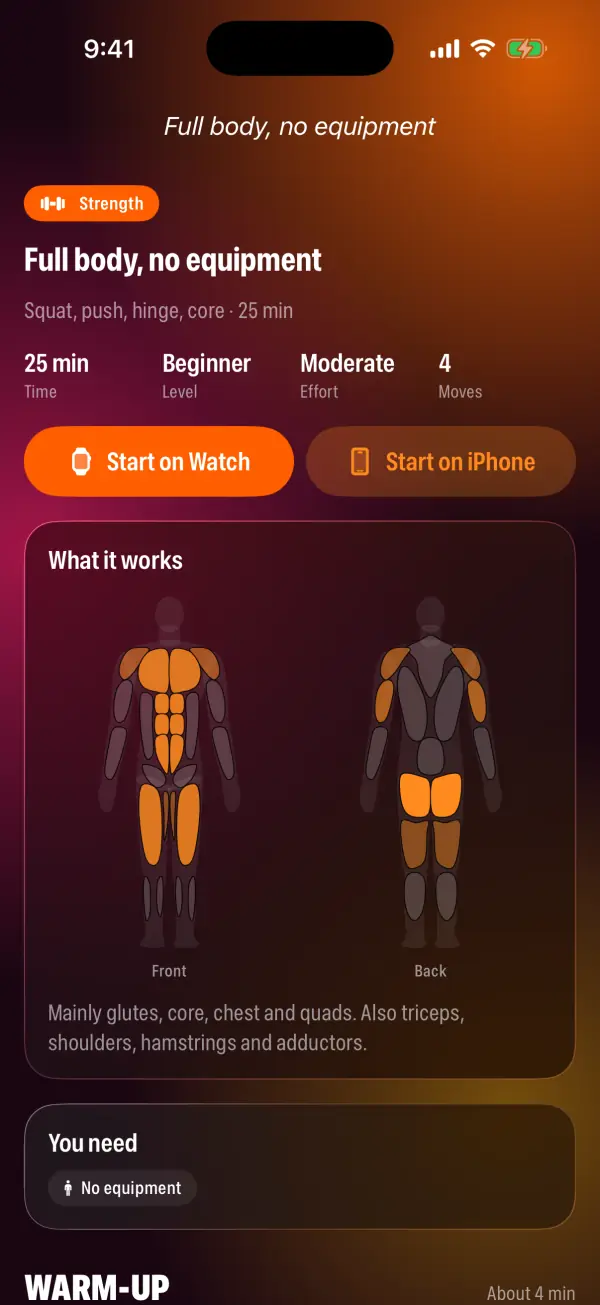
Most exercises train more than one muscle. A bench press works the chest hardest, but the triceps and front shoulders help. A row targets the upper back and lats, with the biceps assisting. The question is whether a set of bench press also counts as a set for your triceps.
The 2026 meta-analysis by Pelland and colleagues tested three ways of counting and found the most support for the fractional method: one full set for the muscles an exercise mainly trains, half a set for muscles that assist, and nothing for muscles that barely work. It's simple and it matches the research better than either counting everything fully or ignoring helpers completely.
Worked example: 4 sets of bench press and 3 sets of overhead press in a week. The chest gets 4 sets, plus a little from overhead press if you count it as a helper. The shoulders get 3 full sets from overhead press plus 2 from bench press (4 × 0.5), so 5. The triceps get 2 from bench press plus 1.5 from overhead press (3 × 0.5), so 3.5 sets before you've done a single triceps exercise.
This is why many lifters find their arms and shoulders already get decent volume from compound lifts. Count the fractional sets first, then add direct work only where a muscle is still short of your target.
Should you split your sets across the week?
When total weekly sets are equal, how you spread them makes little difference to muscle growth. A 2019 meta-analysis of 25 studies by Schoenfeld and colleagues found no meaningful difference between training a muscle once a week and more often when volume was matched, and concluded that people can choose a frequency based on preference. The 2026 analysis by Pelland and colleagues agreed for muscle size, but found that strength did improve with higher frequency, again with diminishing returns.
Practically, splitting sets has two big advantages. Each session stays short enough that your last sets are still good quality, and practising a lift more often helps you get stronger at it. Piling 16 sets for one muscle into a single session tends to mean the later sets are done tired and with less effort.
A rough rule many lifters use is to hit each muscle about twice a week. If you want 12 sets for your quads, that might be 6 on Monday and 6 on Thursday, or 4 sets on each of three full-body days.
- Full body, 3 days a week: 3 to 5 sets per major muscle each session gives roughly 9 to 15 sets a week. A good fit for beginners and busy people.
- Upper/lower, 4 days a week: each muscle is trained twice, so 5 to 8 sets per session gives 10 to 16 sets a week.
- Push/pull/legs, 6 days a week: each muscle is trained twice, so 6 to 10 sets per session gives 12 to 20 sets a week. Better suited to experienced lifters with time to recover.
- Push/pull/legs, 3 days a week: each muscle is trained once, so all of its sets land in one session. It works, but it's harder to get high volumes in without the last sets losing quality.
How to know if you need more or fewer sets
Your weekly set count is something to adjust, not set once. Watch three things: whether you're progressing, how you recover, and whether you can actually keep the routine up.
Signs you could add sets: you've trained consistently for several weeks, your weights or reps have stopped moving up on the key lifts, you recover quickly between sessions, and a muscle you care about looks like it's lagging. Add a set or two per week for that muscle rather than jumping straight to a much higher number.
Signs you may be doing too much: performance drops from week to week, soreness lasts until the next session for that muscle, joints feel achy, sleep gets worse, or you start skipping sessions because they take too long. Cutting sets back often lets progress resume.
Signs the number is fine: you're still adding reps or weight on most lifts every few weeks. If it works, keep doing it. Changing several things at once makes it hard to tell what helped.
If you have a heart condition, high blood pressure, an injury, are pregnant, or haven't been active in a long time, check with a doctor or physiotherapist before ramping up training. Sharp or joint pain is not normal training soreness; stop and get it looked at.
Tracking weekly sets per muscle with VedaWatch
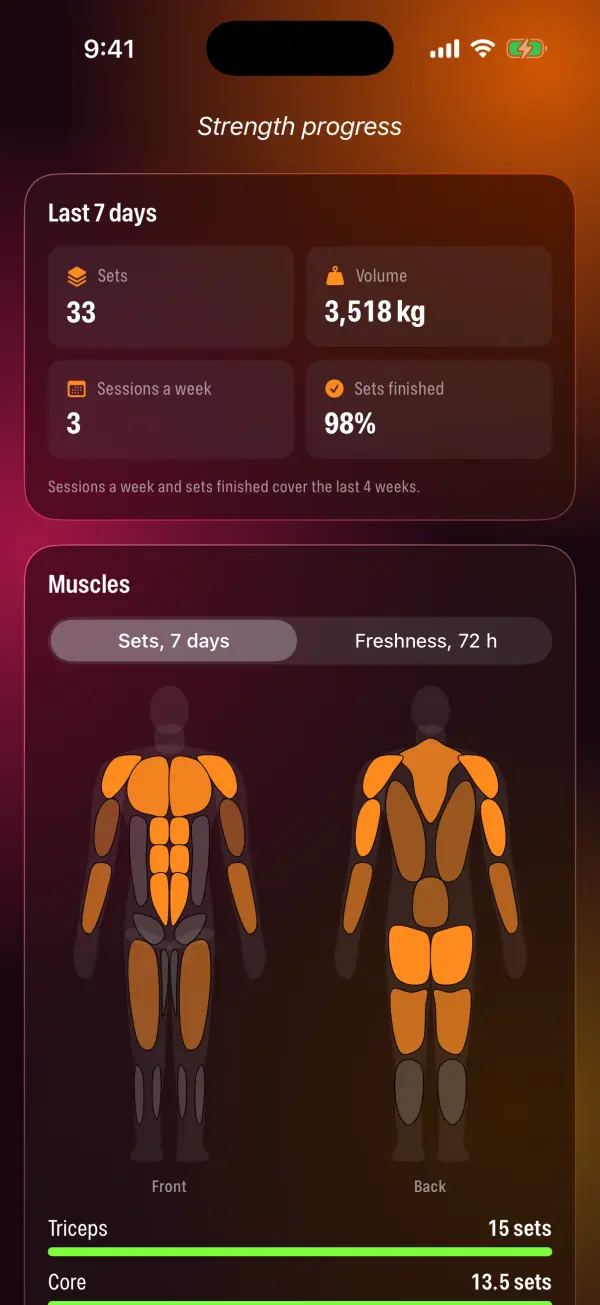
Counting fractional sets by hand across a week is tedious. If you lift with VedaWatch's guided strength sessions on Apple Watch or iPhone, the Strength progress screen on the Train tab does it for you.
The Muscles card shows sets per muscle for the last 7 days, using the same fractional counting the 2026 meta-analysis supports: a full set for an exercise's main muscles and half a set for the helpers. Each muscle's bar fills against 10 sets a week, and the body map shades brighter as a muscle gets closer. Sets per week shows a bar for each of the last 8 weeks, so you can see whether your volume is steady, building or dropping off.
Once you have two weeks of history, VedaWatch can point out when a major muscle (chest, upper back, lats, shoulders, quads, hamstrings or glutes) has averaged under 10 sets a week lately. After a month, it also flags weeks with clearly more or fewer sets than usual, so a big jump in volume doesn't sneak up on you. To find exercises for a muscle that's short, tap it on the muscle map in the exercise library.
Only completed work sets from guided VedaWatch sessions count; warm-ups, cardio and mobility steps are left out. Strength workouts started in Apple's Workout app don't record exercises, reps or weights, so they can't be counted per muscle. The 10-set line is a guide based on the research above, not a target every muscle has to hit.
Frequently asked questions
Is 10 sets per muscle per week enough?
For most people, yes, 10 hard sets per muscle per week is enough to build muscle and is close to the threshold the 2017 meta-analysis highlighted. Experienced lifters may get somewhat more growth from 12 to 20, but the extra gain per set gets smaller.
Is 20 sets per muscle per week too much?
Not necessarily for an experienced lifter who recovers well, but in a review of trained men, going above 20 weekly sets didn't add growth for most of the muscles measured. Beginners don't need anywhere near that much.
Do warm-up sets count toward weekly volume?
No. Only count work sets that end within a few reps of failure. Warm-ups prepare you for those sets but don't add much stimulus on their own.
Do I need different volumes for different muscles?
You can. Many people put more sets into muscles they want to grow and keep others at a maintenance level. Remember that compound lifts already give helper muscles like triceps and biceps half sets.
How many sets per muscle should I do in one workout?
Research hasn't settled on an exact cap, but splitting weekly sets over two or more sessions keeps later sets higher in quality. If your last few sets for a muscle in a session feel noticeably weaker, move some of them to another day.
Does cardio count toward my weekly sets?
No. Weekly set counts refer to resistance training sets. Running or cycling can tire your legs, though, so heavy endurance training may mean you recover from fewer leg sets.
Related guides
- How to track strength training progress with Apple Watch: volume, 1RM and muscle balance
- Progressive overload explained: how to progress every lift
- Beginner full body workout plan: 3 days a week for 8 weeks
- Push pull legs split for beginners: 3-day and 6-day plans
- How long to rest between sets: rest times by goal
- Guided strength workouts on Apple Watch: step-by-step sessions with spoken cues and rep counting
Sources & further reading
- Schoenfeld BJ, Ogborn D, Krieger JW. Dose-response relationship between weekly resistance training volume and increases in muscle mass: a systematic review and meta-analysis. J Sports Sci. 2017
- Pelland JC, Remmert JF, Robinson ZP, Hinson SR, Zourdos MC. The resistance training dose response: meta-regressions exploring the effects of weekly volume and frequency on muscle hypertrophy and strength gains. Sports Med. 2026
- Ralston GW, Kilgore L, Wyatt FB, Baker JS. The effect of weekly set volume on strength gain: a meta-analysis. Sports Med. 2017
- Baz-Valle E, Balsalobre-Fernandez C, Alix-Fages C, Santos-Concejero J. A systematic review of the effects of different resistance training volumes on muscle hypertrophy. J Hum Kinet. 2022
- Schoenfeld BJ, Contreras B, Krieger J, et al. Resistance training volume enhances muscle hypertrophy but not strength in trained men. Med Sci Sports Exerc. 2019
- Schoenfeld BJ, Grgic J, Krieger J. How many times per week should a muscle be trained to maximize muscle hypertrophy? A systematic review and meta-analysis. J Sports Sci. 2019
- Robinson ZP, Pelland JC, Remmert JF, et al. Exploring the dose-response relationship between estimated resistance training proximity to failure, strength gain, and muscle hypertrophy: a series of meta-regressions. Sports Med. 2024
- CDC. Adult Activity: An Overview (Physical Activity Guidelines for Americans)
This guide is educational, not medical advice, and has not been clinically reviewed. VedaWatch is not a medical device. If you have symptoms or concerns about your heart or health, contact a qualified healthcare professional.
Put your trends in perspective.
Explore HRV, sleep, and recovery with VedaWatch on your iPhone.
Download VedaWatch on the App Store →