 VedaWatch
Recovery & Apple Watch
Sauna HRV and cold plunge HRV: what the research shows
Do saunas and cold plunges raise HRV? What studies show during, after and weeks later, how to time them around strength training, and who should be careful.
By VedaWatch editorial team · · 10 min read
The short answer
A sauna lowers HRV while you're in the heat, then HRV rebounds above its starting point as you cool down. Cold water after exercise speeds the return of parasympathetic activity in short-term trials. Neither has been shown to raise your HRV baseline over weeks, and cold plunges straight after lifting can blunt strength gains.
Does sauna raise or lower HRV?
Both, at different moments. Heat pushes your heart rate up and pulls vagal (parasympathetic) activity down, so HRV drops while you sit in the sauna. Once you step out and cool down, the picture flips.
The clearest data comes from a Finnish study of 93 adults with cardiovascular risk factors who sat in a 73 °C sauna for 30 minutes. HRV changed significantly during the session, and most measures were back near their starting values after 30 minutes of recovery. During the cool-down, high-frequency power (a vagal marker) went up and low-frequency power went down, and resting heart rate at the end of recovery was 68 beats per minute, against 77 before the sauna. The authors read this as a shift toward parasympathetic activity after the heat.
That is an acute effect. Whether regular sauna use raises your HRV over weeks is a different question, and the best test so far says no. In an 8-week randomized trial, 38 sedentary adults with at least one cardiovascular risk factor were split into exercise plus 15 minutes of sauna after each session, exercise only, or no change. Exercise improved some HRV measures. Adding the sauna gave no additional HRV benefit over exercise alone.
So if you've read that saunas "boost HRV", the fair version is this: a session reliably moves HRV for an hour or so, the cool-down phase looks relaxing to your nervous system, and the long-term HRV payoff is unproven. Exercise is still the thing that moves your baseline.
Does a cold plunge improve HRV?
Cold water does two opposite things. The first seconds trigger a cold shock: a burst of adrenaline and noradrenaline that speeds the heart and raises blood pressure, as skin blood vessels clamp down and push blood toward the chest. That is a sympathetic, fight-or-flight response, the opposite of high HRV.
After exercise, though, a few minutes in cold water seems to help the heart's brakes come back on sooner. A 2025 systematic review of 12 randomized trials in athletes found that every study reported parasympathetic reactivation with cold water immersion after exertion. Six showed a statistically significant advantage over passive recovery, and eight reported moderate to large effect sizes.
Two limits matter. These trials measured HRV in the minutes to hours after exercise, not your overnight average weeks later. And they compared cold water with sitting still, not with sleep, food or an easier training week. A faster post-workout HRV rebound is a real effect, but it isn't the same as better long-term recovery or a higher baseline.
Harvard Health also points out that improvements in HRV haven't consistently been linked to better heart outcomes. So even a real rise in HRV after cold exposure wouldn't, by itself, prove a health benefit.
What happens to your Apple Watch HRV the next morning?
Apple Watch takes most of its HRV readings while you sleep, so what you see the next morning reflects the night, not the session itself. That makes timing and heat matter more than the sauna or plunge on its own.
One study tracked this directly. Seven well-trained cyclists added a 30-minute post-training sauna at 87 °C for 10 days. Their waking heart rate fell by about 10% and waking HRV (ln rMSSD) rose by about 4%, which the authors rated as a trivial-to-small change. Their plasma volume expanded by around 18% after just four sessions, a heat-acclimation effect that can also lower heart rate. In other words, part of a lower morning heart rate after a sauna block may be extra blood volume, not better recovery.
In everyday life the next-morning effect is personal. A late sauna or hot bath can leave you warm in bed, and heat tends to raise night-time heart rate and wrist temperature. Some people sleep deeply after an evening sauna; others toss and turn. A cold plunge late in the evening can leave you wired. The only way to know which camp you're in is to compare your own nights.
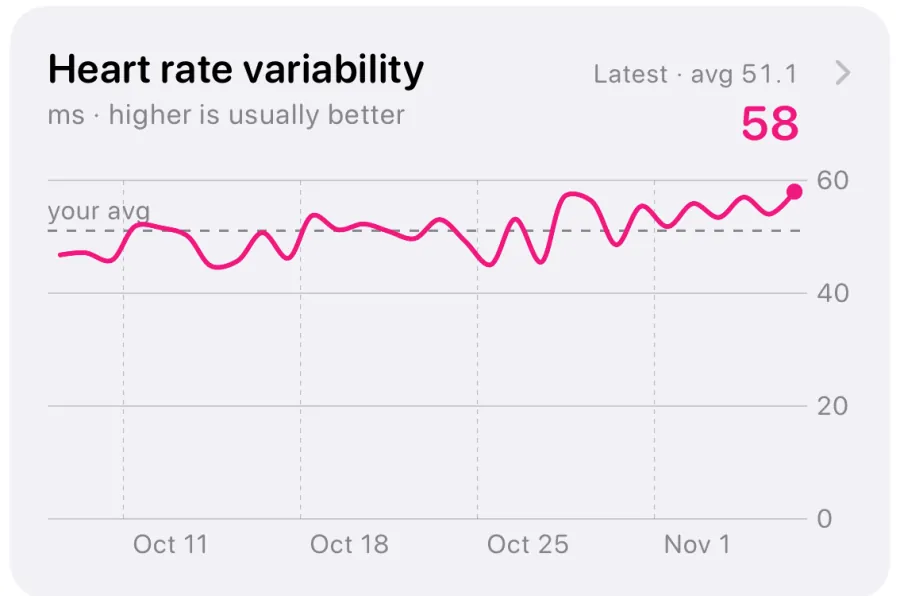
If your HRV jumps the morning after, don't over-read it. A single good number after a sauna doesn't mean you're fully recovered from yesterday's training, and a single dip after a hot evening isn't damage. Look at the pattern over many mornings.
Cold plunge after lifting: does it hurt muscle gains?
This is the part most sauna and plunge articles skip, and it matters if you lift. In a 12-week trial, 21 active men strength trained twice a week and did either 10 minutes of cold water immersion or an active cool-down after each session. Strength and muscle mass increased more with the active cool-down. Type II muscle fibre size rose 17% in that group but not in the cold-water group, and biopsies showed the cold water blunted the signals that drive muscle growth.
A 2021 meta-analysis of the controlled studies agreed: regular cold water immersion at 15 °C or colder alongside resistance training reduced gains in one-rep max, isometric strength, strength endurance and ballistic power, with a moderate standardized effect. The same analysis found no effect on endurance adaptations such as time-trial performance or maximal aerobic power.
Sauna has no similar warning in the research we found. The 8-week trial above used 15 minutes of sauna straight after exercise with no reported harm to HRV, and the cyclist study used post-training sauna for heat acclimation. If you want both, a common-sense layout based on these findings looks like this.
- Heavy strength or hypertrophy day: skip the cold plunge for the next several hours. An active cool-down, food and sleep are better choices. A sauna afterwards is fine for most healthy people if you rehydrate.
- Endurance day (runs, rides, rows): cold water afterwards didn't hurt endurance adaptations in the meta-analysis, so a plunge is a reasonable option if you like it.
- Competition week or two sessions in one day: this is where faster short-term recovery matters more than long-term adaptation, and where cold water has the most to offer.
- Rest day: either works. A morning cold plunge on a rest day keeps it well away from both lifting and bedtime.
- Evening: if you sauna late, finish at least an hour or two before bed so your body has time to cool, and see whether your own nights look different.
How hot, how cold and how long?
There is no proven dose for HRV, so treat the numbers below as what the studies used, not a prescription.
A traditional Finnish sauna runs at 80 to 100 °C at head height with 10 to 20% relative humidity, usually as short stays broken up by cooling off. The HRV studies above used 73 °C for 30 minutes, 87 °C for 30 minutes after training, and 15 minutes after exercise. Infrared saunas run cooler and have far less research behind them.
Cold water research generally means water at 15 °C (59 °F) or colder. Studies of cold immersion have used chest-deep water for roughly 3 to 20 minutes, and cold showers of 30 to 90 seconds. There is no consensus on the best temperature, timing or duration. For context, most people already find water under about 21 °C (70 °F) brisk.
Shorter and milder is the sensible place to start for both. You can always add time; you can't undo a faint or a cold shock.
Sauna then cold plunge: is contrast therapy safe?
Going from a hot sauna into cold water is a long Finnish tradition and popular with athletes. It's also the biggest swing your circulation can get outside of exercise: blood vessels open wide in the heat, then clamp down in the cold, and the cold shock drives heart rate and blood pressure up at once.
For healthy people this is usually tolerated. The authors of a major sauna review note that the health benefits and rationale for hot-to-cold routines aren't well established, and warn that the sudden haemodynamic changes carry a risk of arrhythmias, especially in people with heart disease such as a recent heart attack.
If you do contrast work, enter the cold water gradually rather than jumping in, keep your head above water, don't do it alone, and get out if you feel dizzy, short of breath or your heart feels irregular.
Who should be careful with saunas and cold plunges
Sauna is considered safe for most healthy adults and, used sensibly, even for people with stable cardiovascular disease. These are the situations where the published guidance says to avoid it or take extra care, and where you should talk to your doctor first.
- Avoid sauna with unstable angina, a recent heart attack, uncontrolled high blood pressure, ischaemic or decompensated heart failure, or severe aortic stenosis.
- Take extra care with sauna if you have orthostatic hypotension (dizziness on standing) or severe valve disease: blood pressure can drop suddenly, including during the recovery period after you get out.
- Don't combine sauna and alcohol. Reported sauna deaths have been linked at least partly to alcohol, which raises the risk of low blood pressure, heart complications and falls or burns.
- Avoid cold plunges with a heart rhythm disorder such as atrial fibrillation, and be cautious with any cardiovascular disease or circulation problems such as peripheral artery disease or Raynaud's.
- If you're pregnant, take medicines that affect blood pressure or heart rate, or have any other ongoing condition, ask your doctor before starting either.
- Stop and get help for chest pain, a racing or irregular heartbeat, severe breathlessness, confusion or fainting. These are not normal adaptation signs.
How to test sauna or cold plunge on your own HRV
Group averages hide big individual differences, and your Watch gives you a free n-of-1 experiment. The trick is to change one thing at a time and collect enough mornings to see past normal day-to-day noise.
- Wear your Apple Watch to bed every night so you get overnight HRV, and keep an eye on your average before you start.
- Keep everything else steady for a few weeks: similar training, bedtime, alcohol and caffeine. Alcohol especially can swamp a sauna effect.
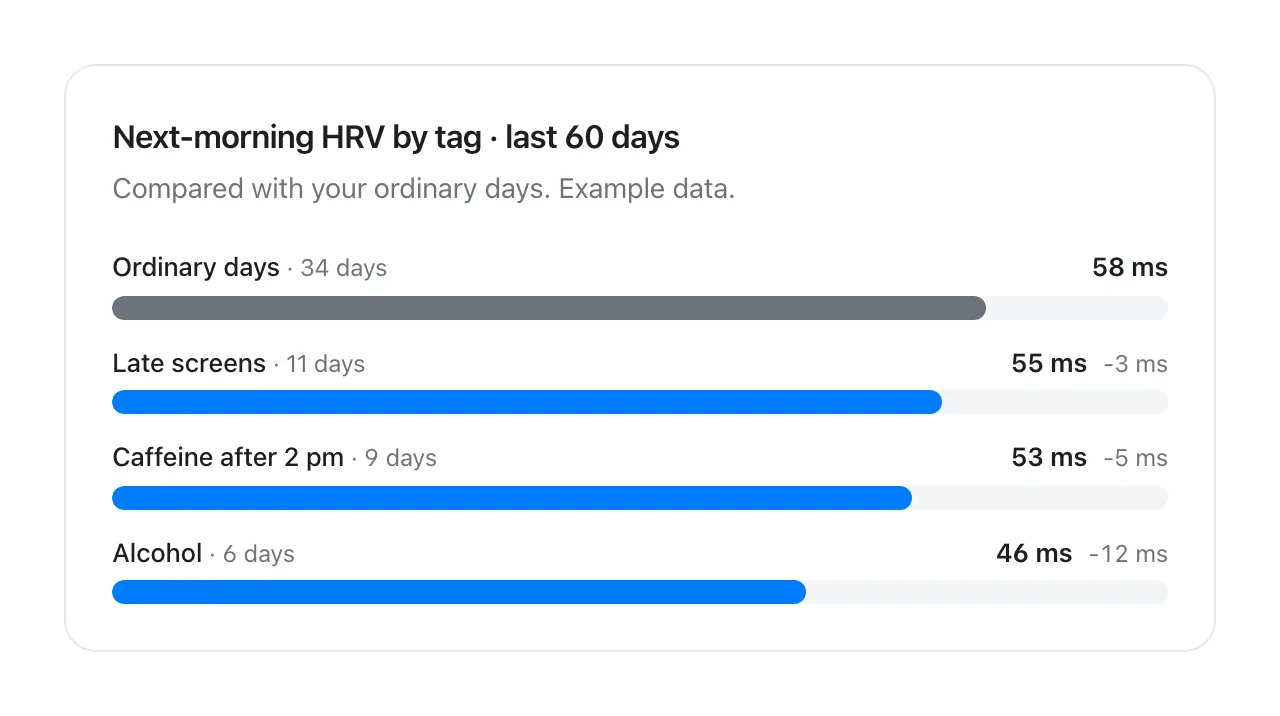
- Log every sauna, hot bath or plunge, and also log the ordinary days. Comparing tagged mornings with untagged ones is what turns a hunch into a pattern.
- Use roughly the same time of day and dose each time, so you're testing one thing, not five.
- Wait for at least several sessions and several ordinary days before you judge. One morning is noise.
- Look at how you feel and perform, not just HRV. If sleep gets worse or lifts stall, that matters more than a few milliseconds.
How VedaWatch helps you see your own sauna and plunge pattern
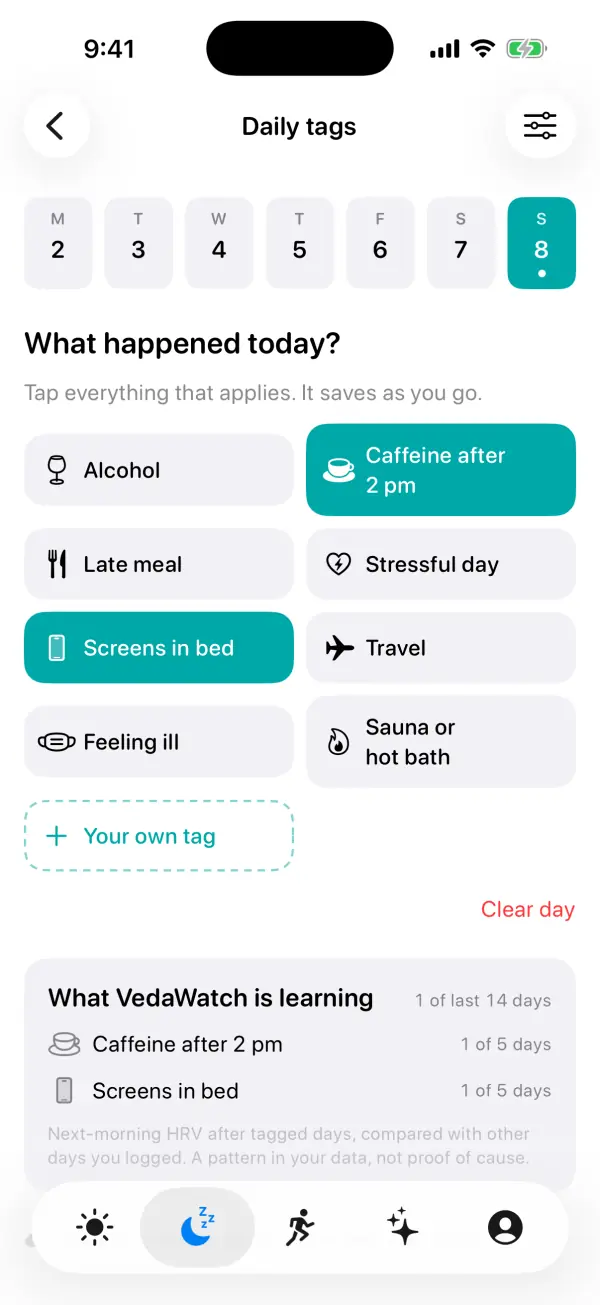
VedaWatch's Daily tags journal has a built-in Sauna or hot bath tag (with a flame symbol), alongside tags like Alcohol, Late meal and Stressful day. For cold plunges, add your own tag with Your own tag, call it "Cold plunge" and pick the snowflake symbol. You can log from iPhone (Recover → Daily tags, or the "How was today?" card), from the Log page in the Apple Watch app, or with the Log Tag action in Shortcuts.
Once a tag has at least 5 logged days with it and 5 without, and your Watch has 30 mornings of overnight HRV, "What VedaWatch is learning" compares next-morning HRV after tagged days with your ordinary days. It only reports a difference of at least 4% that also clears its statistical-uncertainty check; otherwise it says "No clear effect". For most built-in tags a higher HRV is treated as chance, but Sauna or hot bath and your own tags can show a positive result such as "Sauna days help your recovery", or the opposite, "Sauna days cost you recovery". It's a pattern in your data, not proof of cause.
Logging saunas also keeps other features honest. Nights after a logged sauna are left out of the early illness warning, because heat can raise wrist temperature and heart rate the way a fever does, and a wrist temperature alert mentions the sauna when it explains a rise. None of this is medical advice; if your readings or symptoms worry you, talk to a clinician.
Frequently asked questions
Should I use the sauna on a day my HRV is low?
A low HRV often means your body is already under strain from training, poor sleep, alcohol or illness, and heat adds more load. A short, mild session is usually fine if you feel well, but skip it if you feel unwell, and never use a sauna with a fever.
Is a hot bath the same as a sauna for HRV?
Both raise body temperature and heart rate, but almost all of the HRV research uses Finnish-style saunas, so the evidence for baths is thinner. VedaWatch's built-in tag covers both, so you can see whether either goes with a different next-morning HRV for you.
Does a cold shower count as a cold plunge?
It's a milder dose, since less of your body is in cold water at once. Studies have tested cold showers of 30 to 90 seconds, but don't expect the same effects as chest-deep immersion, and none of the HRV recovery trials above used showers.
Will a sauna habit raise my HRV baseline?
In the only randomized trial that tested this over 8 weeks, adding post-exercise sauna to training gave no extra HRV benefit over training alone. Regular exercise, consistent sleep and less alcohol have better evidence for moving your baseline.
Morning or evening cold plunge?
There's no good trial comparing the two for HRV. Because cold triggers an adrenaline surge, many people prefer mornings or rest days, and if you lift, keeping the plunge away from strength sessions protects muscle gains.
Related guides
- What lowers your HRV? Use a tag journal to find out
- How to improve your HRV: habits that actually move the number
- HRV after a workout: the normal dip and how long recovery takes
- Should you train or rest when HRV is low?
- Why is my HRV so low? Causes of a sudden drop and what to check
- Does alcohol lower HRV? Dose, timing and how long it lasts
Sources & further reading
- Laukkanen T et al. (2019). Recovery from sauna bathing favorably modulates cardiac autonomic nervous system. Complementary Therapies in Medicine. doi:10.1016/j.ctim.2019.06.011
- Lee E et al. (2025). Regular postexercise sauna bathing does not improve heart rate variability: A multi-arm randomized controlled trial. Physiological Reports. doi:10.14814/phy2.70449
- Stanley J et al. (2015). Effect of sauna-based heat acclimation on plasma volume and heart rate variability. European Journal of Applied Physiology. doi:10.1007/s00421-014-3060-1
- Galvez-Rodriguez C et al. (2025). Cold water immersion, heart rate variability and post-exercise recovery: a systematic review. Physiotherapy Research International. doi:10.1002/pri.70033
- Roberts LA et al. (2015). Post-exercise cold water immersion attenuates acute anabolic signalling and long-term adaptations in muscle to strength training. Journal of Physiology. doi:10.1113/JP270570
- Malta ES et al. (2021). The effects of regular cold-water immersion use on training-induced changes in strength and endurance performance: a systematic review with meta-analysis. Sports Medicine. doi:10.1007/s40279-020-01362-0
- Laukkanen JA, Laukkanen T, Kunutsor SK (2018). Cardiovascular and other health benefits of sauna bathing: a review of the evidence. Mayo Clinic Proceedings. doi:10.1016/j.mayocp.2018.04.008
- Harvard Health Publishing (2025). Cold plunges: Healthy or harmful for your heart?
This guide is educational, not medical advice, and has not been clinically reviewed. VedaWatch is not a medical device. If you have symptoms or concerns about your heart or health, contact a qualified healthcare professional.
Put your trends in perspective.
Explore HRV, sleep, and recovery with VedaWatch on your iPhone.
Download VedaWatch on the App Store →